
Document indexing: the quick answer文档索引:快速回答
This focused article is part of the unstructured data processing and document intelligence guide; use the pillar guide to compare related concepts, methods, and implementation decisions across the full topic. Scanned archives need document digitization before indexing.
本文是非结构化数据处理与文档智能指南内容集群中的专题文章;如需比较完整主题下的相关概念、方法与实施决策,请返回基石指南。扫描件档案入库前见document digitization。
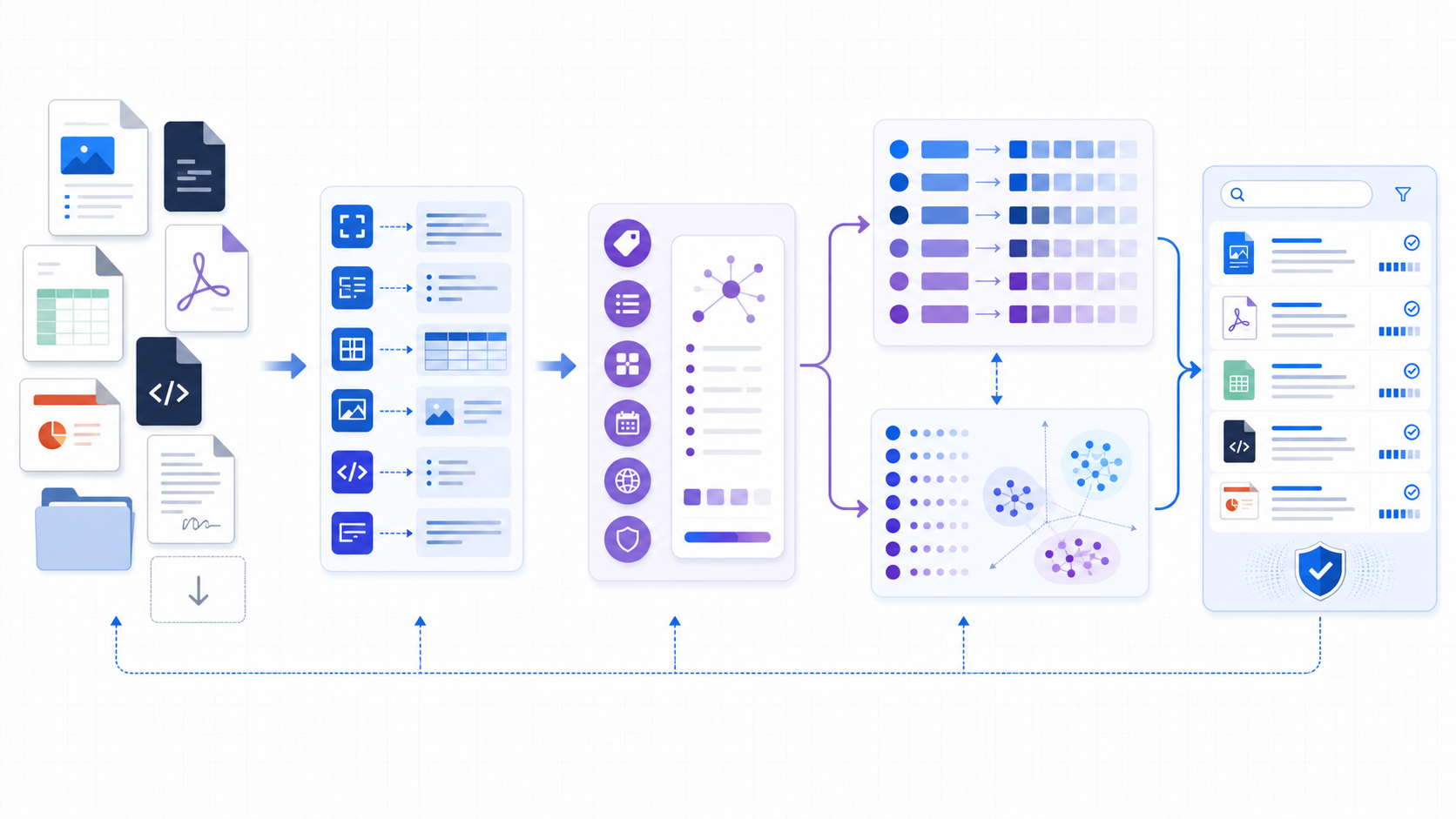
Document indexing is the process of converting document content and descriptive fields into a structured index so relevant files can be found without reading every file at query time. A reliable index stores stable identifiers, searchable text, useful metadata, document relationships, and access rules; it is refreshed when sources change and tested against real retrieval tasks.
文档索引是把文档内容和描述字段转换为结构化索引的过程,使检索系统无需在查询时逐个读取文件就能找到相关内容。可靠的索引会保存稳定标识符、可搜索文本、有用元数据、文档关系和访问规则;源文件变化时会更新,并用真实检索任务验证。
Indexing is not one technology. A small archive may need only filenames and controlled metadata. A knowledge base may combine full-text search with semantic vectors. A scanned archive may require OCR before either method works. The right design follows the questions people ask, the precision they need, and the controls the content requires.
索引并非单一技术。小型档案库可能只需要文件名和受控元数据;知识库可能结合全文检索与语义向量;扫描件档案则可能必须先经过 OCR。正确的设计取决于用户会提出什么问题、需要多高的精确度,以及内容必须遵守哪些控制要求。
Document indexing methods and components文档索引方法与组成部分
A production design often combines methods rather than selecting one winner. Separate the source document from its index record: the document remains the authoritative object, while the index holds fields and derived representations optimized for retrieval.
生产系统通常会组合多种方法,而不是只选一个“赢家”。应将源文档与索引记录分开:文档仍是权威对象,索引保存为检索优化的字段和派生表示。
| Method方法 | Best for适合任务 | Strength优势 | Main limitation主要局限 |
|---|---|---|---|
| Metadata indexing元数据索引 | IDs, dates, owners, status, document type编号、日期、所有者、状态、文档类型 | Precise filters and governance精确筛选和治理 | Depends on consistent fields依赖一致字段 |
| Full-text / inverted index全文/倒排索引 | Exact words, phrases, names, codes精确词、短语、名称、代码 | Fast, explainable lexical matching快速且可解释的词法匹配 | Can miss differently worded concepts可能漏掉不同措辞的同一概念 |
| Semantic / vector index语义/向量索引 | Conceptual questions and paraphrases概念问题和同义改写 | Finds meaning beyond exact terms可跨越精确词匹配含义 | Harder to explain; model-dependent较难解释且依赖模型 |
| Hybrid retrieval混合检索 | Mixed exact and conceptual queries精确与概念混合查询 | Balances lexical and semantic signals平衡词法与语义信号 | Requires ranking and weighting tests需要测试排序与权重 |
Core record fields usually include a stable ID, source URI or path, title, type, timestamps, owner, version, language, security principal or access group, extracted text, and a checksum. Optional chunk records need a parent document ID and position so search results can return enough surrounding context.
核心记录字段通常包括稳定 ID、源 URI 或路径、标题、类型、时间戳、所有者、版本、语言、安全主体或访问组、提取文本和校验和。可选的分块记录还需要父文档 ID 与位置,确保检索结果能返回足够的上下文。
What to prepare before indexing documents建立文档索引前需要准备什么
Start with a source inventory and a retrieval specification, not a search product. List formats, repositories, ownership, update frequency, expected volume, language, permission model, and deletion requirements. Then collect representative queries from actual users and identify which documents should answer them.
首先准备源清单和检索需求,而不是先选搜索产品。列出格式、存储位置、所有权、更新频率、预期规模、语言、权限模型和删除要求。再收集真实用户的代表性问题,并标明哪些文档应该回答这些问题。
- Source samples: native PDFs, scanned PDFs, office files, HTML, email, images, and any unsupported or encrypted examples.
- Metadata dictionary: field names, types, allowed values, owners, and whether each field is searchable, filterable, sortable, or display-only.
- Access model: which users or groups may discover, preview, or open each item.
- Test set: navigational, exact-match, conceptual, negative, multilingual, and permission-sensitive queries.
- Freshness rule: acceptable delay for creates, updates, moves, and deletions to appear in the index.
- 源文件样本:原生 PDF、扫描 PDF、办公文件、HTML、邮件、图片,以及任何不支持或加密的示例。
- 元数据字典:字段名、类型、允许值、负责人,以及每个字段是可搜索、可筛选、可排序还是只展示。
- 访问模型:哪些用户或组可以发现、预览或打开每个项目。
- 测试集:导航型、精确匹配、概念型、否定型、多语言和权限敏感查询。
- 新鲜度规则:创建、更新、移动和删除反映到索引中的可接受延迟。
Confirm retention and residency requirements before copying text into another system. If an index stores sensitive content or embeddings derived from it, the index itself needs protection, deletion handling, auditability, and backup rules.
在把文本复制到另一系统前,先确认保留期限和数据驻留要求。如果索引保存敏感内容或由其生成的向量,索引本身也需要访问保护、删除处理、审计和备份规则。
How to build a document indexing workflow如何搭建文档索引工作流
- Define retrieval jobs and success criteria定义检索任务与成功标准Write concrete tasks such as “find the current refund policy” or “retrieve invoices by supplier and date.” Decide what counts as relevant, current, and permitted.写出具体任务,例如“找到当前退款政策”或“按供应商和日期检索发票”,并定义什么结果才算相关、最新且有权限访问。
- Discover, identify, and fingerprint sources发现、识别并生成源指纹Assign a stable document ID independent of filenames. Capture source location, version, modification time, and a checksum so unchanged files can be skipped and duplicates can be investigated.分配不依赖文件名的稳定文档 ID,记录源位置、版本、修改时间和校验和,从而跳过未变化文件并调查重复项。
- Extract text and structure提取文本与结构Use format-aware parsers for digital files. Apply OCR only when text is embedded as pixels or the parser returns insufficient content. Preserve page, section, table, and reading-order boundaries when they affect meaning.对数字文件使用格式感知解析器。只有文本以像素存在或解析器返回内容不足时才使用 OCR;当页面、章节、表格和阅读顺序影响含义时,应保留这些边界。
- Normalize content without erasing evidence规范化内容但不抹去证据Normalize encodings, whitespace, dates, and controlled values. Keep the original text or source pointer so a user can verify a result. Record parser version and errors.规范编码、空白、日期和受控值;保留原文或源指针,便于用户核验结果;记录解析器版本与错误。
- Design fields and chunks设计字段与分块Map only useful metadata. For long documents, chunk along semantic boundaries with limited overlap. Avoid fixed-size fragments that split tables, headings, clauses, or answer context.只映射有用的元数据。长文档应沿语义边界分块并设置有限重叠,避免固定长度片段切断表格、标题、条款或答案上下文。
- Build lexical, semantic, or hybrid indexes建立词法、语义或混合索引Configure language-aware tokenization and exact fields for codes. Generate embeddings only for fields that benefit from semantic retrieval. Apply access-control fields to every searchable record.配置语言感知的分词,并为代码设置精确字段。只对需要语义检索的字段生成向量;每条可搜索记录都要带访问控制字段。
- Test retrieval and permission trimming测试检索与权限裁剪Run the labeled query set, inspect top results, and verify that unauthorized records never appear. Test absent answers and ambiguous queries, not only happy paths.运行带标注的查询集,检查高位结果,并验证未授权记录永不出现。除了成功路径,还要测试无答案和歧义查询。
- Operate incremental updates and deletion运行增量更新与删除Use change events or scheduled scans to update changed records, remove deleted sources, and retry failures. Monitor queues, stale records, parser regressions, and index version rollouts.使用变更事件或定时扫描更新已变化记录、删除源已移除的记录并重试失败任务;监控队列、陈旧记录、解析器回归和索引版本发布。
Document indexing example: a policy library文档索引示例:政策资料库
Hypothetical example. A team maintains 800 policy and procedure files across a shared drive. Users search by policy number, topic, region, and effective date. Some files are native PDFs, while older scans contain no text layer.
假设示例。某团队在共享盘维护 800 份政策与流程文件。用户会按政策编号、主题、地区和生效日期搜索;部分文件是原生 PDF,旧扫描件则没有文本层。
The team defines one record per policy version with fields for policy ID, title, region, owner, status, effective date, superseded-by ID, permissions, checksum, and extracted text. Exact fields serve policy IDs and region filters; the text field uses full-text search; paragraph chunks also receive vectors for questions such as “what approvals are needed before travel?”
团队为每个政策版本建立一条记录,字段包括政策 ID、标题、地区、所有者、状态、生效日期、替代版本 ID、权限、校验和与提取文本。精确字段用于政策编号和地区筛选,文本字段用于全文检索;段落分块还生成向量,以回答“出差前需要哪些审批”之类的问题。
A query for an exact ID must return the current version first. A conceptual query may return a relevant paragraph, but the interface links back to the full policy and shows its effective date. A nightly job checks source changes; deletion tests confirm that retired confidential documents disappear. The team does not claim success from index size—it measures whether representative tasks return permitted, current, useful documents.
精确 ID 查询必须把当前版本排在首位。概念查询可以返回相关段落,但界面必须链接到完整政策并显示生效日期。夜间任务检查源变化;删除测试确认已停用的机密文档会消失。团队不会用索引规模证明成功,而是衡量代表性任务能否返回有权限、最新且有用的文档。
How to choose document indexing software and architecture如何选择文档索引软件与架构
Choose from requirements that are expensive to retrofit: supported formats, permission synchronization, update and deletion behavior, language analysis, explainability, deployment constraints, and evaluation tooling. Do not select semantic search merely because it is newer. The selection walkthrough is document indexing software.
应优先根据后期难以补救的要求选择方案:支持格式、权限同步、更新与删除行为、语言分析、可解释性、部署限制和评估工具。不要仅因为语义搜索更新就默认选择它。选型走查见 document indexing software。
| If users mostly ask…如果用户主要查询…… | Start with优先方法 | Add when needed按需增加 |
|---|---|---|
| Invoice numbers, case IDs, names, exact clauses发票号、案件号、姓名、精确条款 | Metadata + keyword index元数据+关键词索引 | OCR for scans; fuzzy matching for errors扫描件 OCR;错误容忍的模糊匹配 |
| Topics expressed in varied language用不同措辞表达的主题 | Full text with synonyms带同义词的全文检索 | Semantic vectors and reranking语义向量与重排序 |
| Both identifiers and open-ended questions既有标识符又有开放问题 | Hybrid retrieval混合检索 | Query classification and weighted fusion查询分类与加权融合 |
| A small curated archive小型精选档案 | Manual controlled metadata人工受控元数据 | Full text only if content search is needed只有需要内容搜索时才加全文索引 |
A proof of concept should include the hardest formats and permission cases, not only clean PDFs. Verify exportability and reindex cost before committing: analyzers, embedding models, schemas, and ranking settings change, so a safe system needs a repeatable rebuild path.
概念验证应包含最难处理的格式和权限场景,而不只是干净的 PDF。投入使用前还要验证可导出性和重建索引成本:分析器、向量模型、Schema 和排序设置都会变化,因此安全系统必须具备可重复的重建路径。
How to validate document indexing quality如何验证文档索引质量
“The index built successfully” is an operational signal, not a relevance result. Validate the pipeline in layers so a poor answer can be traced to ingestion, extraction, indexing, ranking, permissions, or presentation.
“索引构建成功”只是运行信号,不是相关性结论。应分层验证流程,才能把不良结果追踪到采集、提取、建索引、排序、权限或展示环节。
Track extraction success by format and parser version. Sample OCR character errors and table integrity. Review duplicate clusters and stale versions. For search, use a stable benchmark set plus fresh failure cases from real sessions. Offline relevance metrics help compare releases, while human review checks whether returned evidence is actually useful and correctly contextualized.
按格式和解析器版本跟踪提取成功率;抽样检查 OCR 字符错误和表格完整性;审查重复簇与陈旧版本。搜索评估应同时使用稳定基准集和真实会话中新出现的失败案例。离线相关性指标用于比较版本,人工审核则判断返回证据是否真正有用、上下文是否正确。
Move from indexed documents to analysis从已整理文档进入联合分析
Prepare documents with readable text, stable versions, meaningful filenames or metadata, and the permissions you intend to enforce. InfiniSynapse is an AI data analyst for joint analysis across structured data and documents; it is not presented here as an OCR scanner or a general-purpose indexing engine. After your sources are ready, use the online application to analyze document content together with connected data sources and review the returned evidence.
请先准备具有可读文本、稳定版本、有意义文件名或元数据,以及明确权限的文档。InfiniSynapse 是用于结构化数据与文档联合分析的 AI 数据分析工具;本页不会把它描述成 OCR 扫描器或通用索引引擎。源数据准备好后,可使用在线应用把文档内容与已连接数据源一起分析,并核对返回证据。
Open InfiniSynapse for document and data analysis打开 InfiniSynapse 进行文档与数据分析Frequently asked questions about document indexing关于文档索引的常见问题
What is document indexing?什么是文档索引?
Document indexing transforms document text, metadata, structure, and permissions into searchable records that a retrieval system can query without scanning every source file at search time.
文档索引把文档文本、元数据、结构和权限转换为可搜索记录,使检索系统无需在每次查询时扫描所有源文件。
Is OCR the same as document indexing?OCR 与文档索引是一回事吗?
No. OCR converts text in scans or images into machine-readable characters. Indexing organizes extracted text and metadata for retrieval. Scanned documents may need OCR before indexing; born-digital files often do not.
不是。OCR 把扫描件或图片中的文字转换为机器可读字符;索引则组织提取文本和元数据以便检索。扫描文档可能需要先 OCR,原生数字文件通常不需要。
What should be included in a document index?文档索引应包含哪些内容?
A useful record typically includes a stable document ID, title, source path, document type, dates, owner, access controls, extracted text, language, version, and fields users actually filter or search.
有用的记录通常包括稳定文档 ID、标题、源路径、文档类型、日期、所有者、访问控制、提取文本、语言、版本,以及用户实际需要筛选或搜索的字段。
How do you test document indexing quality?如何测试文档索引质量?
Use a labeled set of representative queries and expected documents, then measure coverage, retrieval relevance, permission correctness, freshness, duplicate rate, and extraction failures. Review difficult and no-answer cases manually.
使用带标注的代表性查询和预期文档集,衡量覆盖率、检索相关性、权限正确性、新鲜度、重复率和提取失败,并人工复核困难与无答案场景。
When should document indexing use vector search?文档索引何时应使用向量搜索?
Use vector search when users need conceptual matches that do not share exact terms. Keep keyword search for identifiers, names, codes, and exact phrases; many systems combine both in hybrid retrieval.
当用户需要查找不共享精确词汇但概念相近的内容时使用向量搜索。标识符、名称、代码和精确短语仍应使用关键词检索;许多系统会采用混合检索。
Official sources and further reading权威来源与延伸阅读
- Microsoft Learn: indexes in Azure AI SearchMicrosoft Learn:Azure AI Search 中的索引
- Elastic documentation: index and document basicsElastic 官方文档:索引与文档基础
- Amazon Kendra documentation: supported documents and parsingAmazon Kendra 官方文档:支持的文档与解析方式
- InfiniSynapse product page: multimodal document and data analysisInfiniSynapse 产品页:多模态文档与数据分析
These sources describe product-specific implementations. Use them to verify concepts and constraints, then test the behavior of the system and version you actually deploy.
这些来源描述各产品的具体实现。可用它们核对概念和约束,但仍应测试实际部署系统及其版本的真实行为。