
What are text analytics tools?什么是文本分析工具?
This focused article is part of the unstructured data processing and document intelligence guide. When the output is spans and types—not themes or sentiment—use entity extraction tools / NER tools.
本文是非结构化数据处理与文档智能指南内容集群中的专题文章。当输出是片段和类型、而不是主题或情感时,请用实体提取工具 / NER 工具。
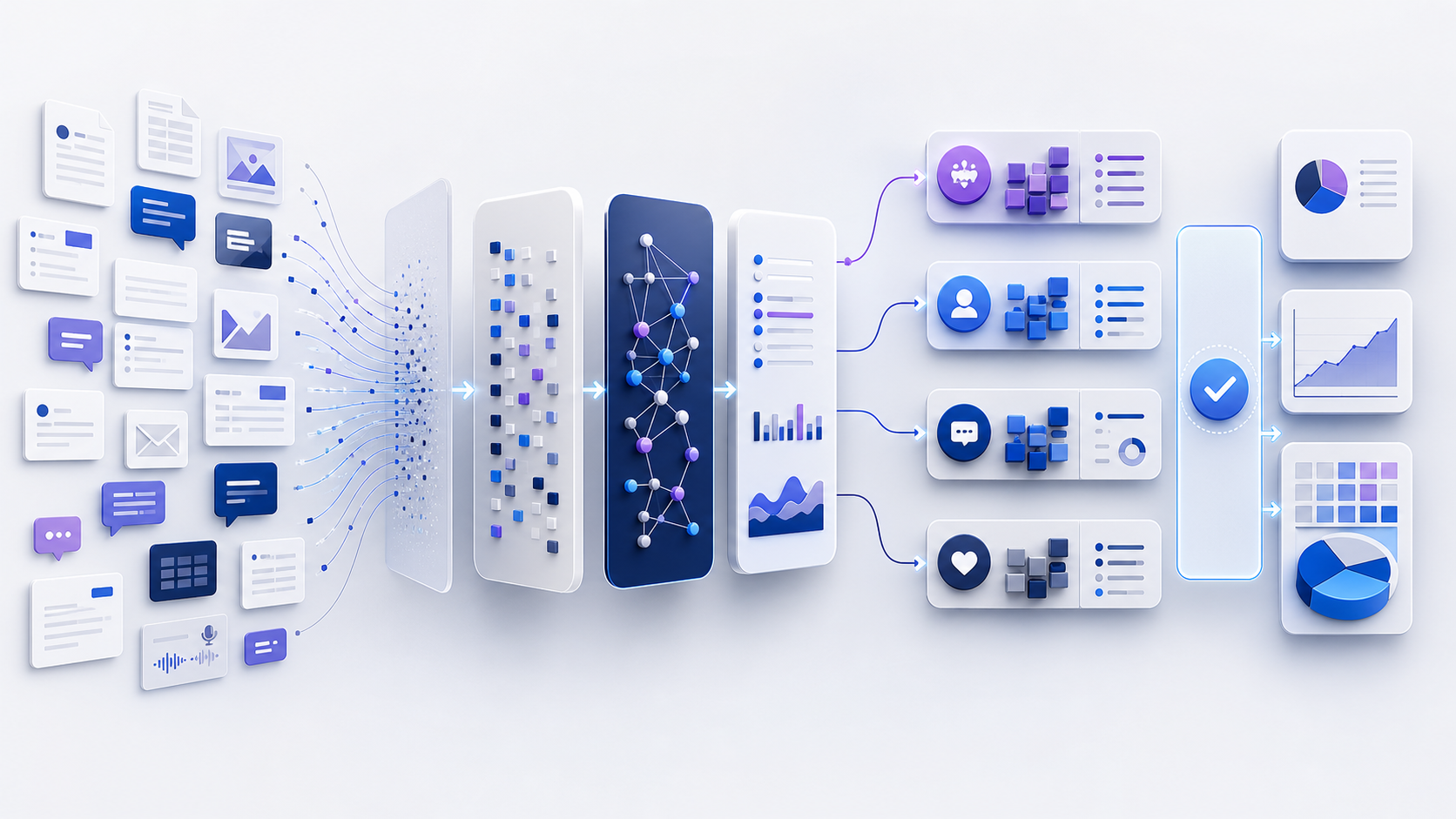
Text analytics tools are software, APIs, or libraries that convert unstructured text into structured signals people can search, count, compare, or review. Typical outputs include topics, classifications, named entities, key phrases, sentiment, similarity, summaries, and source-linked evidence. The right tool is the one that produces the output required by a defined decision—not the one with the longest feature list.
文本分析工具是把非结构化文本转换成可搜索、可计数、可比较或可复核结构化信号的软件、API 或程序库。常见输出包括主题、分类、命名实体、关键词、情感、相似度、摘要和带来源链接的证据。正确的工具应服务于一个明确决策所需的输出,而不是功能清单最长的产品。
Search results for “text analytics tools” mix buyer guides, software category pages, customer-feedback products, NLP APIs, and open-source packages. That mixed SERP reflects mixed intent: some users want a no-code way to read survey comments; others need a production classification endpoint, a reproducible research pipeline, or analysis that combines documents with structured data.
“文本分析工具”的搜索结果通常混合买家指南、软件分类页、客户反馈产品、NLP API 和开源程序包。这种混合 SERP 反映了混合意图:有些用户需要无代码读取问卷评论,有些需要生产级分类接口、可复现研究流程,或把文档与结构化数据联合分析。
Match text analytics software to the task让文本分析软件匹配实际任务
Begin with the question the result must answer. “Analyze these comments” is too vague to evaluate. “Assign each support ticket to one of eight routing categories and flag uncertain cases for review” is testable. So is “identify recurring complaint themes by product line and link every theme to representative comments.”
先明确结果必须回答的问题。“分析这些评论”过于模糊,无法验收;“把每张支持工单分配到八个路由类别之一,并标记不确定案例供复核”则可以测试。“按产品线识别重复投诉主题,并让每个主题链接到代表性原文”同样可以验证。
| Task任务 | Useful output有效输出 | Main validation risk主要验证风险 |
|---|---|---|
| Customer feedback analysis客户反馈分析 | Themes, aspect sentiment, examples, volume by segment主题、方面级情感、示例、分群数量 | Common comments hiding rare severe issues高频评论掩盖低频严重问题 |
| Ticket or document routing工单或文档路由 | Controlled labels, confidence, abstention queue受控标签、置信度、拒答队列 | Minor classes and new categories misrouted少数类别和新类别被误路由 |
| Entity and key-field extraction实体与关键字段提取 | Entity type, normalized value, source span实体类型、规范值、来源片段 | Ambiguous names, dates, and domain abbreviations歧义名称、日期和领域缩写 |
| Exploratory research探索性研究 | Concordance, clusters, topic candidates, quotations上下文索引、聚类、候选主题、引文 | Treating exploratory patterns as confirmed facts把探索模式当作已确认事实 |
| Cross-source business analysis跨数据源业务分析 | Document evidence joined with rows, metrics, and charts文档证据与数据行、指标、图表的联合结果 | Broken joins, weak provenance, inconsistent definitions关联错误、来源不清、定义不一致 |
Text analytics is not always the right answer. Use ordinary search for exact known phrases, a spreadsheet for a small and stable hand-coded sample, a database query when the needed fields are already structured, and a specialist speech pipeline when audio has not yet been transcribed. Automation earns its cost when the corpus is large, recurring, multilingual, fast-changing, or needs consistent processing.
文本分析并非总是正确答案。查找已知精确短语可用普通搜索;小型且稳定的人工编码样本可用电子表格;所需字段已结构化时应直接查询数据库;音频尚未转写时需要专门的语音流程。当语料规模大、持续重复、多语言、变化快或要求一致处理时,自动化才更能体现价值。
Four categories of text analytics tools四类文本分析工具及其取舍
Best for analysts who need upload, exploration, coding, charts, and review in one interface. Check exportability, source traceability, multilingual behavior, and whether categories can be controlled.
适合需要在一个界面中上传、探索、编码、制图和复核的分析人员。应检查可导出性、来源追踪、多语言行为和类别能否受控。
Best for applications that need entity, sentiment, classification, or language endpoints. Evaluate latency, limits, versioning, regional processing, confidence fields, and the cost of every record.
适合需要实体、情感、分类或语言接口的应用。要评估延迟、限额、版本、区域处理、置信字段和逐条调用成本。
Best when engineers need control over models, preprocessing, deployment, and reproducibility. The organization owns evaluation, security updates, infrastructure, monitoring, and model drift.
适合工程团队控制模型、预处理、部署和复现。组织同时承担评估、安全更新、基础设施、监控和模型漂移责任。
Best when text evidence must be interpreted alongside tables, databases, files, or business metrics. Confirm the product preserves evidence and does not substitute a fluent answer for a specialist production NLP endpoint.
适合需要把文本证据与表格、数据库、文件或业务指标联合解释的场景。应确认产品保留证据,且不会用流畅答案替代专业生产级 NLP 接口。
A team may use more than one category. For example, an API can label every incoming ticket, a review interface can handle uncertain cases, and a cross-source workspace can connect monthly themes to account tier and renewal data. Architecture follows the decision and operating model; it should not follow a fashionable model name.
团队可以组合多类工具。例如,API 为每张新工单打标签,复核界面处理不确定案例,跨源工作区再把月度主题与账户等级和续约数据关联。架构应由决策目标和运营模式决定,而不是跟随流行模型名称。
Prepare data before comparing text analytics tools比较文本分析工具前如何准备数据
A polished vendor demo cannot reveal how a tool handles your abbreviations, mixed languages, short replies, duplicated templates, OCR noise, sarcasm, legal restrictions, or rare high-impact cases. Build a representative evaluation pack before opening a trial.
精心设计的厂商演示无法说明工具如何处理你的缩写、混合语言、短回复、重复模板、OCR 噪声、讽刺、法律限制或低频高影响案例。开始试用前应建立代表性评估包。
- Decision statement: name the action that follows the output, the owner, and the cost of a false positive or false negative.决策陈述:说明输出之后的动作、负责人,以及误报和漏报各自的代价。
- Representative corpus: include ordinary records, edge cases, every important language, long and short text, recent data, and examples from each source.代表性语料:包含普通记录、边界案例、每种重要语言、长短文本、近期数据和各来源示例。
- Target schema: define allowed labels, entity types, hierarchy, “other,” “uncertain,” and whether multiple labels may apply.目标 Schema:定义允许标签、实体类型、层级、“其他”“不确定”以及是否允许多标签。
- Gold sample: have qualified reviewers label a manageable subset and record disagreements rather than hiding them.黄金样本:由合格复核者标注一组可管理样本,并记录分歧而不是隐藏分歧。
- Governance constraints: document personal data, retention, processing region, access rules, deletion, and whether external model processing is allowed.治理约束:记录个人数据、保留期、处理区域、访问规则、删除要求以及是否允许外部模型处理。
Do not clean away the problem. Preserve a copy of raw input and log every transformation. Removing punctuation, emoji, negation, case, or sentence boundaries can destroy signals needed for sentiment, intent, entity recognition, or audit.
不要在清洗时删除问题本身。保留原始输入副本,并记录每次转换。删除标点、表情、否定词、大小写或句子边界,可能破坏情感、意图、实体识别或审计所需信号。
How to evaluate text analytics tools step by step如何逐步评估文本分析工具
- Freeze the task and success rule冻结任务与成功标准Write the input, expected output, decision, reviewer, and minimum acceptable performance. Separate exploratory discovery from production automation.写明输入、预期输出、决策、复核者和最低可接受表现,并把探索发现与生产自动化分开。
- Shortlist by operating model按运营模式筛选Remove tools that fail a hard requirement such as deployment region, language, input format, export, API access, source traceability, or permission model.排除不满足处理区域、语言、输入格式、导出、API、来源追踪或权限模型等硬性要求的工具。
- Run the same blind sample运行同一盲测样本Use identical records and instructions. Keep the gold labels hidden from the system operator when practical, and save raw outputs rather than screenshots alone.使用相同记录和指令。条件允许时对系统操作者隐藏黄金标签,并保存原始输出,而不只保留截图。
- Measure errors that matter衡量真正重要的错误Report per-class precision and recall for classification, exact and partial matches for extraction, reviewer agreement for themes, and error slices by language, source, length, and time.分类应报告各类别准确率与召回率,提取应报告精确与部分匹配,主题应报告复核一致性,并按语言、来源、长度和时间切片错误。
- Test review and failure paths测试复核与失败路径Force ambiguous, empty, malformed, duplicated, and adversarial inputs. Confirm that uncertainty can be routed to a person and corrected labels can feed back into the workflow.主动加入歧义、空值、格式错误、重复和对抗输入,确认不确定结果可以路由给人员,并让修正标签回到流程。
- Estimate total ownership cost估算总体拥有成本Include setup, annotation, integration, model or API usage, hosting, monitoring, review labor, security, retraining, migration, and exit costs—not only the license.除许可证外,还要计入设置、标注、集成、模型或 API 调用、托管、监控、复核、安全、重训、迁移和退出成本。
Text analytics tool comparison framework文本分析工具比较与决策框架
| Criterion标准 | Evidence to collect应收集证据 | Warning sign警示信号 |
|---|---|---|
| Task quality任务质量 | Blind-sample metrics and reviewed error examples盲测指标和已复核错误示例 | One aggregate “accuracy” number只有单一综合“准确率” |
| Traceability可追溯性 | Source spans, record IDs, processing version, export来源片段、记录 ID、处理版本、导出 | Summary without supporting records摘要没有支持记录 |
| Language and domain fit语言与领域适配 | Results for each language and specialized vocabulary各语言与专业词汇的分别结果 | A long language list with no task-level tests语言清单很长但没有任务测试 |
| Governance治理 | Data flow, retention, roles, deletion, audit, contracts数据流、保留、角色、删除、审计、合同 | Unclear subprocessors or training use分包处理方或训练用途不清 |
| Operations运营 | Versioning, monitoring, fallback, review queue, reprocessing版本、监控、回退、复核队列、重处理 | No plan for model or corpus drift没有模型或语料漂移计划 |
| Integration and exit集成与退出 | API test, export format, identifiers, migration exerciseAPI 测试、导出格式、标识符、迁移演练 | Insights exist only inside a dashboard洞察只能留在仪表板内 |
Weight the criteria before seeing results. A regulated workflow may give governance and traceability veto power; a research team may value reproducibility and custom preprocessing; a support operation may prioritize throughput, routing confidence, and reviewer ergonomics. Keep the scorecard, test corpus, instructions, and raw outputs so the decision can be repeated when products or models change.
查看结果前先确定权重。受监管流程可能把治理和追溯设为否决项;研究团队可能重视可复现性和自定义预处理;支持运营则可能优先吞吐量、路由置信度和复核体验。保留评分卡、测试语料、指令和原始输出,以便产品或模型变化后重复决策。
Example: choosing a tool for customer feedback text analysis示例:为客户反馈文本分析选择工具
Hypothetical example—numbers are illustrative
假设示例——数字仅用于说明
A product team receives 10,000 support comments per month in English and Chinese. It wants weekly themes by product area, aspect-level sentiment, severe-issue alerts, and links to original comments. The result will guide triage, not automatically close tickets.
某产品团队每月收到 10,000 条中英文支持评论,希望按产品区域生成每周主题、方面级情感、严重问题提醒和原文链接。结果用于辅助分诊,不会自动关闭工单。
The team samples 600 comments across channels, languages, lengths, and months. Two reviewers define twelve product categories plus “other” and “uncertain,” then reconcile a 150-record gold set. It compares a no-code feedback platform, a managed NLP API, and an open-source pipeline on the same 450 blind records. The team records per-category recall, source-link coverage, review time, multilingual errors, export quality, and monthly operating cost.
团队从不同渠道、语言、长度和月份抽取 600 条评论。两名复核者定义十二个产品类别以及“其他”和“不确定”,再对 150 条黄金样本协调分歧。团队让无代码反馈平台、托管 NLP API 和开源流程运行同一组 450 条盲测记录,并记录各类别召回率、来源链接覆盖、复核时间、多语言错误、导出质量和月度运营成本。
A candidate with the best average score still fails if it misses most severe billing complaints in Chinese. The chosen design routes low-confidence results to people, preserves the source comment and model version, and reruns the test set after material configuration or model changes. This is a defensible selection process; a screenshot of an attractive theme chart is not.
即使某候选方案平均分最高,如果漏掉大部分中文严重计费投诉,仍应判定失败。最终方案把低置信结果交给人员复核,保留源评论和模型版本,并在配置或模型发生重大变化后重跑测试集。这才是可辩护的选型流程;漂亮主题图的截图并不是。
Common text analysis errors, limits, and controls文本分析的常见错误、局限与控制措施
“The camera is great but setup is terrible” cannot be reduced safely to one label. Use aspect-level outputs or preserve the full passage.
“相机很好,但设置很糟”不应被简化成单一标签。应使用方面级输出或保留完整片段。
Clusters may change with sampling, prompts, model versions, and preprocessing. Track definitions and compare themes across repeated runs.
聚类会随抽样、提示词、模型版本和预处理变化。应记录定义,并比较多次运行中的主题。
Forcing every record into a category hides uncertainty. Provide “other,” “uncertain,” thresholds, and a review queue.
强迫每条记录进入某类别会隐藏不确定性。应提供“其他”“不确定”、阈值和复核队列。
Counts and summaries need drill-down to source records. Otherwise reviewers cannot distinguish a real pattern from extraction or labeling error.
计数和摘要必须能下钻到源记录,否则复核者无法区分真实模式与提取或标注错误。
Treat generated summaries and inferred themes as analysis outputs, not authoritative facts. The NIST AI Risk Management Framework provides a general structure for governing, mapping, measuring, and managing AI risks. For a managed NLP example, the Google Cloud Natural Language documentation describes entity, sentiment, classification, and syntax functions; verify every vendor against its current official documentation and your own data.
应把生成摘要和推断主题视为分析输出,而不是权威事实。NIST AI 风险管理框架提供了治理、映射、测量和管理 AI 风险的一般结构。作为托管 NLP 示例,Google Cloud Natural Language 官方文档说明实体、情感、分类和句法功能;对任何厂商都应依据其当前官方文档和自己的数据验证。
Validate text analytics results before and after launch上线前后如何验证文本分析结果
Validation is not a one-time acceptance test. Data sources, language, categories, products, customer behavior, prompts, APIs, and models all change. Establish a baseline and a monitoring cadence that matches the decision risk.
验证不是一次性的验收测试。数据来源、语言、类别、产品、客户行为、提示词、API 和模型都会变化。应建立基线,并按照决策风险设定持续监控频率。
- Quality: track task-appropriate metrics, error examples, uncertainty rate, and reviewer disagreement—not accuracy alone.质量:跟踪适合任务的指标、错误示例、不确定率和复核分歧,而不只是准确率。
- Coverage: measure missing text, failed records, unsupported languages, empty outputs, and the share routed to “other.”覆盖:衡量缺失文本、失败记录、不支持语言、空输出和进入“其他”的比例。
- Drift: compare label frequency, vocabulary, confidence, input length, and error slices over time; investigate changes before declaring a trend.漂移:比较标签频率、词汇、置信度、输入长度和错误切片随时间的变化,在确认趋势前先调查变化原因。
- Operations: monitor latency, throughput, review backlog, cost, version changes, access events, and deletion completion.运营:监控延迟、吞吐量、复核积压、成本、版本变化、访问事件和删除完成情况。
- Decision impact: confirm the output changes a defined workflow and does not merely produce a dashboard no one uses.决策影响:确认输出确实改变了明确工作流,而不是只生成无人使用的仪表板。
Keep a rollback path. Store configuration, prompts, model or API version, preprocessing code, label definitions, and a representative test set. If a release changes important error patterns, route more records to manual review or return to the last accepted version while investigating.
应保留回滚路径:保存配置、提示词、模型或 API 版本、预处理代码、标签定义和代表性测试集。如果某次发布改变了重要错误模式,应把更多记录转人工复核,或在调查期间返回上一接受版本。
Move from prepared text to cross-source analysis把准备好的文本带入跨源分析
Prepare readable documents or text files, stable identifiers, relevant structured data, and the access rules you intend to enforce. InfiniSynapse is positioned as an AI data analysis workspace for joint analysis across documents and structured sources; it is not presented here as a dedicated sentiment or entity extraction API. Use it when the job is to interpret prepared text evidence alongside business data, tables, and metrics.
请准备可读文档或文本文件、稳定标识符、相关结构化数据,以及需要执行的访问规则。InfiniSynapse 定位为用于文档与结构化数据联合分析的 AI 数据分析工作区;本页不会把它描述成专用情感或实体提取 API。当任务需要把准备好的文本证据与业务数据、表格和指标联合解释时,可以使用它。
Open InfiniSynapse for document and data analysis打开 InfiniSynapse 进行文档与数据联合分析Best practices and next steps最佳实践与下一步
Start narrow. Select one recurring, reviewable decision with accessible source text and an owner who can judge errors. Compare tool categories against the same baseline, document limitations, and add automation only where it reduces work without hiding evidence.
从窄任务开始。选择一个重复发生、可以复核、有可访问源文本,并且有负责人能够判断错误的决策。让不同工具类别面对同一基准,记录局限,只在减少工作且不隐藏证据的地方增加自动化。
- Preserve raw text, stable record IDs, and source links from ingestion through reporting.从摄取到报告全过程保留原始文本、稳定记录 ID 和来源链接。
- Version taxonomies, prompts, models, preprocessing, and acceptance thresholds together.对分类体系、提示词、模型、预处理和验收阈值统一进行版本管理。
- Report results by language, source, class, and risk group instead of relying on a single average.按语言、来源、类别和风险组报告结果,不依赖单一平均值。
- Design correction and escalation before scaling the automated path.在扩大自动化路径前先设计纠正和升级流程。
- Revisit the shortlist when the task, corpus, governance rules, or integration architecture materially changes.当任务、语料、治理规则或集成架构发生实质变化时,重新评估候选工具。
For adjacent planning, compare the broader data analysis software landscape and review the InfiniSynapse product documentation. These internal resources cover the wider analysis stack; they do not replace a task-specific text analytics proof of concept.
对于相邻规划,可比较更广泛的数据分析软件版图并查看 InfiniSynapse 产品文档。这些内部资源覆盖更广的分析栈,但不能替代针对具体文本分析任务的概念验证。
Frequently asked questions about text analytics tools关于文本分析工具的常见问题
What do text analytics tools do?文本分析工具能做什么?
They turn unstructured language into searchable, countable, or reviewable outputs such as topics, categories, entities, key phrases, sentiment labels, summaries, and links back to source passages.
它们把非结构化语言转换成可搜索、可计数或可复核的输出,例如主题、类别、实体、关键词、情感标签、摘要和返回来源片段的链接。
How should I choose a text analytics tool?应该如何选择文本分析工具?
Define the decision and required output first, then test candidate tools on a representative labeled sample. Compare task quality, language coverage, traceability, privacy, integration effort, operating cost, and human review controls.
先定义决策和所需输出,再让候选工具运行有代表性的标注样本。比较任务质量、语言覆盖、可追溯性、隐私、集成工作量、运营成本和人工复核控制。
Are open-source text analytics tools enough?开源文本分析工具够用吗?
They can be enough when a team can build, evaluate, deploy, and maintain the pipeline. A managed API or no-code platform may fit better when time-to-value, built-in connectors, review workflows, or vendor support matter more than model control.
如果团队能够构建、评估、部署和维护流程,开源工具可能足够。当快速见效、内置连接器、复核工作流或厂商支持比模型控制更重要时,托管 API 或无代码平台可能更合适。
Can text analytics results be trusted without human review?文本分析结果可以不经人工复核就信任吗?
Not by default. Language, domain shifts, sarcasm, multilingual data, OCR errors, and ambiguous categories can change results. Review representative samples, measure errors by class and language, and preserve links to source text.
默认不可以。语言、领域漂移、讽刺、多语言数据、OCR 错误和歧义类别都会改变结果。应复核代表性样本,按类别和语言衡量错误,并保留源文本链接。
Is InfiniSynapse a dedicated sentiment analysis API?InfiniSynapse 是专用情感分析 API 吗?
No. InfiniSynapse is positioned as an AI data analysis workspace for joint analysis across structured data and documents. Use a specialist NLP service when the primary requirement is a production sentiment, entity, or classification API.
不是。InfiniSynapse 定位为用于结构化数据与文档联合分析的 AI 数据分析工作区。如果首要需求是生产级情感、实体或分类 API,应使用专业 NLP 服务。
Choose the text analytics method before choosing a product先选择文本分析方法,再选择产品
A deep tool comparison starts below the interface. Text analytics tools may use deterministic rules, dictionaries, statistical models, classical machine learning, transformer models, generative language models, or a combination. These approaches can produce similar-looking labels while creating very different requirements for training data, explanation, latency, maintenance, and review. A polished dashboard does not reveal which method is appropriate for the decision.
深入比较工具应从界面之下开始。文本分析工具可能使用确定性规则、词典、统计模型、传统机器学习、Transformer 模型、生成式语言模型,或这些方法的组合。它们可以生成外观相似的标签,却会带来完全不同的训练数据、解释、延迟、维护和复核要求。精美仪表板并不能说明哪种方法适合当前决策。
Useful when definitions are stable, exact phrases matter, and every match must be explainable. They are fast and predictable, but synonyms, context, negation, spelling variation, and changing vocabulary require maintenance.
适合定义稳定、精确短语重要且每次匹配都必须可解释的场景。它们快速、可预测,但同义词、语境、否定、拼写差异和变化词汇需要维护。
Useful for repeatable categories when representative labeled examples exist. They support measurable class-level errors, yet rare labels, domain shift, and poor annotation rules can dominate performance.
适合已有代表性标注样本且类别会重复出现的任务,可以衡量类别级错误;但少见标签、领域漂移和不清晰标注规则会主导实际表现。
Useful for semantic search, similarity, clustering, and evidence retrieval. Evaluate the embedding model, chunking, filters, index refresh, multilingual behavior, and whether retrieved passages support the downstream answer.
适合语义搜索、相似度、聚类与证据检索。应评估嵌入模型、分块、过滤、索引刷新、多语言表现,以及检索段落是否支持后续答案。
Useful for flexible extraction, synthesis, codebook suggestions, and question answering. Require structured outputs, citations, uncertainty handling, prompt and model versioning, and tests for unsupported or incomplete claims.
适合灵活提取、综合、编码本建议与问答。需要结构化输出、引用、不确定性处理、提示词与模型版本管理,并测试无依据或不完整主张。
Hybrid designs are common: rules redact identifiers, a classifier routes known categories, embeddings retrieve evidence, and a language model summarizes selected passages. Evaluate each stage separately as well as the end-to-end outcome. Otherwise one strong component can hide silent data loss or unsupported output elsewhere in the pipeline.
混合设计很常见:规则负责身份信息脱敏,分类器路由已知类别,嵌入方法检索证据,语言模型总结所选段落。既要分别评估每个阶段,也要评估端到端结果,否则某个强组件可能掩盖流程其他位置的静默数据丢失或无依据输出。
Plan integration, review, and total ownership cost规划集成、复核与总体拥有成本
Tool quality is only one part of production fit. Map the complete data path before procurement: where text originates, how it is authorized and transferred, what preprocessing occurs, where derived labels are stored, who reviews uncertain cases, and which system consumes the result. Preserve stable record identifiers so analysts can move from a metric to the exact source passage without copying sensitive text into uncontrolled spreadsheets.
工具质量只是生产适配的一部分。采购前应绘制完整数据路径:文本来自哪里、如何授权与传输、进行了哪些预处理、派生标签存在哪里、谁复核不确定案例,以及哪个系统使用结果。应保留稳定记录标识符,让分析师能够从指标返回精确来源片段,而不必把敏感文本复制到不受控表格。
- Ingestion: confirm supported encodings, file sizes, OCR quality, language detection, duplicate handling, incremental updates, and failure reporting.摄取:确认支持的编码、文件大小、OCR 质量、语言检测、重复处理、增量更新和失败报告。
- Security: document identities, roles, encryption, regions, subprocessors, retention, deletion, model-training use, logs, and incident responsibilities.安全:记录身份、角色、加密、区域、分包处理方、保留、删除、模型训练用途、日志和事件责任。
- Review: test queues, bulk correction, escalation, comments, blind review, adjudication, and whether corrections remain linked to model and taxonomy versions.复核:测试队列、批量纠正、升级、评论、盲审、裁定,以及纠正是否继续关联模型与分类体系版本。
- Export and exit: verify complete records, evidence spans, confidence, timestamps, configuration, and portable formats. Run a small migration instead of trusting an export checkbox.导出与退出:验证完整记录、证据范围、置信度、时间戳、配置和可移植格式。应实际运行一次小规模迁移,而不是只相信导出选项。
Calculate cost with realistic monthly volumes and error rates. Include annotation, data preparation, integration engineering, API or compute usage, reviewer time, monitoring, security assessment, retraining, vendor management, and recovery from failed runs. A lower unit price can become more expensive when weak traceability increases review effort or when missing exports create lock-in. Document assumptions and test them during the pilot.
应使用真实月度数据量和错误率计算成本,包括标注、数据准备、集成工程、API 或计算用量、复核时间、监控、安全评估、重训、厂商管理和失败运行恢复。较低单价可能因可追溯性差而增加复核工作,或因导出缺失形成锁定,最终成本更高。应记录所有假设并在试点中验证。
Sources and verification notes来源与核验说明
Primary references used for factual framing: the NIST AI Risk Management Framework, Google Cloud Natural Language documentation, and the spaCy model and pipeline documentation. Product features, supported languages, pricing, limits, and data-handling terms can change; verify current official documentation and contracts during procurement.
用于事实框架的第一方来源包括 NIST AI 风险管理框架、Google Cloud Natural Language 官方文档和 spaCy 模型与处理管线文档。产品功能、支持语言、价格、限额和数据处理条款可能变化;采购时应核对当前官方文档与合同。