What Are Text Analysis Tools?什么是文本分析工具?
This focused article is part of the unstructured data processing and document intelligence guide; use the pillar guide to compare related concepts, methods, and implementation decisions across the full topic.
本文是非结构化数据处理与文档智能指南内容集群中的专题文章;如需比较完整主题下的相关概念、方法与实施决策,请返回基石指南。
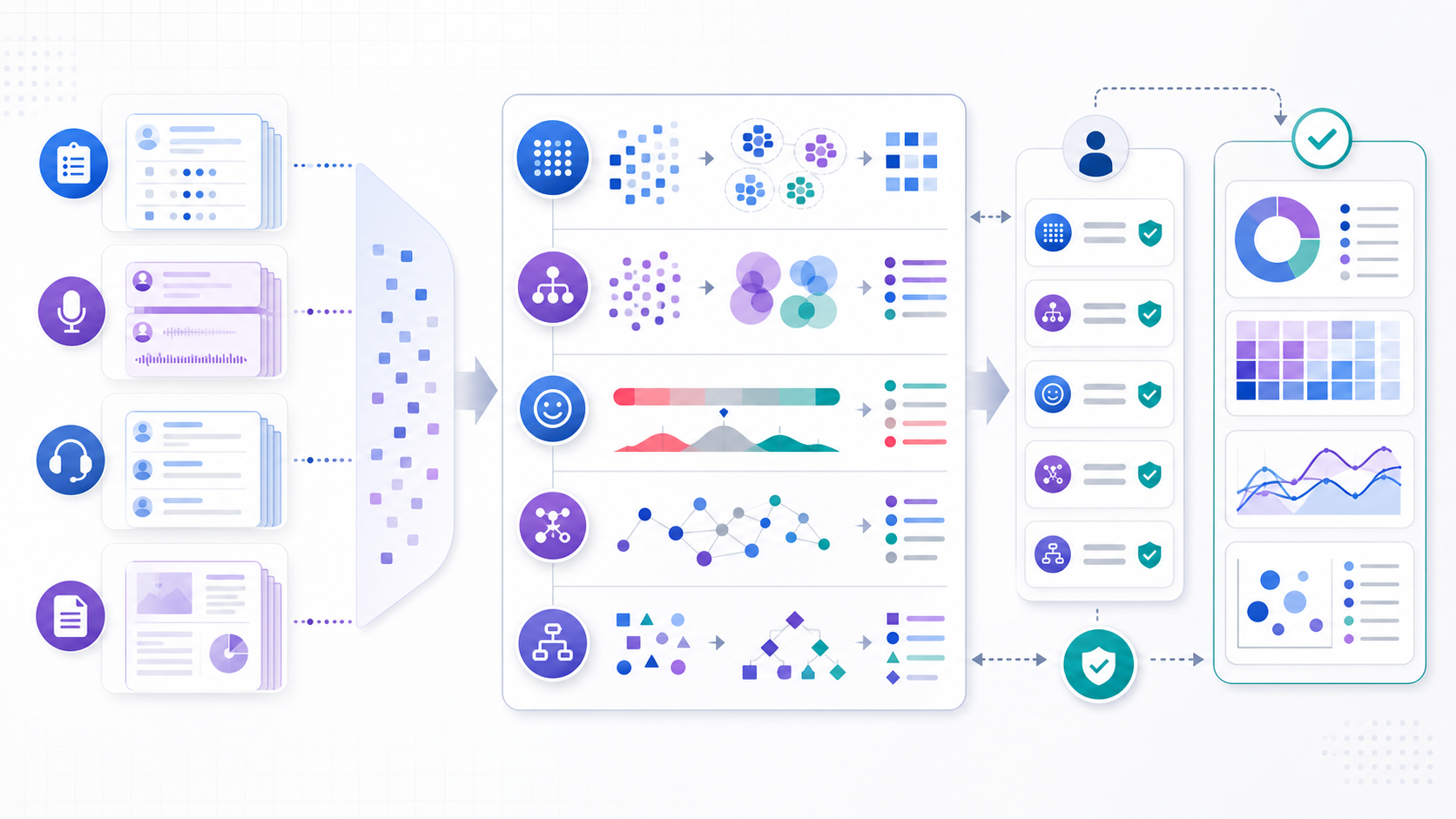
Text analysis tools are software systems that turn unstructured language into searchable, comparable, or structured evidence. Depending on the task, they may apply rules, statistics, natural language processing (NLP), machine learning, or large language models to identify themes, sentiment, entities, categories, relationships, summaries, and relevant passages.
文本分析工具是把非结构化语言转化为可检索、可比较或结构化证据的软件系统。根据任务不同,它们会使用规则、统计、自然语言处理(NLP)、机器学习或大语言模型识别主题、情感、实体、类别、关系、摘要与相关段落。
The category is broad. A corpus tool may count terms and collocations; qualitative text analysis software may support codebooks and reviewer notes; a feedback platform may track themes and sentiment; an NLP library may expose models through code; and an AI workspace may answer questions across documents. These products are not interchangeable. The useful question is not “Which tool has the most AI?” but “Which method produces evidence that is fit for this decision?”
这个类别范围很广:语料库工具可统计词频与搭配,质性文本分析软件可支持编码本和复核笔记,反馈平台可跟踪主题与情感,NLP 库可通过代码调用模型,AI 工作区则可跨文档回答问题。这些产品不能互相替代。真正有用的问题不是“哪个工具的 AI 最多”,而是“哪种方法能为当前决策提供适用的证据”。
What Text Analysis Software Can—and Cannot—Do文本分析软件能做什么、不能做什么
Begin with the analytical job. Theme discovery asks what issues recur. Classification assigns known labels. Sentiment estimates expressed polarity or emotion. Entity extraction finds people, organizations, places, products, dates, or domain terms. Search retrieves passages. Summarization compresses content. Each task needs a different ground truth and error analysis.
首先确定分析任务。主题发现回答哪些问题反复出现;分类把文本分配到已知标签;情感分析估计表达的倾向或情绪;实体抽取识别人名、组织、地点、产品、日期或领域术语;检索返回相关段落;摘要压缩内容。每项任务都需要不同的标准答案与错误分析。
Recurring questions, enough representative text, a defined decision, reviewable outputs, and repeatable categories or evidence requirements.
问题重复出现、具有足够代表性文本、决策目标明确、输出可复核,并且类别或证据要求可以重复执行。
Tiny one-off samples, unclear objectives, inaccessible source context, unsupported languages, or decisions where a plausible summary would hide critical uncertainty.
样本极少且一次性、目标不清、缺少来源语境、语言不受支持,或看似合理的摘要会掩盖关键不确定性的决策。
Sarcasm, implicit meaning, novel categories, policy interpretation, harm assessment, and culturally specific language often require domain reviewers.
讽刺、隐含含义、新类别、政策解释、伤害评估以及文化特定表达通常需要领域复核人员。
A model output is an analytical claim, not the source itself. Preserve passage links, document IDs, confidence, prompts or model versions, and reviewer changes.
模型输出是分析主张,并不是来源本身。应保留段落链接、文档 ID、置信信息、提示词或模型版本以及人工修改记录。
Prepare Data Before Comparing Text Analytics Tools比较文本分析工具前如何准备数据
A polished demo can conceal a poor fit. Build a small evaluation pack before opening a trial. Include normal examples, long and short items, duplicated content, mixed languages, typos, negation, ambiguous wording, missing context, and known difficult cases. Remove material you are not authorized to upload and document any retention or residency requirement.
精美演示可能掩盖不适配问题。开始试用前,应建立小型评估包,包含普通样本、长短文本、重复内容、混合语言、拼写错误、否定表达、歧义措辞、缺失语境以及已知困难案例。删除无权上传的材料,并记录数据保留与驻留要求。
- Question: write the decision the analysis must support, not a vague goal such as “find insights.”
- Unit: decide whether one record is a sentence, response, ticket, paragraph, document, or conversation.
- Labels: define categories, inclusion rules, exclusions, and examples; allow “uncertain” where disagreement is legitimate.
- Holdout set: keep a representative labeled sample separate from prompt tuning and configuration.
- Output contract: specify required fields, evidence links, confidence, export format, access controls, and deletion behavior.
- 问题:写清分析要支持的决策,不要只写“发现洞察”这类模糊目标。
- 单位:确定一条记录是句子、回复、工单、段落、文档还是完整对话。
- 标签:定义类别、纳入规则、排除规则与示例;在合理分歧存在时允许“无法确定”。
- 留出集:把具有代表性的已标注样本与提示词调试和配置过程分开。
- 输出契约:明确必需字段、证据链接、置信信息、导出格式、访问控制与删除行为。
How to Choose a Text Analysis Tool by Method如何按方法选择文本分析工具
No single approach dominates every task. Prefer the simplest method that meets the decision threshold and can be maintained. Deterministic rules are transparent but brittle. Classical NLP and supervised models can be efficient at scale but need preprocessing and labeled data. Generative models handle flexible instructions and summaries, yet may vary between runs or produce unsupported claims. Human coding is slower but essential for concept development and high-stakes interpretation.
没有任何方法在所有任务中占优。应选择能够达到决策门槛且可维护的最简单方案。确定性规则透明但脆弱;传统 NLP 与监督模型适合规模化,但需要预处理和标注数据;生成式模型可处理灵活指令与摘要,却可能在不同运行间变化或生成无来源支持的主张;人工编码较慢,但对概念发展和高风险解释至关重要。
| Approach方法 | Best for适合任务 | Main limitation主要局限 | Validation focus验证重点 |
|---|---|---|---|
| Rules and dictionaries规则与词典 | Stable terms, identifiers, compliance phrases稳定术语、标识符、合规短语 | Misses paraphrase and context容易漏掉改写与语境 | Coverage and false matches覆盖率与误匹配 |
| Classical NLP / ML传统 NLP / 机器学习 | High-volume classification and entities大规模分类与实体抽取 | Training drift and preprocessing训练漂移与预处理依赖 | Precision, recall, subgroup errors精确率、召回率、分组错误 |
| Generative AI生成式 AI | Flexible coding, summaries, question answering灵活编码、摘要、问答 | Variability and unsupported statements结果波动与无依据陈述 | Evidence grounding and repeatability证据依据与可重复性 |
| Human-assisted coding人机协作编码 | New themes, nuanced research, high-risk cases新主题、细致研究、高风险案例 | Time and reviewer consistency时间成本与复核一致性 | Agreement and documented rationale一致性与理由记录 |
A Repeatable Workflow for Evaluating Text Analysis Tools可重复执行的文本分析工具评估流程
- Define the decision and error cost定义决策与错误成本Write what action follows the result. A theme dashboard for exploration can tolerate more uncertainty than routing complaints, screening applications, or making regulated decisions.写清结果会触发什么行动。用于探索的主题看板可以容忍更多不确定性,而投诉路由、申请筛选或受监管决策必须采用更严格标准。
- Create a representative test set建立代表性测试集Sample across time, channels, languages, lengths, categories, and difficult cases. Have domain reviewers label it without seeing tool outputs.按时间、渠道、语言、长度、类别和困难案例抽样,并让领域复核人员在看不到工具输出的情况下标注。
- Run the same task in every finalist对所有候选工具运行同一任务Hold instructions, labels, inputs, and output fields constant. Record defaults and any prompt, model, threshold, or preprocessing change.保持指令、标签、输入与输出字段一致,记录默认值及提示词、模型、阈值或预处理的任何变化。
- Score accuracy and inspect errors评分并检查错误Use task-appropriate metrics, then read false positives, false negatives, unsupported summaries, and uncertain cases. Aggregate scores alone can hide systematic failure.使用适合任务的指标,并逐项阅读误报、漏报、无依据摘要与不确定案例。汇总分数可能掩盖系统性失败。
- Test the operational workflow测试实际工作流Check ingestion, permissions, reviewer queues, exports, APIs, deletion, audit logs, latency, rate limits, and what happens when a file or model call fails.检查数据接入、权限、复核队列、导出、API、删除、审计日志、延迟、速率限制,以及文件或模型调用失败时的行为。
- Set a monitored release rule设定受监控的上线规则Define acceptance thresholds, mandatory review categories, rollback conditions, sampling frequency, and when changes require revalidation.定义验收阈值、强制复核类别、回退条件、抽检频率,以及哪些变更必须重新验证。
Example: Tools for Analyzing Open-Ended Survey Responses示例:分析开放式调查回复的工具
Suppose a product team has 2,000 open-ended responses and wants to decide which onboarding problem to fix. The number is a hypothetical example, not an InfiniSynapse customer result. The team defines one response as the analysis unit, removes direct identifiers, and creates a codebook with categories such as account access, setup confusion, missing integration, speed, and unrelated feedback. Two reviewers independently label a stratified sample and discuss disagreements before testing tools.
假设某产品团队有 2,000 条开放式回复,希望决定优先修复哪个新手引导问题。这个数字只是说明性示例,并非 InfiniSynapse 客户结果。团队把一条回复定义为分析单位,删除直接身份信息,并建立包含账号访问、设置困惑、缺少集成、速度和无关反馈等类别的编码本。两位复核人员独立标注分层样本,并在测试工具前讨论分歧。
The tool may suggest new themes, but the team does not accept them merely because they sound coherent. Reviewers inspect representative passages, merge synonyms, separate causes from symptoms, and mark multi-label responses. They compare theme precision and recall on the holdout set, then calculate counts only after the coding rules stabilize. Quotations remain linked to source IDs so decision makers can inspect context. If one channel contains much longer responses, the team reports channel differences instead of treating all text as equally sampled opinion.
工具可以建议新主题,但团队不会因为这些主题听起来连贯就直接接受。复核人员查看代表性原文,合并同义类别,区分原因与症状,并标记多标签回复。编码规则稳定后,团队才在留出集上比较主题的精确率与召回率并统计数量。引用内容始终链接到来源 ID,便于决策者检查语境。如果某渠道的回复明显更长,团队会报告渠道差异,而不是把所有文本视为同等抽样的意见。
Decision rule: a theme becomes actionable only when its definition is stable, examples are traceable, error rates are acceptable for the decision, and the affected segment is understood. Frequency alone does not prove importance or causality.
决策规则:只有当主题定义稳定、示例可追溯、错误率满足决策要求且受影响群体明确时,该主题才适合转化为行动。出现频率本身不能证明重要性或因果关系。
How to Validate Text Analysis Results如何验证文本分析结果
Validation must match the task. For classification or entity extraction, calculate precision, recall, and F1 for each important class rather than only overall accuracy. For theme discovery, judge whether themes are coherent, distinct, sufficiently supported, and useful for the stated decision; compare coding on a common sample. For summaries and question answering, check whether each material claim is supported by a cited passage and whether important qualifications were omitted.
验证方式必须匹配任务。对分类或实体抽取,应按重要类别计算精确率、召回率与 F1,而不是只看总体准确率。对主题发现,应判断主题是否连贯、互相区分、证据充分并对既定决策有用,同时在共同样本上比较编码结果。对摘要和问答,应检查每个重要主张是否有引用段落支持,以及关键限定条件是否被遗漏。
- Slice the errors: inspect language, channel, document type, length, date, and sensitive groups where lawful and appropriate.
- Measure reviewer agreement: disagreement can reveal an unclear codebook rather than a bad model.
- Retest stability: repeat selected inputs when the system is nondeterministic and record material variation.
- Test abstention: a reliable system should route uncertain or unsupported cases instead of forcing every answer.
- Revalidate changes: new models, prompts, labels, preprocessing, languages, or data distributions can invalidate earlier results.
- 分组检查错误:按语言、渠道、文档类型、长度、日期以及在合法适当情况下的敏感群体检查。
- 衡量复核一致性:分歧可能说明编码本不清,而不一定是模型质量差。
- 复测稳定性:当系统具有随机性时重复运行部分输入,并记录实质性差异。
- 测试拒答:可靠系统应把不确定或缺乏证据的案例路由到复核,而不是强行输出答案。
- 变更后重验:新模型、提示词、标签、预处理、语言或数据分布都可能使早期结果失效。
Common Mistakes with AI Text Analysis ToolsAI 文本分析工具的常见错误
The most common failure is selecting a product before defining the decision. Other failures include testing only clean examples, treating sentiment as a fact about a person, collapsing mixed opinions into one score, accepting generated themes without source evidence, and comparing vendor percentages built from different datasets. Privacy can fail when teams paste personal, confidential, copyrighted, or regulated text into an unapproved service.
最常见的失败是在定义决策前就选择产品。其他问题包括只测试干净样本、把情感分数当作对个人的事实判断、把混合意见压缩成单一分数、接受没有来源证据的生成主题,以及比较基于不同数据集得出的厂商百分比。团队把个人、机密、受版权保护或受监管文本粘贴到未经批准的服务中,也会造成隐私风险。
Language and domain fit matter. A model that performs well on public English reviews may fail on abbreviations in support tickets, code-switching, specialist terminology, or short replies such as “fine.” Topic models can produce clusters that are mathematically stable but operationally useless. Summaries can omit minority views. Entity systems can confuse products with organizations. Build an escalation route and retain the source; do not let an attractive dashboard become the only record.
语言与领域适配非常重要。一个在公开英文评论上表现良好的模型,可能无法处理客服工单缩写、语码切换、专业术语或“还行”这样的短回复。主题模型可能生成数学上稳定但业务上无用的聚类;摘要可能遗漏少数意见;实体系统可能把产品与组织混淆。应建立升级处理路径并保留来源,不能让漂亮的看板成为唯一记录。
Text Analysis Software Selection Checklist文本分析软件选型检查清单
| Area领域 | Questions to verify需要核实的问题 | Evidence to request应要求的证据 |
|---|---|---|
| Task fit任务适配 | Does it support the required unit, labels, multilabel cases, languages, and source citation?是否支持所需分析单位、标签、多标签案例、语言与来源引用? | Results on your labeled holdout set在自有标注留出集上的结果 |
| Workflow工作流 | Can reviewers correct outputs, preserve notes, export records, and reproduce a run?复核人员能否修正输出、保留笔记、导出记录并复现运行? | End-to-end trial with failed cases包含失败案例的端到端试用 |
| Governance治理 | Where is data stored, who can access it, how is it deleted, and is customer data used for training?数据存在哪里、谁可访问、如何删除、客户数据是否用于训练? | Contract, security documentation, and settings合同、安全文档与实际设置 |
| Operations运维 | What are file, context, rate, latency, API, and export limits? What happens during failure?文件、上下文、速率、延迟、API 与导出限制是什么?失败时如何处理? | Measured trial logs and recovery test实测试用日志与恢复测试 |
| Cost成本 | Is pricing based on seats, records, tokens, storage, models, or integrations?定价依据是席位、记录、Token、存储、模型还是集成? | Scenario-based total cost calculation基于实际场景的总成本计算 |
Do not rank products from feature counts alone. Weight criteria by the consequences of failure. A research team may prioritize codebook control and memoing; a support operation may prioritize routing latency and integrations; a regulated workflow may require access controls, deployment options, traceability, and mandatory review.
不要只按功能数量对产品排名,应根据失败后果给各项标准分配权重。研究团队可能优先考虑编码本控制和备忘录;客服运营可能更关注路由延迟与集成;受监管工作流则可能要求访问控制、部署选项、可追溯性与强制复核。
Apply the Framework to Your Own Documents把评估框架应用到你的文档
Prepare a small authorized sample, a specific question, expected evidence, and a few known difficult cases. InfiniSynapse publicly describes natural-language analysis across connected data sources and multi-modal content including documents. Use the online workspace to test a document-analysis workflow; verify outputs against the source before using them in a decision.
请准备一小组已获授权的样本、一个具体问题、预期证据以及几个已知困难案例。InfiniSynapse 官网明确介绍了面向已连接数据源以及包含文档在内的多模态内容进行自然语言分析的能力。你可以使用在线工作区测试文档分析流程,并在用于决策前对照来源验证输出。
Try document analysis online在线尝试文档分析Frequently Asked Questions About Text Analysis Tools关于文本分析工具的常见问题
What is text analysis software?什么是文本分析软件?
It applies rules, statistics, NLP, machine learning, or language models to organize and interpret text for tasks such as themes, sentiment, entities, classification, search, and summarization.
它使用规则、统计、NLP、机器学习或语言模型组织和解释文本,用于主题、情感、实体、分类、检索与摘要等任务。
Which text analysis tool is best?哪种文本分析工具最好?
The best tool matches your text type, analytical question, required evidence, privacy constraints, team skills, and error tolerance. Test finalists on the same representative labeled sample.
最佳工具应匹配你的文本类型、分析问题、证据要求、隐私限制、团队技能与错误容忍度。应使用同一组代表性标注样本测试候选工具。
How do you validate text analysis results?如何验证文本分析结果?
Use a representative holdout set, task-specific labels and thresholds, human-reviewed answers, subgroup error analysis, and repeat testing after material changes.
使用代表性留出集、任务专用标签与阈值、人工复核答案、分组错误分析,并在实质性变更后重新测试。
Can AI text analysis replace human coding?AI 文本分析能替代人工编码吗?
AI can accelerate coding, classification, and summarization, but ambiguous concepts, new themes, sensitive decisions, and high-cost errors still require documented human judgment.
AI 可以加速编码、分类与摘要,但歧义概念、新主题、敏感决策和高成本错误仍需要有记录的人工判断。
How can open-ended survey responses be analyzed?如何分析开放式调查回复?
Define the decision, clean and sample responses, build or discover a codebook, label the text, quantify themes, review ambiguous cases, and preserve representative quotations with privacy controls.
先定义决策,再清理与抽样回复,建立或发现编码本,标注文本,量化主题,复核歧义案例,并在隐私控制下保留代表性引文。
Authoritative Sources and Practical Next Steps权威来源与实际下一步
For technical foundations, consult the NIST AI Risk Management Framework for risk-oriented governance and the scikit-learn model evaluation documentation for definitions of classification metrics. For research workflows, the peer-reviewed guide How to Use LLMs for Text Analysis describes a practical sequence from data preparation and prompting to validation.
技术基础方面,可参考 NIST AI 风险管理框架了解面向风险的治理,并参考 scikit-learn 模型评估文档了解分类指标定义。研究工作流方面,同行评审指南 How to Use LLMs for Text Analysis介绍了从数据准备、提示设计到验证的实践顺序。
Start with one decision and one representative test set. Compare at most a few tools, keep the task constant, inspect errors rather than demos, and document why the chosen workflow is acceptable. Then monitor live samples and revisit the decision whenever data, labels, models, or consequences change.
从一个决策和一组代表性测试集开始。只比较少量候选工具,保持任务不变,检查错误而不是只看演示,并记录为什么所选工作流可以接受。上线后持续抽检;当数据、标签、模型或错误后果发生变化时重新评估。