
What is topic modeling?什么是主题建模?
For the full topic map and the neighboring methods that support this workflow, continue with the unstructured data processing and document intelligence guide.
如需查看完整主题结构以及支撑本流程的相邻方法,请继续阅读非结构化数据处理与文档智能指南。
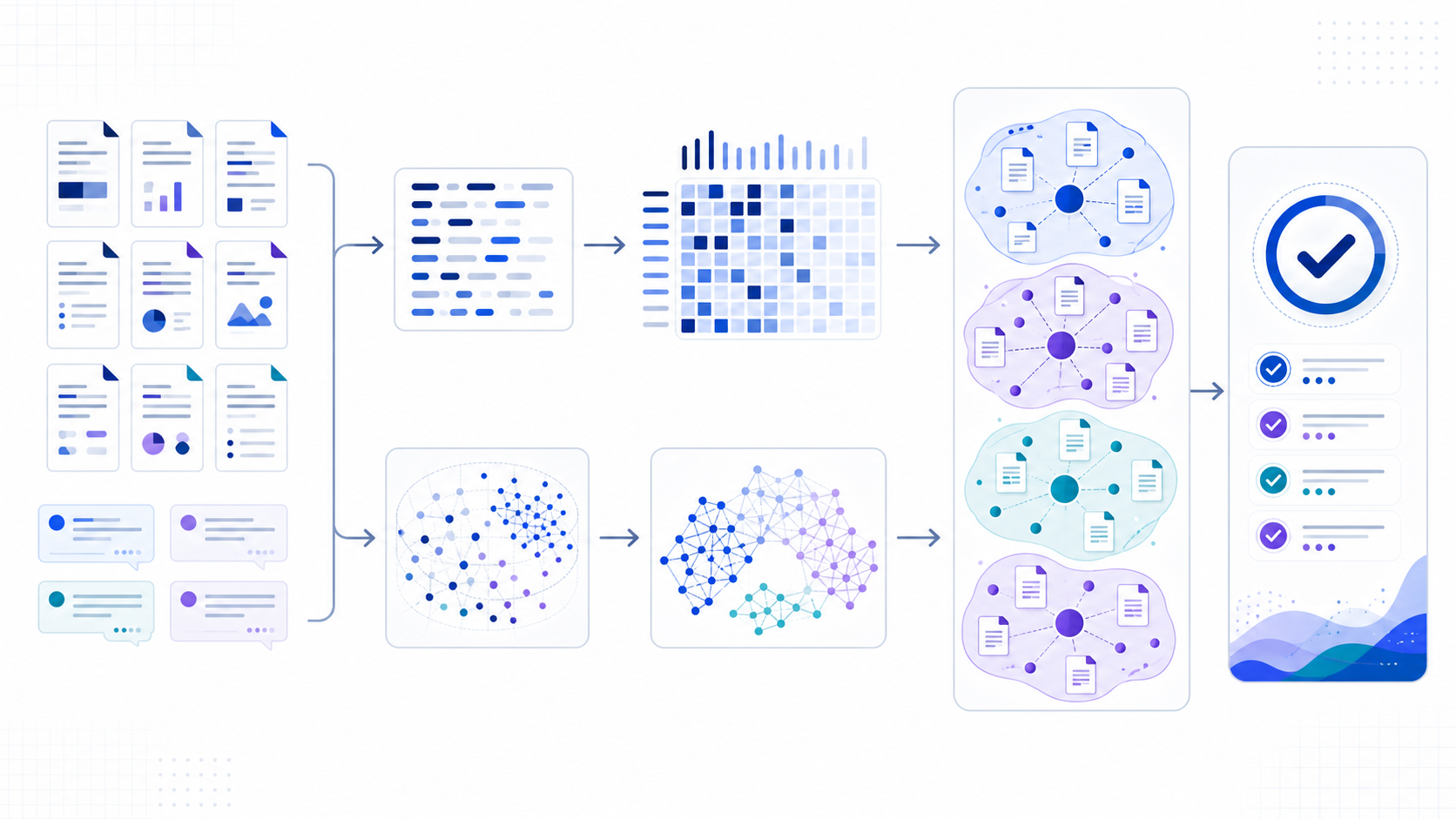
Topic modeling is a family of methods for discovering recurring themes in a collection of documents without requiring a complete set of predefined labels. A model groups words, documents, or semantic representations that tend to occur together, then returns topic descriptors and assignments that people must interpret and validate.
主题建模是一组从文档集合中发现反复出现主题的方法,不要求事先准备完整标签体系。模型会把经常共同出现的词、文档或语义表示组织起来,输出主题描述与归属结果,再由人员解释和验证。
A topic is not automatically a business category or an objective fact. It is a statistical or geometric pattern produced under a particular document definition, preprocessing recipe, representation, algorithm, parameter set, and random seed. Useful topic modeling therefore includes the model and the review process around it.
主题并不会自动成为业务分类,也不是客观事实。它是在特定文档单位、预处理方案、表示方法、算法、参数与随机种子下产生的统计或几何模式。因此,可靠的主题建模既包括模型,也包括围绕模型建立的复核流程。
This makes topic modeling useful for exploring an unfamiliar corpus, organizing research literature, triaging feedback, mapping support conversations, or creating candidate categories. It is less suitable when a stable approved taxonomy already exists and the real need is consistent classification; in that case, supervised classification or rules may be easier to test and govern.
因此,主题建模适合探索陌生语料、整理研究文献、初步归纳反馈、梳理支持对话或提出候选类别。当已有稳定且获批的分类体系、真正目标是保持一致分类时,监督分类或规则通常更容易测试与治理。
When topic modeling helps—and when it does not主题建模何时有用,何时不适用
Use it to see recurring vocabulary and semantic groups before writing a codebook. Treat the output as hypotheses for review, not final labels.
在编写编码手册前,用它查看反复出现的词汇与语义分组。输出应作为待复核假设,而不是最终标签。
Use representative topics and documents to navigate thousands of records, while retaining links to the source text.
用代表性主题与文档浏览成千上万条记录,同时保留返回原文的链接。
After validating topic consistency, compare prevalence by product, region, language, cohort, or period. Do not compare unstable topic IDs blindly.
验证主题一致性后,可按产品、地区、语言、群组或时间比较占比;不要直接比较不稳定的主题编号。
If every record must map to an approved category with measurable error, build a labeled evaluation set and test classification or deterministic rules.
如果每条记录都必须映射到获批类别且错误需要量化,应建立标注评估集并测试分类模型或确定性规则。
Topic models can surface sensitive attributes, merge minority viewpoints into larger clusters, or create misleading labels from frequent but unimportant language. Confirm that the intended use is lawful and appropriate, minimize personal data, preserve permissions, and involve domain reviewers before operational decisions depend on the output.
主题模型可能暴露敏感属性、把少数观点并入大簇,或根据高频但不重要的语言生成误导标签。让运营决策依赖输出之前,应确认用途合法且适当,减少个人数据,保留权限控制,并让领域复核人员参与。
Prepare the corpus before choosing a topic model选择主题模型前先准备语料
The most consequential choice is often the unit of analysis. A document may be a full report, one paragraph, a support ticket, a survey response, or a conversation turn. Long documents can contain several themes; extremely short records may contain too little context. Choose the unit that matches the decision you intend to make, then keep a stable source ID so every topic can be inspected against the original text.
最关键的选择往往是分析单位。一个“文档”可以是整份报告、一个段落、一张支持工单、一条问卷回答或一次对话轮次。长文档可能包含多个主题,极短记录又可能缺少上下文。应根据预期决策选择分析单位,并保留稳定来源 ID,以便把每个主题追溯到原文。
- Define scope: document sources, dates, languages, inclusion rules, exclusions, access rights, and the population the corpus represents.定义范围:记录文档来源、日期、语言、纳入与排除规则、访问权限及语料所代表的总体。
- Remove mechanical noise: exact duplicates, quoted email chains, signatures, navigation text, boilerplate, OCR artifacts, and records without meaningful language.去除机械噪声:清理完全重复项、引用邮件链、签名、导航文字、模板文本、OCR 伪影及没有有效语言的记录。
- Preserve meaning: do not remove negation, domain terms, names, or rare phrases merely because a generic preprocessing recipe calls them noise.保留含义:不要因为通用预处理方案把某些内容视为噪声,就删除否定词、领域术语、名称或低频短语。
- Separate languages deliberately: multilingual embeddings can support combined analysis, but tokenization, stop words, topic quality, and review capacity still vary by language.有意识地处理多语言:多语言嵌入可以支持联合分析,但分词、停用词、主题质量和复核能力仍会随语言变化。
- Keep a holdout review sample: reserve representative documents for qualitative inspection and downstream testing rather than tuning every decision on the same examples.保留复核样本:留出有代表性的文档用于定性检查与下游测试,不要始终在同一批示例上调整全部决策。
Minimum reproducibility record: corpus snapshot or query, inclusion rules, document unit, preprocessing code, model and library versions, representation, parameters, random seed, topic labels, reviewer decisions, and export date.
最低可复现记录:语料快照或查询、纳入规则、文档单位、预处理代码、模型与库版本、表示方法、参数、随机种子、主题标签、复核决定和导出日期。
How topic modeling works主题建模如何工作
Classical and embedding-based methods begin differently, but both compress a large corpus into a smaller set of patterns. Bag-of-words approaches represent each document by term counts or weighted counts. Embedding approaches represent a document or sentence as a dense vector intended to place semantically related text near each other. The model then estimates latent components or clusters and derives a description for each result.
经典方法与基于嵌入的方法起点不同,但都会把大规模语料压缩成较少的模式。词袋方法用词频或加权词频表示文档;嵌入方法把文档或句子表示为稠密向量,使语义相关文本尽量彼此接近。模型随后估计潜在成分或簇,并为每个结果提取描述。
| Concept概念 | Meaning含义 | What to inspect检查内容 |
|---|---|---|
| Document representation文档表示 | Counts, TF-IDF weights, or semantic vectors used as model input作为模型输入的词频、TF-IDF 权重或语义向量 | Whether meaningful distinctions survive preprocessing预处理后有意义的差异是否仍被保留 |
| Topic descriptor主题描述 | High-weight words, phrases, or generated labels that summarize a pattern概括模式的高权重词、短语或生成标签 | Representative documents, not only the displayed words代表性文档,而不只是展示出来的词 |
| Document-topic relation文档—主题关系 | A probability or weight for multiple topics, or a primary cluster assignment多个主题的概率或权重,或主要簇归属 | Ambiguous records and low-confidence assignments歧义记录与低置信度归属 |
| Outlier异常项 | A document that does not fit a stable cluster or component well无法很好归入稳定簇或成分的文档 | Whether it is noise, a rare valid issue, or a preprocessing failure它是噪声、少见但有效的问题,还是预处理失败 |
Topic labels are a reporting layer, not a model truth. A label such as “account access” may be written by a reviewer after inspecting top words and representative records. Store that interpretation separately from the underlying topic ID so reviewers can rename, merge, split, or reject topics without losing the original output.
主题标签是报告层,不是模型真相。例如“账户访问”可能是复核者查看高权重词与代表记录后写下的名称。应把解释与底层主题 ID 分开保存,使复核者可以重命名、合并、拆分或拒绝主题,同时保留原始输出。
Topic modeling techniques: LDA, NMF, and embedding clusters主题建模方法:LDA、NMF 与嵌入聚类
| Method方法 | Useful when适用情况 | Strengths优势 | Cautions注意事项 |
|---|---|---|---|
| Latent Dirichlet allocation (LDA)潜在狄利克雷分配(LDA) | Documents may contain mixtures of topics and a transparent probabilistic baseline is valuable文档可能包含多个主题,且需要透明的概率基线 | Returns document-topic mixtures and topic-word distributions; extensively studied返回文档—主题混合与主题—词分布;研究基础广泛 | Relies on token co-occurrence and bag-of-words assumptions; short text and vocabulary choices can be difficult依赖词共现与词袋假设;短文本和词表选择可能困难 |
| Non-negative matrix factorization (NMF)非负矩阵分解(NMF) | A TF-IDF matrix provides a strong interpretable baseline and deterministic-style components are preferredTF-IDF 矩阵可形成强且易解释的基线,并偏好成分分解 | Conceptually direct, often produces concise term groups, and is efficient on sparse matrices概念直接,常产生简洁词组,并能高效处理稀疏矩阵 | The factorization depends heavily on vocabulary, weighting, initialization, and chosen component count分解结果高度依赖词表、权重、初始化与成分数量 |
| Embedding clustering, including BERTopic-style pipelines嵌入聚类,包括 BERTopic 类流程 | Semantic similarity matters, wording varies, text is short, or multilingual support is needed语义相似性重要、表达多样、文本较短或需要多语言支持 | Can group semantically related records without exact word overlap and can expose outliers可在没有精确词重叠时聚合语义相关记录,并识别异常项 | Results depend on embedding model, dimensionality reduction, clustering, and label extraction; costs and reproducibility require attention结果依赖嵌入模型、降维、聚类与标签提取;需要关注成本与可复现性 |
Do not choose a method from a leaderboard detached from your corpus. Build at least one simple baseline, use the same document set and evaluation rubric, and compare multiple seeds or resamples. If a more complex pipeline does not improve interpretability, coverage, stability, or downstream utility, keep the simpler model.
不要脱离自己的语料,仅根据排行榜选择方法。应至少建立一个简单基线,使用相同文档集与评估量表,并比较多个随机种子或重采样结果。如果复杂流程没有改善可解释性、覆盖率、稳定性或下游效用,应保留更简单的模型。
A repeatable topic modeling workflow可重复执行的主题建模流程
- Write the decision and review questions. State who will use the topics, what decision they support, what a useful topic must contain, and which mistakes would be harmful. Decide whether documents may belong to several topics.写清决策与复核问题。说明谁会使用主题、主题支持什么决策、有用主题应满足什么条件,以及哪些错误会造成伤害。确定文档是否可以属于多个主题。
- Freeze a corpus snapshot. Apply documented inclusion and exclusion rules, retain source IDs and timestamps, measure missing or duplicate records, and create language and source segments for later analysis.冻结语料快照。执行有记录的纳入与排除规则,保留来源 ID 与时间戳,衡量缺失与重复记录,并建立语言和来源分组供后续分析。
- Create minimal and extended preprocessing variants. Start with light normalization, then test whether removing boilerplate, adding phrases, lemmatizing, or changing stop words improves real interpretations. Keep every transformation reversible.建立最小与扩展预处理版本。先进行轻度标准化,再测试删除模板文本、加入短语、词形还原或调整停用词是否改善实际解释。所有转换都应可逆。
- Run comparable baselines. Fit a count or TF-IDF model such as LDA or NMF and, when semantic similarity matters, an embedding-clustering alternative. Use a practical range of topic counts rather than optimizing one arbitrary value.运行可比较基线。拟合 LDA 或 NMF 等词频或 TF-IDF 模型;当语义相似性重要时,再测试嵌入聚类方案。应比较合理的主题数量范围,而不是只优化一个任意数值。
- Inspect words and representative documents together. Review the highest-weight terms, central documents, boundary cases, outliers, and documents with mixed assignments. Draft plain-language labels only after reading evidence.同时检查词与代表文档。复核高权重词、中心文档、边界案例、异常项与混合归属文档。阅读证据之后再拟定通俗主题名称。
- Compare quality and stability. Track coherence, topic diversity, coverage, cluster size, outlier share, and agreement across seeds or resamples. Ask independent reviewers whether labels are coherent, distinct, and relevant.比较质量与稳定性。记录一致性、主题多样性、覆盖率、簇规模、异常项比例,以及不同随机种子或重采样之间的一致程度。让独立复核者判断标签是否连贯、彼此可区分且与任务相关。
- Merge, split, reject, or rename with an audit trail. Do not force every component into the final taxonomy. Record the evidence and reason for each interpretation change, including topics marked as noise or unresolved.带审计记录地合并、拆分、拒绝或重命名。不要强迫每个成分进入最终分类体系。记录每次解释变更的证据与原因,包括标记为噪声或尚未解决的主题。
- Validate the downstream use. Test whether topics improve search, sampling, routing, research synthesis, or trend review. Establish monitoring and rerun criteria before comparing future data with the baseline.验证下游用途。测试主题是否改善搜索、抽样、路由、研究综述或趋势复核。在把未来数据与基线比较之前,先建立监控与重新运行标准。
Example: finding themes in product feedback示例:从产品反馈中发现主题
Hypothetical example—not a customer result假设示例,并非客户结果
A product team has permission to analyze feedback forms and wants to find recurring onboarding problems. It defines one response as one document, removes duplicated submissions and template text, preserves product area, language, date, and source ID, and separates records that contain no substantive comment.
某产品团队获准分析反馈表,希望发现反复出现的入门使用问题。团队把一条回答定义为一份文档,删除重复提交与模板文本,保留产品区域、语言、日期和来源 ID,并分离没有实质评论的记录。
The team compares an NMF baseline on TF-IDF features with an embedding-clustering pipeline across several settings. Reviewers inspect representative documents and tentatively label patterns such as connection setup, permission confusion, file format mismatch, and unrelated feedback. These are illustrative labels only; a real analysis must derive labels from the actual corpus.
团队在多组设置下比较基于 TF-IDF 的 NMF 基线与嵌入聚类流程。复核者查看代表文档,并暂时把模式命名为连接设置、权限困惑、文件格式不匹配和无关反馈。这些只是说明性标签;真实分析必须从实际语料中得到标签。
A topic is accepted only when two reviewers can describe it consistently, representative records support the label, the cluster is not mostly boilerplate, and the pattern remains recognizable across resamples. The final deliverable contains topic definitions, representative source IDs, uncertainty notes, exclusions, model settings, and the intended follow-up—not a claim that the algorithm discovered objective truth.
只有当两名复核者能一致描述主题、代表记录支持标签、簇并非主要由模板文本构成,并且该模式在重采样后仍可识别时,主题才会被接受。最终交付物包括主题定义、代表来源 ID、不确定性说明、排除项、模型设置和后续行动,而不是声称算法发现了客观真相。
How to evaluate topic model quality如何评估主题模型质量
Evaluation must connect model diagnostics with human interpretation and the eventual task. Automated scores are useful for screening candidate configurations, but they can reward word sets that do not support consistent human meaning. Research on automated topic evaluation has shown that common coherence measures can disagree with human judgments, so a high score is not sufficient evidence of validity.
评估必须把模型诊断、人工解释与最终任务连接起来。自动分数可用于筛选候选配置,但也可能奖励无法支持一致人工含义的词组。关于自动主题评估的研究表明,常见一致性指标可能与人工判断不一致,因此高分不足以证明模型有效。
| Dimension维度 | Question问题 | Evidence证据 |
|---|---|---|
| Coherence一致性 | Do the terms and records express a recognizable theme?词与记录是否表达可识别主题? | Coherence diagnostics plus blinded reviewer ratings一致性诊断与盲法复核评分 |
| Distinctiveness区分度 | Are topics meaningfully different rather than synonyms?主题是否有实质差异,而非同义重复? | Shared top terms, document overlap, and reviewer confusion共享高权重词、文档重叠与复核者混淆 |
| Coverage覆盖率 | What proportion of in-scope documents receives a usable interpretation?范围内多少文档获得可用解释? | Assignment, mixed-topic, and outlier rates by segment按分组统计归属、混合主题与异常项比例 |
| Stability稳定性 | Do similar topics reappear after seed changes or resampling?更换随机种子或重采样后是否出现相似主题? | Matched topics, term overlap, and assignment agreement匹配主题、词重叠与归属一致程度 |
| Utility效用 | Does the output improve the intended workflow?输出是否改善预期工作流? | Task-specific review time, retrieval quality, or decision agreement任务相关复核时间、检索质量或决策一致性 |
Choose acceptance criteria before selecting the winning run. Report segment-level results because a model can look acceptable overall while failing on one language, source, product area, or minority theme. If reviewers cannot explain a topic or trace it to evidence, mark it unresolved rather than inventing a confident label.
应在选择最佳运行结果之前定义验收标准。需要按分组报告结果,因为模型可能总体看似可接受,却在某种语言、来源、产品区域或少数主题上失败。如果复核者无法解释主题或追溯证据,应将其标为未解决,而不是编造自信标签。
Common topic modeling mistakes, limits, and risks主题建模的常见错误、局限与风险
- Reading top words as the whole topic: inspect central, mixed, and boundary documents. A plausible word list can hide a heterogeneous cluster.把高权重词当成完整主题:应检查中心、混合与边界文档。看似合理的词表可能掩盖内部差异很大的簇。
- Over-cleaning: aggressive stop-word removal, stemming, or phrase filtering can erase domain meaning, negation, and minority issues.过度清洗:激进删除停用词、词干化或短语过滤可能抹去领域含义、否定表达与少数问题。
- Choosing the topic count by one peak score: compare interpretability, redundancy, coverage, and stability across a range instead.只按单一峰值选择主题数:应在合理范围内同时比较可解释性、重复度、覆盖率与稳定性。
- Treating topic prevalence as population prevalence: the corpus may be a biased sample, collection volume may change, and duplicate or automated text can distort counts.把主题占比当作总体占比:语料可能存在抽样偏差,采集量可能变化,重复项或自动文本也会扭曲计数。
- Comparing topic IDs over time: refitted models can reorder, split, or merge topics. Match topics using terms, representative records, and reviewer definitions before trend claims.直接跨时间比较主题 ID:重新拟合后主题可能重新排序、拆分或合并。提出趋势结论前,应根据词、代表记录与复核定义匹配主题。
- Using private text without governance: minimize sensitive fields, enforce source permissions, document retention, and prevent generated labels or excerpts from exposing restricted information.未经治理使用私密文本:应减少敏感字段,执行来源权限,记录保留期限,并防止生成标签或摘录暴露受限信息。
Alternatives include supervised classification for known labels, keyword or rule systems for explicit phrases, hierarchical clustering for navigation, search and retrieval for evidence discovery, and qualitative coding when depth and context matter more than scale. Hybrid workflows are common: a topic model proposes patterns, reviewers build a codebook, and a tested classifier applies the stable taxonomy.
替代方案包括:对已知标签使用监督分类,对明确短语使用关键词或规则系统,用层次聚类支持导航,用搜索与检索发现证据,以及在深度与语境比规模更重要时采用定性编码。混合流程也很常见:主题模型提出模式,复核者建立编码手册,再用经过测试的分类器应用稳定分类体系。
Connect reviewed topic results to broader data analysis把复核后的主题结果连接到更广泛的数据分析
Before opening the app, prepare readable source documents, stable record IDs, a reviewed topic-assignment table, relevant structured fields, and the access rules you need to enforce. InfiniSynapse is an AI data analysis workspace for joint analysis across documents and structured data; it is not represented here as a dedicated topic-model trainer or coherence benchmark. Use it after topic modeling when the task is to examine reviewed themes alongside dates, segments, metrics, and other connected evidence.
打开应用前,请准备可读源文档、稳定记录 ID、已复核的主题归属表、相关结构化字段,以及需要执行的访问规则。InfiniSynapse 是用于文档与结构化数据联合分析的 AI 数据分析工作区;本页不会把它描述成专用主题模型训练器或一致性基准工具。完成主题建模后,如果需要把已复核主题与日期、群组、指标及其他连接证据一起分析,可使用该应用。
Open InfiniSynapse for document and data analysis打开 InfiniSynapse 进行文档与数据联合分析Best practices and next steps最佳实践与下一步
Start with a narrow decision, a governed corpus, and reviewers who know the domain. Establish a simple baseline before adding embeddings or generated labels. Keep the source text and every transformation traceable, and separate exploratory findings from approved operational categories.
从范围明确的决策、受治理的语料和熟悉领域的复核者开始。加入嵌入或生成标签之前先建立简单基线。保持源文本与每项转换可追溯,并把探索性发现与获批运营类别分开。
- Version the corpus, preprocessing, model, parameters, labels, and reviewer decisions together.对语料、预处理、模型、参数、标签与复核决定统一进行版本管理。
- Review topics by language, source, period, and other meaningful segments—not only in aggregate.按语言、来源、时间及其他有意义分组复核主题,而不只看总体结果。
- Store representative and contradictory documents for every accepted topic.为每个已接受主题保存代表文档与反例文档。
- Define drift signals and rerun triggers before using topic prevalence in recurring reports.在定期报告中使用主题占比之前,先定义漂移信号与重新运行触发条件。
For adjacent product planning, review the InfiniSynapse product documentation and its RAG data analysis guide. These resources describe broader evidence-grounded analysis; they do not replace a dedicated topic-modeling implementation and validation plan.
对于相邻产品规划,可查看 InfiniSynapse 产品文档与RAG 数据分析指南。这些资源说明更广泛的基于证据的分析方式,但不能替代专门的主题建模实现与验证计划。
Frequently asked questions about topic modeling关于主题建模的常见问题
What is topic modeling?什么是主题建模?
Topic modeling is a family of unsupervised or weakly supervised methods that discovers recurring themes in a document collection by analyzing patterns in words, document representations, or semantic embeddings. The output requires human interpretation and validation.
主题建模是一组无监督或弱监督方法,通过分析词、文档表示或语义嵌入中的模式,从文档集合中发现反复出现的主题。输出仍需要人工解释与验证。
How does topic modeling work?主题建模如何工作?
A workflow defines the document unit, cleans and represents the corpus, fits several candidate models, inspects the words and documents associated with each topic, and validates whether the topics are coherent, distinct, stable, and useful for the intended decision.
流程会先定义文档单位,清理并表示语料,拟合多个候选模型,再检查每个主题关联的词与文档,最后验证主题对预期决策而言是否一致、可区分、稳定且有用。
How many topics should I choose?应该选择多少个主题?
There is no universally correct number. Compare a practical range and choose the smallest topic set that preserves meaningful distinctions, covers the corpus, remains stable, and can be interpreted consistently by reviewers. The appropriate granularity depends on the decision.
不存在普遍正确的数量。应比较合理范围,并选择既能保留有意义差异、覆盖语料、保持稳定,又能被复核者一致解释的最小主题集合。合适粒度取决于具体决策。
Is BERTopic always better than LDA?BERTopic 一定比 LDA 更好吗?
No. BERTopic can capture contextual similarity and often suits short or semantically varied text, while LDA offers a transparent probabilistic baseline and document-topic mixtures. The corpus, language, infrastructure constraints, reproducibility needs, and evaluation goal determine the better fit.
不一定。BERTopic 能捕捉上下文相似性,常适合短文本或表达多样的语料;LDA 则提供透明的概率基线与文档—主题混合。应根据语料、语言、基础设施限制、可复现需求与评估目标选择。
How do you evaluate a topic model?如何评估主题模型?
Combine automated diagnostics such as coherence, diversity, coverage, and stability with human review of topic words, representative documents, boundary cases, and downstream usefulness. No single score proves that a topic model is valid.
应把一致性、多样性、覆盖率和稳定性等自动诊断,与人工复核主题词、代表文档、边界案例及下游效用结合起来。任何单一分数都不能证明主题模型有效。
Use topic modeling for document classification and content recommendation把主题建模用于文档分类与内容推荐
Topic modeling is often the discovery layer rather than the final production system. It can reveal candidate categories, common document mixtures, and semantic neighborhoods before a team has a stable taxonomy. The next step depends on the application: preserve probabilistic topic mixtures for exploration, convert reviewed themes into supervised labels for repeatable classification, or use topic representations as one signal in retrieval and recommendation.
主题建模通常是发现层,而不是最终生产系统。它可以在团队尚无稳定分类体系时揭示候选类别、常见文档混合与语义邻域。下一步取决于应用:探索时保留概率主题混合;需要重复分类时把已复核主题转成监督标签;检索与推荐中则把主题表示作为多种信号之一。
Review discovered topics, write label definitions, include negative and boundary examples, annotate a representative set, and train a classifier with measurable per-class errors. Do not treat raw cluster IDs as permanent labels. The supervised contract is on document classification.
复核已发现主题,编写标签定义,加入反例与边界案例,标注代表性样本,再训练可衡量各类别错误的分类器。不要把原始簇 ID 当成永久标签。监督契约见文档分类。
Expose topics as filters or overview maps while linking every label and chart to representative documents. Allow mixed membership and an “unresolved” path so navigation does not force false certainty.
把主题作为筛选器或概览地图,同时让每个标签与图表链接到代表文档。允许混合归属与“未解决”路径,避免导航制造虚假确定性。
Use validated topic or embedding similarity to generate candidates, then combine it with freshness, permissions, quality, diversity, and user context. A shared topic does not prove that an item is relevant or appropriate.
使用已验证的主题或嵌入相似度生成候选,再结合新鲜度、权限、质量、多样性与用户语境。共享主题并不能证明内容一定相关或适当。
Map new documents to a frozen reviewed topic space when comparing periods. Refit only under a documented rule, then align old and new topics before claiming that prevalence changed.
比较时期时,应把新文档映射到冻结且已复核的主题空间。只有满足有记录的规则才重新拟合,并在声称占比变化前对齐新旧主题。
Evaluate the downstream system, not only the model. Classification needs a held-out labeled set, per-class precision and recall, abstention rules, and monitoring for new categories. Recommendation needs offline relevance judgments plus controlled testing of usefulness, diversity, and harmful exposure. Navigation needs findability studies and evidence that users can interpret topic labels consistently. In every case, preserve corpus selection rules, model versions, reviewer changes, and source permissions so results remain auditable.
应评估下游系统,而不只是模型。分类需要标注留出集、各类别精确率与召回率、拒答规则以及新类别监控;推荐需要离线相关性判断,并受控测试有用性、多样性与有害暴露;导航需要可发现性研究,以及用户能一致解释主题标签的证据。所有场景都应保留语料选择规则、模型版本、复核变更与来源权限,使结果可审计。
Authoritative sources and verification notes权威来源与核验说明
Technical framing was checked against the original Latent Dirichlet Allocation paper in the Journal of Machine Learning Research, the scikit-learn NMF and LDA topic extraction example, the official BERTopic documentation, and the NeurIPS paper Is Automated Topic Model Evaluation Broken?
技术说明参考了发表于《机器学习研究杂志》的原始潜在狄利克雷分配论文、scikit-learn 的 NMF 与 LDA 主题提取示例、官方 BERTopic 文档,以及 NeurIPS 论文《自动主题模型评估失效了吗?》。
Libraries, defaults, supported languages, model licenses, and product capabilities can change. Verify current official documentation before implementation, and treat examples in this guide as methodological illustrations rather than measured performance claims.
库、默认参数、支持语言、模型许可与产品能力都可能变化。实施前应核对当前官方文档,并把本指南示例视为方法说明,而非实测性能声明。