What Is Automated Data Extraction?什么是自动化数据提取?
For the full topic map and the neighboring methods that support this workflow, continue with the unstructured data processing and document intelligence guide. Document-only field work stays on document data extraction. Whether a field is right is accurate document data extraction. PDF-only parsing stays on PDF data extraction. Connector-first retrieval stays on get data. After fields are approved, rules, review, and action is intelligent document automation.
如需查看完整主题结构以及支撑本流程的相邻方法,请继续阅读非结构化数据处理与文档智能指南。仅文档字段见文档数据提取。字段是否正确见准确的文档数据提取;仅 PDF 见PDF 数据提取;连接器取回见get data。字段获批后的规则、复核与动作见intelligent document automation。
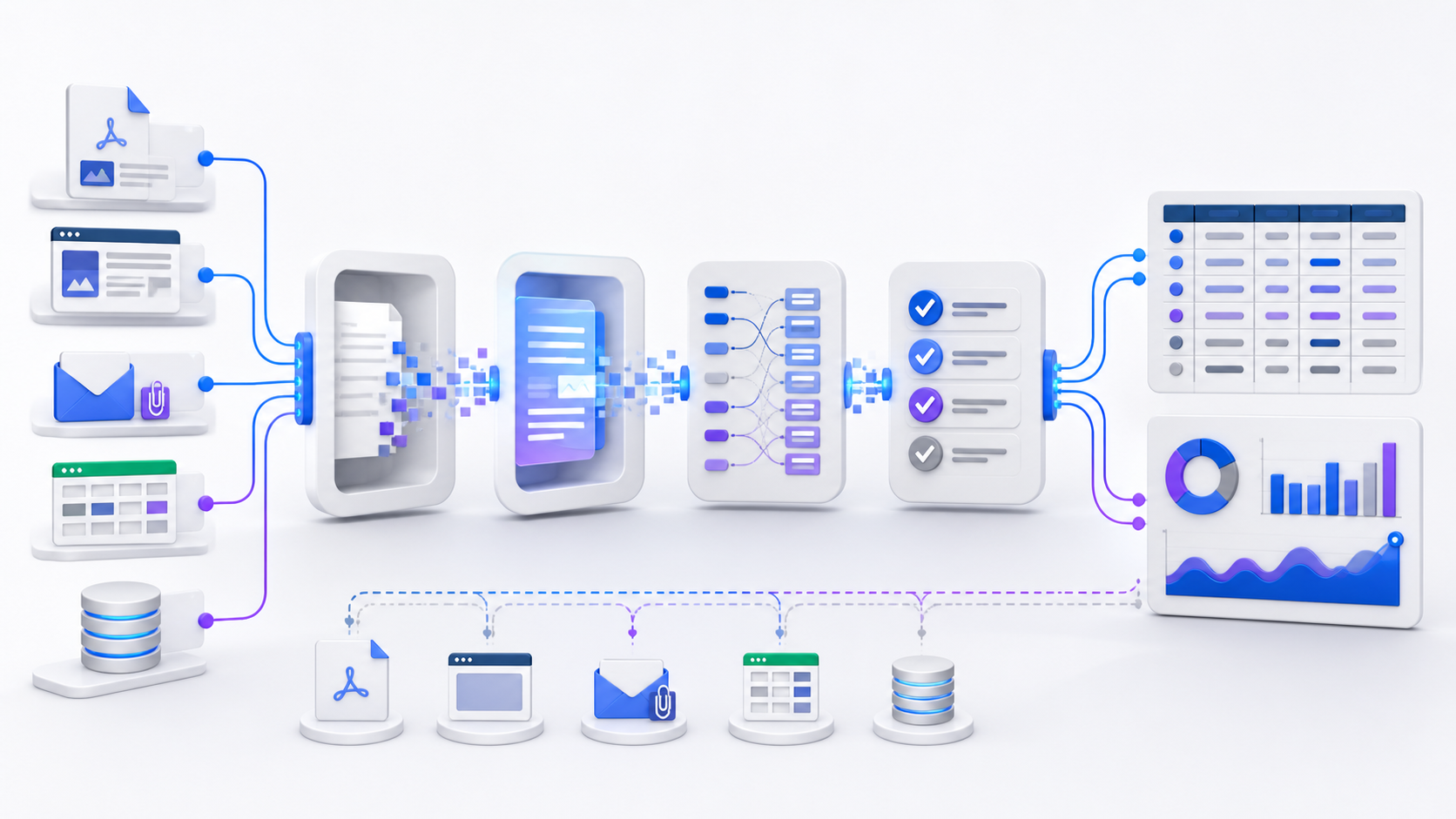
Automated data extraction maps selected fields from a file, page, or system into a named schema, then validates them. Automated data retrieval is the prior step: fetch or open the authorized source. Automatic data extraction is the same job as automated extraction. The goal is a usable record with provenance—not a chat that “read” a PDF.
自动化数据提取把文件、页面或系统中的选定字段写入已命名结构,然后校验。自动化数据取回是前一步:获取或打开授权来源。automatic data extraction 与 automated extraction 是同一件事。目标是带出处的可用记录,而不是“读过”一份 PDF 的对话。
A production workflow usually combines source ingestion, parsing or OCR, field identification, normalization, validation, exception routing, and delivery. Rules work well for stable layouts and APIs. Machine-learning or language-model methods can handle more variation, but they still need explicit schemas, test data, and guardrails. Human review is not a failure of automation; it is a control for ambiguous or expensive errors.
生产级流程通常包含来源接入、解析或 OCR、字段识别、标准化、校验、异常路由和结果交付。规则适合稳定版式与 API;机器学习或语言模型方法可以处理更多变化,但仍然需要明确的目标结构、测试数据和约束。人工复核并不意味着自动化失败,而是用于控制歧义以及高成本错误。
Retrieval vs Extraction取回与提取
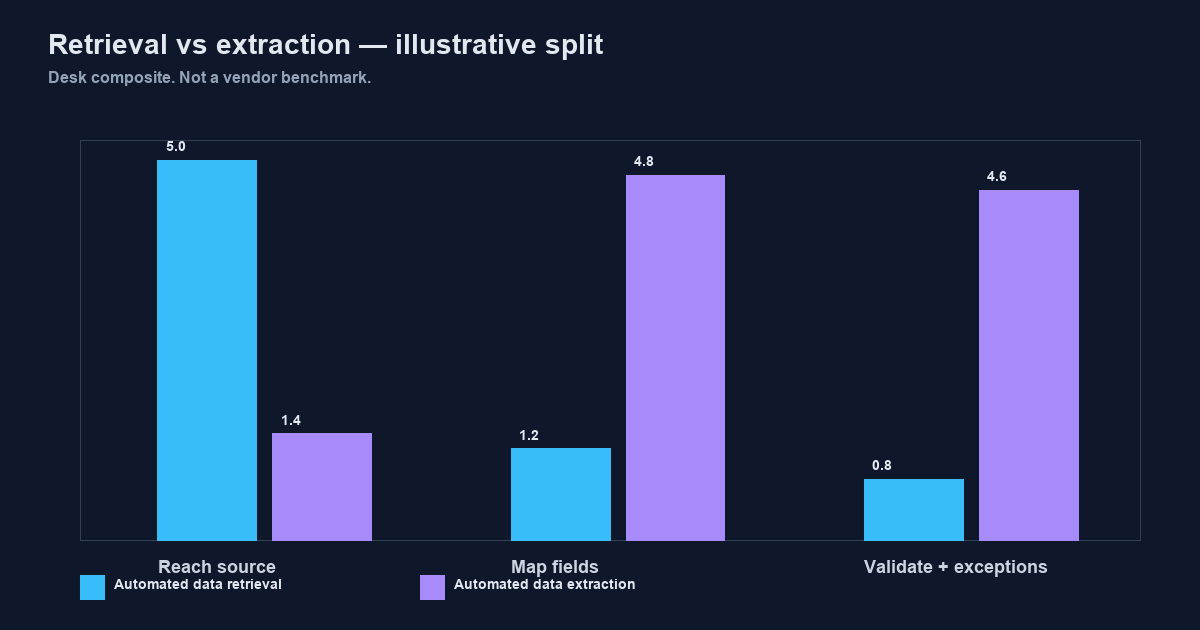
If retrieval fails, extraction never starts. If extraction skips retrieval design, teams paste dumps into a model and call it a pipeline. Prefer official APIs and granted connectors. The W3C PROV overview is the vocabulary for “where this value came from.” Access and retention still follow NIST SP 800-53 Rev. 5 when records are sensitive.
取回失败时,提取不会开始。若跳过取回设计,团队只会把整包粘贴进模型并称之为流水线。优先使用官方 API 和已授权连接器。W3C PROV 概览用来记录“这个值从哪来”。敏感记录的访问与保留仍应对照 NIST SP 800-53 Rev. 5。
| Step | Question | Output |
|---|---|---|
| 步骤 | 要回答的问题 | 产出 |
| Automated data retrieval | Can we reach the authorized source? | File, API payload, query result, or mailbox object—still raw |
| 自动化数据取回 | 能否到达授权来源? | 文件、API 载荷、查询结果或邮箱对象——仍是原始物 |
| Automated data extraction | Which fields belong in the schema? | Typed columns plus provenance and exceptions |
| 自动化数据提取 | 哪些字段属于目标结构? | 带类型的列,外加出处和异常 |
Inputs and Prerequisites Before You Extract开始提取前需要准备什么
The strongest predictor of automated data extraction success is not the model name; it is whether the team defines the output before choosing the extractor. Create a field dictionary that names each field, type, allowed values, null policy, units, date format, source location, and business owner. Add examples of valid, invalid, and genuinely ambiguous values. If two reviewers interpret a field differently, automation will inherit that disagreement.
决定成功的关键通常不是模型名称,而是团队能否在选择提取器之前定义清楚输出。应建立字段字典,记录字段名称、类型、允许值、空值规则、单位、日期格式、来源位置和业务负责人,并加入有效、无效和确实存在歧义的示例。如果两位复核人员对同一字段理解不同,自动化也会继承这种分歧。
- Representative samples: include clean, noisy, scanned, multilingual, long, short, and previously failed inputs—not only the easiest examples.
- Access and permission: document credentials, rate limits, terms of use, retention, and whether personal or regulated data is present.
- Target schema: define stable field names and types before extraction. Version the schema when changes are unavoidable.
- Ground truth: label a test set separately from the development samples so quality claims can be checked honestly.
- Delivery contract: decide whether the output is JSON, CSV, a database table, or an API event and how retries and duplicates are handled.
- 代表性样本:同时包含清晰、模糊、扫描、多语言、长、短以及历史失败样本,而不是只挑最容易的材料。
- 访问与许可:记录凭证、速率限制、使用条款、保留期限,以及是否包含个人信息或受监管数据。
- 目标结构:提取前先确定稳定的字段名和数据类型;必须变更时,为结构建立版本。
- 标准答案:把独立测试集与开发样本分开标注,确保质量结论能够被诚实验证。
- 交付契约:确定输出是 JSON、CSV、数据库表还是 API 事件,并说明重试和重复记录的处理方式。
A Repeatable Automated Data Extraction Workflow可重复执行的自动化数据提取流程
Use this sequence for automated data extraction after retrieval succeeds. Skip a step and the record will look complete while provenance or exceptions go missing.
取回成功后再按此顺序做自动化数据提取。跳过任一步,记录看起来完整,出处或异常却会丢失。
- Define the record and acceptance rules定义记录与验收规则Write the schema, required fields, data types, permissible ranges, uniqueness keys, and conditions that trigger review. Separate “unknown” from a true zero or empty value.写清目标结构、必填字段、数据类型、允许范围、唯一键以及触发复核的条件。必须区分“未知”与真正的零值或空值。
- Inventory sources (retrieval)盘点来源(取回)This is automated data retrieval: group inputs by access method—database/API, HTML, digital document, scan, email, or export. Name an owner and refresh cadence. If you cannot name the host and the grant, you are not retrieving.这一步就是自动化数据取回:按访问方式分组——数据库/API、HTML、数字文档、扫描件、邮件或导出。写明负责人和刷新频率。说不出主机和授权,就还没有取回。
- Choose the least complex extraction method that works选择足够有效且最简单的方法Prefer database queries or official APIs for structured systems, DOM parsing for stable HTML, deterministic parsers for machine-readable files, OCR for scanned text, and learned extraction only where variation defeats rules.结构化系统优先使用数据库查询或官方 API;稳定 HTML 使用 DOM 解析;机器可读文件使用确定性解析器;扫描文本使用 OCR;只有变化超出规则能力时才采用学习型提取。
- Normalize without hiding the source标准化但保留原始来源Convert dates, currencies, units, identifiers, and enumerations to canonical forms. Preserve the raw value, source location, file hash or record ID, extraction time, and extractor version beside the normalized value.把日期、货币、单位、标识符和枚举值转换为标准形式,同时保留原始值、来源位置、文件哈希或记录 ID、提取时间与提取器版本。
- Validate at field, record, and batch level在字段、记录和批次层面校验Check type, format, range, referential integrity, totals, duplicates, and cross-field logic. Confidence alone is not validation; business rules and reconciliation provide independent evidence.检查类型、格式、范围、引用完整性、合计、重复以及跨字段逻辑。置信度本身不等于校验;业务规则和对账才能提供独立证据。
- Route exceptions with context携带上下文路由异常Send reviewers the source excerpt, proposed value, failed rule, and available alternatives. Capture the correction as feedback, but review it before using it to change rules or models.向复核人员展示来源片段、建议值、失败规则和候选值。记录修正结果作为反馈,但在修改规则或模型前仍要审核。
- Deliver idempotently and monitor drift幂等交付并监控漂移Use stable keys so retries do not create duplicates. Monitor completeness, error categories, review rates, latency, and source-layout changes. Keep a rollback path for schema or extractor updates.使用稳定键,避免重试产生重复数据;持续监控完整率、错误类型、复核比例、延迟和来源版式变化,并为结构或提取器更新保留回滚路径。
Compare Automated Data Extraction Methods自动化数据提取方法对比
| Method | Best for | Strength | Main limitation |
|---|---|---|---|
| 方法 | 最适合 | 优势 | 主要限制 |
| Database query or API | Structured operational systems | Typed fields, explicit contracts, efficient incremental loads | Requires permission, schema knowledge, and change management |
| 数据库查询或 API | 结构化业务系统 | 字段类型明确、契约清晰、增量获取高效 | 需要权限、结构知识和变更管理 |
| File or DOM parser | Stable CSV, JSON, XML, HTML, or digital PDFs | Deterministic, testable, and often inexpensive | Breaks when layouts or markup change unexpectedly |
| 文件或 DOM 解析器 | 稳定的 CSV、JSON、XML、HTML 或数字 PDF | 结果确定、易测试、通常成本较低 | 版式或标记变化时容易失效 |
| OCR plus rules | Scans with repeated templates | Turns image text into searchable content and applies known anchors | Image quality and reading order can cause compounding errors |
| OCR 加规则 | 模板重复的扫描件 | 把图像文字转成可搜索内容,并利用固定锚点 | 图像质量与阅读顺序可能造成误差叠加 |
| ML or language-model extraction | Variable semi-structured documents | Handles semantic variation and implicit labels | Needs labeled evaluation, constraints, and careful cost control |
| 机器学习或语言模型提取 | 变化较大的半结构化文档 | 能够处理语义变化和隐含标签 | 需要标注评估、约束和谨慎的成本控制 |
| Human-in-the-loop hybrid | High-risk or ambiguous fields | Balances throughput with accountable review | Requires queue design, reviewer guidance, and feedback governance |
| 人机协作混合流程 | 高风险或存在歧义的字段 | 兼顾处理量与可问责复核 | 需要队列设计、复核规范和反馈治理 |
Choose per source class, not once for the entire organization. A single automated data extraction workflow may query a database, parse an attached spreadsheet, use OCR on a scanned signature page, and request review only for mismatched totals. Combining methods is often safer than forcing every input through the most sophisticated component.
方法应按来源类别选择,而不是全公司只选一次。一个流程可以同时查询数据库、解析附件表格、对扫描签字页运行 OCR,并且只在合计不一致时请求复核。组合多种方法通常比强制所有输入都经过最复杂的组件更安全。
Example: Automating Invoice Data Extraction示例:自动化提取发票数据
Consider a hypothetical accounts-payable team receiving digital PDFs, scans, and emailed spreadsheets. The automated data extraction target record includes supplier ID, invoice number, issue date, currency, net amount, tax, gross amount, purchase-order number, and line items. The example numbers below are illustrative; they are not a performance claim for any product.
假设某应付账款团队持续收到数字 PDF、扫描件和邮件表格。目标记录包含供应商 ID、发票号、开票日期、币种、未税金额、税额、含税总额、采购订单号和行项目。以下数字仅用于说明流程,不代表任何产品的性能承诺。
Illustrative decision path: a digital PDF parser reads embedded text; OCR handles image-only pages; supplier ID is resolved against the vendor master; invoice number plus supplier ID forms a duplicate key; net plus tax must equal gross within the documented rounding tolerance. Any mismatch, unknown supplier, or low-quality scan enters review. Approved records are delivered only after the batch total reconciles with the source manifest.
示例决策路径:数字 PDF 使用嵌入文本解析,纯图像页面使用 OCR;供应商 ID 与供应商主数据匹配;供应商 ID 加发票号组成重复检测键;未税金额加税额必须在规定舍入容差内等于含税总额。任何不一致、未知供应商或低质量扫描件都进入复核。只有批次总数与来源清单对账成功后,已批准记录才会交付。
How to Validate Automated Data Extraction Results如何验证自动化数据提取结果
Do not collapse automated data extraction quality into one accuracy percentage. A record can be 99% complete while the missing 1% contains the payment amount. Evaluate by field and risk tier on a representative, independently labeled set. For fields that may have multiple values, measure precision and recall; for exact identifiers, use exact-match rate; for numeric fields, add tolerance-aware error and reconciliation checks.
不要把质量压缩成一个准确率。记录即使完整度达到 99%,缺失的 1% 也可能正好是付款金额。应在具有代表性、独立标注的测试集上,按字段和风险等级评估。多值字段使用精确率与召回率;标识符使用完全匹配率;数值字段还要加入容差误差和对账规则。
| Check | Question answered | Useful signal |
|---|---|---|
| 检查 | 回答的问题 | 有用信号 |
| Field correctness | Was the right value captured? | Exact match, precision, recall, numeric error |
| 字段正确性 | 是否提取了正确的值? | 完全匹配、精确率、召回率、数值误差 |
| Completeness | Were required fields populated? | Missing rate by field and source class |
| 完整性 | 必填字段是否都有值? | 按字段和来源类别统计缺失率 |
| Consistency | Do related values agree? | Cross-field rules, totals, reference matches |
| 一致性 | 相关数值是否相互吻合? | 跨字段规则、合计、参考数据匹配 |
| Operational quality | Can the workflow run reliably? | Latency, retries, duplicate rate, queue age |
| 运行质量 | 流程是否能稳定运行? | 延迟、重试、重复率、队列等待时间 |
| Drift | Has the input changed? | New layouts, value distributions, review reasons |
| 漂移 | 输入是否发生变化? | 新版式、数值分布、复核原因 |
Set acceptance thresholds before seeing final test results. Re-run the same automated data extraction benchmark after every material parser, prompt, model, OCR engine, or schema change. Keep false positives and false negatives separate because their business costs differ. Finally, sample accepted records—not only rejected ones—so silent errors remain discoverable.
验收阈值应在看到最终测试结果之前确定。解析器、提示、模型、OCR 引擎或结构发生实质变化后,都要重新运行同一基准测试。误报与漏报必须分开统计,因为业务成本不同。最后还应抽检已通过记录,而不只检查被拒记录,以便发现静默错误。
Common Mistakes, Limits, and Risk Controls常见错误、局限与风险控制
These failures show up after automated data extraction looks “done.” Fix the contract before you scale the extractor.
这些问题往往出现在自动化数据提取看似“做完”之后。先修好契约,再扩大提取器。
- Automating before defining the schema: produces plausible but inconsistent columns. Fix the field contract first.
- Treating OCR text as final data: OCR recognizes characters; it does not guarantee field identity, units, or business validity.
- Testing only clean samples: hides rotation, handwriting, compressed images, missing pages, and unusual layouts.
- Using confidence as the only gate: confidence may be poorly calibrated. Combine it with deterministic validation and spot checks.
- Dropping provenance: makes disputes and audits expensive. Preserve source IDs, locations, versions, and raw values.
- Ignoring duplicates and retries: turns a reliable extractor into an unreliable pipeline. Design idempotency at delivery.
- Scraping without authority: can violate access controls, contracts, privacy duties, or site terms. Prefer official APIs and approved sources.
- Sending sensitive data to an unapproved service: assess data residency, retention, encryption, access, and deletion before processing.
- 未定义结构就开始自动化:会产生看似合理但并不一致的列。应先固定字段契约。
- 把 OCR 文本当成最终数据:OCR 只能识别字符,不能保证字段身份、单位和业务有效性。
- 只测试干净样本:会掩盖旋转、手写、图像压缩、缺页和异常版式问题。
- 只用置信度作为门槛:置信度可能校准不佳,必须结合确定性校验和抽检。
- 丢弃来源信息:会让争议处理和审计代价高昂。应保留来源 ID、位置、版本和原始值。
- 忽略重复与重试:会让可靠的提取器变成不可靠的流水线。交付环节必须设计幂等性。
- 未经授权抓取:可能违反访问控制、合同、隐私义务或站点条款。优先使用官方 API 和获批来源。
- 把敏感数据发送给未批准服务:处理前应评估数据驻留、保留、加密、访问和删除机制。
Move From Extracted Records to Analysis从提取记录进入数据分析
Prepare a validated CSV, spreadsheet, database connection, or other supported data source with stable field names and documented units. Then use InfiniSynapse to explore and analyze the structured result. Automated data extraction quality still needs to be established upstream; the analysis step should not be used to conceal missing provenance or unresolved validation failures.
请先准备经过校验的 CSV、电子表格、数据库连接或其他受支持的数据源,确保字段名稳定、单位有说明。随后可使用 InfiniSynapse 探索和分析结构化结果。提取质量仍需在上游得到确认;分析步骤不能用于掩盖来源缺失或尚未解决的校验失败。
Open InfiniSynapse online打开 InfiniSynapse 在线版Implementation Checklist and Next Steps实施检查清单与下一步
Ship automated data extraction on one source family first. A company-wide launch hides which step failed: retrieval, mapping, or review.
先在一个来源族上交付自动化数据提取。全公司铺开时,分不清失败发生在取回、映射还是复核。
- Choose one recurring source family and one business outcome; avoid a company-wide launch as the first experiment.
- Write the schema, validation rules, provenance fields, and review policy before selecting technology.
- Build a representative labeled test set and freeze a separate acceptance set.
- Implement the simplest method per source type and retain raw evidence beside normalized values.
- Measure field-level quality, reconciliation, review load, duplicates, and latency under realistic volume.
- Run a shadow period in which automated output is compared with the existing process before it triggers downstream actions.
- Assign owners for source changes, schema versions, incident response, reviewer guidance, and periodic re-evaluation.
- 选择一个重复出现的来源类别和一个业务结果,第一次试验不要直接覆盖全公司。
- 在选择技术之前写清结构、校验规则、来源字段和复核政策。
- 建立代表性标注测试集,并冻结一份独立验收集。
- 对每种来源实施足够简单的方法,并在标准化值旁保留原始证据。
- 在真实数据量下衡量字段质量、对账结果、复核负担、重复率和延迟。
- 先运行影子期,把自动化输出与现有流程对比,再允许结果触发下游动作。
- 明确来源变更、结构版本、事故响应、复核规范和定期重评的负责人。
Frequently Asked Questions常见问题
It is a repeatable process that captures selected fields, maps them to a schema, validates the result, and routes exceptions. That is also what people mean by automatic data extraction.
它是一套可重复流程:捕获选定字段、写入结构、校验结果并路由异常。automatic data extraction 指的是同一件事。
Automated data retrieval fetches or opens the authorized source. Extraction starts after the bytes are in hand. If you cannot name the host and the grant, you are not retrieving—you are hoping a paste works.
自动化数据取回是获取或打开授权来源。提取从字节到手之后才开始。说不出主机和授权,就还不是取回,只是指望粘贴能用。
Define the target schema and acceptance rules, inventory sources, choose a method per format, normalize output, validate records, review exceptions, deliver idempotently, and monitor drift. That is the operational path for automated data extraction.
先定义目标结构和验收规则,再盘点来源、按格式选择方法、标准化输出、校验记录、复核异常、幂等交付并监控漂移。
No. OCR turns images of text into machine-readable text. Automated data extraction additionally identifies fields, maps them to a schema, validates values, handles exceptions, and delivers records.
不等同。OCR 把文字图像转换为机器可读文本;完整提取还要识别字段、映射结构、校验数值、处理异常并交付记录。
It depends on source quality, layout variation, field definitions, method, and validation design. Measure field-level precision and recall on a representative labeled set rather than trusting one headline number.
准确性取决于来源质量、版式差异、字段定义、方法与校验设计。应在代表性标注集上衡量字段级精确率和召回率,而不是相信一个总数字。
Review low-confidence values, failed business rules, novel layouts, high-risk fields, and any record whose potential error cost is greater than the cost of review.
低置信度值、业务规则失败、新版式、高风险字段,以及潜在错误成本高于复核成本的记录,都应进行人工复核。
Official Sources and Further Reading权威来源与延伸阅读
Use vendor docs for parsers. Use W3C PROV and NIST for provenance and access after automated data extraction writes the row.
解析器用厂商文档。写入行之后的出处与访问,用 W3C PROV 和 NIST。
- AWS documentation: What is Amazon Textract? explains OCR and document-analysis concepts, including text, forms, and tables.
- Google Cloud Document AI overview describes document processors and structured document output.
- W3C PROV overview provides a standard model for representing data provenance.
- NIST SP 800-53 Rev. 5 catalogs security and privacy controls relevant to systems that process sensitive information.
- AWS:Amazon Textract 简介说明 OCR 与文档分析中的文本、表单和表格概念。
- Google Cloud Document AI 概览介绍文档处理器和结构化文档输出。
- W3C PROV 概览提供表示数据来源关系的标准模型。
- NIST SP 800-53 Rev. 5汇总了处理敏感信息系统可参考的安全与隐私控制。