
What Is Intelligent Document Automation?什么是智能文档自动化?
For the full topic map, continue with the unstructured data processing and document intelligence guide. Physical capture stays on document digitization. Classification stays on document classification. Field mapping stays on automated data extraction. Ungated pipelines stay on automated document processing.
完整主题图见非结构化数据处理与文档智能指南。实物捕获见document digitization。分类见document classification。字段写入见automated data extraction。无门控流水线见automated document processing。
Intelligent document automation is a controlled workflow that uses AI-assisted document understanding to classify variable files, extract required information with source evidence, validate uncertainty and connect approved results to human or system actions. The intelligence layer may include machine learning, computer vision, language models or specialized document models, but accountability remains in the surrounding contract, policy, review and audit trail.
智能文档自动化是一套受控工作流:使用AI辅助文档理解对变化的文件进行分类,连同来源证据提取所需信息,校验不确定性,并把获批结果连接到人工或系统动作。智能层可以包含机器学习、计算机视觉、语言模型或专用文档模型,但责任仍存在于周边的契约、策略、复核与审计记录中。
It is not a synonym for “let an AI read everything and act alone.” A usable system identifies which content is observed, which value is inferred, where the evidence appears, which model and prompt produced the result, which deterministic checks passed, and who or what approved the next action. Unknown and unsupported cases are valid outcomes, not inconvenient errors to hide.
它不等于“让AI读取所有内容并独自行动”。可用系统会识别哪些内容是观察所得、哪些值属于推断、证据出现在哪里、哪个模型和Prompt产生结果、哪些确定性检查已经通过,以及由谁或哪个系统批准下一动作。未知和不受支持案例是有效结果,不是应被隐藏的不便错误。
Quick answer: start with one document family and one bounded business decision. Define a typed output schema, evidence requirements, error costs and prohibited actions. Compare rules, specialized models and generative AI on an authorized frozen corpus. Calibrate by document, field and risk slice; send ambiguous or consequential cases to evidence-linked review; release in shadow mode; and expand straight-through action only after downstream outcomes remain correct.
快速回答:从一个文档家族和一个边界明确的业务决策开始。定义类型化输出模式、证据要求、错误成本与禁止动作;使用经授权的冻结语料比较规则、专用模型和生成式AI;按文档、字段与风险切片校准;把歧义或高影响案例送入关联证据的复核;先以影子模式发布;只有下游结果持续正确后才扩大直通动作。
IDA vs IDP vs OCRIDA、IDP 与 OCR
If you landed from an IDP vendor page, the stack is the same job until action. Intelligent document processing usually stops at capture, classify, extract, and validate. Intelligent document automation is that path plus rules, review, and a controlled write into a business system. OCR only makes characters readable. Official vocabulary for “what is IDP” is the Microsoft Power Automate IDP overview. Provenance language follows the W3C PROV overview. Sensitive access still follows NIST SP 800-53 Rev. 5.
若你从 IDP 厂商页进来,在动作之前栈是同一份工作。Intelligent document processing 通常停在采集、分类、提取、校验。Intelligent document automation 是这条路径再加上规则、复核和写入业务系统的受控动作。OCR 只让字符可读。官方对照见 Microsoft Power Automate 的 IDP 概述。出处用语见 W3C PROV 概览。敏感访问仍对照 NIST SP 800-53 Rev. 5。
| Label名称 | Output产出 | Stops at停在哪 |
|---|---|---|
| OCR | Readable characters可读字符 | No field and no action yet还没有字段或动作 |
| Intelligent document processing智能文档处理 | Class + extracted fields + validation分类 + 提取字段 + 校验 | A structured record结构化记录 |
| Intelligent document automation智能文档自动化 | All of the above plus rules, review, and a controlled action以上全部,外加规则、复核和受控动作 | A step in a business system业务系统里的一步 |
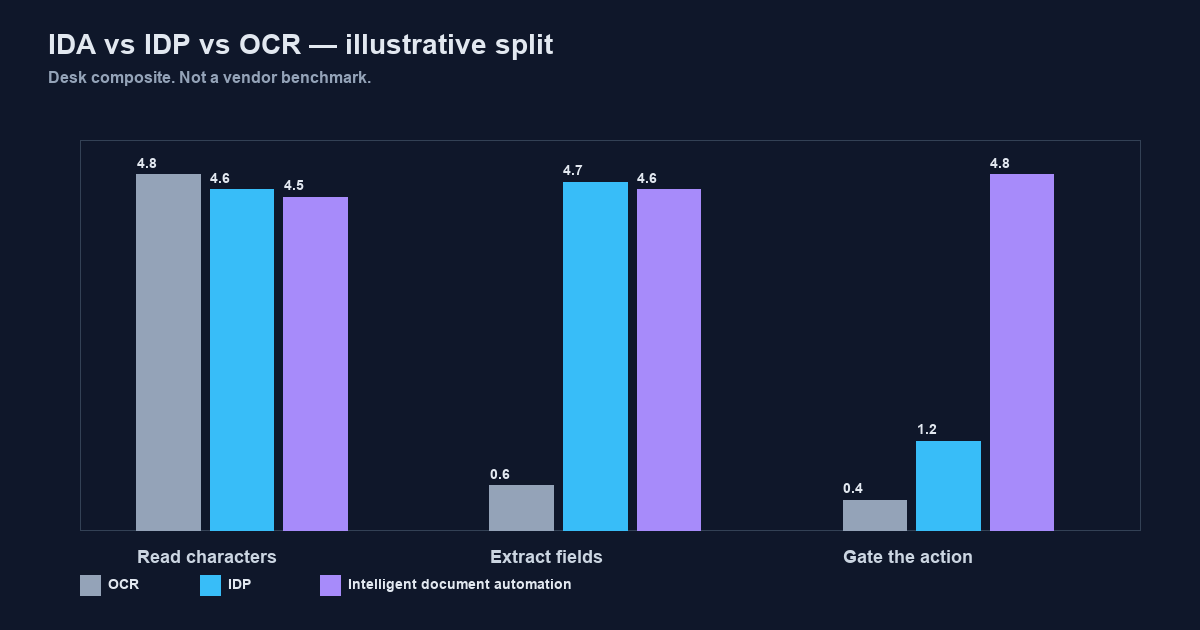
Use intelligent document automation when the next step writes money, rights, or a system of record. Score the interfaces, not the SKU: intelligent document automation is capture plus gates, not a second OCR product.
当下一步会写入资金、权利或系统记录时,用 intelligent document automation。评接口不评 SKU:智能文档自动化是采集加门控,不是第二个 OCR 产品。
Five Layers of Intelligent Document Automation智能文档自动化的五个层级
Preserve the original, recover native structure or OCR, split packets and record quality signals.保留原件,恢复原生结构或OCR,拆分文档包并记录质量信号。
Classify documents and extract typed values, tables and relationships with precise evidence.对文档分类,提取类型化值、表格与关系,并提供精确证据。
Apply schema, cross-field, reference and policy checks; combine uncertainty with business risk.应用模式、跨字段、参考与策略检查,把不确定性与业务风险结合。
Route approved outcomes, create accountable review tasks or stop safely without losing state.路由获批结果,创建责任明确的复核任务,或在不丢失状态的情况下安全停止。
Analyze corrections and drift, then improve labels, rules, prompts or models through versioned change.分析修正与漂移,再通过版本化变更改进标签、规则、Prompt或模型。
Identity, permissions, versions, logs, retention, cost, monitoring and rollback span every layer.身份、权限、版本、日志、保留、成本、监控与回滚贯穿所有层级。
Keep these responsibilities separable even if one product provides several. Intelligent document automation still needs a replaceable model, a replaceable policy, and a replayable audit trail. Separation lets teams replace a model without rewriting business policy, change a review interface without corrupting evidence, and replay a prior input against a new version without pretending the original decision never occurred.
即使一个产品提供多个层级,也应保持这些责任可分离。这样团队可以替换模型而不重写业务策略,更改复核界面而不破坏证据,并使用新版本重放旧输入,而不会假装原始决策从未发生。
An End-to-End Intelligent Document Automation Workflow端到端智能文档自动化工作流
- 1. Register the authorized source.1. 登记经授权来源。 Assign identity, checksum, policy context and permissions before any model receives content.在任何模型接收内容前分配身份、校验和、策略上下文与权限。
- 2. Prepare without erasing evidence.2. 在不抹去证据的情况下准备内容。 Use native parsing where reliable, OCR page images where needed, and preserve originals plus controlled derivatives.可靠时使用原生解析,需要时对页面图像执行OCR,并保留原件与受控副本。
- 3. Separate and classify.3. 拆分并分类。 Split mixed packets, retain parent-child links and allow unknown, ambiguous and unsupported classes. The label, unknown path and class-level evaluation live on document classification.拆分混合文档包,保留父子关系,并允许未知、歧义和不受支持类别。标签、未知路径与逐类评估见文档分类。
- 4. Extract with grounding.4. 连同证据提取。 Return typed fields, tables and relationships together with raw values and exact source locations.返回类型化字段、表格和关系,同时附带原始值与精确来源位置。
- 5. Validate deterministically.5. 执行确定性校验。 Apply required-field, format, range, checksum, reference, cross-field and cross-document checks.应用必填字段、格式、范围、校验和、参考、跨字段与跨文档检查。
- 6. Apply risk-aware policy.6. 应用风险感知策略。 Combine evidence, model behavior, validation, permissions and consequence; confidence alone never grants approval.结合证据、模型行为、校验、权限与后果;置信度本身永远不授予批准。
- 7. Review or escalate exceptions.7. 复核或升级异常。 Give reviewers the source, proposal, failed checks, allowed actions and a route to an accountable expert.向复核人员提供来源、建议、失败检查、允许动作与通往责任专家的升级路径。
- 8. Execute a controlled action.8. 执行受控动作。 Use version and idempotency keys, least privilege, downstream validation and an acknowledgement before completion.使用版本与幂等键、最小权限、下游校验,并在完成前获得确认。
- 9. Monitor outcomes and govern learning.9. 监控结果并治理学习。 Measure drift, correction and business outcomes; improve only through approved data, tests, release and rollback.衡量漂移、修正与业务结果;只通过获批数据、测试、发布与回滚进行改进。
A Confidence Score Is Evidence About a Model, Not Permission to Act置信度是关于模型的证据,不是行动许可
Scores are meaningful only in the context of a processor version, output type, document distribution and evaluation procedure. A field score of 0.9 does not mean the business action is 90% safe, and scores from different models are not automatically comparable. Calibrate using independent labeled data and measure the outcomes at candidate thresholds.
分数只有放在处理器版本、输出类型、文档分布与评估过程的上下文中才有意义。字段分数0.9不表示业务动作有90%的安全性,不同模型的分数也不能自动比较。应使用独立标注数据进行校准,并衡量候选阈值下的结果。
Microsoft’s Document Intelligence transparency note recommends evaluating the real use case and using that pilot to estimate thresholds for straight-through processing or human review. Its numerical threshold is explicitly an example, not a universal setting. Add deterministic gates for impossible dates, invalid identifiers, inconsistent totals, missing evidence and prohibited actions; sample accepted cases so silent errors remain observable.
Microsoft的Document Intelligence透明度说明建议评估真实用例,并用试点结果估计直通处理或人工复核阈值。其中的数值阈值明确只是示例,不是通用设置。还应增加针对不可能日期、无效标识符、合计不一致、证据缺失与禁止动作的确定性门控,并对已接受案例抽样,使静默错误保持可见。
Design Human Review as a Decision System, Not a Failure Inbox把人工复核设计为决策系统,而不是失败收件箱
A generic queue that shows a confidence number forces reviewers to reconstruct the model’s work. A useful task shows the original document, highlighted source region, proposed class or value, raw and normalized forms, failed checks, policy reason and permitted decisions. The reviewer must be able to approve, correct, reject, defer or escalate without editing unrelated fields.
只显示置信度数字的通用队列会迫使复核人员重新完成模型工作。有效任务应展示原始文档、突出显示的来源区域、建议类别或值、原始与规范化形式、失败检查、策略理由与允许决策。复核人员应能批准、修正、拒绝、延期或升级,而不必编辑无关字段。
- Route by skill, language, document family, risk and data permission—not only first-in, first-out.按技能、语言、文档家族、风险与数据权限路由,而不只是先进先出。
- Record reviewer identity, timestamps, viewed evidence, decision, correction and reason.记录复核人身份、时间戳、查看的证据、决策、修正与原因。
- Measure queue age, agreement, correction type, repeat causes and post-review downstream errors.衡量队列年龄、一致性、修正类型、重复原因与复核后的下游错误。
- Do not feed corrections directly into production learning; curate, approve, version and retest them.不要把修正直接送入生产学习;应整理、批准、版本化并重新测试。
AWS documentation illustrates human-review activation using conditions such as missing keys or low confidence, while its current A2I page also notes that new-customer access closes on July 30, 2026. This is an important implementation lesson: review is an architectural responsibility, not a permanent assumption about one vendor service.
AWS文档展示了使用键缺失或低置信度等条件激活人工复核,同时其当前A2I页面也说明新客户访问将于2026年7月30日关闭。这带来重要实施经验:复核是一项架构责任,而不是对某个供应商服务永久可用的假设。
Use InfiniSynapse After Intelligent Automation Produces Approved Evidence在智能自动化生成获批证据后使用InfiniSynapse
Prepare rights-approved documents or validated outputs with stable identity, version, permissions and evidence location. InfiniSynapse’s public site presents multi-source and multimodal analysis across databases, documents, audio and video. It is relevant when approved document evidence needs analysis with related structured or multimodal sources.
准备权利已获批准的文档或经校验输出,并确保身份、版本、权限与证据位置稳定。InfiniSynapse公开网站展示跨数据库、文档、音频与视频的多源多模态分析能力。当获批文档证据需要与相关结构化或多模态来源共同分析时,它具有相关性。
Before opening the tool, confirm supported inputs, authorization, version, evidence integrity and review responsibility. Use InfiniSynapse for downstream analysis. Keep intake, OCR, classification, extraction, confidence policy, review queues, RPA and accountable record actions in their responsible systems.
打开工具前,请确认输入受支持、授权有效、版本与证据完整且复核责任明确。使用InfiniSynapse进行下游分析;接收、OCR、分类、提取、置信度策略、复核队列、RPA与需要明确责任的记录动作仍应保留在负责系统中。
Analyze approved data with InfiniSynapse使用InfiniSynapse分析获批数据Review the public InfiniSynapse capability description and verify current source, format, deployment and control support for the intended workload.
使用前请查看InfiniSynapse公开能力说明,并针对预期工作负载验证当前来源、格式、部署与控制支持。
Intelligent Document Automation FAQ智能文档自动化常见问题
What is intelligent document automation?
什么是智能文档自动化?
Intelligent document automation is a controlled document workflow in which AI-assisted components interpret variable content, produce evidence-linked classifications or extracted values, and hand those results to rules, human reviewers and business systems. Intelligence does not remove accountability: inputs, model versions, evidence, uncertainty, review decisions and final actions still need explicit control.
智能文档自动化是一套受控文档工作流:AI辅助组件解释变化的内容,生成关联来源证据的分类或提取值,再把结果交给规则、人工复核人员与业务系统。智能能力不会消除责任;输入、模型版本、证据、不确定性、复核决策与最终动作仍需明确控制。
Is intelligent document automation the same as intelligent document processing?
智能文档自动化等同于智能文档处理吗?
The terms overlap and vendors use them inconsistently. Intelligent document processing usually names the capture, classification, extraction and validation capability. Intelligent document automation emphasizes connecting those results to rules, review and controlled business actions. Treat the label as secondary; verify the actual interfaces, evidence, controls and operating responsibilities.
两者高度重叠,供应商使用方式并不一致。智能文档处理通常指接收、分类、提取和校验能力;智能文档自动化更强调把这些结果连接到规则、复核与受控业务动作。标签是次要的,应核实实际接口、证据、控制措施与运营责任。
How does intelligent document automation work?
智能文档自动化如何工作?
A workflow registers an authorized document, prepares its native content or page images, classifies the document, extracts required information with source evidence, validates the result against schema and business rules, and combines confidence with risk policy. Approved low-risk cases proceed; uncertain or high-impact cases go to review; every outcome is recorded, monitored and reconciled.
工作流登记经授权文档,准备原生内容或页面图像,执行文档分类,连同来源证据提取所需信息,再按照模式与业务规则校验结果,并把置信度与风险策略结合。获批的低风险案例继续执行;不确定或高影响案例进入复核;每个结果都被记录、监控和对账。
How is intelligent document automation different from OCR?
智能文档自动化与OCR有什么区别?
OCR recognizes characters in page images. Intelligent document automation uses OCR or native parsing as an input, then adds document separation, classification, contextual extraction, normalization, validation, decision policy, human review and downstream orchestration. OCR quality matters, but readable text alone does not establish that a business field or action is correct.
OCR识别页面图像中的字符。智能文档自动化把OCR或原生解析作为输入,并增加文档拆分、分类、上下文提取、规范化、校验、决策策略、人工复核与下游编排。OCR质量很重要,但文本可读本身不能证明业务字段或动作正确。
How should confidence thresholds be set for document AI?
文档AI的置信度阈值应如何设置?
Do not copy a universal threshold. Build a representative labeled test set, calibrate scores by model version, document family, field and risk slice, and compare the consequences of false acceptance, false rejection and review. Combine confidence with deterministic validation and policy. Keep a reject or review band, sample accepted cases and revise thresholds through approved change control.
不要复制一个通用阈值。使用有代表性的标注测试集,按模型版本、文档家族、字段和风险切片校准分数,并比较错误接受、错误拒绝与复核的后果。把置信度与确定性校验和策略结合,保留拒绝或复核区间,对已接受案例抽样,并通过获批变更控制调整阈值。
When is human review required in intelligent document automation?
智能文档自动化何时需要人工复核?
Human review is appropriate when evidence is missing or ambiguous, a required rule fails, the document or class is unknown, the action has material rights, safety, compliance or financial consequences, or policy explicitly requires approval. Reviewers need the source region, proposed value, failed checks, allowed actions and a recorded reason—not merely a low-confidence flag.
来源证据缺失或歧义、必需规则失败、文档或类别未知、动作对权利、安全、合规或财务产生重大影响,或者策略明确要求批准时,应进行人工复核。复核人员需要来源区域、建议值、失败检查、允许动作与记录的理由,而不只是一个低置信度标记。
How do you test intelligent document automation?
如何测试智能文档自动化?
Use an authorized frozen corpus that includes normal, rare, poor-quality, adversarial and out-of-scope cases. Measure classification and extraction by slice, business-rule outcomes, evidence fidelity, review load and downstream correctness. Test model and prompt changes, timeouts, duplicates, partial packets, permission failures, rollback, replay and drift before expanding straight-through processing.
使用经授权的冻结语料,覆盖正常、稀有、低质量、对抗性和超出范围案例。按切片衡量分类与提取、业务规则结果、证据忠实度、复核负载和下游正确性;在扩大直通处理前测试模型与Prompt变更、超时、重复、文档包缺页、权限失败、回滚、重放和漂移。
Can InfiniSynapse provide intelligent document automation?
InfiniSynapse能否提供智能文档自动化?
InfiniSynapse is publicly presented as a multi-source, multimodal analysis tool across databases, documents, audio and video. It can support analysis after documents or validated outputs are approved, but it should not be described as replacing intake, OCR, document classification, schema extraction, confidence gating, human review queues, RPA or accountable system-of-record actions.
InfiniSynapse公开定位为跨数据库、文档、音频与视频的多源多模态分析工具。文档或经校验输出获批后,它可以支持分析;但不能把它描述成替代接收、OCR、文档分类、模式提取、置信度门控、人工复核队列、RPA或需要明确责任的记录系统动作。
Official and First-Party Sources官方与第一方来源
- Microsoft Learn: choose document processing approaches by document structure and taskMicrosoft Learn:按文档结构与任务选择文档处理方法
- Microsoft Document Intelligence transparency note: evaluation, confidence and human reviewMicrosoft Document Intelligence透明度说明:评估、置信度与人工复核
- Microsoft reference architecture: document processing with human reviewMicrosoft参考架构:带人工复核的文档处理
- Google Cloud Document AI: precision, recall, F1 and test-set evaluationGoogle Cloud Document AI:精确率、召回率、F1与测试集评估
- Google Cloud Document AI: representative data, training and evaluationGoogle Cloud Document AI:代表性数据、训练与评估
- AWS: human review workflow conditions and current A2I availability noticeAWS:人工复核工作流条件与当前A2I可用性说明
- NIST AI Risk Management FrameworkNIST人工智能风险管理框架
- InfiniSynapse: public multi-source and multimodal analysis capabilitiesInfiniSynapse:公开的多源多模态分析能力
The official sources describe product-specific document models, evaluation, confidence, workflow and review behavior; NIST provides voluntary risk guidance. Verify the deployed version, region, limits, data terms and contract. This guide’s architecture, controls and hypothetical example are decision frameworks—not universal requirements, performance claims, customer results or a promise of autonomous operation.
上述官方来源说明特定产品的文档模型、评估、置信度、工作流与复核行为;NIST提供自愿性风险指南。应核实实际部署版本、区域、限制、数据条款与合同。本指南的架构、控制与假设示例属于决策框架,不是通用要求、性能声明、客户结果或自主运行承诺。