
Text analytics software, in one clear answer文本分析软件的快速回答
For the full topic map and the neighboring methods that support this workflow, continue with the unstructured data processing and document intelligence guide.
如需查看完整主题结构以及支撑本流程的相邻方法,请继续阅读非结构化数据处理与文档智能指南。
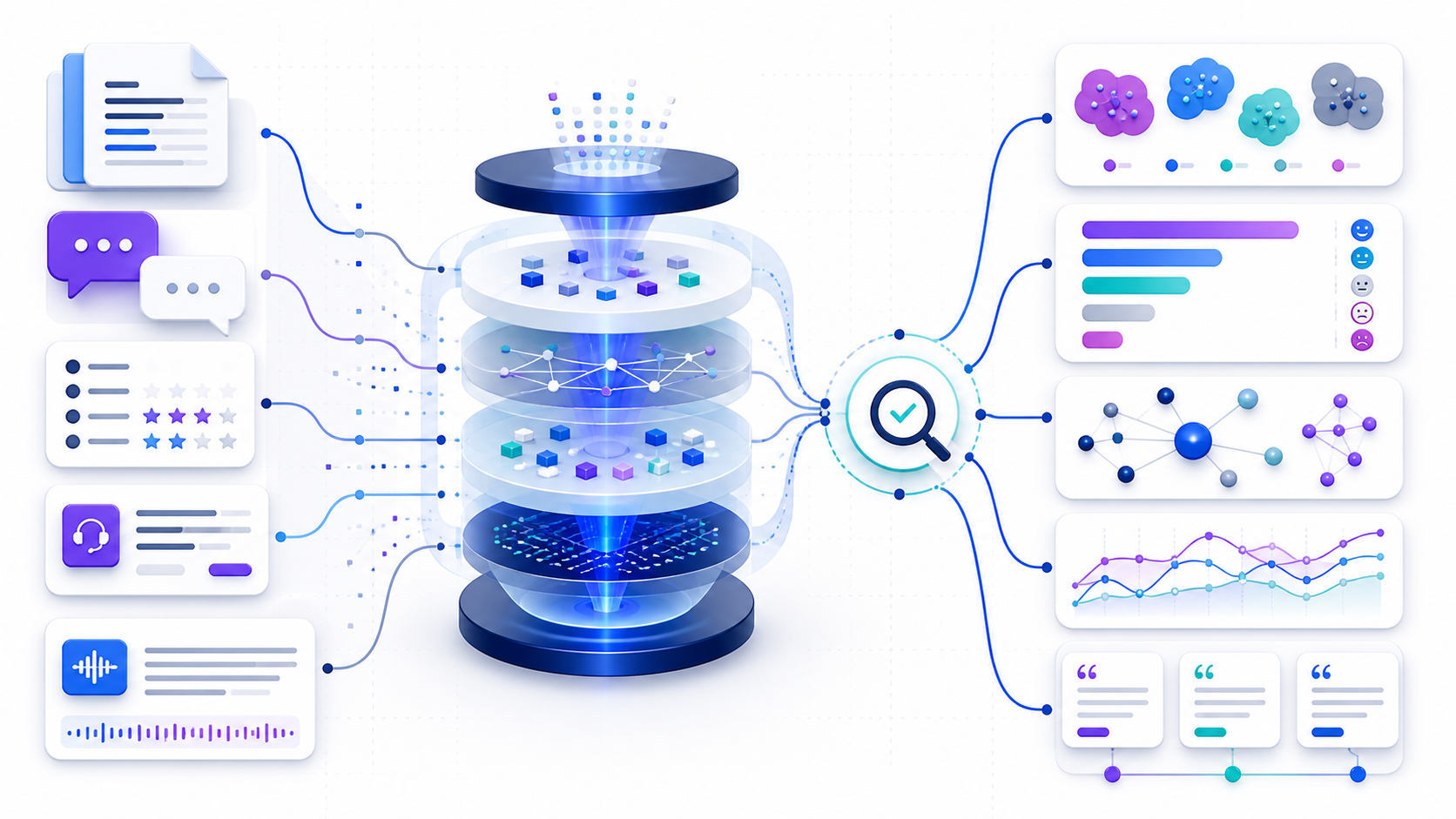
Text analytics software converts unstructured language into structured, reviewable evidence such as themes, categories, sentiment, entities, relationships, summaries, and trends. The useful product is not the one with the longest feature list. It is the one that accepts your real data, performs the exact task behind your decision, exposes source evidence, behaves consistently across important segments, and fits your security and operating constraints.
文本分析软件把非结构化语言转化为可复核的结构化证据,例如主题、类别、情感、实体、关系、摘要和趋势。真正有用的产品并不是功能列表最长的产品,而是能够接收你的真实数据、完成决策所需任务、展示源证据、在重要群体中保持一致,并符合安全与运营约束的产品。
Search results often use text analysis software, text mining software, and AI text analytics as near-synonyms. Keep them in one evaluation cluster unless you need a materially different product: qualitative research coding, social listening, a developer NLP API, enterprise search, or a customer-feedback suite each adds specialized workflows beyond generic text analysis.
搜索结果常把“文本分析软件”“文本挖掘软件”和“AI 文本分析”作为近义表达。除非你需要本质不同的产品类别,否则应在同一选型集群中评估它们。定性研究编码、社交聆听、开发者 NLP API、企业搜索和客户反馈套件都在通用文本分析之外加入了专门工作流。
Core text analytics software capabilities to compare选型时需要比较的文本分析软件核心能力
Capability names are not acceptance criteria. Convert each label into an observable input, output, and review action. For example, “theme discovery” should state whether themes are generated freely or mapped to a fixed taxonomy, whether one record can receive multiple themes, whether analysts can merge or rename them, and whether every aggregate links to the supporting excerpts.
能力名称本身不是验收标准。应把每个标签转化为可观察的输入、输出和复核动作。例如,“主题发现”需要说明主题是自由生成还是映射到固定分类体系,一条记录是否可以分配多个主题,分析师能否合并或重命名主题,以及每个汇总是否能链接到支持它的原文片段。
| Capability能力 | Useful output有用输出 | What to test测试重点 |
|---|---|---|
| Classification and coding分类与编码 | Stable labels, multi-label support, confidence or rationale, versioned taxonomy稳定标签、多标签支持、置信度或理由、版本化分类体系 | Precision and recall by class; unknown and overlapping cases各类别的精确率与召回率;未知和重叠案例 |
| Themes and topics主题与话题 | Coherent groups with counts, representative excerpts, and editable definitions带数量、代表性原文和可编辑定义的一致分组 | Theme stability, coverage, duplication, and evidence quality主题稳定性、覆盖率、重复和证据质量 |
| Sentiment and emotion情感与情绪 | Document-, sentence-, or aspect-level labels tied to source spans与原文范围关联的文档级、句子级或方面级标签 | Negation, mixed views, sarcasm, domain terms, and language variance否定、混合观点、反讽、领域术语和语言差异 |
| Entities and relationships实体与关系 | Normalized people, organizations, products, places, dates, and linked mentions规范化的人物、组织、产品、地点、日期及关联提及 | Boundary accuracy, aliases, ambiguous names, and custom entity types边界准确性、别名、歧义名称和自定义实体类型 |
| Summaries and questions摘要与问答 | Answer or summary with citations to the exact source evidence带精确源证据引用的回答或摘要 | Unsupported claims, omitted exceptions, citation accuracy, and refusal behavior无依据主张、遗漏例外、引用准确性和拒答行为 |
| Operations and governance运营与治理 | Connectors, exports, access controls, audit logs, retention settings, and monitoring连接器、导出、访问控制、审计日志、保留设置和监控 | Deletion, role boundaries, reproducibility, drift, recovery, and total effort删除、角色边界、可重复性、漂移、恢复和总工作量 |
A repeatable workflow for choosing text analytics software选择文本分析软件的可重复工作流
- Frame one decision and one task.限定一个决策和一个任务。 Start with “route urgent billing complaints” or “identify emerging onboarding themes,” not “understand all customer feedback.” Separate classification, discovery, extraction, retrieval, and summarization because each needs different evidence and metrics.从“分流紧急账单投诉”或“识别新出现的入门主题”开始,而不是“理解所有客户反馈”。分类、发现、提取、检索和摘要需要不同证据与指标,应分别处理。
- Create the representative test set.建立代表性测试集。 Sample across source, date, language, length, customer segment, and known edge cases. Remove accidental duplicates and preserve stable record IDs so results can be compared without exposing more data than necessary.按来源、日期、语言、长度、客户群体和已知边缘案例抽样。移除意外重复项并保留稳定记录 ID,使结果可比较且不暴露不必要的数据。
- Write the human reference.编写人工参考答案。 Have qualified reviewers label a subset using explicit definitions. Record disagreements instead of hiding them; low human agreement shows that the task or taxonomy needs clarification before software can be judged fairly.让合格复核者按照明确规则标注一个子集。记录而不是隐藏分歧;人工一致性低说明任务或分类体系需要先澄清,之后才能公平评估软件。
- Configure every candidate comparably.以可比方式配置每个候选产品。 Use the same data split, label definitions, prompt or rules, allowed context, and output schema. Document defaults and manual tuning time; a heavily customized result is not comparable to an out-of-box run without that context.使用相同的数据划分、标签定义、提示词或规则、允许上下文和输出结构。记录默认设置和人工调优时间;没有这些背景,高度定制结果不能与开箱结果直接比较。
- Score outputs and inspect errors.量化输出并检查错误。 Calculate task-appropriate metrics, then review examples behind every important error cluster. Aggregate accuracy can hide failures in a rare language, priority segment, long document, or newly introduced category.计算适合任务的指标,然后复核每个重要错误集群背后的示例。汇总准确率可能掩盖少数语言、优先群体、长文档或新类别中的失败。
- Test operations, not only model output.测试运营能力,而不只测试模型输出。 Re-run the same batch, change a taxonomy, delete a record, revoke a user, export evidence, and simulate a failed refresh. Measure setup, review, correction, and maintenance effort as well as license or usage cost.重新运行同一批次、修改分类体系、删除记录、撤销用户、导出证据并模拟刷新失败。除许可或使用成本外,还要衡量配置、复核、纠正和维护工作量。
- Define the acceptance and fallback rule.定义验收与回退规则。 Approve only the tasks and segments that meet the threshold. Route low-confidence, novel, sensitive, or high-impact cases to a person, and retain a manual or alternative process when the service is unavailable.只批准达到门槛的任务与群体。把低置信度、新颖、敏感或高影响案例交给人工,并在服务不可用时保留人工或替代流程。
How to choose text analytics software by product type如何按产品类型选择文本分析软件
The most important selection question is not “Which tool is best?” but “Which product shape matches the workflow we must own?” A packaged feedback platform shortens time to dashboards, while an NLP API gives engineers more control. Qualitative research software supports human coding and memos; a general analytical system may be better when text must be joined with operational or financial data.
最重要的选型问题不是“哪个工具最好”,而是“哪种产品形态匹配我们必须负责的工作流”。成套反馈平台可以更快形成仪表板,NLP API 则给工程团队更多控制;定性研究软件支持人工编码与备忘录;当文本需要与运营或财务数据联合时,通用分析系统可能更合适。
| Product type产品类型 | Best fit最适合 | Main trade-off主要权衡 |
|---|---|---|
| Customer feedback analytics suite客户反馈分析套件 | Surveys, reviews, tickets, themes, sentiment, dashboards, and CX workflows调查、评论、工单、主题、情感、仪表板和客户体验工作流 | Fast domain workflow; may be less flexible outside feedback data领域工作流快;超出反馈数据后可能不够灵活 |
| Qualitative research software定性研究软件 | Human coding, memos, codebooks, interviews, and defensible research trails人工编码、备忘录、编码本、访谈和可辩护研究轨迹 | Strong interpretation workflow; automation and production integration vary解释工作流强;自动化与生产集成能力不一 |
| NLP or LLM APINLP 或 LLM API | Custom applications, controlled schemas, event pipelines, and developer ownership定制应用、受控结构、事件管道和开发者负责的系统 | Maximum flexibility; team must build review, monitoring, security, and UI灵活性最高;团队需自建复核、监控、安全和界面 |
| Social listening platform社交聆听平台 | Public-channel collection, brand monitoring, influence, and campaign response公共渠道采集、品牌监测、影响力和活动响应 | Rich channel context; not a general private-document analysis system渠道背景丰富;并非通用私有文档分析系统 |
| General AI data analysis platform通用 AI 数据分析平台 | Questions that combine prepared text or documents with databases and other sources把已准备文本或文档与数据库及其他来源结合的问题 | Cross-source reasoning; verify whether specialized coding or sentiment features exist跨来源分析强;需要确认是否具备专门编码或情感功能 |
Example: evaluate support-ticket theme classification示例:评估客服工单主题分类
Consider a hypothetical software company that wants to route English and Chinese support tickets into billing, account access, performance, feature request, and other. The numbers below are an illustrative example, not an InfiniSynapse benchmark or a claim about any vendor.
假设一家软件公司希望把中英文客服工单分到计费、账户访问、性能、功能请求和其他类别。下面数字仅为假设示例,不是 InfiniSynapse 基准,也不是对任何厂商的性能主张。
The aggregate score passes, but error review finds that short Chinese tickets containing product nicknames are misrouted. The correct decision is not “software approved everywhere.” It is “approved for English and standard Chinese records, with a nickname dictionary and human review for short ambiguous tickets.” This narrower statement is operationally useful and auditable.
汇总分数通过,但错误复核发现,包含产品昵称的短中文工单经常被错误分流。正确决策不是“软件在所有场景获批”,而是“英文和标准中文记录获批;对产品昵称维护词典,并对简短歧义工单进行人工复核”。这种更窄的结论才具有运营价值且可审计。
How to validate text analytics results如何验证文本分析结果
Validation must follow the task. For classification, use a confusion matrix plus per-class precision, recall, and F1; for multi-label coding, define whether partial matches count. For entity extraction, measure both exact and relaxed span matching and whether normalization links aliases correctly. For themes, combine reviewer judgments of coherence and distinctness with coverage and stability across runs. For summaries or question answering, inspect factual support, completeness, citation accuracy, and handling of “not enough evidence.”
验证方式必须服从任务。分类应使用混淆矩阵以及各类别的精确率、召回率和 F1;多标签编码要定义部分匹配是否计分。实体提取既要测量严格与宽松范围匹配,也要检查规范化能否正确关联别名。主题发现应把复核者对连贯性和区分度的判断,与覆盖率和跨次运行稳定性结合。摘要或问答则要检查事实依据、完整性、引用准确性和“证据不足”处理。
- Slice before averaging: report by language, source, length, date, category, and consequence level.先分层再平均:按语言、来源、长度、日期、类别和后果等级报告。
- Inspect provenance: an analyst should move from a chart or theme to the exact records and excerpts supporting it.检查来源链:分析师应能从图表或主题回到支持它的精确记录和原文片段。
- Test repeatability: rerun a frozen input and configuration; record whether labels, themes, or citations change and whether versions are visible.测试可重复性:重新运行冻结的输入与配置,记录标签、主题或引用是否变化,以及版本是否可见。
- Monitor drift: compare new traffic with the test set and re-sample after product, policy, language, or channel changes.监测漂移:比较新流量与测试集,并在产品、政策、语言或渠道变化后重新抽样。
For governance, the NIST AI Risk Management Framework provides a voluntary structure for governing, mapping, measuring, and managing AI risk. Apply it in proportion to the consequence of the decision; a weekly topic summary and an automated compliance escalation do not need the same control depth.
在治理方面,NIST AI 风险管理框架提供了用于治理、映射、测量和管理 AI 风险的自愿性结构。控制深度应与决策后果相匹配;每周主题摘要与自动合规升级不应采用完全相同的控制强度。
Common text analytics failures and practical safeguards文本分析常见失败与实用防护措施
New products and issues no longer fit old labels. Version the taxonomy, allow “unknown,” and sample unmatched records instead of forcing every item into a familiar category.
新产品与问题不再适合旧标签。应版本化分类体系、允许“未知”,并抽样未匹配记录,而不是强迫每条内容进入熟悉类别。
A strong average hides weak performance for a language, customer tier, or rare risk. Require slice-level reporting and set stricter thresholds where errors cost more.
良好平均分可能掩盖某种语言、客户等级或少见风险中的低性能。应要求分层报告,并在错误代价更高处设定更严格门槛。
Fluent summaries can omit exceptions or add claims. Require source citations, inspect the cited span, and permit the system to state that evidence is insufficient.
流畅摘要可能遗漏例外或增加主张。应要求源引用、检查所引原文,并允许系统说明证据不足。
Text often contains identifiers and secrets that structured schemas would flag. Minimize collection, redact where appropriate, control roles, verify retention and deletion, and log exports.
文本常包含结构化 Schema 会标记的身份信息与秘密。应最小化采集、适当脱敏、控制角色、验证保留与删除,并记录导出。
Also check rate limits, maximum document size, supported file encodings, language identification, table or layout handling, audio transcription assumptions, and whether exports preserve stable IDs. If a product silently truncates long inputs or changes models without visible versions, an otherwise polished dashboard can become difficult to audit.
还要检查速率限制、最大文档大小、支持的文件编码、语言识别、表格或布局处理、音频转写前提,以及导出能否保留稳定 ID。如果产品静默截断长输入,或在版本不可见的情况下更换模型,即使仪表板精美,也会难以审计。
Move from prepared text evidence to joint analysis从已准备文本证据进入联合分析
Prepare readable documents or text records, stable IDs, clear permissions, and the business data you need to compare. InfiniSynapse is an AI data analyst for joint analysis across structured databases and documents, audio, or video; it is not described here as a dedicated sentiment API, social-listening collector, or qualitative coding suite. When your sources are ready, use the online application to investigate text evidence alongside connected data and review the returned support.
请先准备可读文档或文本记录、稳定 ID、明确权限,以及需要比较的业务数据。InfiniSynapse 是面向结构化数据库与文档、音频或视频联合分析的 AI 数据分析工具;本页不会把它描述成专用情感 API、社交聆听采集器或定性编码套件。数据源准备好后,可使用在线应用把文本证据与已连接数据一起分析,并复核返回的依据。
Open InfiniSynapse for document and data analysis打开 InfiniSynapse 进行文档与数据联合分析Frequently asked questions about text analytics software关于文本分析软件的常见问题
Text analytics software converts unstructured language into structured, reviewable evidence such as themes, categories, sentiment labels, entities, relationships, summaries, and trends, while preserving enough source context for people to verify the result.
文本分析软件把非结构化语言转化为主题、类别、情感标签、实体、关系、摘要和趋势等可复核的结构化证据,同时保留足够的源上下文,让人能够验证结果。
NLP is the broader set of computational methods for working with language. Text mining emphasizes discovering patterns in text collections. Text analytics applies those methods to a defined analytical question and decision workflow. In software searches, text analytics and text analysis are often close variants.
NLP 是处理语言的更广泛计算方法集合。文本挖掘强调从文本集合中发现模式。文本分析则把这些方法应用于明确的分析问题和决策工作流。在软件搜索中,text analytics 与 text analysis 通常是近义变体。
Build a representative gold set, define task-specific acceptance metrics, compare outputs at aggregate and record level, review disagreements by language and segment, test repeatability and traceability, and include privacy, security, integration, and total operating effort.
建立具有代表性的黄金样本,定义任务专用验收指标,在汇总和记录层比较输出,按语言与群体复核分歧,测试可重复性与可追溯性,并把隐私、安全、集成和总运营工作量纳入评估。
Not for every decision. Automation can screen, code, group, and prioritize large text collections, but ambiguous, novel, sensitive, or high-consequence findings still need human review and documented escalation rules.
不能取代所有决策中的人工复核。自动化可以初筛、编码、分组和排序大规模文本,但歧义、新颖、敏感或高后果的发现仍需要人工复核与有记录的升级规则。
InfiniSynapse is presented as an AI data analyst for joint analysis across structured data and documents, audio, or video. It can be a relevant next step when prepared text evidence must be analyzed with connected data, but this page does not claim it is a dedicated sentiment-scoring API or customer-feedback coding suite.
InfiniSynapse 定位为面向结构化数据与文档、音频或视频联合分析的 AI 数据分析工具。当已准备的文本证据需要与已连接数据一起分析时,它可以作为相关下一步;本页不会声称它是专用情感评分 API 或客户反馈编码套件。
Sources and verification references来源与验证参考
- NIST AI Risk Management Framework — voluntary guidance for governing, mapping, measuring, and managing AI risks.NIST AI 风险管理框架——用于治理、映射、测量和管理 AI 风险的自愿性指南。
- Unicode Text Segmentation specification — a primary technical reference for word, sentence, and grapheme boundary behavior across scripts.Unicode 文本分段规范——关于跨文字系统的词、句子和字素边界行为的一手技术参考。
- InfiniSynapse product page — source for the product description used in this guide.InfiniSynapse 产品页——本指南产品能力描述的来源。