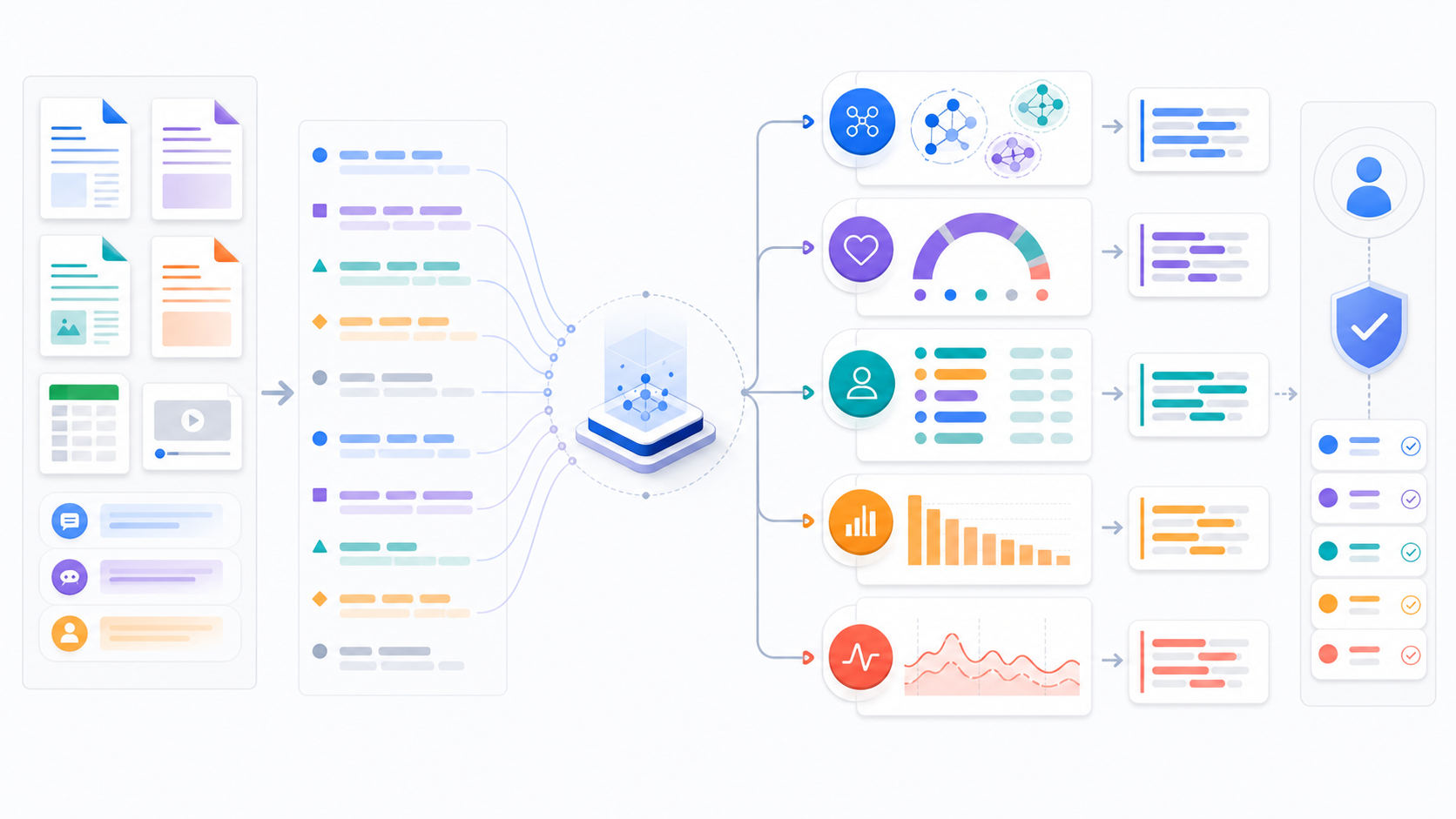
What text analysis software does文本分析软件能做什么
Place this specific workflow in context with the unstructured data processing and document intelligence guide. Span-level named entities belong on entity extraction tools.
可通过非结构化数据处理与文档智能指南理解本专题在整体流程中的位置。片段级命名实体见实体提取工具。
Text analysis software helps people turn unstructured language into organized, inspectable evidence. Depending on the product and method, it may support search, word or phrase frequency, manual and automatic classification, topic discovery, sentiment analysis, entity extraction, summarization, relationship analysis, or qualitative coding. The useful output is not merely a chart; it is a result that can be traced to source text and checked against a defined question.
文本分析软件帮助人们把非结构化语言转化为有组织、可检查的证据。具体产品与方法可能支持检索、词语或短语频率、人工与自动分类、主题发现、情感分析、实体提取、摘要、关系分析或定性编码。真正有用的输出不只是图表,而是能够追溯到源文本,并可依据明确问题进行核验的结果。
When text analysis software is useful—and when it is not文本分析软件何时适用、何时不适用
Text analysis is useful when the answer is distributed across enough language that reading every item repeatedly is slow or inconsistent. Common tasks include grouping support tickets, reviewing open-ended survey responses, comparing policy documents, finding recurring risks in incident notes, screening research abstracts, and connecting narrative evidence with structured measures.
当答案分散在大量语言材料中,逐条反复阅读既慢又容易不一致时,文本分析通常有价值。常见任务包括工单归类、开放式问卷分析、政策文件比较、事故记录中的重复风险识别、研究摘要筛选,以及把叙述证据与结构化指标连接起来。
Repeated, clearly defined questions; many comparable records; decisions that benefit from patterns plus source excerpts; work where humans can review uncertain cases.
问题重复且定义清晰;记录数量多且可比较;决策既需要总体模式也需要原文证据;团队能人工复核不确定案例。
A tiny corpus better read directly; decisions requiring facts absent from the text; unsupported languages or formats; fully automated high-stakes decisions without meaningful review.
语料很少、直接阅读更快;结论依赖文本中不存在的事实;语言或格式不受支持;没有有效人工复核的高风险全自动决策。
Software cannot repair a vague question, a biased sample, missing context, or inaccessible source material. A fluent summary can still omit minority views; a sentiment score can flatten sarcasm or mixed emotion; a topic model can produce unstable clusters. If the decision is consequential, preserve the source, document uncertainty, and keep a review path.
软件无法修复含糊问题、偏差样本、缺失上下文或不可访问的源材料。流畅摘要仍可能漏掉少数观点;情感分数可能压平讽刺或混合情绪;主题模型的聚类也可能不稳定。若决策影响重大,应保存原始材料、记录不确定性,并保留人工复核路径。
Text analytics, text mining, NLP, and qualitative coding compared文本分析、文本挖掘、NLP 与定性编码比较
These labels overlap, but the workflow differs. Choose the smallest method that answers the question. Exact search and rule-based classification are often easier to explain than a generative model; a generative approach can be more flexible when categories are not known in advance. Many reliable projects combine methods instead of treating them as rivals.
这些术语彼此重叠,但工作流程不同。应选择能够回答问题的最小方法。精确检索和规则分类往往比生成模型更容易解释;当类别无法预先确定时,生成式方法更灵活。可靠项目通常会组合方法,而不是把它们视为彼此替代。
| Method方法 | Best question适合回答 | Output输出 | Main caution主要注意点 |
|---|---|---|---|
| Search and frequency检索与频率 | Where and how often does a defined expression appear?某个明确表达在哪里出现、出现多少次? | Matches, counts, concordance匹配、计数、上下文索引 | Synonyms, negation, and context同义词、否定与上下文 |
| Classification分类 | Which known category applies?属于哪个已知类别? | Label and confidence标签与置信度 | Label definitions and class imbalance标签定义与类别不平衡 |
| Topic discovery主题发现 | What recurring themes may exist?可能存在哪些重复主题? | Clusters, topic descriptors, examples聚类、主题描述与示例 | Instability and subjective naming不稳定与主观命名 |
| Sentiment analysis情感分析 | What attitude is expressed toward a target?对目标表达了什么态度? | Polarity, emotion, or aspect labels极性、情绪或方面标签 | Sarcasm, mixed views, domain language讽刺、混合观点与领域语言 |
| Entity extraction实体提取 | Which people, organizations, products, or dates are mentioned?提到了哪些人物、组织、产品或日期? | Typed spans and normalized entities带类型片段与标准化实体 | Aliases, ambiguous names, boundary errors别名、歧义名称与边界错误 |
| Human qualitative coding人工定性编码 | How is meaning constructed in context?意义如何在语境中形成? | Codes, memos, interpretations, evidence编码、备忘录、解释与证据 | Time, consistency, and reflexivity时间、一致性与研究者反思 |
What to prepare before evaluating text analysis software评估文本分析软件前需要准备什么
Do not start with a feature checklist. Start with a decision, a representative corpus, and examples of acceptable output. Write one primary question such as “Which product issues recur in support tickets, and which source excerpts support each issue?” Then define the unit of analysis: entire document, message, paragraph, sentence, speaker turn, or extracted field.
不要从功能清单开始,而应从决策、代表性语料和合格输出示例开始。先写下一个主要问题,例如:“支持工单中反复出现哪些产品问题,每个问题有哪些原文片段支持?”然后定义分析单元:整篇文档、消息、段落、句子、说话轮次或提取字段。
- Representative inputs: include common records, difficult edge cases, short and long items, different periods, supported languages, and known failures.代表性输入:包含常见记录、困难边界案例、长短内容、不同时期、支持语言及已知失败样本。
- Ground truth: label a manageable sample with rules, examples, and an adjudication process for disagreements.基准答案:用明确规则和示例标注一组可管理样本,并规定分歧裁决流程。
- Operational constraints: document file types, volume, update frequency, retention, permissions, deployment, latency, and export needs.运行约束:记录文件类型、规模、更新频率、保留期限、权限、部署、延迟和导出需求。
- Success criteria: specify acceptable error, evidence traceability, reviewer time, and the decision that follows the output.成功标准:明确可接受错误、证据可追溯性、复核时间及输出将支持的具体决策。
PDF warning: a PDF container is not proof of usable text. Image-only scans need OCR. Multi-column pages, tables, headers, footnotes, and reading order can still be wrong after extraction. Test the hardest files, not only clean samples.
PDF 注意:PDF 容器并不意味着文本可直接使用。纯扫描件需要 OCR;多栏页面、表格、页眉、脚注和阅读顺序在提取后仍可能出错。应测试最困难文件,而不只是干净样本。
How to choose text analysis software如何选择文本分析软件
Use a task-based proof of concept. Give each candidate the same frozen input set, expected outputs, reviewer instructions, and time budget. Separate observed results from vendor claims. A polished demo on curated text says little about your abbreviations, languages, OCR noise, privacy rules, or edge cases.
采用基于任务的概念验证。给每个候选工具相同的冻结输入集、预期输出、复核说明和时间预算,并将实际观察与供应商声明分开。针对精选文本的漂亮演示,无法说明工具是否能处理你的缩写、语言、OCR 噪声、隐私规则或边界案例。
| Criterion维度 | Evidence to request需要的证据 | Test测试 |
|---|---|---|
| Method fit方法匹配 | Documented tasks, model behavior, configurable rules已说明的任务、模型行为、可配置规则 | Run the actual decision question运行真实决策问题 |
| Input and language support输入与语言支持 | Formats, encodings, language list, limits格式、编码、语言列表与限制 | Use mixed, noisy, multilingual samples使用混合、含噪、多语言样本 |
| Traceability可追溯性 | Source spans, document IDs, audit logs, versions原文片段、文档 ID、审计日志、版本 | Trace every sampled claim to evidence把抽样结论逐条追溯到证据 |
| Quality controls质量控制 | Confidence, thresholds, review queues, evaluation exports置信度、阈值、复核队列、评估导出 | Inspect false positives and false negatives检查误报与漏报 |
| Governance治理 | Retention, access control, data location, deletion, model-use terms保留、访问控制、数据位置、删除与模型使用条款 | Walk through a real permission and deletion case演练真实权限与删除场景 |
| Portability and cost可迁移性与成本 | Export formats, API, pricing units, migration path导出格式、API、计价单位与迁移路径 | Export results and estimate a representative workload导出结果并估算代表性工作负载 |
Score blockers separately from preferences. If a tool cannot preserve permissions, support a required language, or show source evidence, extra dashboard styling should not compensate. Record both accuracy and reviewer effort: a system can appear accurate because people silently repair its output.
应把阻断项与偏好项分开评分。若工具不能保留权限、支持必需语言或展示来源证据,额外的仪表盘样式不应弥补这些缺陷。同时记录准确性与复核工作量,因为系统可能只是依靠人工默默修复输出,才显得准确。
A repeatable text analysis workflow可重复执行的文本分析流程
- Define the question and decision.定义问题与决策。State what will change after the analysis, who reviews it, and what evidence is required. Convert broad goals such as “understand feedback” into observable questions.说明分析后会改变什么、由谁复核、需要什么证据。把“理解反馈”之类宽泛目标转化为可观察问题。
- Inventory and sample the corpus.盘点并抽样语料。Record sources, time range, language, permissions, duplicates, missing periods, and collection bias. Create a frozen evaluation sample before tuning.记录来源、时间范围、语言、权限、重复、缺失时期和收集偏差。在调优前创建冻结评估样本。
- Extract and normalize without erasing meaning.提取并规范化,但不要抹掉意义。Preserve stable IDs and original text. Correct encoding and obvious extraction defects, but keep raw values so reviewers can reconstruct what happened.保留稳定 ID 与原文。修正编码和明显提取缺陷,同时保留原始值,让复核者能够重建处理过程。
- Choose a method and baseline.选择方法与基线。Start with a simple search, count, or rule when it answers the question. Compare advanced models against that baseline rather than assuming complexity is improvement.若简单检索、计数或规则足以回答问题,就从它开始。将高级模型与基线比较,而不是假设复杂就一定更好。
- Run, review, and retain evidence.运行、复核并保留证据。Save model or software version, configuration, prompt, thresholds, date, source IDs, and sampled outputs. Route low-confidence and high-impact cases to people.保存模型或软件版本、配置、提示词、阈值、日期、来源 ID 与抽样输出,将低置信或高影响案例交给人工。
- Evaluate by subgroup and failure type.按子群与失败类型评估。Check different languages, channels, dates, document types, and rare classes. Examine errors, not just an average score.检查不同语言、渠道、日期、文档类型和少数类别,不只看平均分,还要分析具体错误。
- Publish with limitations and monitor drift.带着局限发布并监测漂移。Show definitions, coverage, exclusions, uncertainty, and links to supporting excerpts. Re-evaluate when data, labels, model versions, or business questions change.展示定义、覆盖范围、排除项、不确定性与支持性原文链接。当数据、标签、模型版本或业务问题变化时重新评估。
Example: analyzing support-ticket text without inventing findings示例:在不虚构发现的前提下分析支持工单文本
Assume a product team wants to identify recurring onboarding problems. This is a hypothetical workflow, not a customer case or measured benchmark. The team exports ticket ID, created date, product area, language, message text, resolution code, and permitted metadata. It removes exact duplicates, separates automated signatures, and keeps a pointer to the untouched ticket.
假设某产品团队希望识别重复出现的入门使用问题。这是一个假设流程,不是客户案例或实测基准。团队导出工单 ID、创建日期、产品区域、语言、消息文本、解决代码及获准使用的元数据;去除完全重复项,分离自动签名,并保留指向原始工单的引用。
Two reviewers label a stratified sample with a short codebook: account setup, data connection, permissions, navigation, billing, unrelated, and unclear. They resolve disagreements, then compare a keyword-rule baseline with the candidate software. For each category, they inspect precision, recall, confusion pairs, unsupported languages, and the time needed to verify evidence. Topic discovery is used only as a secondary check for issues outside the codebook.
两名复核者依据简短编码手册标注分层样本:账户设置、数据连接、权限、导航、计费、无关和不清楚,并裁决分歧。之后,他们比较关键词规则基线与候选软件;对每个类别检查精确率、召回率、混淆类别、不支持语言,以及核验证据所需时间。主题发现仅用于辅助检查编码手册之外的问题。
The deliverable is not “AI found seven themes.” It is a table of category definitions, covered records, error estimates, representative source excerpts, known exclusions, and an owner for follow-up. Any counts in a real report must come from the actual corpus and documented filters.
交付物不应只是“AI 发现了七个主题”,而应包括类别定义、覆盖记录、错误估计、代表性原文、已知排除项与跟进负责人。真实报告中的任何计数都必须来自实际语料及有记录的筛选条件。
How to validate text analysis software results如何验证文本分析软件结果
Validation depends on the task. For classification or extraction, use a holdout set that was not used to tune rules or prompts. Report per-class precision and recall when labels are uneven; an overall accuracy score can hide failure on rare but important categories. For topic discovery or summaries, use structured human review: relevance, coverage, distinctness, faithfulness to source, and consistency across repeated runs.
验证方式取决于任务。分类或提取应使用未参与规则或提示词调优的留出集;标签不平衡时应报告各类别精确率与召回率,因为总体准确率可能掩盖少数但重要类别的失败。主题发现或摘要则应采用结构化人工复核:相关性、覆盖度、区分度、对原文的忠实性,以及重复运行的一致性。
- Traceability: can a reviewer open the exact source span behind every sampled claim?可追溯性:复核者能否打开每条抽样结论背后的精确原文?
- Coverage: which files, languages, dates, or records failed extraction or were excluded?覆盖度:哪些文件、语言、日期或记录提取失败或被排除?
- Reproducibility: are versions, parameters, prompts, and preprocessing steps recorded?可复现性:是否记录版本、参数、提示词和预处理步骤?
- Robustness: do small wording or formatting changes cause materially different conclusions?稳健性:轻微措辞或格式变化是否会导致实质不同的结论?
- Subgroup quality: do error rates differ by language, source channel, document type, or time period?子群质量:不同语言、来源渠道、文档类型或时期的错误率是否不同?
Keep the human reference fallible too. Reviewers can disagree or apply vague labels inconsistently. Use written definitions, blinded double-coding for a sample, and an adjudication log. The goal is a defensible process, not a claim that either software or people are perfect.
也要承认人工参考并非绝对正确。复核者可能意见不一,也可能不一致地使用含糊标签。应采用书面定义、对部分样本进行盲法双人编码,并保留裁决日志。目标是建立可辩护流程,而不是声称软件或人类完美无误。
Common mistakes, privacy risks, and failure conditions常见错误、隐私风险与失败条件
A word count is not a theme. Define inclusion, negation, aliases, and the unit of analysis before interpreting frequency.
词频不等于主题。解释频率前,应定义纳入规则、否定、别名和分析单元。
Scores may not be calibrated. Test observed error at thresholds on your data and retain a review band.
分数可能未经校准。应在自己的数据上测试各阈值的实际错误,并保留人工复核区间。
Aggregates without source IDs prevent error investigation and make persuasive summaries difficult to audit.
没有来源 ID 的汇总会阻碍错误调查,也让看似有说服力的摘要难以审计。
Free text may contain personal, confidential, health, employment, or security information that structured fields do not reveal.
自由文本可能包含结构化字段未显示的个人、机密、健康、雇佣或安全信息。
Before uploading text, confirm authority, purpose, minimization, retention, access, deletion, model-training terms, and cross-border requirements. Redaction may reduce risk but can also remove context or fail on indirect identifiers. For high-impact decisions, use the organization’s legal, privacy, security, and domain review processes rather than relying on a generic checklist.
上传文本前,应确认处理权限、目的、最小化、保留、访问、删除、模型训练条款与跨境要求。脱敏可以降低风险,但也可能删除必要上下文,或漏掉间接标识符。涉及高影响决策时,应遵循组织的法律、隐私、安全和领域审查流程,而不是只依赖通用清单。
Connect prepared text with the rest of your evidence把准备好的文本与其他证据连接起来
Prepare readable documents, stable source IDs, relevant permissions, and a specific analytical question. InfiniSynapse is an AI-powered data analysis tool for joint analysis across structured databases, documents, audio, and video. It is not represented here as a dedicated sentiment-scoring, topic-modeling, qualitative-coding, or OCR product. Use the online application when your task is to ask natural-language questions across prepared document content and connected data, then review the returned evidence against your validation plan.
请准备可读文档、稳定来源 ID、相应权限和明确分析问题。InfiniSynapse 是用于结构化数据库、文档、音频和视频联合分析的 AI 数据分析工具;本页不会把它描述成专用情感评分、主题建模、定性编码或 OCR 产品。当你的任务是对已准备文档与连接数据进行自然语言联合提问时,可使用在线应用,并依据验证计划复核返回证据。
Open InfiniSynapse for document and data analysis打开 InfiniSynapse 进行文档与数据分析Frequently asked questions about text analysis software关于文本分析软件的常见问题
What is text analysis software?什么是文本分析软件?
Text analysis software helps transform unstructured language into structured evidence through methods such as search, frequency analysis, classification, topic discovery, sentiment analysis, entity extraction, summarization, and human-assisted coding.
文本分析软件通过检索、频率分析、分类、主题发现、情感分析、实体提取、摘要和人工辅助编码等方法,把非结构化语言转化为结构化证据。
How do I choose text analysis software?如何选择文本分析软件?
Start with a representative task and labeled examples, then compare input support, method fit, language coverage, evidence traceability, privacy, integration, exportability, and measured error on the same test set.
从代表性任务和已标注示例开始,再用同一测试集比较输入支持、方法匹配、语言覆盖、证据可追溯性、隐私、集成、可导出性和实测错误。
Is text analysis the same as sentiment analysis?文本分析等同于情感分析吗?
No. Sentiment analysis is one text analysis task. Text analysis can also include search, classification, topic discovery, entity extraction, summarization, relationship analysis, and manual qualitative coding.
不等同。情感分析只是文本分析任务之一;文本分析还可包括检索、分类、主题发现、实体提取、摘要、关系分析和人工定性编码。
Can text analysis software analyze PDF files?文本分析软件能分析 PDF 吗?
It can analyze a PDF only after usable text and relevant structure are available. Image-only scans usually need OCR first, while tables, headers, footnotes, and reading order still require validation.
只有在可用文本和相关结构能够取得后,软件才能分析 PDF。纯图片扫描件通常要先 OCR,表格、页眉、脚注和阅读顺序仍需验证。
How do you validate text analysis results?如何验证文本分析结果?
Define labels and decision rules, create a representative holdout set, compare predictions with human review, inspect disagreements by subgroup, and record versions, prompts, thresholds, and source evidence.
定义标签与决策规则,建立代表性留出集,将预测与人工复核比较,按子群检查分歧,并记录版本、提示词、阈值与来源证据。
Official sources and further reading权威来源与延伸阅读
- AWS: definition and methods of text analysisAWS:文本分析的定义与方法
- NIST AI Risk Management FrameworkNIST 人工智能风险管理框架
- Google Cloud Natural Language: analysis basicsGoogle Cloud Natural Language:分析基础
- InfiniSynapse product page: multimodal document and data analysisInfiniSynapse 产品页:多模态文档与数据分析
The vendor documents describe specific products or frameworks; they do not establish that every text analysis tool supports the same methods. Verify the behavior, version, language, and deployment configuration you actually plan to use.
这些资料描述特定产品或框架,并不意味着所有文本分析工具都支持相同方法。应核验你实际计划使用的具体行为、版本、语言与部署配置。