 InfiniSynapse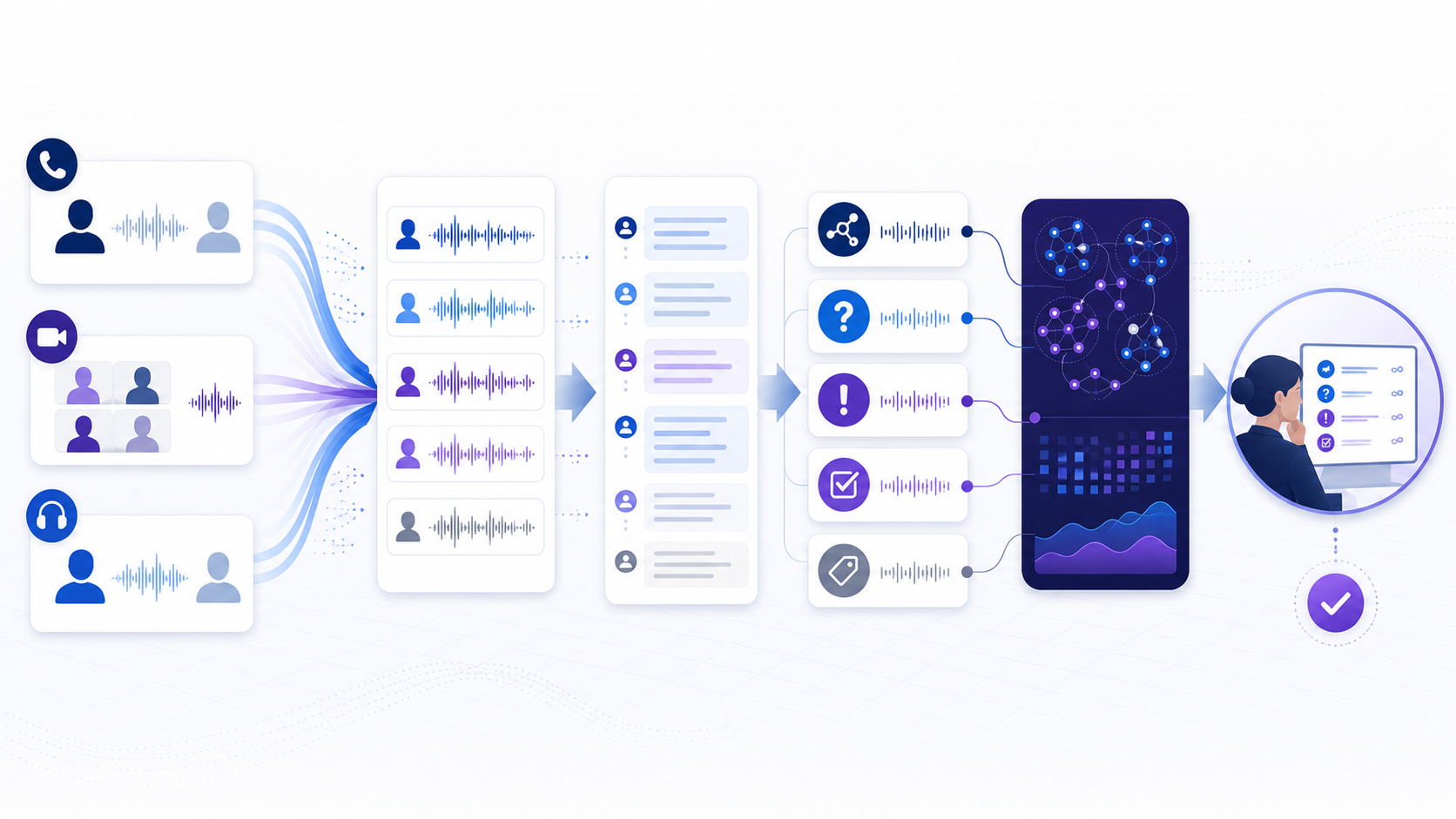
What is conversation intelligence?什么是对话智能?
Place this specific workflow in context with the unstructured data processing and document intelligence guide, which connects the definitions, alternatives, validation steps, and related implementation guides.
可通过非结构化数据处理与文档智能指南理解本专题在整体流程中的位置;该指南串联了定义、替代方案、验证步骤与相关实施文章。
Conversation intelligence is a workflow and software category that turns permitted calls, meetings, or messages into searchable evidence and reviewable analytical signals. It commonly combines capture, transcription, speaker separation, language analysis, cross-conversation aggregation, and human review.
对话智能是一类把已获授权的通话、会议或消息转化为可搜索证据和可复核分析信号的工作流与软件。它通常结合采集、转录、说话人分离、语言分析、跨对话汇总和人工复核。
The useful distinction is between a record and an interpretation. A recording preserves what happened; a transcript makes speech searchable; conversation analytics assigns topics, questions, objections, sentiment, actions, scores, or patterns. Those outputs are hypotheses supported by evidence, not perfect readings of intent. A defensible system lets a reviewer move from a dashboard value back to the relevant call, speaker turn, timestamp, transcript span, and processing version.
关键区别在于“记录”与“解释”。录音保存发生过的内容;转录让语音可搜索;对话分析再标注主题、问题、异议、情感、行动项、评分或模式。这些输出是由证据支持的判断,而不是对意图的完美读取。可辩护的系统应让复核者从仪表盘数值返回对应通话、说话轮次、时间戳、原文片段和处理版本。
Why teams use conversation intelligence—and when not to为什么使用对话智能,以及何时不应使用
Review discovery coverage, objections, competitor mentions, commitments, and next steps across calls while preserving examples for coaching and deal review.
跨通话检查需求发现、异议、竞品提及、承诺与下一步,并保留可用于辅导和商机复核的原始示例。
Find recurring contact reasons, escalation signals, process gaps, policy language, and samples that deserve targeted quality review.
发现重复联系原因、升级信号、流程缺口、政策表述,以及值得定向质检的样本。
Organize interview evidence, compare themes by segment, and retain source clips so researchers can challenge summaries.
组织访谈证据,按群体比较主题,并保留来源片段,让研究人员能够质疑和复核摘要。
Prioritize conversations for trained reviewers. Do not treat an automated flag as a legal conclusion or replace required professional judgment.
为受过培训的复核人员确定优先级。不要把自动标记当作法律结论,也不要用它替代必要的专业判断。
Do not start with conversation intelligence when recording or processing authority is unclear, the decision cannot tolerate unreviewed errors, audio is too poor for reliable transcription, or the team has no owner for taxonomy, escalation, retention, and correction. A smaller manual review may be safer when conversation volume is low and each case demands expert context.
如果录音或处理授权不清、决策无法容忍未经复核的错误、音频质量不足以可靠转录,或者团队没有负责人管理分类体系、升级、保留与纠错,就不应贸然开始。对话量较低且每个案例都需要专家语境时,小规模人工复核可能更安全。
How conversation intelligence works: a repeatable workflow对话智能如何工作:可重复执行的完整流程
- Define the decision before the metric先定义决策,再定义指标State who will use the output and what action it may trigger. “Find support calls needing policy review” is testable; “understand every customer” is not.说明谁会使用输出以及它可能触发什么行动。“找出需要政策复核的客服通话”可以测试;“理解每位客户”则不可操作。
- Capture only authorized channels只采集已获授权的渠道Map dialers, meeting platforms, uploaded recordings, chats, and CRM identifiers. Document notice, consent or other lawful basis, access, retention, deletion, residency, and vendor processing with qualified counsel where needed.梳理拨号系统、会议平台、上传录音、聊天与 CRM 标识符。按需要与合格法律顾问确认通知、同意或其他合法依据、访问、保留、删除、驻留和供应商处理。
- Prepare audio, metadata, and a test corpus准备音频、元数据和测试语料Include representative languages, accents, channel noise, call lengths, roles, outcomes, edge cases, and negative examples. Keep stable conversation IDs and a separate held-out evaluation set.覆盖代表性语言、口音、渠道噪声、通话长度、角色、结果、边界案例和负例。保留稳定对话 ID,并单独建立留出评估集。
- Transcribe and preserve provenance转录并保留来源链路Record speaker labels, timestamps, confidence where available, model or service version, language settings, and transformations. Keep the original recording under its approved controls.记录说话人标签、时间戳、可用置信度、模型或服务版本、语言设置与处理变换,并在已批准控制下保存原始录音。
- Extract configured signals提取已配置的信号Detect only signals tied to the decision: topics, questions, commitments, objections, product mentions, actions, process steps, or quality criteria. Require evidence spans and allow “uncertain” rather than forcing every call into a label.只检测与决策相关的信号:主题、问题、承诺、异议、产品提及、行动项、流程步骤或质量标准。要求提供证据片段,并允许“不确定”,不要强迫每通对话都进入某个标签。
- Aggregate, review, and monitor汇总、复核并持续监控Compare like-for-like groups, review high-impact and sampled ordinary cases, correct outputs, and monitor drift by language, source, team, topic, and time. Rerun the frozen evaluation after material changes.比较可比群组,复核高影响案例和普通抽样案例,纠正输出,并按语言、来源、团队、主题和时间监控漂移。重大变更后重跑冻结评估集。
What to prepare before analyzing conversations分析对话前需要准备什么
| Input输入 | Minimum useful detail最低必要信息 | Failure to prevent需要避免的失败 |
|---|---|---|
| Conversation media对话媒体 | Authorized audio, video, or text; channel and time; stable ID已授权音频、视频或文本;渠道与时间;稳定 ID | Orphaned clips and unverifiable findings孤立片段与不可验证结果 |
| Speaker and business context说话人与业务语境 | Roles, account or case ID, stage, product, outcome, permitted segments角色、客户或案例 ID、阶段、产品、结果、允许分组 | Comparing unlike conversations把不可比对话混在一起 |
| Analysis specification分析规范 | Label definitions, positive and negative examples, evidence rule, uncertainty rule标签定义、正负示例、证据规则与不确定规则 | Vague scores and unstable categories模糊评分与不稳定类别 |
| Evaluation set评估集 | Human-reviewed, representative, held-out conversations and accepted metrics经人工复核、具有代表性、独立留出的对话与验收指标 | Judging quality from demos仅凭演示判断质量 |
| Governance controls治理控制 | Authority, notice, roles, access, retention, deletion, export, incident route授权、通知、角色、访问、保留、删除、导出与事件处理路径 | Uncontrolled sensitive conversation data敏感对话数据失控 |
Conversation intelligence vs recording, transcription, and meeting assistants对话智能与录音、转录和会议助手的区别
| Approach方案 | Primary job主要任务 | Usually missing通常缺少 | Best fit适用场景 |
|---|---|---|---|
| Call recording通话录音 | Preserve media保存媒体 | Searchable transcript and analysis可搜索转录与分析 | Evidence archive under defined controls受控证据存档 |
| Transcription service转录服务 | Convert speech to text语音转文本 | Business taxonomy and cross-call workflow业务分类与跨通话工作流 | Search, captions, downstream pipelines搜索、字幕与下游流程 |
| Meeting assistant会议助手 | Notes, summaries, actions for one meeting单次会议笔记、摘要和行动项 | Governed population analysis and QA受治理的总体分析与质检 | Individual and team productivity个人与团队效率 |
| Conversation intelligence platform对话智能平台 | Analyze calls individually and in aggregate单通与总体对话分析 | May still require custom governance and validation仍可能需要自定义治理与验证 | Recurring sales, support, research, or QA decisions重复发生的销售、客服、研究或质检决策 |
| Custom analytics pipeline自建分析流程 | Fit specialized labels, systems, and controls适配专门标签、系统与控制 | Packaged workflows and lower maintenance成品工作流与较低维护成本 | Teams with engineering, evaluation, and operations ownership具备工程、评估和运营负责人的团队 |
How to choose conversation intelligence software如何选择对话智能软件
Build a scorecard before watching a polished demo. Give veto power to non-negotiable requirements, then weight the rest. Capture coverage asks whether the product supports your real channels without silent gaps. Transcript quality includes speaker attribution, timestamps, multilingual and domain vocabulary—not one vendor accuracy number. Analytical fit covers configurable labels, evidence links, uncertainty, cross-call filters, and reproducible exports.
在观看精美演示前先建立评分卡。把不可妥协的要求设为否决项,再对其他标准赋权重。采集覆盖需要确认产品能否支持真实渠道且不会静默漏数;转录质量包括说话人归属、时间戳、多语言和领域词汇,而不是厂商给出的单一准确率;分析适配则包括可配置标签、证据链接、不确定性、跨通话筛选和可复现导出。
- Privacy and security: inspect the complete data flow, subprocessors, model use, encryption, access controls, retention, deletion, residency, audit logs, and administrative separation.隐私与安全:检查完整数据流、分包处理方、模型用途、加密、访问控制、保留、删除、驻留、审计日志和管理权限分离。
- Integration: test actual dialer, meeting, CRM, warehouse, identity, and export paths—including failure, retry, duplicate, and departure scenarios.集成:实际测试拨号、会议、CRM、数仓、身份与导出路径,并覆盖失败、重试、重复和退出场景。
- Review experience: verify that people can hear the source, inspect transcript context, correct labels, explain exceptions, and track decisions.复核体验:确认人员能够听取来源、查看转录语境、纠正标签、解释例外并追踪决策。
- Operations and exit: include implementation, storage, transcription, model usage, monitoring, review labor, support, reprocessing, export, and migration—not only license cost.运营与退出:除许可证外,还要计入实施、存储、转录、模型调用、监控、复核人力、支持、重处理、导出和迁移。
Example: analyzing support conversations without inventing certainty示例:在不过度制造确定性的前提下分析客服对话
Hypothetical example—numbers are illustrative. A software team wants to understand why customers contact support after a billing change. It has authorized recordings, case IDs, product tier, channel, resolution code, and customer-language fields. The decision is to prioritize policy and product fixes, not score individual agents automatically.
假设示例——数字仅用于说明。某软件团队希望了解计费变更后客户联系支持的原因。团队拥有已获授权的录音、案例 ID、产品层级、渠道、解决代码和客户语言字段。目标是确定政策与产品修复优先级,而不是自动给客服人员评分。
The team samples 500 conversations across weeks, languages, channels, outcomes, and call lengths. Two reviewers define eight contact reasons, plus “other” and “uncertain,” and reconcile a 120-call reference set. Candidate systems process the remaining held-out calls. Reviewers measure transcription word errors on critical billing phrases, speaker-label errors, reason precision and recall, evidence-link coverage, missed severe complaints, review time, and the share routed to “uncertain.”
团队按周次、语言、渠道、结果和通话长度抽取 500 段对话。两名复核者定义八类联系原因以及“其他”和“不确定”,并对 120 通参考集协调分歧。候选系统处理其余留出通话。复核者衡量关键计费短语的转录错误、说话人标签错误、原因类别的 precision 与 recall、证据链接覆盖、漏掉的严重投诉、复核时间和进入“不确定”的比例。
The aggregate chart suggests “invoice confusion” rose after the change, but the team does not stop there. It opens source clips, separates language and product tier, checks whether channel mix changed, and compares the trend with case-resolution data. The final finding is reported with sample definition, processing version, uncertainty, and representative evidence. A future model update must rerun the same frozen set before the dashboard replaces the previous version.
汇总图表显示“账单困惑”在变更后上升,但团队不会就此停止。它会打开来源片段,按语言与产品层级拆分,检查渠道组合是否变化,并把趋势与案例解决数据对照。最终结论附带样本定义、处理版本、不确定性和代表性证据。未来模型更新必须重跑同一冻结评估集,才能替换旧版仪表盘。
Validate conversation analytics before acting on them在采取行动前验证对话分析结果
Evaluation has layers. First, test capture completeness and media quality. Second, measure transcription and diarization errors, especially on names, product terms, numbers, negation, overlapping speech, and role changes. Third, evaluate each business signal against human-reviewed examples. Finally, test the decision workflow: whether alerts arrive, reviewers can correct them, downstream records remain linked, and failures are visible.
评估需要分层。先测试采集完整性和媒体质量;再衡量转录与说话人分离错误,重点检查姓名、产品术语、数字、否定、重叠语音和角色变化;随后用人工复核示例评估每个业务信号;最后测试决策工作流,包括提醒是否到达、复核者能否纠正、下游记录是否保持链接以及失败是否可见。
Report results by important subgroup rather than one average. Precision answers how often a flagged item is right; recall answers how much relevant material was found. For summaries and open themes, use a documented rubric for factual support, omission, source coverage, and usefulness, plus blind review where practical. Monitor population and error changes over time.
应按重要群组报告结果,而不是只给一个平均值。Precision 回答被标记项目有多大比例正确;recall 回答相关材料被找出了多少。对于摘要和开放主题,应使用记录明确的量表评估事实支持、遗漏、来源覆盖和实用性,并尽可能进行盲审;同时持续监控总体和错误随时间的变化。
NIST describes AI risk management as a continuous lifecycle activity and emphasizes documented human roles, monitoring, testing, evaluation, verification, and validation. Apply that principle proportionally: a coaching suggestion and a disciplinary, legal, or financial decision should not share the same evidence threshold.
NIST 将 AI 风险管理描述为贯穿生命周期的持续活动,并强调明确记录人类角色、监控、测试、评估、验证与确认。应按风险比例应用这一原则:辅导建议与纪律、法律或财务决策不应采用相同证据门槛。
Conversation intelligence architecture and signal design对话智能的系统架构与信号设计
A production system is more than a transcription model. It needs a capture layer, identity and metadata mapping, speech processing, analytical services, evidence storage, review tools, and controlled delivery to downstream systems. Each stage should expose failures instead of silently dropping a call or substituting an empty result. Stable conversation IDs connect the recording, transcript, extracted signals, reviewer corrections, and business outcome.
生产系统不只是一个转录模型。它还需要采集层、身份与元数据映射、语音处理、分析服务、证据存储、复核工具,以及受控的下游交付。每个阶段都应显式暴露失败,不能静默丢弃通话或用空结果代替。稳定的对话 ID 应贯穿录音、转录、提取信号、复核修正与业务结果。
| Layer层级 | Responsibility职责 | Control to verify需要验证的控制 |
|---|---|---|
| Capture采集 | Acquire permitted calls, meetings, or messages with identifiers采集已获授权的通话、会议或消息及其标识符 | Coverage, consent status, retry, and duplicate handling覆盖率、同意状态、重试与去重 |
| Processing处理 | Transcribe, separate speakers, normalize, and extract configured signals转录、分离说话人、标准化并提取已配置信号 | Language settings, versions, confidence, and failure codes语言设置、版本、置信度与失败代码 |
| Evidence and review证据与复核 | Link findings to timestamps, excerpts, media, and corrections把结果链接到时间戳、片段、媒体与修正 | Access, audit trail, override reason, and retention访问、审计轨迹、覆盖原因与保留 |
| Activation业务触发 | Send approved outputs to CRM, QA, coaching, or research workflows把获批输出发送到 CRM、质检、辅导或研究流程 | Idempotency, ownership, reversibility, and monitoring幂等性、责任归属、可逆性与监控 |
Translate vague goals into observable labels. Every signal needs a definition, exclusions, positive and negative examples, an evidence rule, an uncertainty state, an owner, and a version. Questions, named products, commitments, dates, amounts, and required phrases can often link directly to transcript spans. Intent, sentiment, urgency, risk, quality, and outcome need stronger rubrics and reviewer calibration. Monitor “other,” abstention, disagreement, and new recurring phrases so the taxonomy can change without hiding drift.
应把模糊目标转化为可观察标签。每个信号都需要定义、排除项、正负例、证据规则、不确定状态、负责人和版本。问题、产品名称、承诺、日期、金额和必需措辞通常可以直接链接到转录片段;意图、情感、紧迫性、风险、质量和结果则需要更严格的量表与复核者校准。持续监控“其他”、拒答、分歧和新高频表达,使分类体系可以演进而不掩盖漂移。
Govern privacy, access, retention, and human decisions治理隐私、访问、保留与人工决策
Conversation data can contain personal information, payment details, health information, confidential strategy, employee discussions, and third-party statements. Governance therefore starts before capture. Document the authority for each channel and region, the notice or consent process where applicable, permitted purposes, who may hear raw media, which fields are redacted, how long each artifact is retained, and how deletion propagates through transcripts, indexes, caches, exports, and backups.
对话数据可能包含个人信息、支付信息、健康信息、保密战略、员工讨论和第三方陈述,因此治理必须从采集前开始。应记录每个渠道与地区的处理依据、适用的通知或同意流程、允许用途、谁能收听原始媒体、哪些字段需要脱敏、各类数据保留多久,以及删除如何传递到转录、索引、缓存、导出与备份。
- Least privilege: separate administrators, analysts, reviewers, managers, and export permissions. Dashboard access should not automatically reveal sensitive media.最小权限:区分管理员、分析人员、复核者、经理和导出权限;能够看到仪表盘不应自动意味着可以访问敏感媒体。
- Purpose limitation: do not reuse coaching, support, or research conversations for unrelated evaluation without checking authority, notice, contracts, and policy.目的限制:未经核对授权、通知、合同与政策,不应把用于辅导、客服或研究的对话重新用于无关评估。
- Human accountability: name the person who reviews consequential outputs, define appeal and correction routes, and log when automation influenced a decision.人工问责:明确复核高影响输出的负责人,定义申诉与纠错路径,并记录自动化何时影响了决策。
- Vendor change control: monitor subprocessors, model use, regions, retention defaults, security settings, and feature changes throughout the contract.供应商变更控制:在合同周期内持续监控分包处理方、模型用途、区域、默认保留、安全设置与功能变化。
Higher-impact uses need stronger evidence and narrower automation. A theme used for product research does not carry the same consequence as a disciplinary flag, compliance escalation, eligibility decision, or financial action. Define prohibited uses and mandatory human review before launch, then test whether those controls work in the actual interface, exports, APIs, and downstream integrations.
影响越高,证据要求应越强,自动化范围应越窄。用于产品研究的主题,与纪律标记、合规升级、资格决定或财务行动的后果不同。上线前应定义禁止用途和强制人工复核,并测试这些控制在真实界面、导出、API 与下游集成中是否有效。
Roll out conversation intelligence and measure business value上线对话智能并衡量业务价值
Start with a shadow deployment: process real, authorized conversations but do not let automated outputs trigger irreversible actions. Compare results with the current process, review both flagged and unflagged samples, and record how much work moves to people. A pilot should have an owner, baseline, acceptance thresholds, incident route, rollback condition, and end date. Without those elements, a trial can continue indefinitely while producing attractive but unused dashboards.
应从影子部署开始:处理真实且已获授权的对话,但不让自动输出触发不可逆行动。把结果与现有流程比较,同时抽查已标记与未标记样本,并记录有多少工作转移给人员。试点应有负责人、基准、验收阈值、事件处理路径、回滚条件和结束日期;否则试用可能无限持续,只产生漂亮但无人使用的仪表盘。
| Value question价值问题 | Useful measure有用指标 | Common trap常见陷阱 |
|---|---|---|
| Does it improve coverage?是否提高覆盖? | Eligible conversations processed, searchable, and linked to evidence符合条件且已处理、可搜索并链接证据的对话比例 | Counting failed or empty transcripts as analyzed把失败或空转录计为已分析 |
| Does it improve decisions?是否改善决策? | Accepted findings, completed actions, and outcome change against baseline被采纳结果、完成行动及相对基准的结果变化 | Treating dashboard views as business impact把仪表盘浏览量当成业务影响 |
| Does it save effort?是否节省工作量? | Review time, correction time, queue age, and avoided manual search复核时间、纠正时间、队列时长及减少的人工搜索 | Ignoring taxonomy, monitoring, and exception labor忽略分类、监控和异常处理人力 |
| Is it sustainable?是否可持续? | Total cost, incidents, drift, reprocessing, adoption, and exportability总成本、事件、漂移、重处理、采用率与可导出性 | Comparing license price without operating cost只比较许可价格而忽略运营成本 |
Scale only when the pilot meets both quality and operating thresholds. Add channels, languages, teams, and actions one at a time so failures remain diagnosable. Keep the original baseline and frozen evaluation set; otherwise improvements after tuning cannot be separated from an easier sample, a changed population, or different reviewer behavior. Track the full cost of capture, storage, transcription, model use, review, correction, monitoring, support, reprocessing, export, and migration.
只有试点同时达到质量与运营阈值时才扩大规模。应逐一增加渠道、语言、团队与行动,使失败仍可诊断。保留原始基准与冻结评估集,否则调优后的改善无法与样本变简单、总体变化或复核行为改变区分开来。还要跟踪采集、存储、转录、模型调用、复核、纠正、监控、支持、重处理、导出与迁移的完整成本。
Analyze conversation evidence with related business data把对话证据与相关业务数据联合分析
InfiniSynapse is presented as an AI-powered data analysis workspace across databases, files, documents, audio, and video. It is not described here as a live call recorder, dialer, CRM auto-sync, real-time sales coach, or dedicated conversation intelligence platform. Use it for the analysis stage when you have authorized conversation media or reviewed transcript exports, stable IDs, relevant structured data, and clear access rules.
InfiniSynapse 定位为可跨数据库、文件、文档、音频和视频进行 AI 辅助分析的数据工作区。本页不会把它描述成实时通话录音器、拨号系统、CRM 自动同步工具、实时销售教练或专用对话智能平台。当你已经拥有获授权的对话媒体或经复核的转录导出、稳定 ID、相关结构化数据与明确访问规则时,可将它用于分析阶段。
Before opening the app, prepare only data you are authorized to use: recordings or transcripts, conversation and speaker IDs, timestamps, product or case fields, definitions for the questions you want to answer, and review rules. Then use the InfiniSynapse web app to explore evidence across those sources. Verify outputs before operational use.
打开应用前,只准备你有权使用的数据:录音或转录、对话与说话人 ID、时间戳、产品或案例字段、待回答问题的定义以及复核规则。随后使用 InfiniSynapse 网页应用跨来源探索证据,并在业务使用前验证输出。
Open InfiniSynapse for cross-source data analysis打开 InfiniSynapse 进行跨来源数据分析For adjacent preparation methods, read the InfiniSynapse guide to RAG data analysis and the product documentation. These links describe broader data-grounded analysis; they do not establish unverified call-capture or coaching features.
如需了解相邻的数据准备方法,请阅读 InfiniSynapse RAG 数据分析指南和产品文档。这些链接描述更广泛的有数据依据分析,并不代表未经验证的通话采集或辅导能力。
Conversation intelligence best practices and next steps对话智能最佳实践与下一步
- Begin with one recurring decision, named owner, documented risk level, and correction path.从一个重复决策、明确负责人、已记录风险等级和纠错路径开始。
- Keep original media, stable IDs, timestamps, speaker turns, model versions, and evidence links under approved controls.在已批准控制下保留原始媒体、稳定 ID、时间戳、说话轮次、模型版本和证据链接。
- Separate transcription, speaker attribution, signal extraction, aggregation, and decision errors during diagnosis.诊断时分别衡量转录、说话人归属、信号提取、汇总与决策错误。
- Use representative negative and edge cases; never validate only on clean demonstration calls.使用代表性负例与边界案例,绝不只在干净的演示通话上验证。
- Let “uncertain” and “not enough evidence” be valid outputs, especially for high-impact use.允许“不确定”和“证据不足”成为有效输出,尤其是在高影响场景。
- Recheck recording authority, access, retention, deletion, and vendor changes as channels and jurisdictions change.随着渠道与司法辖区变化,重新检查录音授权、访问、保留、删除和供应商变更。
- Freeze a test set and rerun it after material changes to models, prompts, labels, preprocessing, integrations, or policy.冻结测试集,并在模型、提示词、标签、预处理、集成或政策重大变化后重跑。
Frequently asked questions about conversation intelligence关于对话智能的常见问题
Conversation intelligence is a workflow and software category that captures permitted calls or meetings, turns speech into searchable records, analyzes individual and cross-conversation signals, and presents evidence for human review and action.
对话智能是一类采集已获授权的通话或会议、把语音转成可搜索记录、分析单通与跨对话信号,并向人员提供证据以便复核和行动的工作流与软件。
It captures an authorized conversation, separates speakers, transcribes speech, extracts configured signals, aggregates patterns across conversations, links findings to source evidence, and routes uncertain or high-impact results to people.
它采集获授权的对话、分离说话人、转录语音、提取已配置的信号、汇总跨对话模式、把结果链接到来源证据,并把不确定或高影响结果交给人员。
No. Call recording preserves audio or video. Conversation intelligence adds transcription, indexing, analysis, comparison, and workflow outputs, although every analytical result still needs traceability to the underlying conversation.
不同。通话录音保存音频或视频;对话智能增加转录、索引、分析、比较和工作流输出,但每个分析结果仍需追溯到底层对话。
Test products on an authorized, representative corpus. Compare capture coverage, transcription and speaker quality, evidence links, configurable analysis, privacy controls, integrations, review workflow, monitoring, exportability, and total operating effort.
在已获授权且有代表性的语料上测试产品,并比较采集覆盖、转录与说话人质量、证据链接、可配置分析、隐私控制、集成、复核流程、监控、可导出性和总体运营工作量。
Not for every purpose. It can prioritize and expand review coverage, but ambiguous language, poor audio, domain terms, sarcasm, speaker errors, and changing policies require sampled human review and escalation rules.
不能覆盖所有目的。它可以确定复核优先级并扩大覆盖,但歧义语言、低质音频、领域术语、讽刺、说话人错误和政策变化仍需要人工抽样复核与升级规则。
Authoritative sources权威来源
- IBM: What is conversation intelligence?IBM:什么是对话智能?
- Microsoft Learn: Set up conversation intelligenceMicrosoft Learn:设置对话智能
- NIST AI Risk Management FrameworkNIST AI 风险管理框架
- NIST AI RMF Core: govern, map, measure, and manageNIST AI RMF 核心:治理、映射、衡量与管理
These sources support the category definition, a first-party implementation example, and the risk-management principles used in this guide. Product-specific capabilities must still be verified against current documentation and a real proof of concept.
这些来源支持本页采用的类别定义、第一方实施示例和风险管理原则。具体产品能力仍需根据最新文档和真实概念验证进行确认。