
What multimodal embeddings are什么是多模态嵌入
Place this specific workflow in context with the unstructured data processing and document intelligence guide, which connects the definitions, alternatives, validation steps, and related implementation guides.
可通过非结构化数据处理与文档智能指南理解本专题在整体流程中的位置;该指南串联了定义、替代方案、验证步骤与相关实施文章。
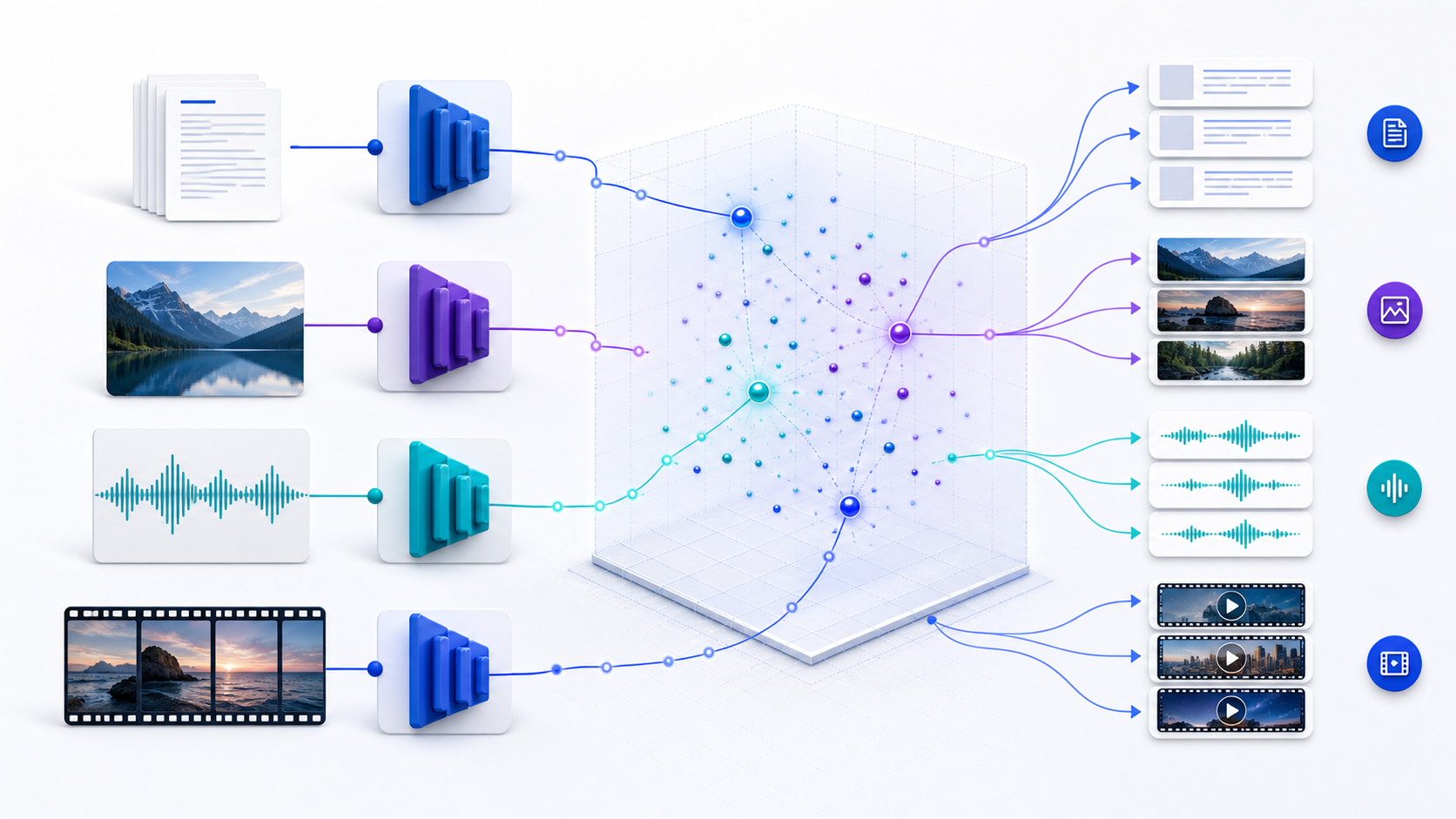
Multimodal embeddings are numerical vectors that make meaning from different data types comparable. A compatible set of encoders maps text, images, audio, video, or document pages into a joint embedding space. Items that the model considers semantically related should be close under a chosen similarity measure, enabling text-to-image search, image-to-image discovery, audio retrieval, clustering, ranking, and retrieval for multimodal RAG.
多模态嵌入是让不同数据类型的语义可以相互比较的数值向量。一组彼此兼容的编码器把文本、图像、音频、视频或文档页面映射到联合嵌入空间。模型认为语义相关的项目,在选定相似度度量下应彼此接近,从而支持文本搜图、以图搜图、音频检索、聚类、排序以及多模态 RAG 的检索环节。
An embedding is not the original content, a summary, or a generated answer. It is a compact learned representation used for comparison. “Multimodal” also does not guarantee every possible modality: one model may align only text and images, while another supports text, images, audio, video, or visual documents. The model card and API schema—not the category label—define what can be embedded together.
嵌入不是原始内容、摘要或生成答案,而是一种用于比较的紧凑学习表示。“多模态”也不意味着覆盖所有模态:有的模型只对齐文本与图像,另一些才支持文本、图像、音频、视频或视觉文档。能共同嵌入哪些内容,应以模型卡和 API 输入规范为准,而不能只看类别名称。
How a joint embedding space aligns modalities联合嵌入空间如何对齐不同模态
Most practical systems use modality-specific preprocessing and encoders. A text encoder tokenizes a caption or query; a vision encoder converts pixels or image patches; audio and video encoders sample signals or frames. Training then pulls matched pairs or groups closer and pushes unrelated examples apart. The result is not a human-readable coordinate system. It is a geometry optimized for the training objective and data distribution.
多数实际系统为不同模态使用专门的预处理与编码器:文本编码器对说明或查询进行分词,视觉编码器处理像素或图像块,音频与视频编码器则对信号或帧采样。训练过程把匹配的样本对或样本组拉近,并把无关样本推远。得到的坐标空间并不具有人类可读含义,它是一种针对训练目标和数据分布优化的几何结构。
Separate encoders produce compatible vectors. It is efficient for large-scale retrieval because corpus vectors can be precomputed, but cross-item interaction is limited before ranking.
不同编码器生成兼容向量。语料向量可预先计算,适合大规模检索;但在排序前,查询与候选之间的细粒度交互有限。
A unified model can encode multiple inputs together, while late fusion combines separate rankings or scores. These designs may capture context better but add compute, calibration, and operational complexity.
统一模型可共同编码多种输入,后期融合则合并各自的排名或分数。它们可能更好地利用上下文,但会增加计算、校准与运维复杂度。
Similarity commonly uses cosine similarity, dot product, or a distance supported by the vector index. Scores are meaningful only within the model and preprocessing configuration that produced them. A threshold copied from another model, vector dimension, normalization rule, or corpus is not a reliable acceptance criterion.
相似度常用余弦相似度、点积,或向量索引支持的距离函数。分数只有在生成它的模型与预处理配置中才有意义。从另一模型、向量维度、归一化规则或语料复制阈值,并不能形成可靠的验收标准。
Prepare the data and decisions before creating embeddings创建嵌入前先准备数据与决策
Start with the retrieval decision, not the model catalog. Write down who searches, which query modalities they will use, what a relevant result means, how quickly results must arrive, and what errors are costly. This definition determines the test set, model shortlist, chunking strategy, metadata, and fallback behavior.
先定义检索决策,而不是先浏览模型目录。明确谁在搜索、会使用哪些查询模态、什么结果算相关、结果必须多快返回,以及哪些错误代价较高。这个定义将决定测试集、候选模型、切分策略、元数据和回退行为。
- Source inventory: record modality, file type, size, duration, language, ownership, access class, and update frequency.来源清单:记录模态、文件类型、大小、时长、语言、所有者、访问级别和更新频率。
- Stable identity: assign asset IDs and parent-child links so chunks, frames, transcripts, and originals remain traceable.稳定标识:分配资产 ID 与父子关系,让切片、帧、转写和原件始终可追溯。
- Representative judgments: collect real or carefully authored queries with relevant, partially relevant, and irrelevant results across every required direction.代表性判断:为每个所需检索方向收集真实或谨慎编写的查询,并标注相关、部分相关与不相关结果。
- Governance: decide whether content may leave the environment, how vectors are retained, who can search them, and how deletion propagates.治理规则:决定内容能否离开当前环境、向量保留多久、谁可以检索,以及删除如何同步传播。
Security note: embeddings can retain useful information about source content and should not be assumed anonymous. Apply access controls to the vector index, preserve tenant boundaries, and test deletion and re-indexing paths.
安全提示:嵌入可能保留关于源内容的有用信息,不能默认视为匿名数据。应对向量索引实施访问控制,保持租户边界,并测试删除与重新索引路径。
Multimodal embeddings vs text embeddings and hybrid retrieval多模态嵌入、文本嵌入与混合检索如何选择
The most important comparison is not between vendor names; it is between evidence pathways. If a scanned page is mostly text, OCR plus a strong text embedding may retrieve exact concepts better and provide easier debugging. If color, shape, layout, scene, tone, or nonverbal events matter, a native multimodal embedding can preserve signals that captions or transcripts discard. When both matter, keep both representations and fuse their candidates.
最重要的比较不是厂商名称,而是证据路径。如果扫描页主要由文字构成,OCR 加强文本嵌入可能更擅长检索精确概念,也更容易排查。如果颜色、形状、版式、场景、语气或非语言事件很重要,原生多模态嵌入可以保留说明文字或转写会丢失的信号。两类证据都重要时,应同时保留表示并融合候选结果。
| Approach方案 | Choose when适用条件 | Watch for注意问题 |
|---|---|---|
| Text-only baseline纯文本基线 | Captions, OCR, or transcripts carry nearly all task meaning.说明、OCR 或转写承载了几乎全部任务语义。 | Visual or acoustic information lost during conversion.转换时丢失视觉或声学信息。 |
| Shared multimodal model共享多模态模型 | Cross-format retrieval is central and supported modalities match the corpus.跨格式检索是核心,并且模型支持的模态与语料一致。 | Modality imbalance, opaque failures, model-specific score calibration.模态不平衡、失败难解释、分数需按模型校准。 |
| Hybrid and late fusion混合与后期融合 | Exact text, metadata, and cross-modal meaning all affect relevance.精确文字、元数据和跨模态语义都会影响相关性。 | More indexes, score normalization, tuning, and observability.需要更多索引、分数归一化、调参与可观测性。 |
Shortlist only models that support the required inputs, languages, maximum sizes, output dimensions, licensing, region, privacy controls, and throughput. Verify whether queries and corpus items use the same endpoint or distinct compatible encoders. A model change normally requires re-embedding the corpus because vectors from unrelated spaces cannot be safely mixed.
候选模型必须满足所需输入、语言、最大尺寸、输出维度、许可证、部署地区、隐私控制和吞吐量。还要核对查询与语料是使用同一端点,还是使用不同但兼容的编码器。模型变更通常需要重新嵌入语料,因为来自无关空间的向量不能安全混用。
How to create a multimodal embedding pipeline如何创建多模态嵌入流程
- Define retrieval directions and relevance. List text→image, image→image, text→video, audio→text, or other flows separately. Specify whether a result is relevant because of subject, event, style, wording, layout, or business context.定义检索方向与相关性。分别列出文本→图像、图像→图像、文本→视频、音频→文本等流程,并说明结果是因主题、事件、风格、措辞、版式还是业务上下文而相关。
- Create an evaluation set before optimization. Sample easy, difficult, multilingual, rare, negative, and permission-sensitive cases. Freeze a first version so model comparisons use the same judgments.优化前先建立评估集。抽取简单、困难、多语言、罕见、负例与权限敏感案例,并冻结首个版本,让不同模型基于同一套判断比较。
- Normalize without erasing meaning. Apply documented image resizing, audio sampling, video segmentation, OCR, transcription, and text chunking. Retain the original asset and preprocessing version.规范化但不抹掉意义。按文档执行图像缩放、音频采样、视频分段、OCR、转写和文本切分,并保留原始资产与预处理版本。
- Generate compatible vectors. Use the provider’s prescribed encoder and normalization for every supported modality. Batch where allowed, log failures, and never substitute a different encoder silently.生成兼容向量。每种受支持模态都使用提供方规定的编码器和归一化方式;在允许时批处理,记录失败,并且绝不静默替换编码器。
- Store vectors with traceable metadata. Keep model version, vector dimension, modality, asset ID, chunk or timestamp, access scope, source checksum, and created time beside each vector.连同可追溯元数据存储向量。为每个向量保存模型版本、维度、模态、资产 ID、切片或时间戳、访问范围、源校验值与创建时间。
- Retrieve, filter, and rerank. Embed the query with a compatible encoder, apply authorization before returning candidates, combine lexical or metadata results where useful, then rerank a bounded set.检索、筛选与重排。使用兼容编码器嵌入查询,在返回候选前实施授权筛选;必要时合并词法或元数据结果,再对有限候选集进行重排。
- Evaluate and monitor by direction. Measure quality, latency, failures, cost, and drift separately for each modality pair. Re-index and rerun the fixed benchmark when the model or preprocessing changes.按方向评估与监控。分别衡量每组模态方向的质量、延迟、失败、成本和漂移。模型或预处理变化后,重新索引并重跑固定基准。
Example: cross-modal search across product support evidence示例:跨产品支持证据进行跨模态搜索
Hypothetical example—not a benchmark or customer case假设示例——不是基准测试或客户案例
Assume a support team needs to find evidence related to “the chart freezes after a filter changes.” Its corpus contains ticket text, screenshots, short screen recordings, and structured fields such as product version and operating system. A text-only index retrieves tickets that repeat the phrase but can miss silent recordings showing the failure. A visual-only index may find similar chart layouts while missing the relevant product version.
假设支持团队需要查找与“更改筛选条件后图表冻结”相关的证据。语料包含工单文本、截图、短录屏,以及产品版本和操作系统等结构化字段。纯文本索引能找到重复该措辞的工单,却可能漏掉展示故障但没有语音的录屏;纯视觉索引可能找到相似图表版式,却忽略相关产品版本。
The team builds three comparable paths: OCR and transcript text embeddings; native image/video embeddings; and a hybrid candidate set filtered by version. Reviewers judge results for text→screenshot and text→video separately. They record recall@10, nDCG@10, median latency, failed encodes, and evidence-trace completeness. The best production design is whichever meets the stated acceptance thresholds—not automatically the most complex model.
团队构建三条可比较路径:OCR 与转写文本嵌入、原生图像/视频嵌入,以及按版本筛选的混合候选集。复核者分别判断文本→截图和文本→视频结果,记录 recall@10、nDCG@10、中位延迟、编码失败数与证据追溯完整度。最合适的生产方案是满足既定验收阈值的方案,而不一定是最复杂的模型。
How to evaluate multimodal embeddings reliably如何可靠评估多模态嵌入
Offline retrieval quality requires relevance judgments. A visually appealing demo is not evidence that the system handles rare queries, negatives, multilingual content, or permission filters. Evaluate each query-target direction separately because strong text-to-image performance does not imply equally strong image-to-text or text-to-video performance.
离线检索质量需要相关性判断。视觉效果漂亮的演示,并不能证明系统能处理罕见查询、负例、多语言内容或权限筛选。每个查询—目标方向都应单独评估,因为文本搜图表现强,并不意味着图像搜文或文本搜视频同样可靠。
| Measure指标 | What it answers回答的问题 | Common trap常见陷阱 |
|---|---|---|
| Recall@k | Did the top k contain the relevant item?前 k 个结果是否包含相关项目? | Ignoring whether useful results appear too low for users.忽略有效结果对用户而言是否排得太低。 |
| Precision@k / nDCG | How relevant and well ordered are the top results?顶部结果有多相关,排序有多合理? | Treating incomplete judgments as definitive.把不完整标注当作确定结论。 |
| MRR | How early does the first relevant result appear?第一个相关结果出现得多早? | Missing tasks that need several supporting results.忽略需要多个支持证据的任务。 |
| Operational measures运行指标 | Latency, throughput, encode failures, index age, cost, and deletion completion.延迟、吞吐、编码失败、索引新鲜度、成本与删除完成度。 | Optimizing quality while the pipeline is too slow or stale.只优化质量,却让流程过慢或索引过旧。 |
Break metrics down by modality, language, source, content age, query difficulty, and protected or risk-relevant groups where applicable. Inspect false positives and false negatives, not just averages. For an online test, measure task completion and downstream decision quality with safeguards; click-through alone can reward attractive but irrelevant media.
应按模态、语言、来源、内容新旧、查询难度,以及适用时的受保护或风险相关群体拆分指标。除了平均值,还要检查假阳性与假阴性。在线测试应在有保护措施的情况下衡量任务完成与下游决策质量;仅看点击率可能奖励好看但不相关的媒体。
Move from a retrieval prototype to joint multimodal analysis从检索原型进入多模态联合分析
Before opening the tool, prepare accessible source files, stable identifiers, relevant structured tables, and the permissions you need to preserve. InfiniSynapse is positioned as an AI data analysis workspace for joint analysis across structured databases, documents, audio, and video. It is not presented here as an embedding-generation API. Use a documented embedding model for vector creation; use InfiniSynapse when the next job is to examine prepared evidence alongside business data and metrics.
打开工具前,请准备可访问的源文件、稳定标识符、相关结构化表格,以及需要保留的权限规则。InfiniSynapse 定位为跨结构化数据库、文档、音频和视频进行联合分析的 AI 数据分析工作区;本页不会把它描述成嵌入生成 API。向量创建应使用有明确文档的嵌入模型;当下一步是把准备好的证据与业务数据、指标共同检查时,可使用 InfiniSynapse。
Open InfiniSynapse for joint multimodal analysis打开 InfiniSynapse 进行多模态联合分析Frequently asked questions about multimodal embeddings关于多模态嵌入的常见问题
What are multimodal embeddings?什么是多模态嵌入?
They are numerical representations that place content from two or more modalities, such as text, images, audio, or video, in a comparable vector space so semantic similarity can support retrieval, clustering, or ranking.
它们是把文本、图像、音频或视频等两种及以上模态放入可比较向量空间的数值表示,使语义相似度可以支持检索、聚类或排序。
Do all modalities need the same embedding model?所有模态都必须使用同一个嵌入模型吗?
They need compatible encoders whose outputs are intentionally aligned. Using unrelated text and image encoders does not make cosine scores comparable unless an additional alignment or fusion method is trained and evaluated.
它们需要输出经过刻意对齐的兼容编码器。直接使用彼此无关的文本与图像编码器,并不会让余弦分数可比较,除非另外训练并评估对齐或融合方法。
How do you evaluate multimodal embeddings?如何评估多模态嵌入?
Create representative query-result relevance judgments for every required modality direction, then measure recall@k, precision@k, mean reciprocal rank, or nDCG alongside latency, cost, coverage, and subgroup errors.
为每个所需模态方向建立有代表性的查询—结果相关性标注,再衡量 recall@k、precision@k、平均倒数排名或 nDCG,并同时检查延迟、成本、覆盖率与分组错误。
Are multimodal embeddings always better than text embeddings?多模态嵌入总是优于文本嵌入吗?
No. Text embeddings may be simpler and stronger when meaning is carried mainly by captions, transcripts, or OCR text. Compare a text-only baseline, a multimodal model, and a hybrid approach on the same task-specific evaluation set.
不是。当含义主要由说明、转写或 OCR 文本承载时,文本嵌入可能更简单、更强。应在同一任务评估集上比较纯文本基线、多模态模型与混合方案。
Can InfiniSynapse generate multimodal embeddings?InfiniSynapse 能生成多模态嵌入吗?
This page does not claim that InfiniSynapse is an embedding-model API. InfiniSynapse is presented as an AI data analysis workspace for joint analysis across structured data, documents, audio, and video; use a documented embedding provider or self-hosted model for vector generation.
本页不声称 InfiniSynapse 是嵌入模型 API。InfiniSynapse 被定位为跨结构化数据、文档、音频与视频进行联合分析的 AI 数据分析工作区;向量生成应使用有明确文档的嵌入提供方或自托管模型。
Official sources and verification notes官方来源与核验说明
Primary references used for technical framing include the CLIP research paper on learning transferable visual representations from language supervision, OpenSearch multimodal search documentation, Amazon Titan Multimodal Embeddings documentation, and the Google DeepMind Gemini Embedding model page. Supported modalities, limits, prices, regions, and model versions can change; verify the current provider documentation before implementation.
技术框架使用的第一方资料包括:关于从语言监督学习可迁移视觉表示的 CLIP 研究论文、OpenSearch 多模态搜索文档、Amazon Titan Multimodal Embeddings 文档,以及 Google DeepMind Gemini Embedding 模型页面。支持模态、限制、价格、地区与模型版本可能变化,实施前应核验提供方当前文档。