Customer Acquisition Cost: Audit Spend and Payback
By William Zhu & the InfiniSynapse Data Team · Published: 2026-08-22 · Last updated: 2026-08-31 · Last verified: 2026-08-31 · Next review: 2026-11-30 · About · Privacy policy · Terms · Editorial standards · Corrections
Table of Contents
- TL;DR
- What Customer Acquisition Cost Means in 2026
- A Payback-Join Framework
- How Teams Compare CAC Clocks
- Tool Landscape for CAC Packs
- Implementation Steps You Can Audit
- Desk Sample: Illustrative CAC Pack
- Evidence Boundaries and Independent Validation
- How to Cite This Page
- Selection Scorecard for CAC Packs
- Failure Modes That Invent Cheap CAC
- Frequently Asked Questions
- Conclusion
TL;DR
We evaluate these patterns at the InfiniSynapse desk on sanitized composites; sample figures on this page are illustrative, not customer uplifts.
Direct answer: Customer acquisition cost is usable only next to payback and usage: a signed spend definition joined to the billing month you can open and the meters those logos actually ran, so months-to-recover stay reconcilable—without copying every invoice into a new finance warehouse first.
What you'll learn: a join-first CAC definition; a spend-plus-payback framework; blended versus cohort methods; a two-stage implementation path; an illustrative CAC desk; a scorecard; and the failure modes that invent a cheap CAC.
Download evidence: desk log · aggregate CSV · verification script · source check · reproduction protocol. First-party illustrative evidence only; not audited finance, customer, causal, or benchmark evidence.
Customer acquisition cost fails when spend is a marketing blob, payback is a vanity MRR, and usage never meets the new logos. The fix is a signed channel list, a covered cohort, and a question you can replay. It is not a prettier CAC tile.
What Customer Acquisition Cost Means in 2026
Key Definition: Customer acquisition cost is the audit of signed acquisition spend against new paying accounts, joined to contribution and usage so payback stays inspectable. The unit of work is a board pack that prints coverage, not a spend-per-logo nobody can restate.
Customer acquisition cost starts when someone writes “paid media plus onboarding labor for new paying accounts in the window; contribution is month-one recognized revenue minus the signed variable stack; report only logos with complete spend and a usage key” and the next run uses the same words.
If the missing object is the months clock itself, continue in payback period analysis. If the missing object is NRR against the same invoices, use SaaS metrics analytics. If the missing object is the cost stack, use contribution margin analysis. The parent join of money, usage, and cost remains unit economics analytics. Fully loaded CAC enters the ratio on the SaaS unit economics CAC page, and that page holds the ratio when CAC is missing.
CAC is usable only next to payback and usage. Bind the spend sentence to the billing and usage sources in a short knowledge-base note before you ask for a company-wide figure.
Klaviyo's S-1 (retrieved 2026-09-04) is a public-company example defining CAC payback as months until cumulative non-GAAP gross profit exceeds adjusted selling and marketing expense. For customer acquisition cost, it is one disclosed method—not a universal formula, SEC endorsement, or validation of this page.
The IAB/MRC Retail Media Measurement Guidelines (retrieved 2026-09-04) emphasize disclosed attribution windows, consistent methods, viewability, and bias controls. In customer acquisition cost, their scope is retail media; another channel still needs its own signed policy.
CAC is usable only next to payback and usage
Slide CAC often starts from “marketing spend divided by new logos” and then edits the exceptions in the speaker notes. Customer acquisition cost refuses that path. A cheap CAC with no contribution and no usage is not a unit. It is a spend ratio wearing an economics name.
A semantic layer can freeze those names. A Markdown note bound to the spend, billing, and usage extracts is enough for the first pack.
Why coverage and usage must share the join
Incomplete spend is the usual lie. Averaging logos with spend and logos without spend will look cheaper than cash. Print the covered share. If coverage is thin, do not publish company-wide CAC.
Usage is the second lie. New logos that never generate load will look cheap until hosting arrives. Join the first-month meter on the same customer key. If the meter key is missing, say so.
Trials and internal seats need their own rule. Mixing trial conversions into the paying denominator without a dated spend line will invent months.
A Payback-Join Framework
Use one table as the contract. Customer acquisition cost questions should name spend, contribution, usage, and coverage.
| Layer | What you lock | Typical source | Failure if skipped |
|---|---|---|---|
| Cohort | new paying accounts in a window | Billing export | Mixed old and new logos |
| Spend | channels and labor included | Spend export + note | A blob |
| Contribution | variable stack, dated | Invoices + cost lines | Vanity MRR payback |
| Usage | first-month meter on the same key | Usage export | Cheap logos with no load |
| Coverage | share with complete CAC | Same note | Company-wide fiction |
| Clock | months, not annualized one-month | Written field | Invented years |
Customer acquisition cost can start when the first honest pack joins a spend export to a billing extract and a usage extract in place. A warehouse helps later, when many consumers need the same grain on a schedule.
When operators need a recurring view, generate a dashboard from the same query that produced the table.
File the spend extract the way an SEC EDGAR submission names a period: one window, one filer, one as-of. Customer acquisition cost on an undated marketing dump will argue with last month’s dump.
How Teams Compare CAC Clocks
Teams argue tools. They should argue which dollars enter the numerator. Customer acquisition cost methods differ in the spend they are willing to sign.
| Method | Works when | Breaks when |
|---|---|---|
| Paid-media only | Ads are the question | Sales labor dominates |
| Fully loaded | The board wants all-in CAC | Nobody signed the labor list |
| Cohort CAC | New logos in a dated window | Old logos leak into the set |
| Blended CAC | You need a fast tile | Mix hides a failing channel |
Cohort CAC versus blended CAC
Cohort customer acquisition cost holds the new-paying set still and asks what those logos cost and returned. Blended customer acquisition cost divides company-wide spend by company-wide new logos. Do not average them. A blend that includes brand spend for existing accounts is not acquisition. It is a growth ratio wearing a CAC name.
AI for data analysis can draft the join. A human still owns the channel list.
Payback and usage as first-class fields
Simplified monthly payback is CAC divided by comparable monthly contribution or gross profit—not contribution divided by CAC. Customer acquisition cost without compatible numerator, denominator, and periods is not payback. If usage is part of the chosen operating policy and is missing, print the unmatched meter rate; usage is not a universal CAC requirement.
If the extract itself is the money source, use billing data analysis. If a five-person board still needs the unit sentence, continue in unit economics for startups.
Tool Landscape for CAC Packs
A data agent is a fit when the question is a goal (“CAC for the July 2026 new-paying cohort joined to month-one contribution and usage”) and you need the SQL trail. It is a poor fit when someone wants the tool to pause an ad account.
Warehouse-resident spend facts
Read-only roles only. Customer acquisition cost should never write to the ad platform or the billing provider. InfiniSynapse does not ship a native Stripe connector; use a dated billing export plus a spend export you already operate. If you connect Postgres or a warehouse table, record the role and the window. Natural language to SQL is an execution path, not a replacement for the spend sentence.
Google Ads data-driven attribution (retrieved 2026-09-04) allocates credit using advertiser-specific converting and non-converting paths. Customer acquisition cost cannot treat it as causality, cross-platform completeness, or customer-level accuracy.
File-first packs for early-stage teams
Five-person companies often have an ads CSV, a Stripe export, and a usage dump. Customer acquisition cost can start there. Freeze the file dates. Bind “new paying account.” Ask CAC under the written channel and coverage rules. Do not paste live API keys into a prompt.
The Stripe Invoice object (retrieved 2026-09-04) documents customer, billing reason, status, amount, currency, timestamps, and line-item periods. Customer acquisition cost can use those fields for a billing cohort; they do not provide ad attribution, spend, usage, or CAC.
Implementation Steps You Can Audit
Customer acquisition cost starts with the spend sentence. A pack that starts from “what is our magic CAC” will invent a denominator.
Lock the channel list and the covered cohort
Write which channels and labor enter CAC. Write how a late invoice hits the acquisition month. Get a finance partner and a growth partner to initial the note. This is a signed paragraph, not a product metric warehouse.
Pick customer_id and prove it exists on spend attribution, invoices, and the usage extract. A fuzzy email join will double-count logos. List unmatched spend and unmatched meters. If match rate is weak, do not publish CAC.
Data governance is the longer question of who owns that sentence. The shorter question: can this file restate last month’s CAC with the same words.
Ask CAC joined to payback, then inspect SQL
Ask one goal: CAC for the last complete new-paying cohort, joined to month-one contribution and first-month usage, with coverage printed. Customer acquisition cost quality is the inspectable join. Open the query. Check that a brand campaign did not land on every logo.
If an agent drafted SQL, read it. Attach it. Replay next month with the same channel rule. Download Markdown or PDF from the task workspace so the chat is not the only artifact.
For independent price context only, BLS series WPU366 (retrieved 2026-09-04) reports producer-price observations for internet advertising sales. It is not platform CPM, advertiser spend, attribution evidence, or a CAC benchmark.
Desk Sample: Illustrative CAC Pack
The following numbers are an illustrative desk composite, not a customer result and not an uplift claim.
| Item | Desk composite (illustrative) |
|---|---|
| New paying cohort | August 2026, 42 logos, trials excluded |
| Signed spend | $63,000 paid media + $9,000 onboarding labor |
| Covered logos | 36 of 42 with complete spend and a usage key |
| Cohort CAC (covered) | $2,000 per covered logo |
| Blended CAC (all 42) | $1,714 if the six orphans are in the denominator |
| Month-one contribution | $410 median on covered logos |
| Payback | Held: a median contribution is not aggregation-compatible with cohort CAC |
| First-month usage | 18 of 36 covered logos above the written floor |
| Action | Publish covered CAC; hold payback and do not headline the blend |
Customer acquisition cost on this pack is useful because the six orphans are visible.
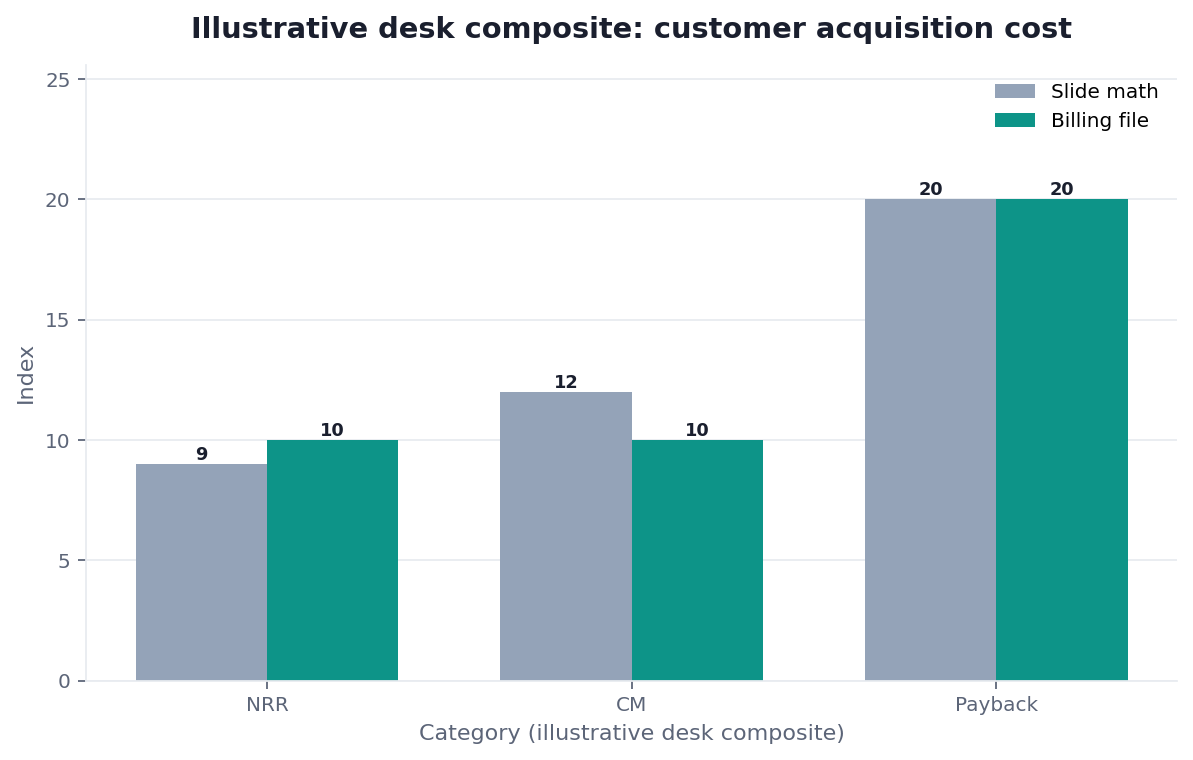
Figure. Illustrative desk composite (method × coverage). Not a customer experiment, SLA, or official benchmark.
| Evidence class | What you can cite | What you cannot claim |
|---|---|---|
| Desk composite on this page | Grain, coverage, inspectable artifacts | Customer uplift %, vendor bake-off win |
| Published authority (named above) | Filing and definition discipline from the cited sources | That those sources ran this desk sample |
Desk composite: $2,000 covered CAC versus $1,714 blended; payback held because the $410 median is not aggregation-compatible. Direct context: Klaviyo's disclosed payback definition, IAB/MRC attribution guidance, Google Ads attribution behavior, Stripe invoice fields, and BLS ad-price data.
The operator reviewed this sanitized composite at the InfiniSynapse desk on 2026-08-23. The desk log records the held payback, and the CSV exposes aggregate outputs only. Existing analogical references remain available from IRS statistics, SEC EDGAR, OECD data, CDC NCHS, and NLM; none validates CAC, payback, or this run.
Evidence Boundaries and Independent Validation
For customer acquisition cost, spend rows, billing rows, attribution maps, source invoices, contribution calculations, usage rows, SQL, approvals, and customer outcomes are unavailable. The arithmetic $72,000 ÷ 36 = $2,000 and $72,000 ÷ 42 ≈ $1,714 is inspectable, but it does not establish data completeness, attribution validity, or causality.
Customer acquisition cost cannot be independently reproduced from aggregates. The checker confirms displayed values only. The source check limits every citation; the open protocol states what an external reproduction would require. No qualifying independent report, audited customer case, or media investigation exists as of 2026-08-31.
How to Cite This Page
Zhu, W., & InfiniSynapse Data Team. (2026). Customer acquisition cost: audit spend and payback. InfiniSynapse. https://infinisynapse.com/en/blog/customer-acquisition-cost
Run: InfiniSynapse Data Team. (2026). Desk log CAC-COVERAGE-20260823. https://infinisynapse.com/blog-media/customer-acquisition-cost/downloads/desk-log-CAC-COVERAGE-20260823.md
Neither is an independent audit, customer case, peer-reviewed study, benchmark, or proof of payback.
Selection Scorecard for CAC Packs
Score from 1 to 5. A pack that cannot inspect SQL should not win on a prettier spend chart.
| Criterion | What “5” looks like | Disqualifier |
|---|---|---|
| Channel list | Paid + labor written | Marketing blob |
| Coverage | Unmatched spend printed | Silent inner joins |
| Payback join | Contribution sentence attached | CAC with no money back |
| Usage join | First-month meter on the same key | Cheap logos with no load |
| Audit | Pack + SQL downloadable | Chat-only CAC |
| Write path | Read-only spend and billing | Agent can pause ads |
Customer acquisition cost scores well when a skeptical CFO can replay the join. It scores poorly when the stack implies a finance warehouse you do not operate.
Failure Modes That Invent Cheap CAC
Name the break on the pack. Customer acquisition cost reviews go faster when the known distortions are written down.
Putting old logos in the new-paying set
Existing accounts are not acquisition. Customer acquisition cost that folds expansions into the new-logo denominator will look cheaper than cash. Keep a second row for expansion spend if the board wants both stories.
Publishing CAC without payback or usage
A cheap CAC with no contribution is not a unit. Customer acquisition cost should print months-to-recover on the same covered set. If usage is missing, print the unmatched meter rate.
Brand spend dumped equally on every new logo
Shared brand dumped equally on every account will punish small plans. Customer acquisition cost should mark allocated brand as allocated. If nobody will sign the allocation, leave it below the line.
A fourth pattern is trials that convert mid-window and get a CAC of zero because spend landed last quarter. Write the attribution window once.
Before you open a workspace, check the channel list, the billing-to-spend key, the usage key, and whether coverage is large enough to publish.
Route the same diagnosis to the live guide that owns the next object. Each row is a single hop, not a reading dump.
| Live guide | Open it when |
|---|---|
| unit economics analytics | the question is contribution and payback |
| payback period analysis | the clock itself is the missing object |
| usage plus revenue join | meters sit next to invoices |
| data governance | the missing object is an owned definition |
Join CAC to the billing month you can open
Upload sanitized spend, billing, and usage extracts, bind the channel list, and ask covered CAC joined to month-one contribution. This check uses only sources you authorize.
Commercial association: You do not need the workspace to complete the educational diagnosis on this page.
Open InfiniSynapseHow this page is sourced. William Zhu is cofounder of InfiniSynapse (GitHub @allwefantasy); no personal LinkedIn, finance credential, customer affiliation, or independent reviewer role is claimed. Desk experience is limited to designing and reviewing analysis-pack methods. Reviewed internally by analytics engineering · data platform · LLM security · editor; these roles are not licensed accountants or independent auditors. Editorial standards · corrections · publishing principles · Contact zhuhl@infinisynapse.com. Company About. COI: InfiniSynapse sells an AI-native Data Agent. Klaviyo, SEC, IAB, MRC, Google, Stripe, BLS, IRS, OECD, CDC, and NLM did not validate this run. This page is a method note, not accounting, tax, investment, employment, or legal advice.
Frequently Asked Questions
Do I need a finance warehouse before customer acquisition cost is real?
Bottom line: No. Customer acquisition cost is real when a locked new-paying cohort, a signed channel list, and a coverage sentence can be joined to billing and usage and replayed. A warehouse is optional for the first board pack on dated exports.
What spend should customer acquisition cost include?
Bottom line: Write the list. Paid media plus onboarding labor is a common first sentence. Fully loaded customer acquisition cost is a second pack for sales commission. Do not average them. If a channel has no key, keep it below the line.
How should customer acquisition cost treat logos with missing spend?
Bottom line: Print the uncovered share and refuse company-wide CAC when the map is thin. Do not put orphans in the denominator to look cheaper. Never treat a model-drafted CAC as a board fact without the query.
Can customer acquisition cost replace the ad platform?
Bottom line: No. Customer acquisition cost explains spend on authorized reads. It does not pause campaigns or write invoices. Keep the path read-only. InfiniSynapse does not provide a native Stripe connector; analyze a dated billing export next to the spend file.
Conclusion
Customer acquisition cost is a join you can defend: a spend extract, a locked new-paying cohort, and a payback sentence someone signed. Print coverage and usage, and refuse company-wide CAC when the map is thin.
When the channel list and the extracts are ready, ask covered CAC joined to payback on an authorized source at https://app.infinisynapse.com/. Download the pack and keep the SQL.