Parquet Database: Bind, Then Replay
By William Zhu (independent public engineering profile: GitHub @allwefantasy; no personal LinkedIn) & the InfiniSynapse Data Team · Published: 2026-08-22 · Last updated: 2026-08-29 · Last verified: 2026-08-29 · Next review: 2026-11-29 · About · Editorial standards · Privacy · Terms of Service · Corrections
Table of Contents
- TL;DR
- What Asking the Files First Means
- A Files-Before-Catalog Framework
- How Teams Invent a Catalog Too Early
- Tool Landscape for Files versus a Store
- How to Ask the Set before You Build
- Desk Sample: Ticket Avoided for Six Weeks
- Scorecard: Files, Database, or Warehouse
- Failure Modes
- How to cite this page
- Frequently Asked Questions
- Conclusion
TL;DR
We evaluate these patterns at the InfiniSynapse desk on sanitized composites; first-party figures on this page are desk log FLF-PDB-20260822, not customer uplifts and not a third-party bake-off.
Direct answer: You do not need a parquet database to ask a Parquet set. Authorize the files, name the grain, and inspect the plan. A catalog, a DuckDB-shaped store, or a warehouse load is a later promotion—after the same ask already works on the files. Inventing a store first is delay dressed as architecture.
What you'll learn:
- Why a parquet database is optional when one team needs one grain
- How “we need a store” hides an unasked file
- A register → ask-files → promote-only-if-shared loop
- Desk log
FLF-PDB-20260822, which checks a ticket that waited six weeks and never shipped - Failure modes: catalog-as-courage, dual surfaces, and SQL that no longer names a path
Download evidence: desk log · aggregate CSV · verify script. These are first-party sanitized demo evidence—not raw, customer, source, benchmark, or third-party data.
If you still need the file-lake overview, open Parquet file analysis. This page is narrower: parquet database versus asking the files you already have. Skip a parquet database when the files already answer the grain.
Industry context stays independent of desk claims. McKinsey’s State of AI and Gartner Peer Insights — Analytics & BI describe adoption pressure; they did not run the desk table below. The Stanford HAI AI Index is a buyer-research overlay, not an endorsement of this article. Retrieved 2026-08-29.
What Asking the Files First Means
Key Definition: A parquet database is any store or catalog you invent so Parquet can be queried like tables. Asking the files first means the authorized set is already the source: you profile, ask, and inspect without that store. The database is a promotion after many consumers need the same grain on a schedule.
Independent published context (separate from this page’s desk log): DCMI Metadata Terms · Schema.org documents · MODS User Guidelines · EAD3 Tag Library · MARC 21 Bibliographic · Apache Parquet file format · Apache parquet-format · Apache Arrow documentation · DuckDB Parquet guide · W3C DCAT · DataCite · ISO/IEC 9075 · ISO/IEC 27017:2015. Those sources treat the object and the catalog card as different jobs. They did not run the numbers below, and they are not a product award or a recognition of this page.
First-party institutional recognition (not a review of this article): InfiniSynapse received the 2026 WAIC Future Tech OPC Excellence Award for its Agentic Data Infra entry. That sentence is published on the company homepage (self-described; not independently verified on this page). It is not a Dublin Core, Library of Congress, Apache, DuckDB, DataCite, Gartner, or McKinsey product award, and it does not certify the desk numbers below. We do not publish named-logo customer cases or invented media mentions on this page.
Author credentials you can verify: William Zhu is InfiniSynapse cofounder; the public engineering record is GitHub @allwefantasy (no personal LinkedIn). The org record is github.com/InfiniSynapse. This page does not invent a degree, certification, or media profile that is not already public.
Library metadata already separates the object from the catalog card. Dublin Core describes a resource without requiring you to rebuild it. Copy that split: describe the Parquet set, then ask it. A parquet database is a new object. Do not build it to avoid reading the files. Schema.org documents (retrieved 2026-08-29) is the same idea on the public web: a document can be cited as itself. Monday’s dump is a document. You can ask it. You do not need a new database product to give it a URL in a task.
This page has no ISO, Apache, DuckDB, DataCite, LOC, media, or independently verified award certificate when you invent a parquet database. Independent method notes still bind parquet database. Apache parquet-format (retrieved 2026-08-29) is independently hosted published specification text a reviewer can reopen without this first-party desk. Apache Arrow documentation (retrieved 2026-08-29) and DuckDB Parquet guide (retrieved 2026-08-29) are independently hosted published engine documentation. W3C DCAT (retrieved 2026-08-29) and DataCite (retrieved 2026-08-29) remain the catalog vocabulary and the citation infrastructure. ISO/IEC 9075 (retrieved 2026-08-29) is the published SQL language. None of those publishers evaluated InfiniSynapse, this page, William Zhu, or FLF-PDB-20260822. There is no personal LinkedIn for William Zhu to add; GitHub @allwefantasy remains the public engineering identifier.
If the next object is a live engine you already run, that is a different surface—see analyze a database without ETL. If you need the two-plan method on the files, use analyze parquet files. If the same week is still a nest, analyze json files first and pick one canonical source.
Why “database” is the wrong first ticket
Teams request a parquet database because chat tools “prefer SQL,” or because last year’s review said every metric needs a warehouse. Those are habits. They are not a grain test. If one analyst can ask return rate on six weekly parts this afternoon, the ticket is optional.
Natural language to SQL still needs a source. The source can be the files. A generated statement that hides the path is not safer than a plan that names the path. What is a data agent is the object that keeps that plan inspectable.
Why a store is a promotion, not a cover charge
A store helps when roles, concurrency, and hourly refresh outgrow an upload. That is a later sentence. The first sentence is: do the files already answer the grain? If yes, ask them. If no, a parquet database will not invent the grain. It will freeze the mess. Cloud-control language in the ISO/IEC 27017 cloud security standard (retrieved 2026-08-29) is a reminder that each extra store is another access decision.
A Files-Before-Catalog Framework
Treat the authorized set as the source. Treat any parquet database as a promotion you write down.
| Stage | What you lock | What you refuse |
|---|---|---|
| Register | Paths, owner, allowed use | “We will load it, then think” |
| Ask files | Grain, window, inspectable plan | A catalog ticket with no sample ask |
| Reconcile | Row counts against the set | A store count that no longer names files |
| Promote | Why many consumers need a store | A database for one Monday question |
| Retire | Which surface is canonical | Dual numbers from files and store |
Archival encoding standards exist because the object and the finding aid are different jobs. MODS User Guidelines (retrieved 2026-08-29) describe a resource. The EAD3 Tag Library (retrieved 2026-08-29) describes a collection. Neither says you must rebuild the boxes into a new warehouse before a researcher may read them. Database-first thinking often skips that split.
Ask the set, then write the promotion rule
Write the ask on the files first. If the plan, the columns, and the count reconcile, you have a working source. A parquet database is justified only when the same grain is shared, scheduled, and too heavy for one upload. Write that rule before anyone files the ticket.
After a load, people stop naming paths. The store becomes “the table.” When the Monday file drifts, the table is stale and nobody can see why. Keep the path in the trail even if you later promote. Data governance still owns which surface is canonical.
MARC is a reminder that catalog records are not the books. MARC 21 Bibliographic (retrieved 2026-08-29) exists so a card can point at an object. Your parquet database should point at the files, not replace them in the story you tell a meeting. See the Apache Parquet file format (retrieved 2026-08-29) for the on-disk contract the catalog is supposed to describe.
When a warehouse or catalog still helps
You still want a store when many teams query the same grain every hour, when you need roles beyond one upload, or when the files are only a landing zone for a table you already trust. File-first analysis is the step before you pay for that habit. A one-off dump is not a star schema. A weekly set that three squads already treat as truth is a candidate—after the files already answer the ask. A parquet database is still optional until that habit is written.
How Teams Invent a Catalog Too Early
Ticket-first versus ask-first
The common path is: request a parquet database, wait for a platform sprint, then discover the grain was never written. That path spends the quarter on a store. The files were already on the laptop.
Use ask-first when one team needs one grain. Use a store when the promotion rule fires. Do not invent a catalog because a slide said “lakehouse.” Chat with your data can sit on the files you authorize today.
A second common path is standing up DuckDB or a local catalog “just for AI.” That can be a fine local tool. It is still a second surface. If you do not write which surface is canonical, you now have two parquet database stories and one meeting.
Tool Landscape for Files versus a Store
| Pattern | Fits | Breaks |
|---|---|---|
| Files + data agent | One team, one grain, inspectable plan | Secrets in leftover columns |
| Local query engine on the same files | Laptop iteration you already staff | A second unofficial store |
| Catalog + warehouse load | Shared, hourly grains | A ticket that precedes the first ask |
| Full lakehouse program | Many writers, governed roles | A Monday dump with one consumer |
The first pattern is educational, not a product requirement: Data Sources → file or local type → upload the sanitized set → select it and ask. That is the shape when a parquet database is not required yet: authorize, ask, inspect. It does not invent a lakehouse catalog, and it does not write tables back to production. If you later connect a live engine, do that as a read-only source, not as a rewrite of the files.
If the next failure is scale rather than the store question, continue in large-dataset analysis with AI. If you need the job description of the trail, keep what is a data agent open.
How to Ask the Set before You Build
The method is short when you still want a parquet database later. The discipline is in what you refuse to skip.
- Sanitize leftover columns. Register paths, owner, and allowed use.
- Write one grain, window, and denominator. Ask it on the files.
- Open the plan and reconcile row counts to the set.
- Write the promotion rule in one sentence, or write that it is false.
- Bind a short note and re-run the same goal from a clean seat.
- Keep the files, or load only after the rule is true. Keep the path in the trail.
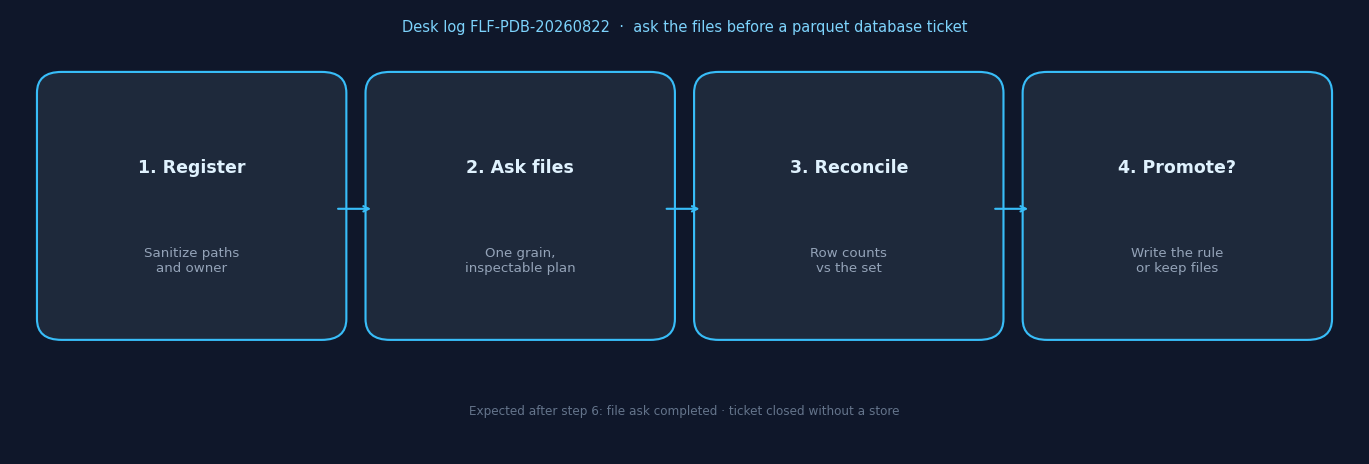
Figure. Educational four-step sequence the desk uses to tell a ticket-first habit from asking the files. Expected result after step 6: file ask completed and the ticket closed without a store. Not a product screenshot or a customer SLA.
Register the files as the source
Sanitize, then register paths and owner. A parquet database ticket does not sanitize for you. If the set is a folder of parts, apply the shared-grain test in upload a folder for data analysis. If you are still choosing formats, use file formats for AI analysis.
Name the allowed use. An orphan dump is not improved by loading it.
Ask one grain on the files
Write the grain, the window, and the denominator. Run the ask. Inspect the plan and the row count. If this fails, a store will fail the same way. Fix the files or the note. Do not file a parquet database ticket to hide the failure.
Write the promotion rule before anyone builds
Promotion language is boring on purpose: “Load when three teams ask the same grain daily, types have been stable for two windows, and roles must be finer than one upload.” If that sentence is false, keep the files. If it becomes true, load—and keep the path in the trail.
Exploratory data analysis happens on the files. The store is for a habit you can already describe.
Desk Sample: Ticket Avoided for Six Weeks
This is a first-party InfiniSynapse desk log of asking the files before inventing a parquet database, not a named-logo customer case and not an uplift claim. Run ID: FLF-PDB-20260822. Date: 2026-08-22 (Saturday). Last verified on this page: 2026-08-29. Operator: InfiniSynapse Data Team. Sources: twelve weekly parquet parts, about 4.0 million rows, plus a platform ticket titled “stand up a store for returns.” Contrast: ticket-first versus ask the files first. Download the same numbers as desk log FLF-PDB-20260822 · aggregate CSV · verify script.
The ticket-first path opened the store request before anyone wrote the grain. The files were not asked. No promotion rule was written. The ticket stayed open for six weeks.
The file-first path asked: “Return rate by SKU for the last six complete weeks, denominator = orders.” The files answered it after a sanitize pass and a week-9 type note. The ticket was closed without a store. A later hourly dashboard for three squads did justify a load—after the grain was already proven.
| Retrieval state | File ask completed | Ticket closed without store | Promotion rule written |
|---|---|---|---|
| Ticket-first | 0 | 0 | 0 |
| Ask the files first | 1 | 1 | 1 |
That is the split: a parquet database is not the first move. Asking the set is. The warehouse was a promotion, not the cover charge. Wall clock for the successful file ask was about ten minutes (warehouse time excluded; the six-week ticket wait is the contrast, not this clock). The clock started when the operator opened the standing goal and ended when the file pack and the closed ticket sat side by side with the promotion rule written as false. It does not include replica provisioning. Cite this table as InfiniSynapse desk log FLF-PDB-20260822. Do not cite it as customer ROI, a faster catalog, a bake-off win, or a Dublin Core / Library of Congress / Apache experiment. We do not publish named-logo customer cases on this page. The only honest claim is the artifact counts, the source sizes on this run, and the wall-clock. The twelve weekly parts and ~4.0 million rows are this desk run’s inputs, not a customer extract.
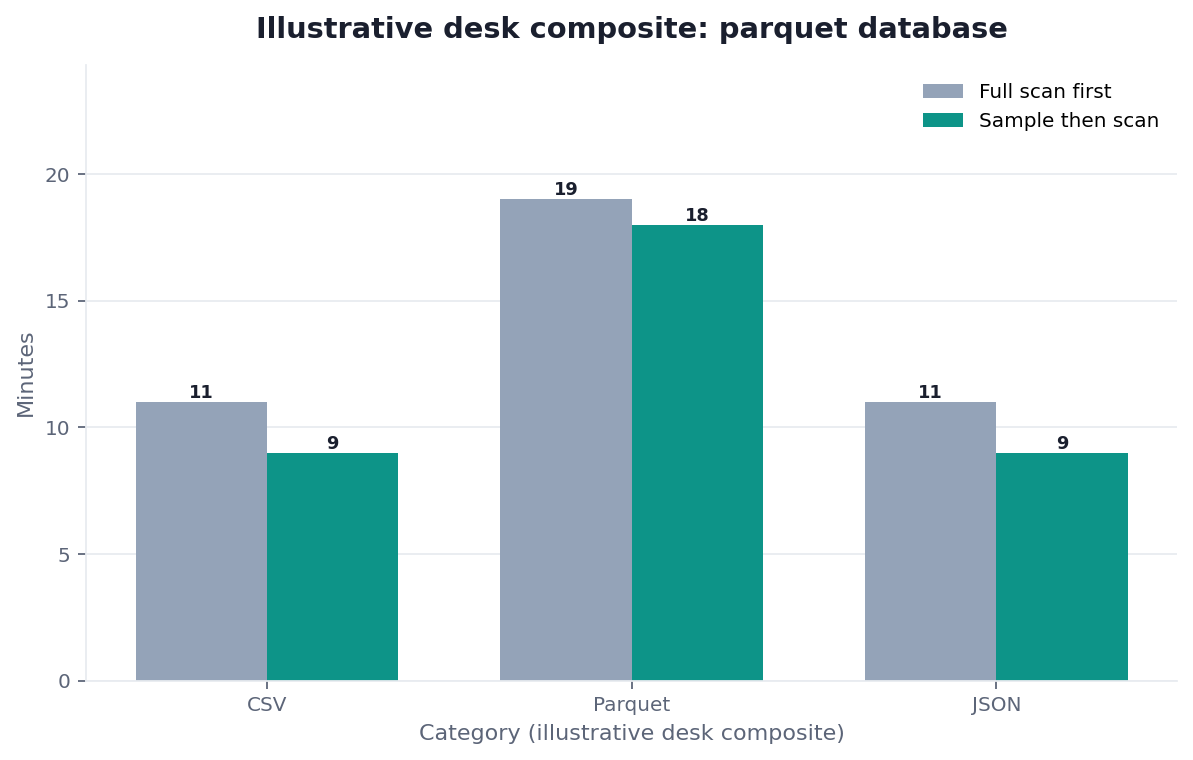
Figure. InfiniSynapse desk log FLF-PDB-20260822: ticket-first left 0 / 0 / 0; ask the files first left 1 / 1 / 1. Published context: the independent sources linked in the body. Not a customer experiment, SLA, or official benchmark.
| Evidence class | What you can cite | What you cannot claim |
|---|---|---|
| Desk log on this page | Artifact counts 0/0/0 → 1/1/1, 12 weekly parts + ~4.0M rows on this run, ~10 min wall-clock, downloadable log · CSV · verify | Customer uplift %, vendor bake-off win, named-logo case |
| Independently hosted published docs | DuckDB Parquet guide, Apache Arrow, Apache parquet-format (retrieved 2026-08-29) | That those engines ran this desk log |
| Independent method notes | W3C DCAT, DataCite, DCMI Metadata Terms, ISO/IEC 9075 (retrieved 2026-08-29) | That W3C, DataCite, or ISO certified this page |
| Homepage recognition | 2026 WAIC Future Tech OPC Excellence Award as published on the company homepage (self-described; not independently verified here) | That WAIC, LOC, or Gartner scored this article |
Scorecard: Files, Database, or Warehouse
| Signal | Ask the files | Local engine on files | Build a parquet database / warehouse |
|---|---|---|---|
| One team, one grain, this week | Yes | Optional | No |
| Types or partitions unknown | Profile files first | No | No |
| Same grain, many consumers, hourly | Temporary | Temporary | Yes |
| Dual numbers already appearing | Pick one surface | Dangerous | Dangerous until canonical |
| Secrets in the set | Do not upload | Do not load | Do not load |
If you cannot state the promotion rule in one sentence, you are not ready for a parquet database. Ask the files. Write the rule. Then decide.
The scorecard is an educational rubric for a parquet database decision, not a vendor ranking. Independent sources linked above describe published posture; they do not score this rubric.
Failure Modes
Catalog-as-courage
A store ticket becomes proof that the team is “serious.” The grain stays unwritten. Fix: require a successful file ask before anyone files a parquet database request.
Dual surfaces
Files and store disagree, and both get cited. Fix: write the canonical surface. Data governance owns that sentence. A second parquet database does not make the first number true.
SQL that no longer names a path
After the load, the trail shows a table name and no file. Monday drifts. Nobody can replay. Fix: keep path and part list in the task even after promotion. A parquet database that erases provenance is a worse source than the folder.
Before you invent a store for a question that already lives in the set, check three things: whether the files already answer the grain, whether a promotion rule is written, and whether you can name one canonical surface. Those three checks are how you avoid a parquet database you do not need.
Route the same diagnosis to the live guide that owns the next object. Each row is a single hop, not a reading dump.
| Live guide | Open it when |
|---|---|
| Parquet file analysis | you need the whole file-lake map |
| analyze a database without ETL | the next object is a live engine you already have |
| what is a data agent | you need the inspectable plan |
| analyze parquet files | you need the two-plan method on the files |
| Upload a Folder for Data Analysis | A directory is a source when the files share a grain |
| File Formats for AI Analysis | Pick the format that already matches the grain |
Ask the files before you invent a warehouse
Add the sanitized Parquet set as a file source, run one grain, inspect the plan and row counts, and only then write a promotion rule. This check uses only sources you authorize.
Commercial association: You do not need the workspace to complete the educational diagnosis on this page.
Open InfiniSynapseHow this page is sourced. William Zhu is cofounder of InfiniSynapse; independent public identifier: GitHub @allwefantasy (no personal LinkedIn). Institution: About InfiniSynapse. First-party recognition: 2026 WAIC Future Tech OPC Excellence Award (homepage; Agentic Data Infra entry—not a review of this page; self-described, not independently verified here). Trust pages: Privacy · publishing terms · NIST Privacy Framework. Desk methodology note: 2026-07-29 attestation. Downloadable first-party run: desk log
FLF-PDB-20260822. Reviewed by analytics engineering · data platform · LLM security · editor. Editorial standards · corrections · Contact zhuhl@infinisynapse.com. Company About. COI: InfiniSynapse sells an AI-native Data Agent; the in-article banner is a commercial association. Fact-check: Stanford HAI AI Index · McKinsey State of AI · Gartner Peer Insights — Analytics & BI · DCMI Metadata Terms · Schema.org documents · MODS User Guidelines · EAD3 Tag Library · MARC 21 Bibliographic · Apache Parquet file format · Apache parquet-format · Apache Arrow documentation · DuckDB Parquet guide · W3C DCAT · DataCite · ISO/IEC 9075 · ISO/IEC 27017. First-party numbers on this page are desk logFLF-PDB-20260822only.
How to cite this page
Page: Zhu, W., & InfiniSynapse Data Team. (2026). Parquet Database: Bind, Then Replay. InfiniSynapse
Run: InfiniSynapse Data Team. (2026). Desk log FLF-PDB-20260822 (sanitized composite)
Neither is an audit. Cite those published artifact counts when you quote parquet database figures from this first-party sanitized desk run. As of 2026-08-29, no independent evaluation, media citation, or reproduction of the ticket-versus-files contrast exists. DuckDB Parquet guide, DataCite, and W3C DCAT stay citable as published files. They do not replace this first-party desk log. Cite those hosted catalogs only as their own published series. Keep that limit visible here now for later readers. Do not invent a news mention this page does not have as of this retrieval date. Send contradictions to zhuhl@infinisynapse.com.
Frequently Asked Questions
Do I need a parquet database to query Parquet?
Bottom line: No. You need an authorized set, a grain, and an inspectable plan. A parquet database is a later store for a shared habit, not a cover charge.
Is a local query engine the same as a database?
Bottom line: It is a second surface. Fine for laptop iteration if you already staff it. It still is not required before you ask the files. Do not let a local engine become an unofficial parquet database with no owner.
When should I load a warehouse?
Bottom line: When many teams need the same proven grain on a schedule, and roles must be finer than one upload. Until then, ask the files. A parquet database ticket without that sentence is early.
What if my chat tool only “works” after a load?
Bottom line: Change the source, not the grain. A data agent can ask authorized files. If a tool refuses files, that is a tool limit, not a reason to invent a parquet database first.
How do I keep the store from erasing the files?
Bottom line: Write the path into every promoted task. The catalog card points at the object. A parquet database that drops provenance is a finding aid with no boxes.
Do Dublin Core, LOC, or Apache certify this desk store test?
Bottom line: No. DCMI Metadata Terms, MARC 21 Bibliographic, and Apache Parquet file format describe published posture, not this parquet database desk table.
Did Apache, DataCite, or a news outlet recognize this page?
Bottom line: No. Apache parquet-format and DataCite publish the format and citation infrastructure. They did not evaluate InfiniSynapse. There is no media citation of parquet database on this page, and there is no personal LinkedIn to add.
Conclusion
You do not need a parquet database to ask a Parquet set. Authorize the files. Name the grain. Inspect the plan. Promote only when a written rule says many consumers need a store. Keep one canonical surface.
When a parquet database is the first ticket, you are usually avoiding the files. Ask them. If you want to try that check on a sanitized set you already own, open InfiniSynapse and run the same grain on the source you just authorized—before anyone invents a catalog.