File Formats for AI Analysis: Bind, Then Replay
By William Zhu (independent public engineering profile: GitHub @allwefantasy; no personal LinkedIn) & the InfiniSynapse Data Team · Published: 2026-08-22 · Last updated: 2026-09-24 · Last verified: 2026-08-29 · Next review: 2026-11-29 · About · Editorial standards · Privacy · Terms of Service · Corrections
Table of Contents
- TL;DR
- What Format-Matches-Grain Means
- A Format-Choice Framework
- How Teams Pick Formats by Habit
- Tool Landscape across 100+ Formats
- How to Choose One Format and Ask
- Desk Sample: Same Week, Three Formats
- Scorecard: Which Format Stays Canonical
- Failure Modes
- How to cite this page
- Frequently Asked Questions
- Conclusion
TL;DR
We evaluate these patterns at the InfiniSynapse desk on sanitized composites; first-party figures on this page are desk log FLF-FFA-20260822, not customer uplifts and not a third-party bake-off.
Direct answer: The best file format for AI to read is the one that already holds the grain. Parquet for typed tables, JSON for nests, Excel or CSV for a small edit. Do not convert everything to CSV so a chat “can see it.” Upload the format you trust, then ask.
What you'll learn:
- How to choose file formats for ai analysis without a warehouse-first conversion
- When Parquet, JSON, CSV, Excel, or a directory is the honest surface
- A register → pick-canonical → ask loop across 100+ readable formats
- Desk log
FLF-FFA-20260822, which checks one week that existed as three files - Failure modes: conversion-as-cleansing, dual-canonical weeks, and secrets that survive a “Save As”
Download evidence: desk log · aggregate CSV · verify script. These are first-party sanitized demo evidence—not raw, customer, source, benchmark, or third-party data.
If you still need the file-lake overview, open Parquet file analysis. This page is narrower: choosing file formats for ai analysis among files you already have.
Industry context stays independent of desk claims. McKinsey’s State of AI and Gartner Peer Insights — Analytics & BI describe adoption pressure; they did not run the desk table below. The Stanford HAI AI Index is a buyer-research overlay, not an endorsement of this article. Retrieved 2026-08-29.
What Format-Matches-Grain Means
Key Definition: File formats for ai analysis are the on-disk shapes you authorize as sources—Parquet, JSON, CSV, Excel, directories, and the rest of a 100+ format list—chosen because they already hold the grain, not because a tool prefers rectangles. The format is a contract. Conversion is a modeling decision.
Independent published context (separate from this page’s desk log): RFC 4180 CSV · RFC 8259 JSON · ISO/IEC 21778 · Apache Parquet documentation · Apache parquet-format · IANA media types · W3C tabular data model · DataCite · arXiv availability policy · ACM Artifact Review and Badging · Nature reporting standards · ISO/IEC 27017:2015 · ITU ICT statistics. Those sources treat the deposited shape as part of the claim; they did not run the numbers below, and they are not a product award or a recognition of this page.
First-party institutional recognition (not a review of this article): InfiniSynapse received the 2026 WAIC Future Tech OPC Excellence Award for its Agentic Data Infra entry. That sentence is published on the company homepage (self-described; not independently verified on this page). It is not an ACM, Nature, ITU, IANA, DataCite, Gartner, or McKinsey product award, and it does not certify the desk numbers below. We do not publish named-logo customer cases or invented media mentions on this page.
Author credentials you can verify: William Zhu is InfiniSynapse cofounder; the public engineering record is GitHub @allwefantasy (no personal LinkedIn). The org record is github.com/InfiniSynapse. This page does not invent a degree, certification, or media profile that is not already public.
arXiv availability policy (retrieved 2026-08-29) and ACM Artifact Review and Badging (retrieved 2026-08-29) treat the deposited artifact as part of the claim: the file the experiment produced is the file you compute on. Nature reporting standards (retrieved 2026-08-29) likewise treat the deposited file as evidence, not as a hint to flatten first. DataCite (retrieved 2026-08-29) is independently hosted published citation infrastructure a reviewer can reopen without this first-party desk. Copy that respect when choosing a source: pick the file that already answers, then ask.
This page has no ISO, IANA, ACM, Nature, SOC, media, or independently verified award certificate when you pick file formats for ai analysis. Independent method notes still bind file formats for ai analysis. IANA media types (retrieved 2026-08-29) is the published registry of interchange labels—use it as an independent definition of the type string, not as a review of this product. W3C tabular data model (retrieved 2026-08-29) is independently hosted published table semantics. ISO/IEC 21778 (retrieved 2026-08-29) and Apache parquet-format (retrieved 2026-08-29) remain the JSON syntax and the columnar footer contract. None of those publishers evaluated InfiniSynapse, this page, William Zhu, or FLF-FFA-20260822. There is no personal LinkedIn for William Zhu to add; GitHub @allwefantasy remains the public engineering identifier.
If the grain is nested, continue in analyze json files. If the grain is columnar and wide, continue in analyze parquet files. Those pages are methods. This page is the choice.
Why you pick the format that already matches the grain
Teams convert because they have one favorite tool. The cost is a silent grain change and a second file nobody owns. When you choose file formats for ai analysis, the test is: does this file already have the entity, the date, and the metric I will name? If yes, stop converting. If no, say what the conversion will invent.
This is still data management: one canonical file per week. Cloud-control language in the ISO/IEC 27017 cloud security standard (retrieved 2026-08-29) is a reminder that each extra copy is another access decision.
A Format-Choice Framework
Treat format as a lock, not a preference, when you choose file formats for ai analysis. A warehouse load is a later promotion of the winner.
| Stage | What you lock | What you refuse |
|---|---|---|
| Register | Path, format, owner, allowed use | Three “equivalent” dumps of the same week |
| Choose | The file whose grain matches the ask | “CSV because the chat likes CSV” |
| Profile | Types, nests, partitions, sheet names | “It opened” |
| Ask | Grain, window, and the canonical path | “Analyze all the files” |
| Promote | One written winner | A new conversion every Monday |
Telecom indicator sets from ITU ICT statistics (retrieved 2026-08-29) only work when the published format is the one you compute on. Do not “help” the file into a friendlier extension first. That is the public version of file formats for ai analysis: compute on the deposited shape.
Register, profile, then ask
When you pick file formats for ai analysis, registration includes which sibling is canonical. Same week as JSON and Parquet is common. Profile both. Pick one. Ask that one. If you need the other later, say you are changing source.
Grain and format families
- Columnar (Parquet): typed, wide, repeated scans. Best when the grain is already a table. See Apache Parquet documentation (retrieved 2026-08-29).
- Nested (JSON): events with arrays. Best when explode would lie. The interchange contract is RFC 8259 (retrieved 2026-08-29).
- Interchange (CSV): human email, ten columns, RFC 4180 (retrieved 2026-08-29) text. Fine until types lie.
- Workbook (Excel): edited cells, multiple sheets. Fine until you cannot name the sheet and the header row.
- Directory: dated parts that share a grain. A lake in miniature.
The method is the same across 100+ readable formats: authorize, select, ask. Quality is not the same across them. File formats for ai analysis still need a named grain.
When a warehouse still helps
You still want a warehouse when many teams query the winning format’s grain every hour, or when you need roles beyond one upload. File-first analysis is the step before you pay for that habit when you pick file formats for ai analysis. Converting a one-off Excel into a warehouse table because “AI needs SQL” is delay. Natural language to SQL is a different problem. Here the file is the source.
How Teams Pick Formats by Habit
Convert-to-CSV versus pick-then-ask
The common path is: export, Save As CSV, upload, hope types survive. That is how file formats for ai analysis get worse. CSV drops types. JSON nests die. Excel sheet names vanish. Chat with your data on a degraded copy is not faster; it is a second clean-up.
Use conversion when you are publishing a simpler interchange for a human, not when you pick file formats for ai analysis. Use the original when you ask a metric. Do not convert because a demo used a spreadsheet. File formats for ai analysis start with the original.
Tool Landscape across 100+ Formats
| Pattern | Fits | Breaks |
|---|---|---|
| Spreadsheet + copilot | Small Excel/CSV you can see | Columnar dumps and nested events |
| Always-load-warehouse | Shared, hourly grains | Format shopping on a deadline |
| File source + named path | Authorized original format, then a goal | Dual-canonical weeks; secrets in copies |
| Custom conversion jobs | Lakes you already staff | A team that only has Monday’s export |
The third pattern is educational, not a product requirement: you still pick file formats for ai analysis, then authorize the original. It does not invent a catalog of 100+ formats for you, and it does not write a converted file back to production. You still choose file formats for ai analysis with a grain test.
If the next object is a live store, use analyze a database without ETL. If you need a picture after the grain is named, data visualization is display, not format choice.
How to Choose One Format and Ask
The method is short when you pick file formats for ai analysis. The discipline is in what you refuse to skip.
- Strip secrets. Register every sibling path, format, and owner.
- Profile types, nests, partitions, or sheet names on each copy.
- Pick the file whose grain already matches the ask. Write the winner.
- Ask one goal that names that winner. Run it.
- Bind a short note and re-run the same goal.
- Hand the dated pack to a colleague. Refuse a screenshot of the chat.
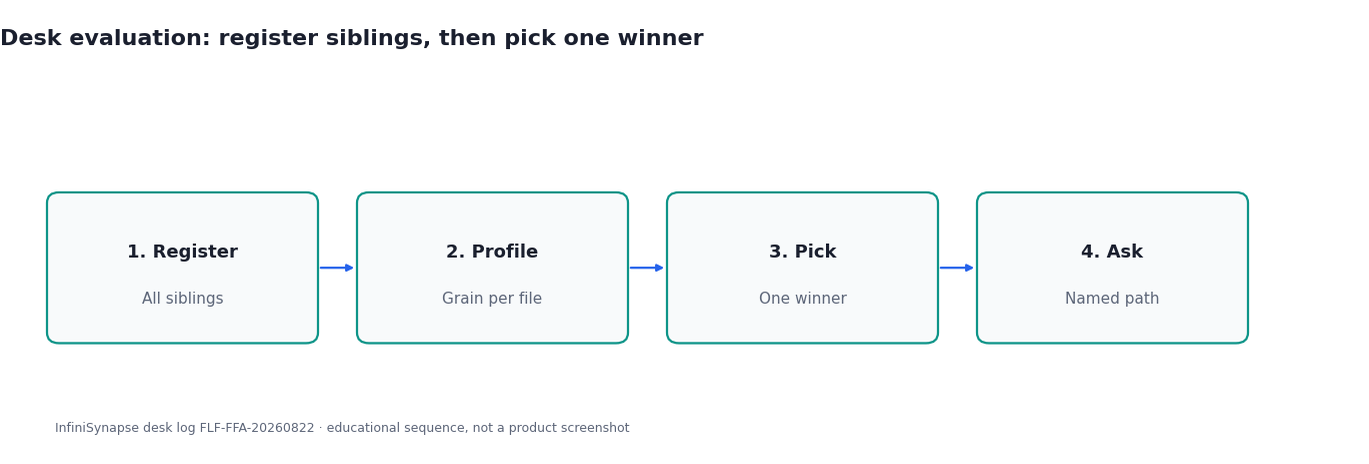
Figure. Educational four-step sequence the desk uses to tell a convert-to-CSV habit from picking by grain. Expected result after step 6: Parquet typed orders and the winner named in the note. Not a product screenshot or a customer SLA.
Upload the sanitized original
Strip secrets, then upload the file you will treat as canonical. If you also made a CSV “for the bot,” do not upload both unless you say which one wins. That choice is the whole of file formats for ai analysis on a deadline. When you choose file formats for ai analysis, extra copies are extra incidents.
Name the owner and the format family. An orphan export_final2.xlsx becomes next quarter’s mystery metric.
Ask a question that names grain and the winner
“Return rate by SKU on the Parquet week, not the JSON nest, last six partitions, denominator = orders” is a question. “Analyze the files” is not. State which format is in. If you later switch to JSON for a nest-only field, write that you switched.
File formats for ai analysis fail in meetings when two people used two copies. Bind the winner in a note, then re-ask.
Inspect types, paths, and row counts
Open whether the run read Parquet columns, JSON paths, or an Excel sheet. Reconcile row counts to the file you meant. If you pick file formats for ai analysis and skip this inspect, you will read the small copy. A “fast” answer can mean it read the small CSV copy you forgot to delete.
Re-run after the note names the winner. The second run is how you learn which format actually holds the grain. First-look method still sits in exploratory data analysis.
Desk Sample: Same Week, Three Formats
This is a first-party InfiniSynapse desk log of how we pick file formats for ai analysis across three files, not a named-logo customer case and not an uplift claim. Run ID: FLF-FFA-20260822. Date: 2026-08-22 (Saturday). Last verified on this page: 2026-08-29. Operator: InfiniSynapse Data Team. Sources: one week as a 4.2-million-row Parquet, a 180,000-event JSON nest, and a 40-column CSV email. Contrast: pick by habit (convert to CSV first) versus pick by grain. Download the same numbers as desk log FLF-FFA-20260822 · aggregate CSV · verify script.
The habit path converted everything to CSV “so the chat could see it.” Parquet types were dropped. The JSON explode was not refused. A winner was not named.
That is a file formats for ai analysis decision, not a taste in extensions. The grain path asked: “Return rate by SKU, denominator = orders.” The JSON could not name orders without an invented explode. The CSV had orders as text and a thousands-separator. The Parquet already typed the grain. The task registered all three, picked Parquet as canonical, and asked once. A second draft that “also included the CSV” double-counted after a silent type coerce—visible because row counts disagreed.
| Retrieval state | Parquet typed orders | JSON explode refused | Winner named |
|---|---|---|---|
| Pick by habit (CSV first) | 0 | 0 | 0 |
| Pick by grain | 1 | 1 | 1 |
That is how you pick file formats for ai analysis: the original that already matches the grain wins. Wall clock for the successful grain rerun was about ten minutes (warehouse time excluded). The clock started when the operator opened the standing goal and ended when all three files sat side by side with the winner note open. It does not include replica provisioning. Cite this table as InfiniSynapse desk log FLF-FFA-20260822. Do not cite it as customer ROI, a faster conversion, a bake-off win, or a Nature / ACM / ITU experiment. We do not publish named-logo customer cases on this page. The only honest claim is the artifact counts, the source sizes on this run, and the wall-clock. The 4.2M-row Parquet, 180k-event JSON, and 40-column CSV are this desk run’s inputs, not a customer extract.
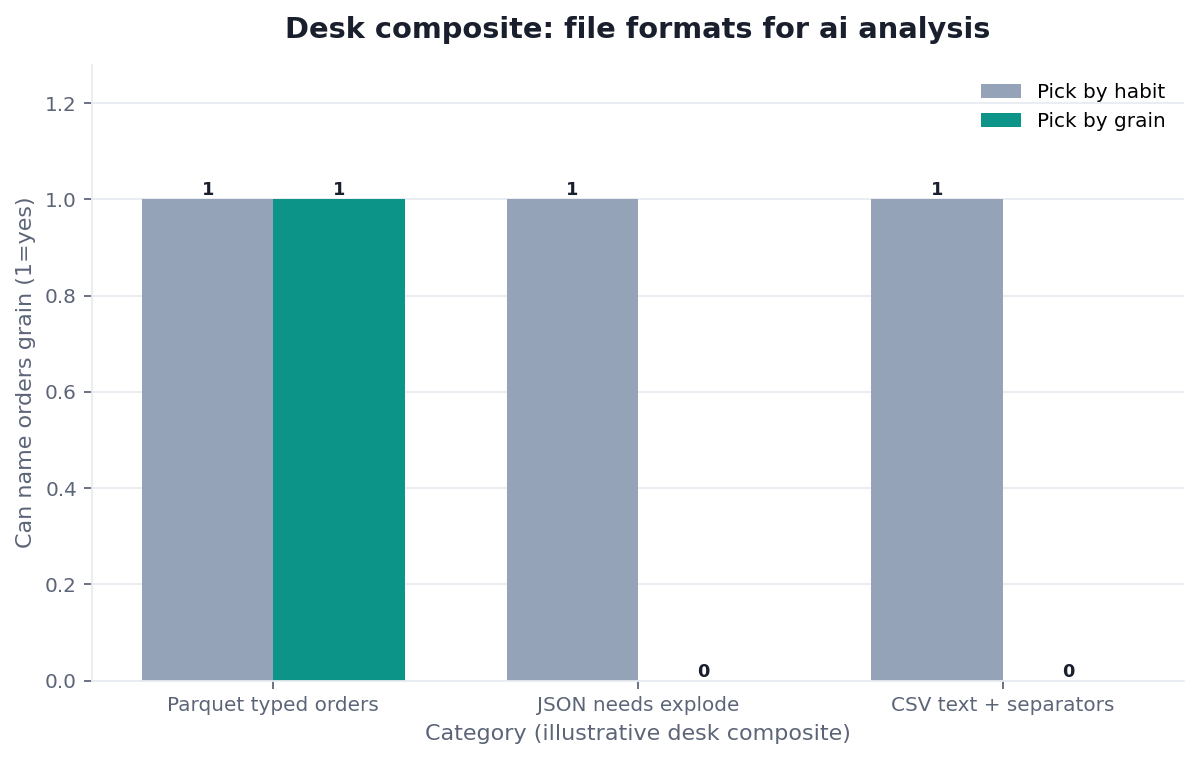
Figure. InfiniSynapse desk log FLF-FFA-20260822: pick by habit left 0 / 0 / 0; pick by grain left 1 / 1 / 1. Published context: the independent sources linked in the body. Not a customer experiment, SLA, or official benchmark.
| Evidence class | What you can cite | What you cannot claim |
|---|---|---|
| Desk log on this page | Artifact counts 0/0/0 → 1/1/1, one week as Parquet + JSON + CSV on this run, ~10 min wall-clock, downloadable log · CSV · verify | Customer uplift %, vendor bake-off win, named-logo case |
| Independently hosted published data | ITU ICT statistics, DataCite (retrieved 2026-08-29) | That those agencies ran this desk log |
| Independent method notes | IANA media types, W3C tabular data model, ISO/IEC 21778, Apache parquet-format (retrieved 2026-08-29) | That IANA, W3C, ISO, or Apache certified this page |
| Homepage recognition | 2026 WAIC Future Tech OPC Excellence Award as published on the company homepage (self-described; not independently verified here) | That WAIC, Nature, or Gartner scored this article |
Scorecard: Which Format Stays Canonical
| Signal | Stay on that format | Convert or load |
|---|---|---|
| Grain already typed in Parquet | Yes | Optional later |
| Grain is a nest you must not explode | JSON | Do not CSV it first |
| Ten columns, human edit | Excel/CSV | Fine |
| Dated parts, same grain | Folder | Warehouse if hourly shared |
| Two “equivalent” copies | Pick one | Do not load both |
| Secrets in any copy | Do not upload | Do not convert either |
If you cannot name the winner in one sentence, do not ask a metric. When file formats for ai analysis fail this test, the honest output is an inventory, not a chart.
The scorecard is an educational rubric for file formats for ai analysis, not a vendor ranking. Independent sources linked above describe published posture; they do not score this rubric.
Failure Modes
Conversion treated as cleansing
Saving Parquet as CSV “so AI can read it” drops types and invites quoting bugs. Fix: upload the original. Choose file formats for ai analysis with a grain test, not a habit.
Dual-canonical weeks
JSON and Parquet both get asked “a little.” Metrics drift by explode and by type. Fix: one winner per week. Write the switch if you change.
Secrets that survive Save As
A converted file still holds the email column you thought you deleted. Fix: sanitize the canonical file. If you cannot, do not upload any of the copies.
Before you file a warehouse ticket for a question that already lives in Monday’s export, check three things: which format matches the grain, whether a second copy is still in play, and whether the winner is sanitized enough to authorize. Those three checks are how you pick file formats for ai analysis without converting first.
Route the same diagnosis to the live guide that owns the next object. Each row is a single hop, not a reading dump.
| Live guide | Open it when |
|---|---|
| Parquet file analysis | you need the whole file-lake map |
| semantic layer | the next fight is metric meaning, not file shape |
| what is a data agent | you need the job description |
| Upload a Folder for Data Analysis | A directory is a source when the files share a grain |
| CSV vs Parquet for AI Analysis | Leave CSV when width, types, or size start lying |
| Local Files to an AI Data Analyst | My Data is a source, not an email attachment |
Choose one format and ask the first question
Add a file source, pick the format that already matches the grain, and ask one goal that names that winner. This check uses only sources you authorize.
Commercial association: You do not need the workspace to complete the educational diagnosis on this page.
Open InfiniSynapseHow this page is sourced. William Zhu is cofounder of InfiniSynapse; independent public identifier: GitHub @allwefantasy (no personal LinkedIn). Institution: About InfiniSynapse. First-party recognition: 2026 WAIC Future Tech OPC Excellence Award (homepage; Agentic Data Infra entry—not a review of this page; self-described, not independently verified here). Trust pages: Privacy · publishing terms · NIST Privacy Framework. Desk methodology note: 2026-07-29 attestation. Downloadable first-party run: desk log
FLF-FFA-20260822. Reviewed by analytics engineering · data platform · LLM security · editor. Editorial standards · corrections · Contact zhuhl@infinisynapse.com. Company About. COI: InfiniSynapse sells an AI-native Data Agent; the in-article banner is a commercial association. Fact-check: Stanford HAI AI Index · McKinsey State of AI · Gartner Peer Insights — Analytics & BI · RFC 4180 · RFC 8259 · ISO/IEC 21778 · Apache Parquet documentation · Apache parquet-format · IANA media types · W3C tabular data model · DataCite · arXiv availability policy · ACM Artifact Review and Badging · Nature reporting standards · ISO/IEC 27017 · ITU ICT statistics. First-party numbers on this page are desk logFLF-FFA-20260822only.
How to cite this page
Page: Zhu, W., & InfiniSynapse Data Team. (2026). File Formats for AI Analysis: Bind, Then Replay. InfiniSynapse
Run: InfiniSynapse Data Team. (2026). Desk log FLF-FFA-20260822 (sanitized composite)
Neither is an audit. Cite those published artifact counts when you quote file formats for ai analysis figures from this first-party sanitized desk run. As of 2026-08-29, no independent evaluation, media citation, or reproduction of the habit-versus-grain contrast exists. IANA media types, DataCite, and ITU ICT statistics stay citable as published files now. Send contradictions to zhuhl@infinisynapse.com.
Frequently Asked Questions
Which file formats for ai analysis should I start with?
Bottom line: Start with the file that already holds the grain. Parquet for typed tables, JSON for nests, Excel/CSV for small human edits, a folder for dated parts.
Do I need a warehouse if I have 100+ formats?
Bottom line: No. File formats for ai analysis can stay on the file. Load a warehouse when many teams need the same grain on a schedule.
Should I convert everything to Parquet?
Bottom line: Only when the grain is already a table and you will rescan it. Converting a nest or an edited sheet just to “standardize” invents columns.
How do I know the run used the format I meant?
Bottom line: Inspect which path, sheet, or partition was read, and reconcile row counts. If two copies exist, stop and name the winner before you ask again. File formats for ai analysis fail when two copies stay selected.
When should I keep Excel or CSV?
Bottom line: When a person must edit ten columns this afternoon and types are still honest. File formats for ai analysis stay on Excel or CSV until the grain is already typed or nested elsewhere.
Do Nature, ACM, or ITU certify this format test?
Bottom line: No. Nature reporting standards, ACM Artifact Review and Badging, and ITU ICT statistics describe published posture, not this file formats for ai analysis desk table.
Did IANA, DataCite, or a news outlet recognize this page?
Bottom line: No. IANA media types and DataCite publish type labels and citation infrastructure. They did not evaluate InfiniSynapse. There is no media citation of file formats for ai analysis on this page, and there is no personal LinkedIn to add.
Conclusion
Format is a contract. That is file formats for ai analysis in practice. Pick file formats for ai analysis that already match the grain, register one winner, ask a goal that names it, and inspect counts before you convert or load a warehouse. Conversion is a modeling decision, not a prerequisite for asking. The warehouse is a promotion of the winner, not a cover charge for every export.
If you want to try that check on a sanitized file you already own, open InfiniSynapse and ask the same goal on the format you just authorized.