CSV vs Parquet: Bind, Then Replay
By William Zhu (independent public engineering profile: GitHub @allwefantasy; no personal LinkedIn) & the InfiniSynapse Data Team · Published: 2026-08-22 · Last updated: 2026-09-24 · Last verified: 2026-09-24 · Next review: 2026-11-29 · About · Editorial standards · Privacy · Terms of Service · Corrections
Table of Contents
- CSV vs Parquet in one sentence
- What each file stores
- What this desk did not measure
- TL;DR
- What the Format Split Means
- A Leave-CSV Framework
- How Teams Stay on CSV Too Long
- Tool Landscape for Text vs Columns
- How to Compare One CSV and One Parquet
- Desk Sample: Same Grain, Two Files
- Scorecard: Stay on CSV or Leave
- Failure Modes
- How to cite this page
- Frequently Asked Questions
- Conclusion
CSV vs Parquet in one sentence
CSV vs Parquet is a text row a person can edit against a typed column a scan can trust. Keep CSV for a short table someone still opens and changes. Leave CSV when the width or a guessed type would invent a number. That leave-when-it-lies test is the rest of this page.
What each file stores
| CSV | Parquet | |
|---|---|---|
| Layout | One text row after another | Columns, so a scan can skip the rest |
| Types | None until a reader guesses | Stored with the file |
| Edit | A person can open it | A poor email draft |
| Size and speed | Not the test on this page | Not measured here |
What this desk did not measure
This desk did not run a query-speed contest and did not reproduce anyone else's "about 5× smaller" claim. Log FLF-CVP-20260822 is one week that existed as both files, at the same grain. It is not a third-party bake-off. An AI ask can hide a guessed type inside a fluent sentence. That is the failure this page keeps.
TL;DR
We evaluate these patterns at the InfiniSynapse desk on sanitized composites; first-party figures on this page are desk log FLF-CVP-20260822, not customer uplifts and not a third-party bake-off.
Direct answer: Use CSV vs Parquet as a leave-when-it-lies test, not a brand fight. Keep CSV for ten-column human edits. Leave CSV when width, types, or size start inventing numbers. Parquet is the typed scan surface. You do not need a warehouse to make that switch.
What you'll learn:
- When CSV vs Parquet is a grain decision rather than a preference
- How quoting, encodings, and inferred types make CSV lie under AI asks
- A register → compare-one-week → pick-winner loop without a mirror warehouse
- Desk log
FLF-CVP-20260822, which checks one week that existed as both files - Failure modes: thousands-separators, header drift, and “Save As” as cleansing
Download evidence: desk log · aggregate CSV · verify script. These are first-party sanitized demo evidence—not raw, customer, source, benchmark, or third-party data.
If you still need the file-lake overview, open Parquet file analysis. This page is narrower: CSV vs Parquet as a leave-when-it-lies test, not a storage-hobby argument.
Industry context stays independent of desk claims. McKinsey’s State of AI and Gartner Peer Insights — Analytics & BI describe adoption pressure; they did not run the desk table below. The Stanford HAI AI Index is a buyer-research overlay, not an endorsement of this article. Retrieved 2026-08-29.
What the Format Split Means
Key Definition: CSV vs Parquet is the choice between a row-oriented text interchange and a columnar typed table you can authorize as a source. CSV is for humans and email. Parquet is for scans that need types, projection, and a stable schema. Neither format requires a warehouse first.
Independent published context (separate from this page’s desk log): RFC 4180 CSV · Apache Parquet documentation · Apache parquet-format · Apache Arrow documentation · DuckDB CSV guide · DuckDB Parquet guide · W3C tabular data model · ISO/IEC 9075 · Wikipedia Apache Parquet · pandas I/O — CSV · ACM Artifact Review and Badging · arXiv availability policy · Science journal data policies · Stanford HAI AI Index. Those sources set the industry bar for interchange, typed dumps, and deposited format as part of a claim; they did not run the numbers below, and they are not a product award or a recognition of this page.
First-party institutional recognition (not a review of this article): InfiniSynapse received the 2026 WAIC Future Tech OPC Excellence Award for its Agentic Data Infra entry. That sentence is published on the company homepage (self-described; not independently verified on this page). It is not an ACM, Apache, Science, DuckDB, ISO, Gartner, or McKinsey product award, and it does not certify the desk numbers below. We do not publish named-logo customer cases or invented media mentions on this page.
Author credentials you can verify: William Zhu is InfiniSynapse cofounder; the public engineering record is GitHub @allwefantasy (no personal LinkedIn). The org record is github.com/InfiniSynapse. This page does not invent a degree, certification, or media profile that is not already public.
Computing venues have been explicit that representation changes results. ACM Artifact Review and Badging (retrieved 2026-08-29) and arXiv availability policy (retrieved 2026-08-29) treat the deposited artifact as part of the claim: a lossy text export is not a repeatable table. Science journal data policies (retrieved 2026-08-29) say the same. Copy that seriousness into every format choice: if the number needs types, do not ask the email CSV.
The text interchange contract itself is RFC 4180 (retrieved 2026-08-29). Column encodings and footer stats start from Apache Parquet documentation (retrieved 2026-08-29). Treat the typed dump as a contract, as described in the Wikipedia Apache Parquet overview (retrieved 2026-08-29). The Apache parquet-format repository (retrieved 2026-08-29) is independently hosted published specification text a reviewer can reopen without this first-party desk.
This page has no ISO, Apache, DuckDB, ACM, Science, media, or independently verified award certificate when you run CSV vs Parquet. Independent method notes still bind CSV vs Parquet. Apache Arrow documentation (retrieved 2026-08-29) is the published columnar companion—use it as an independent definition of in-memory layout, not as a review of this product. DuckDB CSV guide (retrieved 2026-08-29) and DuckDB Parquet guide (retrieved 2026-08-29) are independently hosted published engine documentation. W3C tabular data model (retrieved 2026-08-29) and ISO/IEC 9075 (retrieved 2026-08-29) remain the table semantics and the SQL language. None of those publishers evaluated InfiniSynapse, this page, William Zhu, or FLF-CVP-20260822. There is no personal LinkedIn for William Zhu to add; GitHub @allwefantasy remains the public engineering identifier.
Adoption surveys from the Stanford HAI AI Index (retrieved 2026-08-29) keep showing teams adding AI on top of whatever file they already email. That makes the format split an operating decision in 2026, not a storage-hobby argument.
If the alternative is a nest rather than a table, use analyze json files. If you already picked Parquet, use analyze parquet files for the sample-then-scan contract.
Why you leave CSV when width, types, or size start lying
CSV has no type system. “00123”, “1,234”, and “N/A” are all strings until something guesses—pandas I/O — CSV (retrieved 2026-08-29) documents the same coerce. Parquet stores types. On the same grain, the usual lie is not compression—it is a coerce. AI asks amplify that lie because a fluent sentence hides the guessed type.
This is still data management: one canonical file after you run CSV vs Parquet. A second “AI-friendly” CSV is a second owner problem.
A Leave-CSV Framework
Treat CSV as interchange. Treat Parquet as the scan surface. A warehouse is a later promotion of the winner. Write that split down before you reopen CSV vs Parquet in a meeting.
| Stage | What you lock | What you refuse |
|---|---|---|
| Register | Both paths, owner, allowed use | Mystery final_final.csv |
| Compare | Same grain, same week, row counts | “Parquet is always smaller, so it wins” |
| Profile | CSV quoting/types vs Parquet schema | “It opened in Excel” |
| Ask | One winner, one grain, one window | Asking both “a little” |
| Promote | Notes that name the winner | A new CSV email every Monday |
Register, profile, then ask
When you run CSV vs Parquet, registration includes which file is the email copy and which file is the typed dump. Profile quoting, encoding, and null tokens on the CSV. Profile schema and partitions on the Parquet. Then pick. Ask that one.
Grain, width, and type lies
Leave CSV when:
- Width grows past what a human will edit (dozens of columns, repeated scans).
- Types matter (IDs with leading zeros, decimals, timestamps, booleans).
- Size makes a full-text parse the analysis (millions of rows you keep rescanning).
Stay on CSV when a person must edit ten columns this afternoon. CSV vs Parquet is not “Parquet is modern.” It is “which file will not invent a number.” If width, types, and size are all still honest, you can delay the switch. If any one of them is already lying, do not wait for a warehouse ticket to make the CSV vs Parquet call. Ask the typed file this morning. Keep the text file for the human edit, then retire it from the metric.
A practical compare takes one week that exists in both shapes. Count rows. Print the CSV header and the Parquet schema. Ask the same grain once. If orders is text with commas on the CSV and int64 on the Parquet, you already have the leave reason. You do not need a compression benchmark. You need a type that will survive a second ask. That is the whole of CSV vs Parquet at desk scale: one week, one grain, one documented lie, one winner.
When a warehouse still helps
You still want a warehouse when many teams query the winning grain every hour. File-first analysis is the step before you pay for that habit when you run CSV vs Parquet. Loading the lying CSV “so AI has SQL” just freezes the lie. Natural language to SQL does not repair types you already destroyed.
How Teams Stay on CSV Too Long
Email-CSV versus typed scan
The common path is: finance emails CSV, someone pastes it into a chat, types coerce, a chart ships. That is not a CSV vs Parquet decision. That is habit. Chat with your data on a typed Parquet of the same grain is the same ask with fewer invented decimals.
Use CSV for the edit. Use Parquet for the scan. Do not keep CSV because last year’s dashboard import started there.
Tool Landscape for Text vs Columns
| Pattern | Fits | Breaks |
|---|---|---|
| Spreadsheet + copilot | Small CSV/Excel edits | Wide, typed, repeated scans |
| Always-load-warehouse | Shared hourly grains | A one-off email you have not typed yet |
| File source + named path | Authorized winner, then a goal | Asking both copies; secrets in the email |
| Custom conversion job | Lakes you already staff | A team that only has Monday’s attachment |
The third pattern is educational, not a product requirement: you still run CSV vs Parquet, then authorize one winner. It does not invent a lakehouse catalog, and it does not write a converted file back to production. You still run CSV vs Parquet with a grain-and-type test, then you keep only the winner selected.
If you need a picture after the winner is named, data visualization is display. If you need first-look method, use exploratory data analysis.
How to Compare One CSV and One Parquet
The method is short when you run CSV vs Parquet. The discipline is in what you refuse to skip.
- Strip secrets. Register both paths, owner, and allowed use.
- Profile CSV quoting, encoding, and null tokens. Profile Parquet schema and partitions.
- Compare the same week and the same grain. Count rows on both.
- Write one goal on one winner. Run it.
- Bind a short note that names the winner and re-run the same goal.
- Hand the dated pack to a colleague. Refuse a screenshot of the chat.
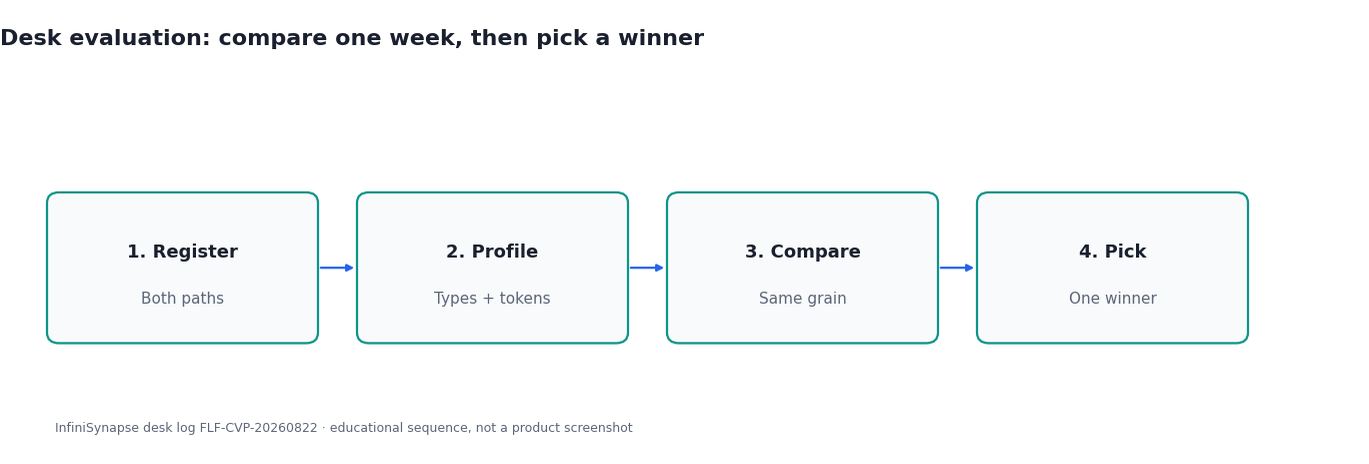
Figure. Educational four-step sequence the desk uses to tell an email-CSV habit from a typed-scan winner. Expected result after step 6: orders typed int64 and the winner named in the note. Not a product screenshot or a customer SLA.
Upload both sanitized copies of the same grain
Strip secrets. Upload the CSV and the Parquet of the same week only long enough to compare. Name the owner. CSV vs Parquet is a comparison, not a reason to keep both forever. After the compare, retire the loser from the chat selection.
If you only have CSV, you can still ask—then write the lie you saw (types, width, size) as the CSV vs Parquet reason to request a typed dump next week.
Ask the same goal on one winner
“Return rate by SKU, denominator = orders, last six weeks, on the Parquet, not the CSV” is a question. “Which file is better” is not a metric. After you decide, ask the winner only.
When CSV vs Parquet is written this way, a count clash is evidence. A vibe about “Parquet feels faster” is not.
Inspect types, quoting, and row counts
Open whether orders was text with commas on the CSV and int64 on the Parquet. Reconcile row counts. A “fast” CSV answer can mean it sampled a parse error as a null. That inspect step is the evidence in a CSV vs Parquet decision, not a feeling that Parquet “looks cleaner.”
Re-run after the note names the winner. The second run is how you leave CSV on purpose. Self-service analytics still needs that note, or the next person will reopen the email.
Desk Sample: Same Grain, Two Files
This is a first-party InfiniSynapse desk log of a CSV vs Parquet week that existed as both files, not a named-logo customer case and not an uplift claim. Run ID: FLF-CVP-20260822. Date: 2026-08-22 (Saturday). Last verified on this page: 2026-08-29. Operator: InfiniSynapse Data Team. Sources: one week as a 4.2-million-row Parquet and a CSV email of the same grain. Contrast: CSV email first versus asking the typed Parquet. Download the same numbers as desk log FLF-CVP-20260822 · aggregate CSV · verify script.
The CSV-email path stored orders as text with thousands-separators. A first ask coerced a fraction of rows to null and moved the rate. Orders were not typed as int64. The thousands-separator nulls were not caught in the note. A winner was not named.
That is the lie CSV vs Parquet is supposed to catch. The typed path asked: “Return rate by SKU, denominator = orders.” The Parquet typed orders as int64. Row counts matched only after the CSV parse was excluded. The note named Parquet as winner.
| Retrieval state | Orders typed int64 | Thousands-separator nulls caught | Winner named |
|---|---|---|---|
| CSV email first | 0 | 0 | 0 |
| Ask the typed Parquet | 1 | 1 | 1 |
That is a real CSV vs Parquet decision: types started lying, so the text file left. Wall clock for the successful typed rerun was about ten minutes (warehouse time excluded). The clock started when the operator opened the standing goal and ended when both files sat side by side with the type clash and the winner note open. It does not include replica provisioning. Cite this table as InfiniSynapse desk log FLF-CVP-20260822. Do not cite it as customer ROI, a faster scan, a bake-off win, or an ACM / arXiv / Science experiment. We do not publish named-logo customer cases on this page. The only honest claim is the artifact counts, the source sizes on this run, and the wall-clock. The 4.2-million-row week is this desk run’s input, not a customer extract.
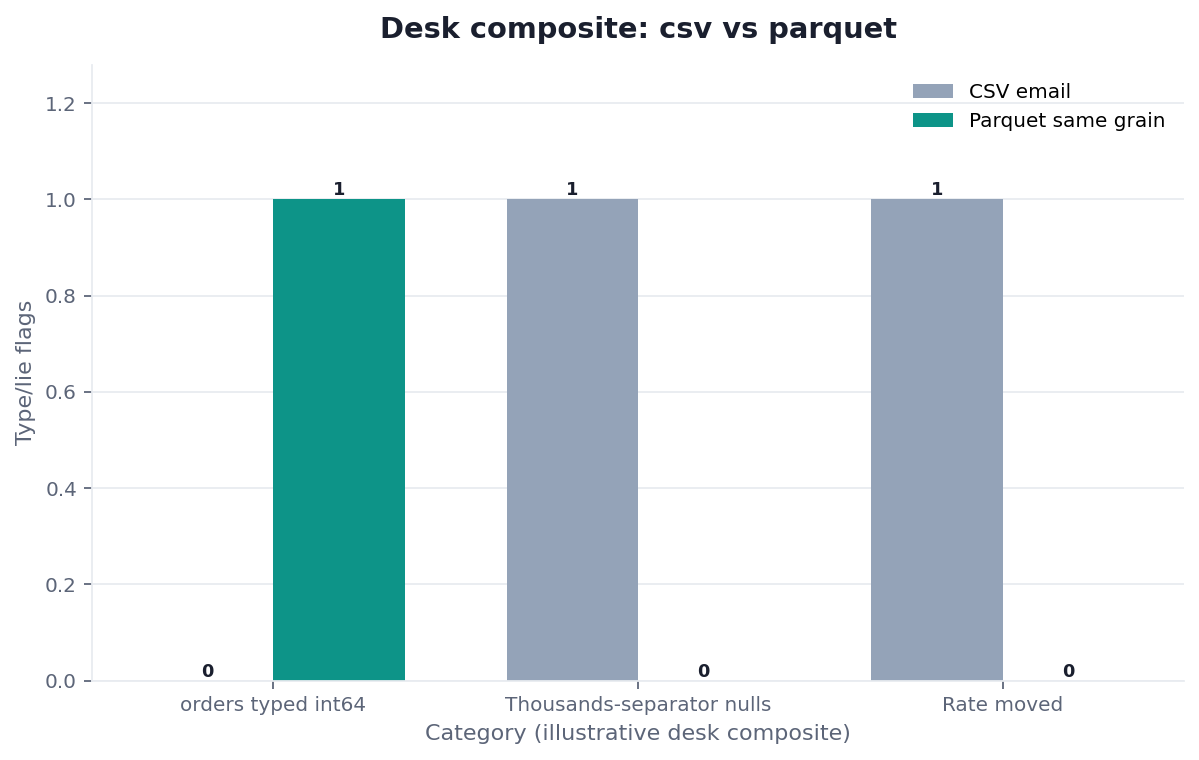
Figure. InfiniSynapse desk log FLF-CVP-20260822: CSV email first left 0 / 0 / 0; asking the typed Parquet left 1 / 1 / 1. Published context: the independent sources linked in the body. Not a customer experiment, SLA, or official benchmark.
| Evidence class | What you can cite | What you cannot claim |
|---|---|---|
| Desk log on this page | Artifact counts 0/0/0 → 1/1/1, one 4.2M-row week as CSV + Parquet on this run, ~10 min wall-clock, downloadable log · CSV · verify | Customer uplift %, vendor bake-off win, named-logo case |
| Independently hosted published docs | DuckDB CSV guide, DuckDB Parquet guide, pandas I/O — CSV (retrieved 2026-08-29) | That those engines ran this desk log |
| Independent method notes | Apache parquet-format, Apache Arrow, W3C tabular data model, ISO/IEC 9075 (retrieved 2026-08-29) | That Apache, W3C, or ISO certified this page |
| Homepage recognition | 2026 WAIC Future Tech OPC Excellence Award as published on the company homepage (self-described; not independently verified here) | That WAIC, ACM, or Gartner scored this article |
Scorecard: Stay on CSV or Leave
| Signal | Stay on CSV | Leave for Parquet | Load a warehouse |
|---|---|---|---|
| Ten columns, human edit | Yes | Not yet | No |
| Width, types, or size lying | No | Yes | Later if shared hourly |
| Leading-zero IDs | Dangerous | Yes | Only after types are true |
| Same grain, many consumers, hourly | No | Temporary | Yes |
| Secrets in the email | Do not upload | Do not upload the typed copy either | Do not load |
If you cannot describe the lie in one sentence, you are not ready to switch. Write the lie, then run CSV vs Parquet again on the same week.
The scorecard is an educational rubric for CSV vs Parquet, not a vendor ranking. Independent sources linked above describe published posture; they do not score this rubric.
Failure Modes
Thousands-separators and quoted nulls
1,234 and "N/A" become wrong ints or dropped rows. People then blame the agent. Fix: profile CSV tokens before any ask. Leave for Parquet when the tokens are the analysis. That is a CSV vs Parquet leave, not a model failure.
Header drift across emailed weeks
Week 9 adds a column in the middle. A positional read shifts metrics. Fix: compare headers every week. CSV vs Parquet often ends here: Parquet schema makes the add visible, so you stop guessing column position.
Save As treated as cleansing
Exporting Parquet to CSV “for the bot” reintroduces the lie you just escaped. Fix: upload the typed file. Do not create a third copy.
Before you file a warehouse ticket for a question that already lives in Monday’s typed file, check three things: whether CSV is still lying, whether Parquet already holds the grain, and whether both copies are sanitized enough to authorize. Those three checks close CSV vs Parquet without a load.
Route the same diagnosis to the live guide that owns the next object. Each row is a single hop, not a reading dump.
| Live guide | Open it when |
|---|---|
| Parquet file analysis | you need the whole file-lake map |
| what is a data agent | you need the job description |
| data governance | the next fight is who may email the CSV |
| Upload a Folder for Data Analysis | A directory is a source when the files share a grain |
| File Formats for AI Analysis | Pick the format that already matches the grain |
| Local Files to an AI Data Analyst | My Data is a source, not an email attachment |
Compare one CSV and one Parquet of the same grain
Add both sanitized files, ask the same goal on one winner, and inspect types and row counts. This check uses only sources you authorize.
Commercial association: You do not need the workspace to complete the educational diagnosis on this page.
Open InfiniSynapseHow this page is sourced. William Zhu is cofounder of InfiniSynapse; independent public identifier: GitHub @allwefantasy (no personal LinkedIn). Institution: About InfiniSynapse. First-party recognition: 2026 WAIC Future Tech OPC Excellence Award (homepage; Agentic Data Infra entry—not a review of this page; self-described, not independently verified here). Trust pages: Privacy · publishing terms · NIST Privacy Framework. Desk methodology note: 2026-07-29 attestation. Downloadable first-party run: desk log
FLF-CVP-20260822. Reviewed by analytics engineering · data platform · LLM security · editor. Editorial standards · corrections · Contact zhuhl@infinisynapse.com. Company About. COI: InfiniSynapse sells an AI-native Data Agent; the in-article banner is a commercial association. Fact-check: Stanford HAI AI Index · McKinsey State of AI · Gartner Peer Insights — Analytics & BI · RFC 4180 CSV · Apache Parquet documentation · Apache parquet-format · Apache Arrow documentation · DuckDB CSV guide · DuckDB Parquet guide · W3C tabular data model · ISO/IEC 9075 · Wikipedia Apache Parquet · pandas I/O — CSV · ACM Artifact Review and Badging · arXiv availability policy · Science journal data policies. First-party numbers on this page are desk logFLF-CVP-20260822only.
How to cite this page
Page: Zhu, W., & InfiniSynapse Data Team. (2026). CSV vs Parquet: When Types Start Lying. InfiniSynapse
Run: InfiniSynapse Data Team. (2026). Desk log FLF-CVP-20260822 (sanitized composite)
Neither is an audit. Cite those published artifact counts when you quote CSV vs Parquet figures from this first-party sanitized desk run. As of 2026-08-29, no independent evaluation, media citation, or reproduction of the email-first-versus-typed contrast exists. DuckDB guides, Apache parquet-format, and ISO/IEC 9075 stay citable as published files. Keep that limit visible now. Send contradictions to zhuhl@infinisynapse.com.
Frequently Asked Questions
When should you use CSV instead of Parquet?
Use CSV for a short table a person still edits. Switch when the width or a guessed type would change the number. Compression is not the test.
Is Parquet always better in a CSV vs Parquet choice?
Bottom line: No. CSV is fine for a ten-column human edit. Leave when width, types, or size start lying.
Do I need a warehouse to leave CSV?
Bottom line: No. CSV vs Parquet can stay on files. Load a warehouse when many teams need the winning grain on a schedule.
Can I keep both files “just in case”?
Bottom line: Only during the comparison. After you pick, one winner. Two copies become two metrics.
How do I know which file the run used?
Bottom line: Inspect the path, types, and row counts. If both files are still selected, stop and name the winner before you ask again.
When should I stay on CSV?
Bottom line: When a person must edit ten columns this afternoon and types are still honest. CSV vs Parquet stays on the text file until width, types, or size invent numbers.
Do ACM, arXiv, or Science certify this format test?
Bottom line: No. ACM Artifact Review and Badging, arXiv availability policy, and Science journal data policies describe published posture, not this CSV vs Parquet desk table.
Did Apache, DuckDB, or a news outlet recognize this page?
Bottom line: No. Apache parquet-format and DuckDB Parquet guide publish the format and the engine. They did not evaluate InfiniSynapse. There is no media citation of CSV vs Parquet on this page, and there is no personal LinkedIn to add.
Conclusion
CSV is interchange. Parquet is a typed scan. Write the CSV vs Parquet winner before anyone reopens the email. Run CSV vs Parquet as a leave-when-it-lies test: keep the text file for human edits, switch when width, types, or size invent numbers, and inspect counts before you load a warehouse. The warehouse is a promotion of the winner, not a requirement for the switch.
If you want to try that check on a sanitized pair you already own, open InfiniSynapse and ask the same goal on the file you just named as winner.