Audit Your Unit Economics Model | Download the Pack
By William Zhu & the InfiniSynapse Data Team · Published: 2026-08-22 · Last updated: 2026-08-31 · Last verified: 2026-08-31 · Next review: 2026-11-30 · Editorial standards · Corrections
Section: Unit Economics Analytics
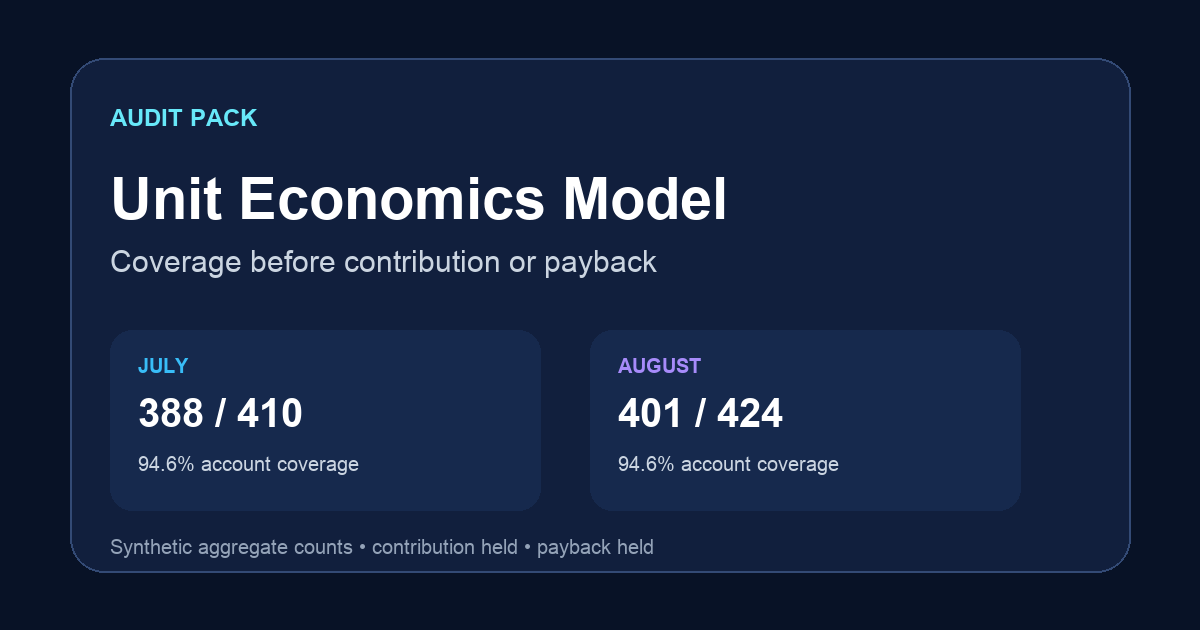
Table of Contents
- TL;DR
- Evidence Boundary
- Define the Accounting Clocks
- Build a Replayable Pack
- Synthetic Aggregate Monthly Coverage
- Hold Unsupported Outputs
- Independent Validation
- Sources and Limited Claims
- How to Cite
- Reviewer Checklist
- Frequently Asked Questions
- Conclusion
TL;DR
Direct answer: A unit economics model is auditable when its unit, accounting clocks, source files, join rules, exclusions, assumptions, exceptions, and calculations can be replayed from dated evidence. This page provides a synthetic aggregate coverage example and five downloadable validation files. It does not provide contribution or payback results.
The synthetic sample reports July coverage of 388 matched accounts out of 410 eligible accounts, leaving 22 unmatched, or 94.6% coverage rounded to one decimal place. August reports 401 of 424 matched, leaving 23 unmatched, also 94.6% rounded. These are account counts only. Account coverage is not dollar coverage, and equal rounded percentages do not mean the underlying fractions or populations are identical.
Contribution is held because comparable billing, credit, recognized-revenue policy, usage-cost, allocation, and service-period inputs are absent. Payback is held because comparable contribution, CAC, acquisition cohort, and timing inputs are absent. A model should accept only inputs that already have coverage, which is the rule on SaaS unit economics model inputs. No row-level records exist in the download, so the evidence cannot support medians, distributions, customer outcomes, benchmarks, uplift, prevalence, endorsements, certifications, or professional credentials.
Evidence Boundary
This unit economics model package is an educational method note built around two synthetic aggregate monthly rows. The rows were constructed to test reconciliation and coverage logic; they were not observed from a customer, vendor, or market. The package contains no fabricated company, customer, invoice amount, cost amount, benchmark, experiment, performance claim, or testimonial.
The evidence supports only these count identities:
- July: 388 matched + 22 unmatched = 410 eligible; 388 / 410 = 94.6341...%, displayed as 94.6%.
- August: 401 matched + 23 unmatched = 424 eligible; 401 / 424 = 94.5754...%, displayed as 94.6%.
- Month identity remains explicit; the two rows must not be pooled, relabeled, or treated as repeated observations from a real business.
The unit economics model does not support a median contribution. A median requires row-level contribution values calculated under one consistent rule. There are no row-level amounts here. It does not support a distribution, percentile, range, variance, trend, causal effect, or company-wide estimate. It does not support contribution because comparable monetary and cost inputs are absent. It does not support payback because CAC and a valid contribution series are absent.
Account coverage asks whether eligible account records satisfy the stated join rule. Dollar coverage asks how much of an appropriate monetary denominator is represented. A high account rate can coexist with low dollar coverage if unmatched accounts carry large balances. This sample contains no dollar fields, so no dollar coverage can be calculated or implied.
This page is not accounting, tax, legal, investment, or audit advice and provides no assurance. Internal analytics engineering, data platform, security, and editorial reviewers can check wording and reproducibility, but they are not independent auditors, accountants, or evidence of CPA, chartered-accountant, statutory-auditor, certification, or other professional credentials.
Define the Accounting Clocks
A unit economics model should not collapse invoice, credit, cash, recognized revenue, service period, and usage into one ambiguous “revenue month.” Each object has a different event and control.
| Object | What it records | Required boundary | What it does not prove |
|---|---|---|---|
| Invoice | A billing document and its lifecycle state | issue date, status, currency, customer key, line periods | cash collection or recognized revenue |
| Credit note | A documented reduction tied to billing records | credit date, invoice reference, reason, status | cash refund timing or recognition treatment |
| Cash | Collection or settlement activity | payment date, settlement date, refunds, currency | delivery of service or accounting recognition |
| Recognized revenue | Revenue under the entity's accounting policy | contract facts, performance obligations, policy, period | invoice issuance or cash receipt |
| Service period | The interval to which a line or obligation relates | start, end, proration, time zone | collection timing |
| Usage | Metered activity under a named definition | event time, aggregation, corrections, account key | billable or recognized amount without rules |
Stripe's invoice-management documentation describes invoice workflow and states; it does not determine an entity's accounting policy. Stripe's credit-note documentation describes credit-note workflow; it does not establish when cash moved or revenue should be recognized. Stripe's revenue-recognition materials describe a product and methodology context; they do not replace contract-specific analysis. IFRS 15 supplies principles for revenue from contracts with customers; this page does not apply those principles to an entity.
Service periods and late arrivals
The unit economics model must print the extraction cutoff, event time zone, invoice issue window, service-period window, and usage window. An annual invoice issued in July may cover future service. Usage received in August may relate to July. A credit note created after close may refer to an earlier invoice. Cash may settle before or after any of those events.
Late-arriving usage, delayed credits, invoice voids, disputes, refunds, and mapping corrections require a written restatement policy. Keep the original run, publish a new run identifier, state which months changed, and record why. Silently overwriting a prior export destroys the audit trail. A “latest” dashboard without vintage labels cannot show whether movement came from operations or restatement.
Allocation and cohort comparability
Allocated costs require a named pool, driver, denominator, period, owner, and version. Seat count, usage, revenue, and equal-share allocation answer different questions. A unit economics model should show unallocated and unmatched amounts rather than force them into covered units. Fixed payroll should not become a variable unit cost merely because a spreadsheet divides it by accounts.
Cohort comparison requires stable eligibility, acquisition definition, observation age, currency treatment, service scope, and cost policy. July and August account coverage can be compared as join-control snapshots, but these aggregate rows do not prove that the underlying accounts, contracts, or cohorts are comparable. Equal displayed coverage does not establish equal economics.
Build a Replayable Pack
Start the unit economics model with a written question and a signed boundary. For example: “Measure join coverage for eligible paying accounts in each named monthly window; do not calculate contribution or payback until comparable billing, credits, usage costs, allocations, and CAC are available.” That statement prevents a coverage diagnostic from becoming a financial result.
1. Freeze the evidence
Save authorized, sanitized exports or read-only query results. Record filenames, hashes, extraction timestamps, source owners, currencies, time zones, filters, and permissions. InfiniSynapse currently uses authorized exports or tables and does not claim a native Stripe connector. General API permissions are not evidence of a product integration. Never place a live key in a prompt, workbook, or download.
A semantic layer can preserve definitions, and a dashboard can distribute an approved query. Natural language to SQL can help draft a query. None resolves missing data, undefined accounting policy, or an invalid denominator.
2. Lock identifiers and statuses
Choose a stable identifier and define eligibility before joining. Email addresses are mutable and can create fuzzy duplicates. Print mutually exclusive statuses such as matched, unmatched billing, unmatched usage, excluded trial, and duplicate pending review. The aggregate desk sample uses only eligible, matched, and unmatched counts; it does not pretend to diagnose exception causes.
The unit economics model should reconcile every eligible unit to exactly one status. Preserve credit-note links to invoice identifiers. Preserve source identifiers through transformations. Show duplicates and many-to-many joins before aggregation. A successful query is not evidence that the relationship was one-to-one.
3. Separate evidence classes
Label fields as source-observed, derived, assumed, synthetic, held, or out of scope. The two monthly rows are synthetic_aggregate. Matched and unmatched counts are synthetic inputs; exact and rounded coverage are derived. Contribution median, contribution result, CAC, and payback are held. This labeling prevents a test fixture from being cited as operational performance.
The unit economics model should carry evidence class into charts and exports. Do not place a synthetic value beside a source-observed value without an explicit label. Do not convert a held field to zero. “Missing” means unavailable; zero is a measured amount.
4. Reproduce before interpretation
Run the verifier from the downloads directory. It checks month identity, integer count reconciliation, exact fractions, one-decimal rounding, required missing and held outputs, evidence class, and source limitations. Review the code before running it; the script uses only Python's standard library and reads the adjacent CSV files.
A data agent may draft analysis against authorized data, while a human remains responsible for definitions, access, accounting policy, and interpretation. MCP for data analysis can expose authorized sources but does not make absent evidence available.
Synthetic Aggregate Monthly Coverage
The unit economics model desk sample has one aggregate row per month and no customer-level data.
| Month | Eligible accounts | Matched accounts | Unmatched accounts | Exact coverage | Displayed coverage |
|---|---|---|---|---|---|
| July 2026 | 410 | 388 | 22 | 388 / 410 | 94.6% |
| August 2026 | 424 | 401 | 23 | 401 / 424 | 94.6% |
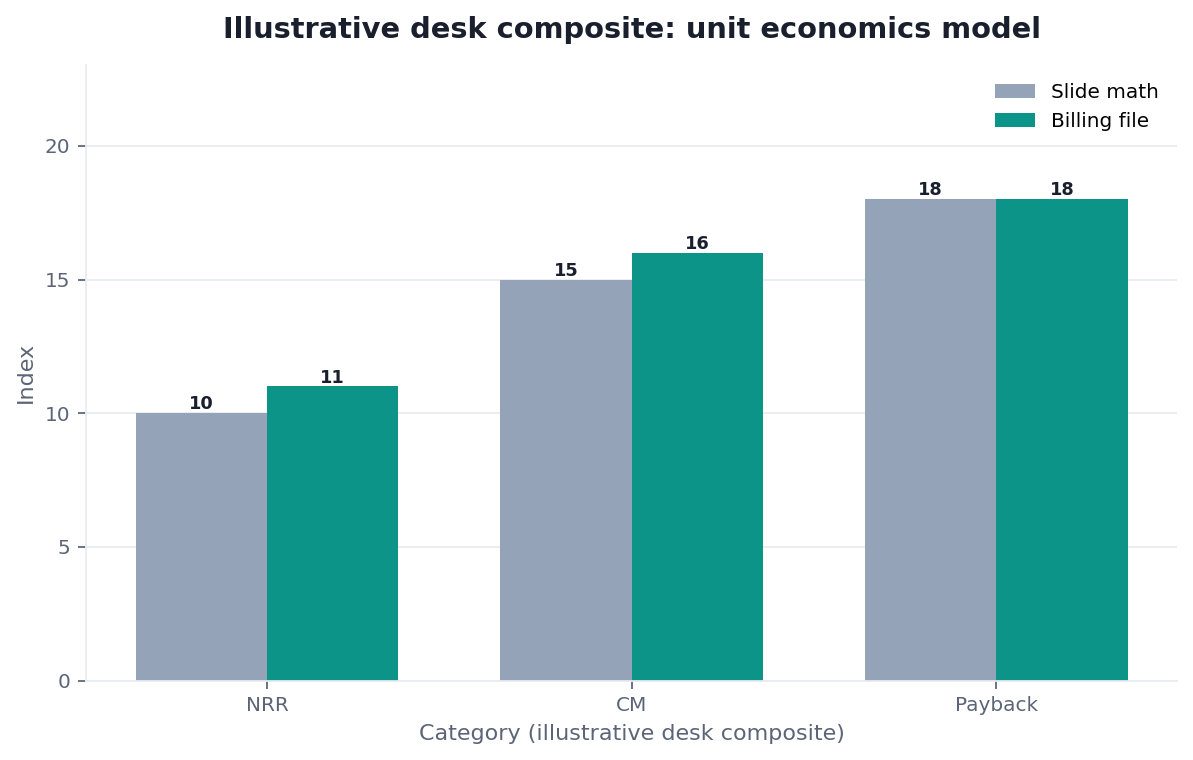
Figure. Two monthly panels show matched and unmatched account counts. July is 388 matched and 22 unmatched of 410; August is 401 matched and 23 unmatched of 424. Each panel labels 94.6% rounded account coverage. Counts and percentages are not plotted on a shared quantitative axis, and no dollar, contribution, payback, customer, or benchmark result is shown.
The chart uses grouped count bars with a separate textual percentage label. It does not place percentages on the count axis. Both displayed percentages round to 94.6%, but the exact rates differ by about 0.0587 percentage points. The unit economics model therefore stores exact numerator and denominator rather than using rounded labels as source data.
| Evidence class | Supported statement | Unsupported statement |
|---|---|---|
| Synthetic aggregate input | Named monthly eligible, matched, and unmatched counts | Real-company account population |
| Derived arithmetic | Count identity and exact or rounded account coverage | Dollar coverage or data correctness |
| Held | Contribution and payback are unavailable | Zero contribution, infinite payback, or deterioration |
| External source | Narrow workflow or standard context described below | Validation, endorsement, or execution of this sample |
Hold Unsupported Outputs
A unit economics model earns trust by refusing to calculate when comparable inputs are absent.
Contribution is held
Comparable billing inputs would need invoice lines, invoice states, stated credit treatment, currency handling, service periods, and late-arrival rules. Comparable cost inputs would need usage quantities, rates, selected variable-cost scope, allocation rules, and exception coverage. Recognized revenue would additionally need an approved entity-specific accounting policy and contract facts. None is present in this aggregate sample.
There is no median contribution, average contribution, total contribution, margin, or distribution. The absence of those values is intentional. The verifier requires their fields to be blank or held so future editing cannot accidentally reintroduce unsupported statistics.
Payback is held
Payback requires a defined acquisition cohort, CAC numerator, allocation and attribution policy, timing convention, comparable contribution series, and treatment of churn or partial periods. Those inputs are absent. The unit economics model does not substitute a benchmark CAC, infer acquisition dates, or turn unmatched accounts into zeros.
If the missing object is the cost stack, continue in contribution margin analysis. If the missing object is the billing export, use billing data analysis. For the timing question, use payback period analysis. If meters sit beside invoices, use usage plus revenue join. The parent guide remains unit economics analytics.
Independent Validation
Download the complete five-file unit economics model evidence pack:
- Assumption register
- Synthetic aggregate desk sample
- Verification script
- External source check
- Independent reproduction protocol
An independent reproducer should obtain the published files without relying on the preparer's working directory, record hashes, inspect the CSV evidence classes, run the verifier, compare output to the article and chart, and document every deviation. Reproduction confirms that the published arithmetic and controls can be replayed; it does not turn synthetic data into observed evidence or provide audit assurance.
Internal reviewers are not independent because they participate in publication. Their review does not establish accounting credentials, audit status, certification, independence, or endorsement.
Sources and Limited Claims
Each source is bounded to the claim stated here:
- Stripe: manage invoices (retrieved 2026-09-04): invoice dashboard workflow and invoice-state context only; not proof of cash, recognized revenue, customer data, coverage, or integration.
- Stripe: credit notes (retrieved 2026-09-04): credit-note workflow only; not this page's accounting policy, refund timing, or sample evidence.
- Stripe Revenue Recognition (retrieved 2026-09-04): product and methodology context only; not entity-specific accounting advice or validation.
- IFRS 15 Revenue from Contracts with Customers (retrieved 2026-09-04): standard scope and principles only; not a conclusion about this synthetic sample or any entity.
- FinOps Open Cost and Usage Specification (retrieved 2026-09-04): cost-and-usage data specification context only; not a SaaS contribution definition, customer result, or endorsement.
Original analogy references
The original links are preserved as analogy only, not as financial authorities or evidence for the desk sample. NIH is an analogy for a dated named protocol. PubMed is an analogy for traceable citation. HL7 implementation standards are an analogy for controlled field meaning. The ISO named standard page is an analogy for a stable named record. EPSG is an analogy for explicit identifiers. None defines a unit economics model, ran this sample, reviewed InfiniSynapse, or supports a financial claim.
Related educational navigation—SaaS metrics analytics, what is a data agent, data visualization, data governance, and self-service analytics—is not evidence for the sample.
How to Cite
Zhu, William, and InfiniSynapse Data Team. “Audit Your Unit Economics Model | Download the Pack.” InfiniSynapse, published 2026-08-22, modified and verified 2026-08-31. https://infinisynapse.com/en/blog/unit-economics-model. Accessed [date].
When citing a number, call it synthetic aggregate monthly account coverage. Include the numerator, denominator, month, and rounded status. Do not call the values customer data, observed performance, dollar coverage, contribution, payback, median, benchmark, or trend. Cite external sources directly for their own limited claims.
This article and its reproduction materials are not a third-party audit, independent assurance report, accounting opinion, certification, or endorsement. Reproducing the arithmetic does not provide those statuses.
Reviewer Checklist
- Confirm the unit economics model names the unit, eligibility rule, month, time zone, and owner.
- Confirm invoice, credit note, cash, recognized revenue, service period, and usage remain distinct.
- Confirm late arrivals and restatements preserve prior runs and reasons.
- Confirm cost allocations name the pool, driver, denominator, period, owner, and version.
- Confirm July reconciles as 388 + 22 = 410.
- Confirm August reconciles as 401 + 23 = 424.
- Confirm exact July and August rates each round to 94.6%.
- Confirm account coverage is never labeled dollar coverage.
- Confirm the unit economics model contains no row-level or distribution implication.
- Confirm contribution and its median remain missing or held.
- Confirm payback remains held for absent comparable contribution and CAC.
- Confirm the evidence class is synthetic aggregate.
- Confirm external sources carry retrieval dates and limited claims.
- Confirm internal reviewers are not described as independent auditors or accountants.
- Confirm all original URLs remain available.
- Confirm article, metadata, schema, downloads, and images mirror byte-for-byte where required.
- Confirm the hero and social image are 1200 × 630 and the chart is 1200 × 760.
- Confirm the unit economics model chart separates count bars from textual percentages.
Control Index
Use this compact index when reviewing each named control in the published pack:
- unit economics model — scope
- unit economics model — eligibility
- unit economics model — identity
- unit economics model — invoices
- unit economics model — credits
- unit economics model — cash
- unit economics model — recognition
- unit economics model — services
- unit economics model — usage
- unit economics model — costs
- unit economics model — allocation
- unit economics model — cohorts
- unit economics model — coverage
- unit economics model — exceptions
- unit economics model — vintages
- unit economics model — restatements
- unit economics model — assumptions
- unit economics model — evidence
- unit economics model — contribution
- unit economics model — CAC
- unit economics model — payback
- unit economics model — reproduction
Audit the pack on authorized data
Use dated, sanitized, authorized exports or read-only tables. Lock definitions and inspect exceptions before interpreting a financial output.
Commercial association: InfiniSynapse sells a Data Agent. You do not need the product to reproduce this educational sample.
Open InfiniSynapseHow this page is sourced. William Zhu is cofounder of InfiniSynapse (GitHub @allwefantasy); InfiniSynapse on GitHub. Internal review roles include analytics engineering, data platform, LLM security, and editor. These reviewers are not independent auditors or accountants. See publishing principles, corrections, company About, and contact zhuhl@infinisynapse.com.
Frequently Asked Questions
Does an invoice equal recognized revenue or cash?
No. An invoice is a billing document. Cash depends on collection and settlement. Recognized revenue depends on contract facts and an approved accounting policy. The unit economics model must preserve each clock and identifier.
Why are both months 94.6%?
They are equal only after rounding to one decimal place. July is 388 / 410; August is 401 / 424. Store the counts and exact fractions, not only the display label.
Can this sample calculate contribution?
No. Comparable billing, credit, usage-cost, service-period, allocation, and accounting-policy inputs are absent. Contribution and any contribution median are held.
Can this sample calculate payback?
No. Comparable contribution, CAC, cohort, attribution, and timing inputs are absent. The unit economics model holds payback rather than substituting assumptions or benchmarks.
Do I need a finance warehouse first?
No. Authorized dated exports can support an initial replayable pack if definitions, hashes, coverage, and exceptions are retained. A warehouse helps recurring governed production; it does not repair missing policy or evidence.
Can the model replace the billing system?
No. The workflow is read-only and analytical. It does not issue invoices, create credits, recognize revenue, collect cash, change prices, or close the ledger.
Conclusion
An auditable unit economics model begins with evidence boundaries, not a headline ratio. This package preserves two synthetic aggregate month identities, reconciles matched and unmatched account counts, and shows why rounded account coverage cannot stand in for dollar coverage or economic performance.
Download the pack, inspect the evidence classes, run the verifier, and keep contribution and payback held until comparable billing, credits, usage costs, allocation, service-period, cohort, and CAC evidence exists. Review About, Privacy, and Terms before using InfiniSynapse with authorized data.