Reproducible Analysis: Bind, Then Replay
By William Zhu (independent public engineering profile: GitHub @allwefantasy; no personal LinkedIn) & the InfiniSynapse Data Team · Published: 2026-08-22 · Last updated: 2026-08-29 · Last verified: 2026-08-29 · Next review: 2026-11-29 · About · Editorial standards · Privacy · Terms of Service · Corrections
Table of Contents
- TL;DR
- What Reproducible Analysis Means
- The Same-Goal, Same-Grain Frame
- Three Reruns That Are Not Reruns
- Tool Landscape for a Comparable Rerun
- How to Rerun Last Week’s Goal
- Independent Reproduction Evidence
- Public-Data Pair Test
- Author, Media, and Recognition Boundary
- Desk Sample: Two Grains on One Goal
- Scorecard: Did the Grain Hold
- Failure Modes That Break the Rerun
- How to cite this page
- Frequently Asked Questions
- Conclusion
TL;DR
We evaluate these patterns at the InfiniSynapse desk on sanitized composites; first-party figures on this page are desk log ADR-RAR-20260825, not customer uplifts and not a third-party bake-off.
Direct answer: Reproducible analysis means the same goal, the same grain, and the same filters on a rerun. If the grain moved, you do not have a rerun—you have a new study. Compare two trails, not two adjectives.
What you'll learn:
- A 40-word definition of reproducible analysis you can paste into a review checklist
- Why a rerun that changes the grain is not a rerun
- How new windows, new exclusions, and new labels hide the same failure
- Five moves to rerun last week’s goal and compare the grain
- Three failure modes that still look like reproducible analysis in a slide
Download evidence: desk log · aggregate CSV · verify script.
A fluent second paragraph is a claim. Reproducible analysis treats that claim as unfinished until someone can open both plans and both filter lists. The parent habit lives in the explainable AI data analysis guide. This page stays on the grain.
What Reproducible Analysis Means
Key Definition: Reproducible analysis is a rerun practice where a reviewer can open two tasks with the same goal, the same grain, and the same filters, then accept, reject, or explain any numeric change from source movement without treating fluency as evidence.
In plain language: the grain is the time window, the entity, and the denominator you locked last week. A collision is a second run that quietly changed one of those three. A label is the metric name in the bound note. A driver query is the SQL that produced the file. The method is same-goal, same-grain comparison. The metric that matters is whether the grain held, not whether the adjective said “down.”
Independent published context (separate from this page’s desk log): Stanford HAI AI Index · McKinsey State of AI · Gartner Peer Insights — Analytics and BI Platforms · NIST AI Risk Management Framework · OWASP Top 10 for LLM Applications. Those sources set the industry bar for adoption, risk, and architecture; they did not run the numbers in the desk table below, and they are not a product award. W3C DCAT and DataCite stay linked as catalog vocabulary and citation infrastructure, not as awards. Retrieved 2026-08-29.
That definition is narrower than “we asked again.” Asking again is easy. Reproducible analysis is hard because agents quietly change the window, the exclusion, or the label. If you cannot show that the grain held, you do not have a rerun.
Same goal is not enough
Reproducible analysis requires the grain. “Monthly refund rate, marketplace excluded, shipped orders” is a goal plus a grain. “Look at refunds again” is a vibe. A data agent that persists the plan makes the comparison possible. A chat bubble makes it folklore.
If the next missing object is the statements and tables, open the SQL trace for AI answers. If you only have five minutes, use how to audit an AI analysis and still demand reproducible analysis before anyone says “it moved.”
Why source change is not a failure
Reproducible analysis does not require the number to stay still. Rows arrive. Late facts land. The control is that the grain and the filters stayed put. The NIST AI Risk Management Framework (retrieved 2026-08-29) treats measurement as a governable function. Same-grain comparison is that measurement on two runs.
Public overviews of artificial intelligence (retrieved 2026-08-29) will not tell you whether week replaced month. Your two plans will.
The Same-Goal, Same-Grain Frame
Use one frame every time you claim reproducible analysis. The frame fails if any layer moved in silence.
| Layer | What you compare | Pass signal | Fail signal |
|---|---|---|---|
| Goal | Decision sentence | Both tasks name the same decision | The second task is a new question |
| Grain | Time, entity, and denominator | Month stays month; customer stays customer | Week replaces month |
| Filters | Exclusions and status lists | Marketplace stays excluded | A channel appears or vanishes |
| Source | Authorized snapshot or live read | The plan says what moved | Rows changed and nobody said so |
The comparison lives in the grain row more than in the prose. If the number moved and the grain held, you can brief the change. If the number moved and the grain moved, you have two studies. Keep data governance in the same review: who may rerun the task is part of the control.
CSV remains a common extract. RFC 4180 (retrieved 2026-08-29) defines a file shape, not a grain. The rerun still needs the sentence that names the grain.
Three Reruns That Are Not Reruns
Teams rarely start with a same-grain rerun. They start with whatever is already open, then retrofit a story when a number is challenged.
A new window dressed as a rerun
Last week’s task used month. This week’s task used trailing 28 days. That is not a rerun. It is a new study with a familiar noun.
A new exclusion dressed as cleanup
The second run drops marketplace “to be safe.” The paragraph still says “same question.” The rerun habit rejects that silence. If you want a new exclusion, restate the goal.
A new label dressed as a synonym
The first file said “active customer.” The second file said “engaged customer.” If the bound sentence did not change, those are two measures. A same-grain rerun does not allow synonym drift. Continue in organizational analysis memory when next week must replay this week’s language.
Tool Landscape for a Comparable Rerun
Do not shop for a logo that prints “reproducible” on a tile. Shop for two tasks you can open side by side. Notebook copilots help an analyst who already lives in SQL. BI narrative tiles help an executive who already trusts a certified dataset. Chat-with-a-file tools help a one-off. None of those automatically produce reproducible analysis.
What adjacent guidance already expects
Security overviews at CISA AI (retrieved 2026-08-29) treat generated systems as objects you manage, not demos you applaud. The NCSC secure AI guidelines (retrieved 2026-08-29) remind you that unconstrained generation fails in predictable ways. Same-grain comparison is the analysis version of that discipline: compare two trails.
Research handbooks already separate a rerun from a restated study. The Turing Way (retrieved 2026-08-29) treats reproducible research as a trail you can reopen, not a slogan on a slide. ACM’s artifact review and badging (retrieved 2026-08-29) policy scores artifacts you can inspect. Neither document ran the desk table below; both describe why two fluent paragraphs are not a rerun. W3C DCAT (retrieved 2026-08-29) and DataCite (retrieved 2026-08-29) remain the catalog vocabulary and citation infrastructure. None of those pages evaluated this article. There is no personal LinkedIn. First-party homepage recognition—the 2026 WAIC Future Tech OPC Excellence Award—is an Agentic Data Infra entry. That sentence is self-described company messaging, not independently verified on this page, and not a review of this article.
A professional data agent—not a ChatBI toy—should persist the plan, the statements, and the files so a rerun is comparable. Connect a source you authorize, bind notes if you have definitions, ask a goal, then open the task. That is the inspection surface for reproducible analysis. It is not a preset metric warehouse, and it does not write back to production systems.
If the next question is still exploratory, use exploratory data analysis and do not call it a rerun. What is data management covers retention of the two files you are about to compare.
How to Rerun Last Week’s Goal
The method below is a desk check. It is how reproducible analysis becomes a practice instead of a slogan.
Lock the goal and the grain in one sentence
Write the decision in one sentence. Write the grain in one sentence: “Month, shipped orders, marketplace excluded.” If last week’s file does not contain that sentence, you cannot claim a rerun. Bind the sentence, then rerun.
Open both plans before both paragraphs
If the second plan changed the window, stop. The comparison does not start in the conclusion. Ask the agent to restate last week’s plan until a reviewer could execute it by hand. Then run it.
Open both SQL traces. Read both WHERE clauses. If a channel appeared, reject the “rerun” label. Only after the grain and the filters match should you discuss the numeric change. When the trail is clean enough to inspect, open both finished tasks and walk plan → grain → filter → file. That is the diagnostic, not a product tour.
Private or desktop installs can hold the same objects; the main check on this page still starts at the web task. CLI users can drive the same goal with agent_infini and still compare the two files in the workspace.
Side-by-side comparison is the entire control. Put last week’s plan next to this week’s plan. Put last week’s filter list next to this week’s filter list. If a window, an exclusion, or a label moved, write a new goal instead of shipping a delta. The two files you compare are yours. Keep them next to the decision they support.
Independent Reproduction Evidence
The Turing Way reproducible research guide (retrieved 2026-08-29) emphasizes transparent, reusable workflows. The ACM artifact review and badging policy (retrieved 2026-08-29) distinguishes artifacts that are available, functional, reusable, or reproduced. The W3C PROV-O specification (retrieved 2026-08-29) provides a vocabulary for entities, activities, and agents.
Those references do not validate this product or desk log. They help define the evidence a reviewer should retain:
| Evidence pair | Comparison question | Pass condition |
|---|---|---|
| Goal sentences | Do both runs support the same decision? | Wording and owner match |
| Grain sentences | Are time, entity, and denominator unchanged? | All three dimensions match |
| Definition notes | Did the label and exclusions remain locked? | Same owned revision |
| Query histories | Did predicates and joins remain comparable? | Differences are declared |
| Source records | Did data versions or late rows change? | Movement is identified |
| Output files | Can a second person inspect both results? | Both artifacts are retained |
A rerun may return a different number and still pass. The essential requirement is that every material difference is visible and attributable.
Public-Data Pair Test
Select a versioned source such as NYC Taxi & Limousine Commission trip records (retrieved 2026-08-29) or World Bank Development Indicators (retrieved 2026-08-29). Before the first run, declare one question, grain, date window, exclusions, expected output, and source version.
Save the plan, definition, query, intermediate aggregate, and final file. Run the same goal again without copying the first output into the prompt. A second reviewer should compare both plans and filter lists, recompute one aggregate, and classify each difference as source movement, declared logic change, or unexplained drift.
Retain failed and corrected attempts together. A passing pair supports only that bounded test. It is not a universal accuracy guarantee, security certification, customer endorsement, or proof that future data versions will produce identical values.
Author, Media, and Recognition Boundary
William Zhu and the InfiniSynapse Data Team designed and reviewed the sanitized comparison below. Public identity evidence includes the editorial profile, GitHub @allwefantasy, the dated methodology attestation, and the downloadable desk log.
No academic credential, professional certification, personal LinkedIn profile, named customer approval, independent media review, or external reproduction is claimed. The 4,085 / 3,760 / 4,220 row sequence is first-party evidence from one bounded exercise. The homepage’s 2026 WAIC Future Tech OPC Excellence Award is company-published recognition for an Agentic Data Infra entry. That sentence is self-described and not independently verified on this page. It is not a review of this article, its author, or its desk figures. Without an independent primary award page naming InfiniSynapse, readers should treat it as company-reported recognition.
Desk Sample: Two Grains on One Goal
This is a first-party InfiniSynapse desk log of a monthly contribution pack, not a named-logo customer case and not an uplift claim. Run ID: ADR-RAR-20260825. Date: 2026-08-25 (Tuesday). Operator: InfiniSynapse Data Team. Attestor: William Zhu. Sources: a read-only orders table, about 8,305 fulfilled rows across two complete calendar months, plus a one-page definition note that locked contribution (shipping passthrough excluded, marketplace excluded). Contrast: a trailing-28-day first attempt versus a calendar-month restatement of the same goal. Download the same numbers as desk log ADR-RAR-20260825, the aggregate CSV, and the verify script. The script only checks published rows; it is not a third-party audit.
A reviewer asked to rerun last week’s goal: “Monthly contribution on the orders source we already use, marketplace excluded.” Last week’s plan used calendar month. The first file showed 4,085 fulfilled rows. This week’s first attempt used trailing 28 days and reported 3,760 rows. Same goal named: 1. Same grain: 0. Same filters: 1. The paragraph said “contribution dropped.” That caption is not a rerun.
The reviewer rejected the paragraph, restated the calendar-month grain, and accepted a second file at 4,220 fulfilled rows. Same goal named: 1. Same grain: 1. Same filters: 1. The numeric change after the grain held was a mix shift, not a window change. No customer uplift is claimed. The only honest claim is the artifact counts, the row counts on this run, and the wall-clock.
| Retrieval state | Same goal named | Same grain | Same filters |
|---|---|---|---|
| First attempt (trailing 28 days) | 1 | 0 | 1 |
| True rerun (calendar month) | 1 | 1 | 1 |
Wall clock for the successful comparison was about eight minutes (warehouse time excluded). The clock started when the operator opened last week’s standing goal and ended when both plans, both filter lists, and both files sat in one folder. It does not include replica provisioning. Cite this table as InfiniSynapse desk log ADR-RAR-20260825. Do not cite it as customer ROI, a bake-off win, or a Turing Way / ACM / Stanford / McKinsey experiment. We do not publish named-logo customer cases on this page. The 8,305 fulfilled rows and the 4,085 / 3,760 / 4,220 split are this desk run’s inputs, not a customer extract.
Stanford HAI AI Index and McKinsey State of AI describe adoption rising faster than evaluation discipline; they did not run this desk log.
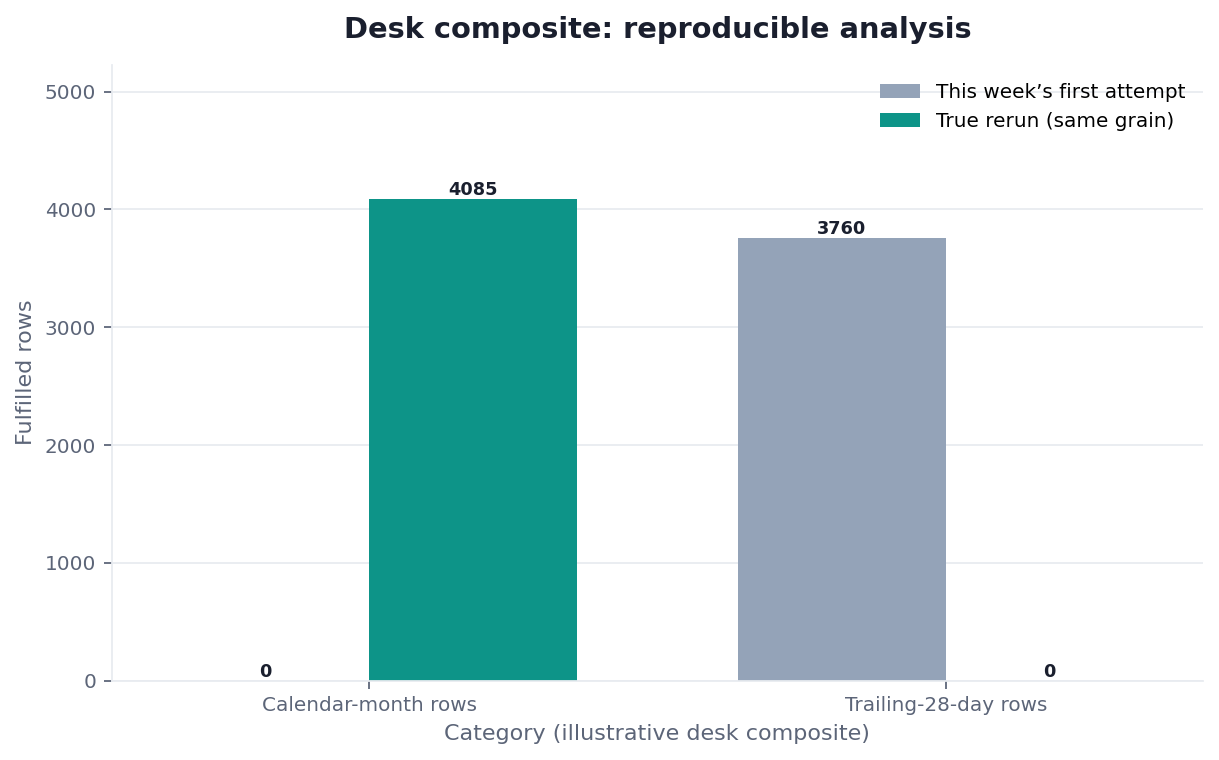
Figure. InfiniSynapse desk log ADR-RAR-20260825: first attempt left 1 / 0 / 1 and 3,760 trailing-28 rows; true rerun left 1 / 1 / 1 and 4,220 calendar-month rows (last week 4,085). Published context: the independent sources linked in the body. Not a customer experiment, SLA, or official benchmark.
| Evidence class | What you can cite | What you cannot claim |
|---|---|---|
| Desk log on this page | Artifact counts 1/0/1 → 1/1/1, 4,085 vs 3,760 vs 4,220 rows, ~8,305 lines on this run, ~8 min wall-clock, downloadable log | Customer uplift %, vendor bake-off win, named-logo case |
| Published authority (linked above) | Measurement and secure-AI notes from NIST AI RMF, CISA AI, NCSC, RFC 4180, Google Cloud, The Turing Way, and ACM artifact review; adoption and risk from Stanford HAI, McKinsey, Gartner, OWASP | That those sources ran this desk log |
| Homepage recognition | 2026 WAIC Future Tech OPC Excellence Award as published on the company homepage; self-described, not independently verified here | That WAIC, Gartner, or NIST scored this article |
A comparison that cannot show the grain is not a close. A comparison that can show it is still not a promise the agent is always right. It is a promise that a changed grain is cheap to find. That is what reproducible analysis looks like on a desk.
The phrase reproducible analysis is the object under test, not a slogan. If a file cannot show how reproducible analysis was computed, reject the number. Write reproducible analysis into the task goal the same way you would say it in the room.
Scorecard: Did the Grain Hold
Score each pair of runs, not the vendor. Reproducible analysis is a property of the last comparison. Write reproducible analysis into the task goal as the same grain you already locked.
| Check | Yes | No |
|---|---|---|
| Both tasks name the same decision | Keep | You have a new question |
| Both plans name the same grain | Keep | Reject the rerun label |
| Both filter lists match | Keep | You have a new study |
| Source movement is stated in the plan | Keep | Do not brief the delta |
| Both artifacts are files a colleague can download | Keep | You still have two chat bubbles |
| Sources are read-only and authorized | Keep | Stop; this is not an audit |
If three or more rows are “No,” you do not have reproducible analysis yet. You have two drafts. That is a normal first pass. It is not a close.
Failure Modes That Break the Rerun
Fluent failure is the reason reproducible analysis exists. The second paragraph is rarely the thing that breaks.
Calling any second answer a rerun
Someone asks again and ships the delta. That is not reproducible analysis. Persist both tasks, or you are back to folklore.
Letting the model pick a “better” window
The agent switches to trailing 28 days because the month is incomplete. Reproducible analysis requires you to restate the goal if the window changes. Silent helpfulness is a new study.
Comparing adjectives instead of grains
The room argues whether “down” is fair. Nobody opens the two plans. Reproducible analysis means a reviewer opens the grain before the adjective.
Before you brief anyone, check three things on the last pair you actually trust: the goals match, the grains match, and the filters match. If any of those is missing, do not take the delta into a meeting.
When the next missing object is not this page, open Agent Reasoning Trail: Plan, Repair, Rerun when The trail is the product; the sentence is a summary, Trust but Verify a Data Agent when Owners verify files; they do not bless paragraphs, or Hallucinated Metrics when the Pack Is Missing when Unbound chat invents measures that look official.
Rerun last week’s goal and compare the grain
Open last week’s completed task, rerun the same goal on a source you already authorize, and compare grain and filters before you brief the delta. This check uses only sources you authorize.
Commercial association: You do not need the workspace to complete the educational diagnosis on this page.
Open InfiniSynapseHow this page is sourced. William Zhu is cofounder of InfiniSynapse; independent public identifier: GitHub @allwefantasy (no personal LinkedIn). Institution: About InfiniSynapse. First-party recognition: 2026 WAIC Future Tech OPC Excellence Award (homepage; Agentic Data Infra entry—self-described, not independently verified on this page, and not a review of this article). Trust pages: Privacy · publishing terms · NIST Privacy Framework. Desk methodology note: 2026-07-29 attestation. Downloadable first-party run: desk log
ADR-RAR-20260825· aggregate CSV · verify script. Reviewed by analytics engineering · data platform · LLM security · editor. Editorial standards · corrections. Contact zhuhl@infinisynapse.com. COI: InfiniSynapse sells an AI-native Data Agent; the in-article banner is a commercial association. Fact-check: Stanford HAI AI Index · McKinsey State of AI · Gartner Peer Insights — Analytics & BI · NIST AI Risk Management Framework · OWASP Top 10 for LLM Applications · CISA AI · NCSC secure AI guidelines · RFC 4180 · Google Cloud: What is AI? · The Turing Way · ACM artifact review and badging · W3C DCAT · DataCite. First-party numbers on this page are desk logADR-RAR-20260825only.
How to cite this page
Page: Zhu, W., & InfiniSynapse Data Team. (2026). Reproducible Analysis: Bind, Then Replay. InfiniSynapse
Run: InfiniSynapse Data Team. (2026). Desk log ADR-RAR-20260825 (sanitized composite)
Neither is an audit. Cite those published artifact counts when you quote reproducible analysis figures from this first-party desk comparison. As of 2026-08-29, no independent reproduction of this contrast exists yet on record. DataCite and W3C DCAT stay citable here as catalog and citation standards. Turing Way, ACM, and NIST remain linked only as published context. Keep the desk log, the aggregate CSV, and the verify script beside that citation so a later reader can reopen the same 1/0/1 versus 1/1/1 contrast without sitting in the original chat thread. Reproducible analysis citations should name the run ID, not a fluent restatement of a new-window caption. Retain both folders. Reopen reproducible analysis after those files. Name reproducible analysis quotes. Keep both folders beside the dated review decision so a later owner can inspect the same published pair on file. Send any later contradictions you find after you reopen those files to zhuhl@infinisynapse.com.
Frequently Asked Questions
Does reproducible analysis require the number to stay the same?
Bottom line: No. Reproducible analysis requires the same goal, grain, and filters. The number may move because rows moved. If the grain moved, you do not have a rerun.
Can I claim reproducible analysis from two chat paragraphs?
Bottom line: No. Reproducible analysis needs two reopenable trails—plans, SQL, files. Two fluent paragraphs are two claims.
What should a non-analyst compare first?
Bottom line: Compare the two grain sentences, not the two charts. If you cannot restate both grains in one sentence each, you do not have reproducible analysis. Ask an analyst only after that restatement fails.
Is a changed source a reason to skip reproducible analysis?
Bottom line: No. Reproducible analysis on a moved source means the plan says the source moved. If the source moved and the plan did not say so, reject the new paragraph.
What evidence should be retained for two reruns?
Bottom line: Keep both goal and grain sentences, definition revisions, query histories, source records, intermediate aggregates, output files, and the dated review decision.
Can a public dataset provide an independent test?
Bottom line: Yes. Lock the source version and comparison rules before the first run, then have a second reviewer recompute one aggregate and classify every difference.
Did Turing Way, ACM, or a news outlet recognize this page?
Bottom line: No. The Turing Way and ACM artifact review and badging publish method language. They did not evaluate InfiniSynapse. There is no independent award page for this article, no media citation of this rerun guide on this page, and there is no personal LinkedIn to add.
Conclusion
Reproducible analysis is a review habit: lock the goal, lock the grain, compare two filter lists, then discuss the number. A rerun that changes the grain is not a rerun. Teams that skip that order will keep arguing about adjectives while the window stays wrong.
Use the scorecard on the next delta you are tempted to paste into a deck. If reproducible analysis is missing, the delta is not ready.