SQL Trace: Bind, Then Replay
By William Zhu (independent public engineering profile: GitHub @allwefantasy; no personal LinkedIn) & the InfiniSynapse Data Team · Published: 2026-08-22 · Last updated: 2026-08-29 · Last verified: 2026-08-29 · Next review: 2026-11-29 · About · Editorial standards · Privacy · Terms of Service · Corrections
Table of Contents
- TL;DR
- What a SQL Trace Is for an AI Answer
- The SQL Trace Framework
- Three Places Teams Hide the Trace
- Tool Landscape for an Inspectable Trace
- How to Open Every Intermediate Table
- Independent Lineage and Query Evidence
- Public-Data Replay Test
- Author, Media, and Recognition Boundary
- Desk Sample: Two Passes on One Refund Pack
- Scorecard: Can You Open the Tables
- Failure Modes That Look Like a Trace
- How to cite this page
- Frequently Asked Questions
- Conclusion
TL;DR
We evaluate these patterns at the InfiniSynapse desk on sanitized composites; first-party figures on this page are desk log ADR-STA-20260825, not customer uplifts and not a third-party bake-off.
Direct answer: A sql trace is the reopenable plan, the statements the agent ran, and every intermediate table those statements wrote. The paragraph is a summary. If a reviewer cannot open a table, you do not have a sql trace—you have narration.
What you'll learn:
- A 40-word definition of sql trace you can paste into a review checklist
- Why every intermediate table must open, not merely exist in a log
- How chat, one-shot copilots, and closed agent runs hide the same object
- Five moves to inspect a finished task without trusting fluency
- Three failure modes that still look like a sql trace in a slide
Download evidence: desk log · aggregate CSV · verify script.
A fluent number is a claim. A sql trace treats that claim as unfinished until someone can reopen the filter, the join, and the grain. The parent habit lives in the explainable AI data analysis guide. The definition behind the trace is the pasteable sentence. This page stays on the tables.
What a SQL Trace Is for an AI Answer
Key Definition: A sql trace is an analysis object where a reviewer can reopen the planned steps, the SQL the agent executed, and every intermediate table those statements materialized, then accept, reject, or rerun the same goal on authorized sources without treating fluency as evidence.
In plain language: the grain is the time window, the entity, and the denominator the plan named. A collision is a filter or a remap that the paragraph never stated. A label is the metric sentence in the bound note. A driver query is each statement in the trail. The method is plan → statement → table → file. The metric that matters is whether every intermediate table opens, not whether the memo said “flat.”
Independent published context (separate from this page’s desk log): Stanford HAI AI Index · McKinsey State of AI · Gartner Peer Insights — Analytics and BI Platforms · NIST AI Risk Management Framework · OWASP Top 10 for LLM Applications. Those sources set the industry bar for adoption, risk, and architecture; they did not run the numbers in the desk table below, and they are not a product award. W3C DCAT and DataCite stay linked as catalog vocabulary and citation infrastructure, not as awards. Retrieved 2026-08-29.
The object is narrower than “the model showed some SQL.” A pasted statement in a vanished session is not evidence. A screenshot of a result grid is not a replay. A sql trace has to persist next to the paragraph so a second person can challenge a predicate.
The objects a reviewer can open
Open the trail the way you open a pull request. Read the plan first. Then open each statement. Then open each intermediate table. Then, and only then, read the paragraph. That order is the entire difference between inspectable evidence and a story that happens to mention a number.
If the next missing object is a durable definition rather than a statement, continue in data knowledge base. A data agent that plans, executes, and writes tables—see What Is a Data Agent—gives you objects to argue with. A chat bubble does not.
Why a paragraph is not the trail
Teams still collapse the trail into “the answer cited a query.” Citation without replay is theater. If you cannot see how 12,685 fulfilled rows split into 6,275 then 6,410 after filters, you cannot defend the percentage. The evidence is the middle tables, not the adjective in the memo.
Observability culture already assumes you can open a span. Cloud-native projects collected under the CNCF project landscape (retrieved 2026-08-29) treat traces as first-class objects, not footnotes. Analysis should borrow that habit: a trail you cannot click is not a control.
The SQL Trace Framework
Use one frame every time you claim a sql trace. The frame fails if any layer is a black box.
| Layer | What you open | Pass signal | Fail signal |
|---|---|---|---|
| Plan | Ordered steps the agent intended | Steps name sources, grains, and the decision | Steps are slogans (“analyze refunds”) |
| Statement | Each SQL or equivalent the agent ran | You can read the predicate and the join | Only a final number, no statement |
| Intermediate table | Every materialized result between steps | A reviewer can open the grain and the row count | The table is mentioned, not openable |
| Artifact | Markdown, chart, or extract the task wrote | A colleague can download the pack | The only object is the chat bubble |
The inspectable object lives in the middle two rows. If the plan is vague but the tables open, a reviewer can still work. If the prose is elegant and the tables are closed, the inspection has already failed. Keep data governance in the same review: who may see the statements and the row samples is part of the audit.
Declared infrastructure is useful here as a metaphor, not as a product claim. The Terraform documentation (retrieved 2026-08-29) treats desired state as an inspectable file. Treat the trail the same way: if the state is not a file a colleague can open, you do not have state.
Three Places Teams Hide the Trace
Teams rarely start with an inspectable trail. They start with whatever is already open, then retrofit a story when a number is challenged.
Chat that never wrote a statement
Someone pastes a CSV into a general chatbot and asks for “the story.” The model returns a confident memo. There is no plan object, no replayable statement, and no intermediate table. That is not inspectable evidence. It is a draft. Useful for brainstorming; fatal as a close pack. Pair that intake with chat with your data only if the chat is the request and the sql trace is the evidence.
Copilot SQL that evaporated
A natural language to SQL copilot emits a query you can copy. That is better. It is still not inspectable evidence if the session disappears, the intermediate tables are gone, and nobody can see which schema snapshot the model used. One correct statement in a private window does not create an institutional trail.
Agent runs with closed intermediate tables
A data agent can still hide the trail. Persistence without inspection is just a longer log. If the task wrote three tables and the UI only shows the last paragraph, you have a closed run. The angle on this page is blunt: every intermediate table must open. A five-minute walk of those objects is the sibling method in how to audit an AI analysis.
Tool Landscape for an Inspectable Trace
Do not shop for a logo that prints “XAI” on a tile. Shop for a trail you can reopen next week. Notebook copilots help an analyst who already lives in SQL. BI narrative tiles help an executive who already trusts a certified dataset. Chat-with-a-file tools help a one-off. None of those automatically produce a sql trace.
Review culture already has objects. The GitHub Docs (retrieved 2026-08-29) treat a pull request as a diff you can reopen. GitLab’s public product notes at about GitLab (retrieved 2026-08-29) describe merge requests the same way: the conversation is attached to the change, not floating in chat. Ticket systems such as Jira (retrieved 2026-08-29) persist the request next to the work item. The trail is the analysis equivalent of those objects.
Distributed systems already name the same habit. OpenTelemetry traces (retrieved 2026-08-29) treat a span as something you can reopen, not a slogan in a status page. That documentation did not run the desk table below; it describes why a closed middle hop is not a trace. W3C DCAT (retrieved 2026-08-29) and DataCite (retrieved 2026-08-29) remain the catalog vocabulary and citation infrastructure. None of those pages evaluated this article. There is no personal LinkedIn. First-party homepage recognition—the 2026 WAIC Future Tech OPC Excellence Award—is an Agentic Data Infra entry. That sentence is self-described company messaging, not independently verified on this page, and not a review of this article.
A professional data agent—not a ChatBI toy—should expose schema recall, the planned steps, the statements it ran, and the files it wrote. Connect a source you authorize, bind notes if you have definitions, ask a goal, then open the task. That is the inspection surface for a sql trace. It is not a preset metric warehouse, and it does not write back to production systems.
If you need the plan, the repair, and the rerun as one object, continue in agent reasoning trail. If the next question is exploratory rather than a close, use exploratory data analysis and still demand a sql trace before anyone quotes a figure.
How to Open Every Intermediate Table
The method below is a desk check. It is how a sql trace becomes a practice instead of a slogan.
Start from the plan, not the number
Write the decision in one sentence: “We will or will not change the refund reserve.” Write the metric in one sentence: “Refund rate is refunded orders / shipped orders, marketplace excluded.” If the plan does not name the grain, the window, and the source, stop. Inspection does not start in the conclusion.
Read the predicate and the join
Open every statement in the trail. Read the WHERE clause. Check the join keys. Confirm the grain of each intermediate table. If table two dropped a channel and the paragraph never said so, reject the paragraph.
Keep the file next to the statement
A trail without a downloadable artifact is still a chat bubble with extra steps. The task should leave a markdown pack, a chart, or an extract a colleague can open. When the trail is clean enough to inspect, open the same finished task and walk plan → statement → table → file. Private or desktop installs can hold the same objects; the main check on this page still starts at the web task.
Independent Lineage and Query Evidence
The W3C PROV-O specification (retrieved 2026-08-29) provides a vocabulary for entities, activities, and agents. OpenLineage (retrieved 2026-08-29) documents an open model for jobs, runs, and datasets. The OpenTelemetry trace specification (retrieved 2026-08-29) explains how spans preserve parent-child relationships across a request.
These standards address different systems, but they establish a useful evidence pattern: every material hop should have identity, order, inputs, outputs, timing, and ownership.
| Trace field | Review question | Minimum evidence |
|---|---|---|
| Run identity | Which execution produced the answer? | Stable run ID and timestamp |
| Source identity | Which database snapshot or live source was read? | Authorized source and version context |
| Statement order | What executed before each table existed? | Ordered, reopenable query text |
| Parameters | Which window, statuses, and exclusions were bound? | Saved values, not reconstructed prose |
| Intermediate output | What grain and row count left each step? | Openable schema and aggregate |
| Final artifact | Which file cites the run? | Downloadable report with source references |
| Reviewer decision | Who accepted, rejected, or reran it? | Dated disposition and reason |
Linking to a standard does not prove that a specific run met it. The run-level objects must remain inspectable.
Public-Data Replay Test
Choose a versioned source such as NYC Taxi & Limousine Commission trip records (retrieved 2026-08-29) or World Bank Development Indicators (retrieved 2026-08-29). Declare one question, grain, date window, exclusions, expected intermediate tables, and pass rule before execution.
Give a second reviewer the finished artifact without an oral walkthrough. The reviewer should open the plan, read each query in order, inspect every intermediate schema and row count, and independently recompute one aggregate. Preserve failed and corrected attempts together.
A passing replay demonstrates that this bounded trail worked for one source version. It does not certify general accuracy, database security, customer outcomes, or every future run.
Author, Media, and Recognition Boundary
William Zhu and the InfiniSynapse Data Team designed and reviewed the sanitized exercise below. Public identity evidence includes the editorial profile, GitHub @allwefantasy, the dated methodology attestation, and the downloadable desk log.
No academic credential, database certification, personal LinkedIn profile, named customer approval, independent media review, or external audit is claimed. The 0/0/0 to 1/1/1 contrast is first-party evidence from one bounded exercise. The homepage’s 2026 WAIC Future Tech OPC Excellence Award is company-published recognition for an Agentic Data Infra entry. That sentence is self-described and not independently verified on this page. It is not a review of this article, its author, or its desk figures. Without an independent primary award page naming InfiniSynapse, readers should treat it as company-reported recognition.
Desk Sample: Two Passes on One Refund Pack
This is a first-party InfiniSynapse desk log of a monthly refund-rate pack, not a named-logo customer case and not an uplift claim. Run ID: ADR-STA-20260825. Date: 2026-08-25 (Tuesday). Operator: InfiniSynapse Data Team. Attestor: William Zhu. Sources: a read-only orders table, about 12,685 fulfilled rows across two complete calendar months, plus a one-page definition note that locked refund rate (marketplace excluded). Contrast: paragraph-only review versus a pass that opened every intermediate table. Download the same numbers as desk log ADR-STA-20260825, the aggregate CSV, and the verify script. The script only checks published rows; it is not a third-party audit.
A reviewer asked whether refund rate moved last month on the orders source the team already uses. The first pass stayed in the memo. Plan opened: 0. Statement opened: 0. Intermediate table opened: 0. That reading is not a sql trace.
The same goal was then walked as objects. The plan named two tables, a calendar grain of month, and the bound refund-rate note. The first statement filtered order_status IN ('fulfilled','refunded'). An intermediate table showed 6,410 fulfilled rows in the later month and 6,275 in the earlier month. A second statement grouped refunds by SKU family and exposed a mid-month remap. Plan opened: 1. Statement opened: 1. Intermediate table opened: 1.
The evidence was not a 0.6-point family shift. The evidence was the opened family table. The reviewer rejected the first paragraph, asked for a restated plan that isolated the remap, and accepted the second file. No customer uplift is claimed. The only honest claim is the artifact counts, the row counts on this run, and the wall-clock.
| Retrieval state | Plan opened | Statement opened | Intermediate table opened |
|---|---|---|---|
| Paragraph only | 0 | 0 | 0 |
| Opened intermediate table | 1 | 1 | 1 |
Wall clock for the successful pass was about seven minutes (warehouse time excluded). The clock started when the operator opened the standing goal and ended when the plan, both statements, and both intermediate tables sat in one folder. It does not include replica provisioning. Cite this table as InfiniSynapse desk log ADR-STA-20260825. Do not cite it as customer ROI, a bake-off win, or a CNCF / Terraform / GitHub / Stanford / McKinsey experiment. We do not publish named-logo customer cases on this page. The 12,685 fulfilled rows and the 6,275 / 6,410 split are this desk run’s inputs, not a customer extract.
Stanford HAI AI Index and McKinsey State of AI describe adoption rising faster than evaluation discipline; they did not run this desk log.
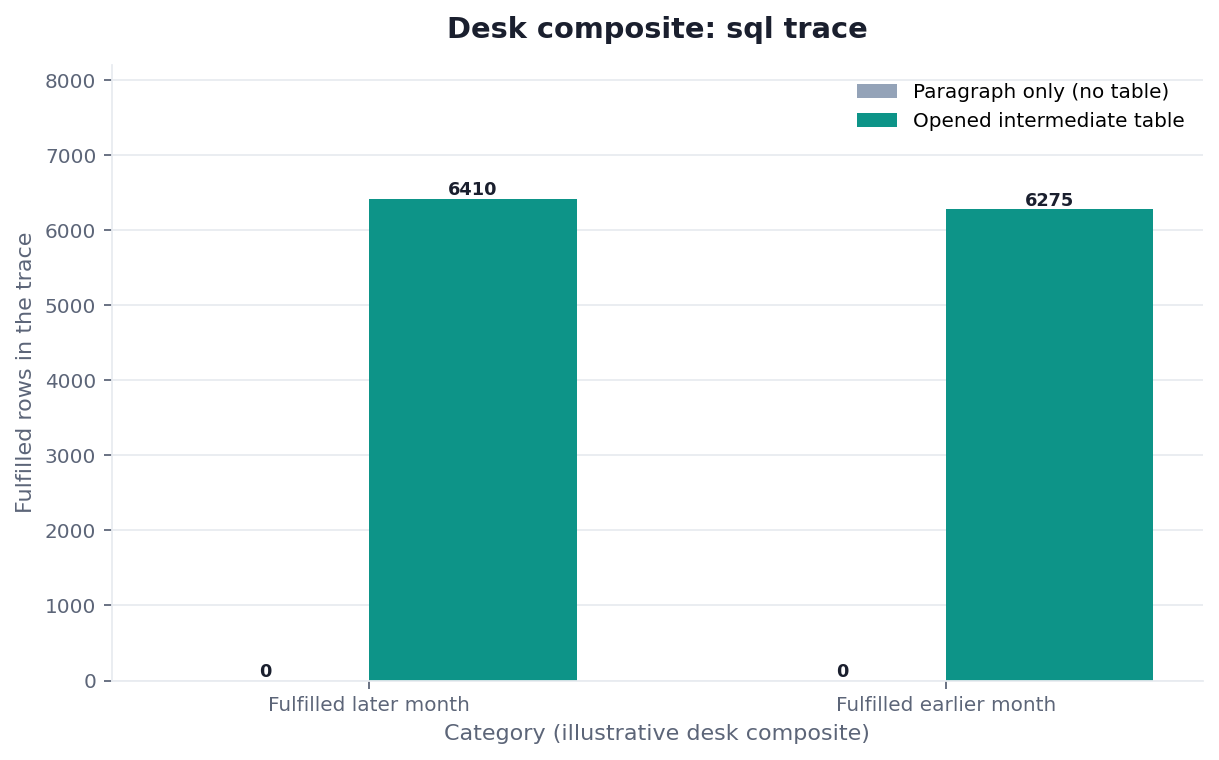
Figure. InfiniSynapse desk log ADR-STA-20260825: paragraph-only left 0 / 0 / 0; opened intermediate table left 1 / 1 / 1 (6,275 vs 6,410 fulfilled rows). Published context: the independent sources linked in the body. Not a customer experiment, SLA, or official benchmark.
| Evidence class | What you can cite | What you cannot claim |
|---|---|---|
| Desk log on this page | Artifact counts 0/0/0 → 1/1/1, 6,275 vs 6,410 fulfilled rows, ~12,685 lines on this run, ~7 min wall-clock, downloadable log | Customer uplift %, vendor bake-off win, named-logo case |
| Published authority (linked above) | Inspectable-object habits from CNCF, Terraform, GitHub Docs, GitLab, Jira, and OpenTelemetry traces; adoption and risk from Stanford HAI, McKinsey, Gartner, NIST AI RMF, OWASP | That those sources ran this desk log |
| Homepage recognition | 2026 WAIC Future Tech OPC Excellence Award as published on the company homepage; self-described, not independently verified here | That WAIC, Gartner, or NIST scored this article |
A trail that cannot show the remap is not a close. A trail that can show it is still not a promise the agent is always right. That is what a sql trace looks like on a desk.
Scorecard: Can You Open the Tables
Score each run, not the vendor. A sql trace is a property of the last answer.
| Check | Yes | No |
|---|---|---|
| The goal names a decision, not a vibe | Keep | Rewrite the question |
| The plan lists source, grain, and window | Keep | Reject the paragraph |
| Every statement in the trail is visible | Keep | Do not brief the number |
| Every intermediate table opens | Keep | You have a closed log |
| Artifact is a file a colleague can download | Keep | You still have a chat bubble |
| Source is read-only and authorized | Keep | Stop; this is not an audit |
If three or more rows are “No,” you do not have a sql trace yet. You have a draft. That is a normal first pass. It is not a close.
Failure Modes That Look Like a Trace
Fluent failure is the reason a sql trace exists. The paragraph is rarely the thing that breaks.
A screenshot instead of a statement
Someone pastes a grid into Slack and calls it the trail. Next week the session is gone. A screenshot is not a sql trace. It is not replayable.
An intermediate table nobody can query
The agent mentions “temp_refunds” and never exposes it. That is a closed trail. If you cannot open the grain, you cannot defend the percentage.
A filter that lives only in the memo
The memo says “revenue was flat.” The query quietly dropped a channel. Read the predicate before the adjective.
Before you brief anyone, check three things on the last answer you actually trust: the plan names the grain, the sql trace shows every table, and the metric sentence exists outside the model’s head. If any of those is missing, do not take the paragraph into a meeting.
When the next missing object is not this page, open Trust but Verify a Data Agent when Owners verify files; they do not bless paragraphs, Hallucinated Metrics when the Pack Is Missing when Unbound chat invents measures that look official, or Reproducible Analysis: Same Goal, Same Grain when A rerun that changes the grain is not a rerun.
Open the SQL trace on the last completed task
Open a completed task and walk plan → statement → intermediate table → file on a source you already authorize. This check uses only sources you authorize.
Commercial association: You do not need the workspace to complete the educational diagnosis on this page.
Open InfiniSynapseHow this page is sourced. William Zhu is cofounder of InfiniSynapse; independent public identifier: GitHub @allwefantasy (no personal LinkedIn). Institution: About InfiniSynapse. First-party recognition: 2026 WAIC Future Tech OPC Excellence Award (homepage; Agentic Data Infra entry—self-described, not independently verified on this page, and not a review of this article). Trust pages: Privacy · publishing terms · NIST Privacy Framework. Desk methodology note: 2026-07-29 attestation. Downloadable first-party run: desk log
ADR-STA-20260825· aggregate CSV · verify script. Reviewed by analytics engineering · data platform · LLM security · editor. Editorial standards · corrections. Contact zhuhl@infinisynapse.com. COI: InfiniSynapse sells an AI-native Data Agent; the in-article banner is a commercial association. Fact-check: Stanford HAI AI Index · McKinsey State of AI · Gartner Peer Insights — Analytics & BI · NIST AI Risk Management Framework · OWASP Top 10 for LLM Applications · CNCF project landscape · Terraform documentation · GitHub Docs · about GitLab · Jira · OpenTelemetry traces · W3C DCAT · DataCite. First-party numbers on this page are desk logADR-STA-20260825only.
How to cite this page
Page: Zhu, W., & InfiniSynapse Data Team. (2026). SQL Trace: Bind, Then Replay. InfiniSynapse
Run: InfiniSynapse Data Team. (2026). Desk log ADR-STA-20260825 (sanitized composite)
Neither is an audit. Cite those published artifact counts when you quote sql trace figures from this first-party desk comparison. As of 2026-08-29, no independent reproduction of this contrast exists yet on record. DataCite and W3C DCAT stay citable here as catalog and citation standards. OpenTelemetry, CNCF, and NIST remain linked only as published context. Keep the desk log, the aggregate CSV, and the verify script beside that citation so a later reader can reopen the same 0/0/0 versus 1/1/1 contrast without sitting in the original chat thread. Sql trace citations should name the run ID, not a fluent restatement of a paragraph-only memo. Retain both folders. Reopen sql trace after those files. Name sql trace quotes. Keep both folders beside the dated review decision so a later owner can inspect the same pair today. Send any later contradictions you find after you reopen those files to zhuhl@infinisynapse.com.
Frequently Asked Questions
Is a copied query enough to count as a sql trace?
Bottom line: No. A sql trace requires reopenable objects next to the paragraph—plan, statements, and intermediate tables. A copied query in a vanished session is a draft, not a trail.
Do I need a warehouse before I can keep a sql trace?
Bottom line: No. A sql trace is a property of the run, not of the platform. Connect a source you authorize, bind a definition if you have one, and keep the tables the task wrote. A warehouse can help at scale; it is not a prerequisite.
What should a non-analyst open first in the sql trace?
Bottom line: Open the plan and the filter list, not the chart. If you cannot restate the grain in one sentence, you are not ready to quote the number. Ask an analyst only after that restatement fails.
Can I trust a sql trace if the source changed overnight?
Bottom line: Trust the comparison of two traces, not a vibes check. A sql trace on a rerun means you can see whether the definition, the window, or the rows changed. If the source moved and the plan did not say so, reject the new paragraph.
Is a screenshot of a result grid a sql trace?
Bottom line: No. A screenshot is a picture of one hop. A sql trace needs the plan, the statements, and every intermediate table so a second person can replay the filter. Paste the file, not the grid.
How many intermediate tables must a sql trace include?
Bottom line: Every table the statements wrote. A sql trace that hides “temp_refunds” is a closed log. If you cannot open the grain and the row count on each hop, reject the paragraph.
What metadata should be stored for every query step?
Bottom line: Keep the run ID, source context, ordered statement, bound parameters, timing, output schema, row count, and reviewer disposition. Do not reconstruct them from the final paragraph.
Can an independent reviewer replay the evidence?
Bottom line: Yes. Use a versioned public source and declared pass rule, then require the reviewer to inspect each hop and independently recompute one aggregate.
Did OpenTelemetry, CNCF, or a news outlet recognize this page?
Bottom line: No. OpenTelemetry traces and the CNCF project landscape publish inspectable-object language. They did not evaluate InfiniSynapse. There is no independent award page for this article, no media citation of this trail guide on this page, and there is no personal LinkedIn to add.
Conclusion
A sql trace is a review habit: read the plan, open every statement, open every intermediate table, keep the file. The paragraph is the last object, not the first. Teams that skip that order will keep arguing about adjectives while the join stays wrong.
Use the scorecard on the next number you are tempted to paste into a deck. If the sql trace is missing, the number is not ready.