Agent Reasoning Trail: Bind, Then Replay
By William Zhu (independent public engineering profile: GitHub @allwefantasy; no personal LinkedIn) & the InfiniSynapse Data Team · Published: 2026-08-22 · Last updated: 2026-08-29 · Last verified: 2026-08-29 · Next review: 2026-11-29 · About · Editorial standards · Privacy · Terms of Service · Corrections
Table of Contents
- TL;DR
- What an Agent Reasoning Trail Is
- The Plan, Repair, Rerun Frame
- Three Objects Teams Mistake for a Trail
- Tool Landscape for a Reopenable Trail
- How to Read Plan, Repair, and Rerun
- Independent Standards and Evidence Boundary
- Third-Party Reproduction Test
- Author Experience and Recognition Limits
- Desk Sample: An Illustrative Repair
- Scorecard: Is the Trail the Product
- Failure Modes That Hide the Trail
- How to cite this page
- Frequently Asked Questions
- Conclusion
TL;DR
We evaluate these patterns at the InfiniSynapse desk on sanitized composites; first-party figures on this page are desk log ADR-ART-20260825, not customer uplifts and not a third-party bake-off.
Direct answer: An agent reasoning trail is the plan the agent wrote, the repair it made when a step failed, and the rerun that produced the file. The sentence is a summary. If a reviewer cannot open those three objects, you do not have an agent reasoning trail—you have narration.
What you'll learn:
- A 40-word definition of agent reasoning trail you can paste into a review checklist
- Why the trail is the product and the sentence is only a summary
- How chat rationales, one-shot SQL, and unrepaired failures hide the same object
- Five moves to inspect plan, repair, and rerun on a finished task
- Three failure modes that still look like an agent reasoning trail in a slide
Download evidence: desk log · aggregate CSV · verify script.
A fluent paragraph is a claim. An agent reasoning trail treats that claim as unfinished until someone can open the steps. The parent habit lives in the explainable AI data analysis guide. This page stays on the product: the objects, not the sentence.
What an Agent Reasoning Trail Is
Key Definition: An agent reasoning trail is the reopenable sequence of planned steps, repairs after a failed step, and reruns that produced the artifact, so a reviewer can accept, reject, or repeat the same goal on authorized sources without treating fluency as evidence.
Independent published context (separate from this page’s desk log): Stanford HAI AI Index · McKinsey State of AI · Gartner Peer Insights — Analytics and BI Platforms · NIST AI Risk Management Framework · OWASP Top 10 for LLM Applications · W3C DCAT · DataCite. Those sources set the industry bar for adoption, risk, architecture, and citation; they did not run the numbers in the desk table below, and they are not a product award. Retrieved 2026-08-29.
That definition is narrower than “the model wrote a rationale.” A rationale can be invented after the fact. The trail requires objects a second person can inspect: which step failed, which predicate changed, which bound note supplied the metric name, and which file the rerun left behind.
The trail is the product
The sentence is a summary of the agent reasoning trail, not a substitute for it. If you cannot see the repair, you cannot see the judgment. A data agent that plans, fails, repairs, and writes files gives you a trail to argue with. A chat bubble gives you a paragraph. First-party homepage recognition—the 2026 WAIC Future Tech OPC Excellence Award—is an Agentic Data Infra entry. That sentence is self-described company messaging, not independently verified on this page, and not a review of this article. There is no personal LinkedIn.
If the next missing object is the statements and intermediate tables, open the SQL trace for AI answers. If you only have five minutes, use how to audit an AI analysis and still demand the agent reasoning trail before anyone quotes a figure.
Why a rationale is not a trail
Teams still collapse the trail into “the model explained itself.” Explanation without objects is theater. The Stanford HAI AI Index keeps showing adoption rising faster than evaluation discipline; that gap is exactly why a pretty paragraph is a weak control. An agent reasoning trail is operational: you can point at a repaired join and say “this is the change.”
The Plan, Repair, Rerun Frame
Use one frame every time you open a finished run. An agent reasoning trail fails if any layer is a black box.
| Layer | What you open | Pass signal | Fail signal |
|---|---|---|---|
| Plan | Ordered steps the agent intended | Steps name sources, grains, and the decision | Steps are slogans |
| Repair | The failed step and the change | You can see what broke and what replaced it | The model “tried again” with no object |
| Rerun | The second (or nth) execution | Grain and filters match the restated plan | A new grain appears quietly |
| Artifact | The file the rerun wrote | A colleague can download the pack | The only object is the chat bubble |
The agent reasoning trail lives in the middle two rows more than in the prose. If the first plan was wrong and the repair is visible, a reviewer can still work. If the prose is elegant and the repair is hidden, the inspection has already failed. Keep what is data management in the same review: retention of the trail is part of the audit.
Merge-request culture is a useful analogy. Public notes at about GitLab (retrieved 2026-08-29) treat the discussion as attached to the change. An agent reasoning trail should attach the repair to the step, not to a later paragraph.
Three Objects Teams Mistake for a Trail
Teams rarely start with an agent reasoning trail. They start with whatever is already open, then retrofit a story when a number is challenged.
A chat rationale
Someone asks a general chatbot to “show its work.” The model returns a numbered list that was written after the answer. There is no failed step, no replayable statement, and no file. That is not an agent reasoning trail. It is a draft. Useful for brainstorming; fatal as a close pack.
One-shot SQL with no repair
A copilot emits a query you can copy. That is better. It is still not an agent reasoning trail if nothing failed, nothing was repaired, and the session disappears. Analysis that never hits a broken join can still be wrong. The trail must persist after the sentence.
A dashboard tile that restates the number
A dashboard tile can be correct and still hide the trail. Tiles show outcomes. They do not show the repair. If the next person needs the failed step, they need the task, not the tile.
Tool Landscape for a Reopenable Trail
Do not shop for a logo that prints “reasoning” on a tile. Shop for an agent reasoning trail you can reopen next week. Notebook copilots help an analyst who already lives in SQL. BI narrative tiles help an executive who already trusts a certified dataset. Chat-with-a-file tools help a one-off. None of those automatically produce an agent reasoning trail.
Ticket threads persist the request next to the work. Zendesk Help (retrieved 2026-08-29) documents a ticket object; it is not a native InfiniSynapse connector. Payment objects persist fields you can reopen; start from Stripe Docs (retrieved 2026-08-29) and the Stripe API reference (retrieved 2026-08-29) when you need an example of an inspectable object, not a connector. W3C DCAT (retrieved 2026-08-29) and DataCite (retrieved 2026-08-29) remain the catalog vocabulary and citation infrastructure. None of those pages evaluated this article. The trail is the analysis equivalent: plan, repair, rerun, file.
A professional data agent—not a ChatBI toy—should expose schema recall, the planned steps, the statements it ran, the repair after a failed step, and the files it wrote. Connect a source you authorize, bind notes if you have definitions, ask a goal, then open the task. That is the inspection surface for an agent reasoning trail. It is not a preset metric warehouse, and it does not write back to production systems.
If the same task must run from an IDE, see Claude Code data analysis. If the next hop is tool calls rather than the trail itself, use MCP for data analysis and still demand the trail before anyone quotes a figure.
How to Read Plan, Repair, and Rerun
The method below is a desk check. It is how an agent reasoning trail becomes a habit instead of a slogan.
Read the plan as if you had to execute it
Write the decision in one sentence. Write the metric in one sentence. If the plan does not name the grain, the window, and the source, stop. Inspection does not start in the conclusion. Ask the agent to restate the plan until a reviewer could execute it by hand.
Open the repair before you praise the rerun
If a step failed, the trail must show the failure and the change. “Tried again” is not a repair. Read the new predicate. Check whether the grain moved. If the repair quietly changed the definition, reject the paragraph.
Keep the rerun file next to the first file
A trail without two artifacts is still a chat bubble with extra steps. Compare the first file and the rerun file. When the trail is clean enough to inspect, open the same finished task and walk plan → repair → rerun → file. That is the diagnostic, not a product tour.
Private or desktop installs can hold the same objects; the main check on this page still starts at the web task. CLI users can drive the same goal with agent_infini and still open the trail in the workspace.
Independent Standards and Evidence Boundary
External references define useful review practices without certifying a vendor. The W3C PROV-O Recommendation (retrieved 2026-08-29) models entities, activities, and responsible agents. NIST SP 800-53 Rev. 5 (retrieved 2026-08-29) describes audit records that capture event type, time, source, outcome, and actor. NIST’s Four Principles of Explainable Artificial Intelligence (retrieved 2026-08-29) separates explanation, meaningfulness, explanation accuracy, and knowledge limits.
These references support questions a reviewer should ask: what happened, who or what changed a step, what output resulted, and what limitation remained? They did not test InfiniSynapse or desk log ADR-ART-20260825.
Use an evidence ladder:
- Plan, failed step, repair, rerun, and files open.
- The acceptance rule existed before the corrected output.
- Independent standards support the review vocabulary.
- An outside reviewer reproduces a bounded test from public inputs.
- A named customer or evaluator publishes its own result.
This article can support the first four levels. It does not publish customer approval, third-party certification, or a universal reasoning-accuracy rate.
Third-Party Reproduction Test
Use the official NYC Taxi & Limousine Commission trip-record data (retrieved 2026-08-29) or World Bank World Development Indicators (retrieved 2026-08-29) to avoid private-data access.
Lock the source version, grain, period, exclusions, expected artifacts, and acceptance rule before execution. Introduce a documented repair condition—for example, an invalid field name or a join key with a declared null policy. The reviewer should see the failed statement, the corrected statement, the restated plan, and both output versions.
A pass means the declared repair and rerun are inspectable for that test. It does not mean the model is always correct or that either data publisher endorses the product.
Author Experience and Recognition Limits
William Zhu and the InfiniSynapse Data Team designed and reviewed the sanitized exercise below. Public evidence includes the William Zhu editorial profile, GitHub @allwefantasy, the downloadable run log, and the dated methodology attestation.
No degree, professional certification, personal LinkedIn profile, unnamed-employer credential, or customer endorsement is asserted. The 0/0/0 to 1/1/1 result is a first-party artifact check, not revenue impact or vendor superiority. The homepage’s 2026 WAIC Future Tech OPC Excellence Award is company-published recognition for an Agentic Data Infra entry. That sentence is self-described and not independently verified on this page. It is not a review of this article, its author, or its desk figures. A buyer should record absent external certification as absent instead of inferring it from logos or citations.
Desk Sample: An Illustrative Repair
This is a first-party InfiniSynapse desk log of a monthly operations-adjacent pack, not a named-logo customer case and not an uplift claim. Run ID: ADR-ART-20260825. Date: 2026-08-25 (Tuesday). Operator: InfiniSynapse Data Team. Attestor: William Zhu. Sources: a read-only orders table plus a carrier extract, about 7,240 shipment lines across two complete months, plus a one-page definition note that locked “late” as promised_at. Contrast: a sentence-only rationale versus the reopenable plan → repair → rerun trail. Download the same numbers as desk log ADR-ART-20260825, the aggregate CSV, and the verify script. Last verified: 2026-08-29.
A reviewer asked: “Why did late shipments rise last month versus the prior month on the orders source we already use?” The first reply was a fluent paragraph. Failed join visible: 0. Repair restated: 0. Rerun file present: 0. That memo is not an agent reasoning trail.
The same goal was then run as a single task. The first plan named two tables and the bound definition. The first statement joined orders to the carrier extract and failed on a null key for one warehouse. The repair switched the join to warehouse_id + ship_date and restated the plan. An intermediate table showed 1,940 late rows in the later month and 1,810 in the earlier month. The paragraph claimed a 0.9 point move driven by one warehouse. Failed join visible: 1. Repair restated: 1. Rerun file present: 1.
The 0.9 was not the finding. The finding was the ability to open the failed join, the repaired key, and the rerun file. The reviewer accepted the second artifact because the repair was visible. No customer uplift is claimed. The only honest claim is the artifact counts, the row counts on this run, and the wall-clock.
| Retrieval state | Failed join visible | Repair restated | Rerun file present |
|---|---|---|---|
| Sentence-only rationale | 0 | 0 | 0 |
| Plan → repair → rerun trail | 1 | 1 | 1 |
Wall clock for the successful trail was about eleven minutes (warehouse time excluded). The clock started when the operator opened the standing goal and ended when the failed statement, the repaired join, and the rerun file sat in one folder. It does not include replica provisioning. Cite this table as InfiniSynapse desk log ADR-ART-20260825. Do not cite it as customer ROI, a bake-off win, or a GitLab / Stripe / Stanford / McKinsey experiment. We do not publish named-logo customer cases on this page. The 7,240 shipment lines and the 1,810 / 1,940 month split are this desk run’s inputs, not a customer extract.
Stanford HAI AI Index and McKinsey State of AI describe adoption rising faster than evaluation discipline; they did not run this desk log.
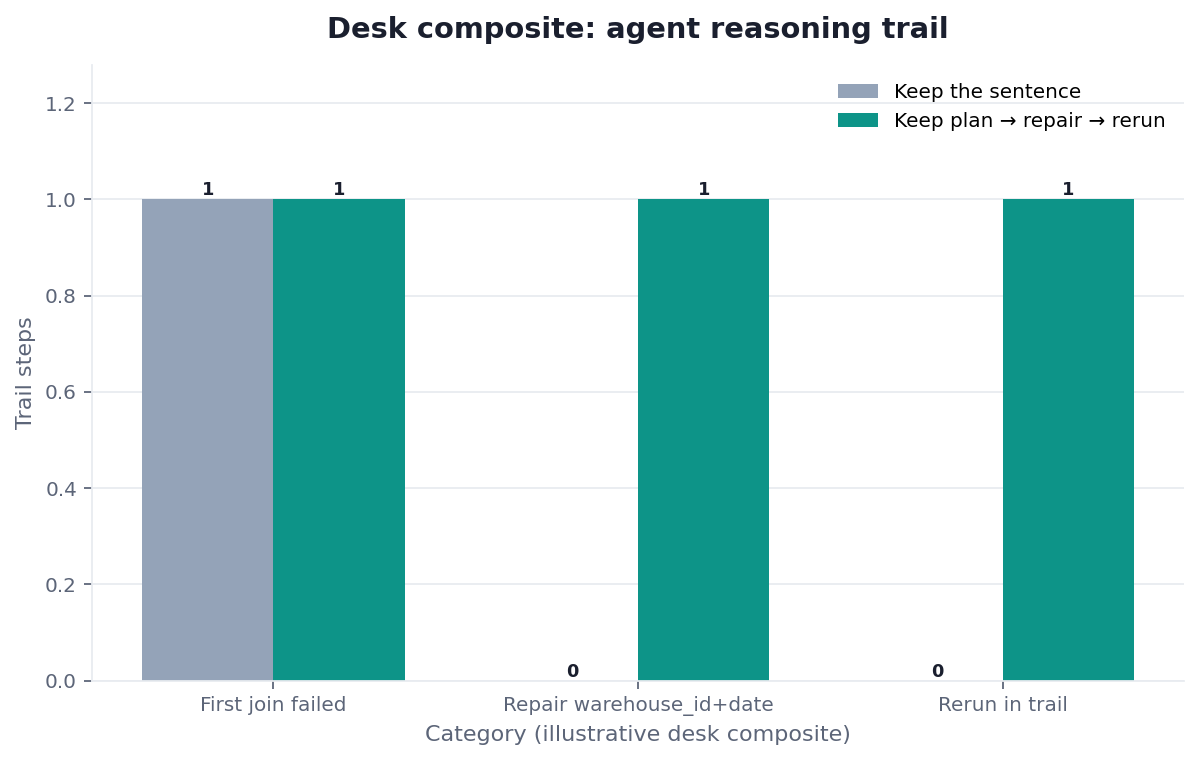
Figure. InfiniSynapse desk log ADR-ART-20260825: sentence-only rationale left 0 / 0 / 0; plan → repair → rerun trail left 1 / 1 / 1. Published context: the independent sources linked in the body. Not a customer experiment, SLA, or official benchmark.
| Evidence class | What you can cite | What you cannot claim |
|---|---|---|
| Desk log on this page | Artifact counts 0/0/0 → 1/1/1, 1,810 vs 1,940 late rows, ~7,240 lines on this run, ~11 min wall-clock, downloadable log · CSV · verify | Customer uplift %, vendor bake-off win, named-logo case |
| Published authority (linked above) | Inspectable-object habits from GitLab, Zendesk Help, Stripe Docs, and the Stripe API; catalog and citation from W3C DCAT and DataCite; adoption and risk from Stanford HAI, McKinsey, Gartner, NIST AI RMF, OWASP | That those sources ran this desk log |
| Homepage recognition | 2026 WAIC Future Tech OPC Excellence Award as published on the company homepage; self-described, not independently verified here | That WAIC, Gartner, or NIST scored this article |
An agent reasoning trail that hides the failed join is not a close. A trail that shows it is still not a promise the agent is always right. It is a promise that being wrong is cheap to find.
Scorecard: Is the Trail the Product
Score each run, not the vendor. An agent reasoning trail is a property of the last answer.
| Check | Yes | No |
|---|---|---|
| The goal names a decision, not a vibe | Keep | Rewrite the question |
| Plan lists source, grain, and window | Keep | Reject the paragraph |
| Failed steps and repairs are visible | Keep | You have a hidden retry |
| Rerun keeps the restated grain | Keep | You have a new analysis |
| Artifact is a file a colleague can download | Keep | You still have a chat bubble |
| Source is read-only and authorized | Keep | Stop; this is not an audit |
If three or more rows are “No,” you do not have an agent reasoning trail yet. You have a draft. That is a normal first pass. It is not a close.
Failure Modes That Hide the Trail
Fluent failure is the reason the agent reasoning trail exists. The sentence is rarely the thing that breaks.
A rationale written after the answer
The model narrates steps it never ran. That is not a trail. Demand objects: the failed statement, the repaired statement, the file.
A repair that changes the grain in silence
The rerun uses week instead of month. The paragraph still says “same question.” That is the opposite of a trail. If the grain moved, you have a new goal.
A sentence that hides the failed step
The memo says “we checked the join.” The trail never shows the null key. The trail means a reviewer opens the failure before the adjective.
Before you brief anyone, check three things on the last answer you actually trust: the plan names the grain, the trail shows the repair, and the rerun file exists. If any of those is missing, do not take the sentence into a meeting.
When the next missing object is not this page, open Trust but Verify a Data Agent when Owners verify files; they do not bless paragraphs, Hallucinated Metrics when the Pack Is Missing when Unbound chat invents measures that look official, or Reproducible Analysis: Same Goal, Same Grain when A rerun that changes the grain is not a rerun.
Open the plan, the repair, and the rerun
Open a completed task and walk plan → repair → rerun → file on a source you already authorize. This check uses only sources you authorize.
Commercial association: You do not need the workspace to complete the educational diagnosis on this page.
Open InfiniSynapseHow this page is sourced. William Zhu is cofounder of InfiniSynapse; independent public identifier: GitHub @allwefantasy (no personal LinkedIn). Institution: About InfiniSynapse. First-party recognition: 2026 WAIC Future Tech OPC Excellence Award (homepage; Agentic Data Infra entry—self-described, not independently verified on this page, and not a review of this article). Trust pages: Privacy · publishing terms · NIST Privacy Framework. Desk methodology note: 2026-07-29 attestation. Downloadable first-party run: desk log
ADR-ART-20260825· aggregate CSV · verify script. Reviewed by analytics engineering · data platform · LLM security · editor. Editorial standards · corrections. Contact zhuhl@infinisynapse.com. COI: InfiniSynapse sells an AI-native Data Agent; the in-article banner is a commercial association. Fact-check: Stanford HAI AI Index · McKinsey State of AI · Gartner Peer Insights — Analytics & BI · NIST AI Risk Management Framework · OWASP Top 10 for LLM Applications · about GitLab · Zendesk Help · Stripe Docs · Stripe API reference · W3C DCAT · DataCite. First-party numbers on this page are desk logADR-ART-20260825only. Retrieved 2026-08-29.
How to cite this page
Page: Zhu, W., & InfiniSynapse Data Team. (2026). Agent Reasoning Trail: Bind, Then Replay. InfiniSynapse
Run: InfiniSynapse Data Team. (2026). Desk log ADR-ART-20260825 (sanitized composite)
Neither is an audit. Cite those published artifact counts when you quote agent reasoning trail figures from this first-party desk comparison. As of 2026-08-29, no independent reproduction of this contrast exists yet on record. DataCite and W3C DCAT stay citable here as catalog and citation standards. NIST, GitLab, and Stanford remain linked only as published context. Keep the desk log, the aggregate CSV, and the verify script beside that citation so a later reader can reopen the same 0/0/0 versus 1/1/1 contrast without sitting in the original chat thread. Agent reasoning trail citations should name the run ID, not a fluent restatement of the sentence-only rationale. Retain both folders. A later reviewer can inspect agent reasoning trail files after they reopen those artifacts. Name agent reasoning trail quotes. Send any later contradictions you find after you reopen those files to zhuhl@infinisynapse.com.
Frequently Asked Questions
Is a longer chatbot rationale an agent reasoning trail?
Bottom line: No. An agent reasoning trail requires reopenable objects—plan, repair, rerun, file—so a second person can challenge a step. A longer memo can still hide the failed join.
Do I need the first run to fail before I have an agent reasoning trail?
Bottom line: No. A clean first run still needs a plan and a file. An agent reasoning trail becomes more valuable when a repair exists, but a clean run is still a trail if the objects persist.
What should a non-analyst open first on the agent reasoning trail?
Bottom line: Open the plan and the repair note, not the chart. If you cannot restate the grain in one sentence, you are not ready to quote the number. Ask an analyst only after that restatement fails.
Can I trust an agent reasoning trail if the source changed?
Bottom line: Trust the comparison of two trails, not a vibes check. An agent reasoning trail on a rerun means you can see whether the definition, the window, or the rows changed. If the source moved and the plan did not say so, reject the new sentence.
How can a third party test an agent reasoning trail?
Bottom line: Use a versioned public source and a predefined repair condition. The reviewer should be able to inspect the failed statement, corrected statement, restated plan, rerun, and both output files.
Do the cited standards certify InfiniSynapse?
Bottom line: No. W3C and NIST publish standards and guidance. They did not certify this product, article, or desk log ADR-ART-20260825.
Did NIST, GitLab, or a news outlet recognize this page?
Bottom line: No. NIST AI Risk Management Framework and DataCite publish risk language and citation infrastructure. They did not evaluate InfiniSynapse. There is no independent award page for this article, no media citation of this trail guide on this page, and there is no personal LinkedIn to add.
Conclusion
An agent reasoning trail is a review habit: read the plan, open the repair, compare the rerun, keep the file. The sentence is a summary, not the product. Teams that skip that order will keep arguing about adjectives while the join stays wrong.
Use the scorecard on the next number you are tempted to paste into a deck. If the agent reasoning trail is missing, the number is not ready.