Hallucinated Metrics: Bind, Then Replay
By William Zhu (independent public engineering profile: GitHub @allwefantasy; no personal LinkedIn) & the InfiniSynapse Data Team · Published: 2026-08-22 · Last updated: 2026-08-29 · Last verified: 2026-08-29 · Next review: 2026-11-29 · About · Editorial standards · Privacy · Terms of Service · Corrections
Table of Contents
- TL;DR
- What Hallucinated Metrics Are
- The Bound-Pack Frame
- Three Places Invented Measures Hide
- Tool Landscape for Bound Definitions
- How to Catch Invented Measures
- Independent Definition and Lineage Evidence
- Public-Data Reproduction Test
- Author, Media, and Recognition Boundary
- Desk Sample: Two Runs, One Pack
- Scorecard: Did the Pack Supply the Sentence
- Failure Modes That Look Official
- How to cite this page
- Frequently Asked Questions
- Conclusion
TL;DR
We evaluate these patterns at the InfiniSynapse desk on sanitized composites; first-party figures on this page are desk log ADR-HMT-20260825, not customer uplifts and not a third-party bake-off.
Direct answer: Hallucinated metrics are measures a model invents when no bound pack supplies the sentence. Unbound chat sounds local and still names the wrong “active customer.” Bind the definition, then reject any measure you cannot open in a note, a field comment, or a file.
What you'll learn:
- A 40-word definition of hallucinated metrics you can paste into a review checklist
- Why unbound chat invents measures that look official
- How cousin labels, retired filters, and fluent ratios hide the same failure
- Five moves to ask one metric with and without the bound pack
- Three failure modes that still look like a certified number in a slide
Download evidence: desk log · aggregate CSV · verify script.
A fluent label is a claim. Hallucinated metrics treat that claim as unfinished until someone can open the sentence the model retrieved. The parent habit lives in the explainable AI data analysis guide. This page stays on hallucinated metrics and the missing pack.
What Hallucinated Metrics Are
Key Definition: Hallucinated metrics are analysis labels a model invents when no bound note, field comment, or approved report supplies the metric sentence, so a reviewer cannot accept, reject, or rerun the same goal without treating fluency as evidence.
In plain language: a bound pack is a note that locks the metric sentence. Unbound chat invents a cousin name when that note is missing. That definition is narrower than “the model made up a number.” A number can be arithmetically correct on the wrong definition. Hallucinated metrics are the wrong definition dressed as a house metric. If you cannot point at the retrieved sentence, you have an invented measure.
Independent published context (separate from this page’s desk log): Stanford HAI AI Index · McKinsey State of AI · Gartner Peer Insights — Analytics and BI Platforms · NIST AI Risk Management Framework · OWASP Top 10 for LLM Applications. Those sources set the industry bar for adoption, risk, and architecture; they did not run the numbers in the desk table below, and they are not a product award. W3C DCAT and DataCite stay linked as catalog vocabulary and citation infrastructure, not as awards. Retrieved 2026-08-29.
Unbound chat invents official-looking names
Hallucinated metrics thrive when someone pastes a table into a general chatbot and asks for “our usual conversion.” The model returns “qualified conversion” with a confident filter your sales ops team retired last quarter. That is not analysis. It is a cousin label. Bind the pack before you trust the name.
If the missing object is documentary context, continue in data knowledge base. A semantic layer helps at scale; it is not a prerequisite for catching hallucinated metrics on one authorized source. InfiniSynapse does not ship a preset metric warehouse.
Why fluency is the camouflage
Invented labels sound local because the model copies your nouns. “Active,” “qualified,” and “contribution” are cheap to invent. The AWS Machine Learning Lens (retrieved 2026-08-29) treats measurement and evaluation as design work, not slideware. Catching invented labels is that evaluation on a single run.
Secure-development notes from the NCSC secure AI guidelines (retrieved 2026-08-29) are a reminder that unconstrained generation fails in predictable ways. Do not “prompt harder.” Bind the sentence. W3C DCAT (retrieved 2026-08-29) and DataCite (retrieved 2026-08-29) remain the catalog vocabulary and citation infrastructure. None of those pages evaluated this article. There is no personal LinkedIn. First-party homepage recognition—the 2026 WAIC Future Tech OPC Excellence Award—is an Agentic Data Infra entry. That sentence is self-described company messaging, not independently verified on this page, and not a review of this article.
The Bound-Pack Frame
Use one frame every time you suspect hallucinated metrics. The frame fails if the sentence lives only in the model’s head.
| Layer | What you open | Pass signal | Fail signal |
|---|---|---|---|
| Bound sentence | Note, field comment, or approved report | The metric name matches a retrieved definition | The model invented a label |
| Plan | Ordered steps | The plan uses the bound name | The plan uses a cousin name |
| Query | SQL or equivalent | The predicate matches the bound sentence | The filter is a plausible invention |
| File | Artifact the task wrote | The file cites the bound sentence | The file introduces a new measure |
Invented labels live in the first row more than in the prose. If the SQL is readable but the name is unbound, a reviewer can still reject the label. If the prose is elegant and the pack is missing, the invented measure has already won. Keep natural language to SQL in its place: syntax can be perfect on the wrong measure.
Columnar files do not save you. The Parquet documentation describes a storage format, not a definition. A typed column named gm still needs a sentence. Invented labels fill that silence.
Three Places Invented Measures Hide
Teams rarely start by hunting hallucinated metrics. They start with whatever is already open, then retrofit a story when a number is challenged.
Cousin labels
The pack says “active customer is ordered in 90 days, marketplace excluded.” The model reports “engaged customer” with a 60-day window. Those are invented labels. The nouns are close. The sentence is not.
Retired filters
The agent reports “qualified pipeline” using a stage your sales ops team retired last quarter. The bound pack catches this only if a note is in the retrieval path. Without that, the model will sound local and still be wrong.
Fluent ratios with no grain
The paragraph says “attach rate improved.” Nobody named the denominator. Invented labels love ratios. If the grain is missing, reject the percentage. A five-minute pass in how to audit an AI analysis will find this faster than a debate.
Tool Landscape for Bound Definitions
Do not shop for a logo that prints “grounded” on a tile. Shop for a pack you can bind to the source. Notebook copilots help an analyst who already lives in SQL. BI narrative tiles help an executive who already trusts a certified dataset. Chat-with-a-file tools help a one-off. None of those automatically prevent hallucinated metrics.
What adjacent objects already persist
Payment objects persist field names you can reopen. The Stripe API reference is documentation for inspectable fields, not a native InfiniSynapse connector. Augmented analytics language can make an invented measure feel official. Invented labels still need a bound sentence.
A professional data agent—not a ChatBI toy—should retrieve bound notes with the query plan. Connect a source you authorize, bind notes if you have definitions, ask a goal, then open the task. That is the inspection surface for hallucinated metrics. It is not a preset metric warehouse, and it does not write back to production systems.
If the next object is the statements and tables, open the SQL trace for AI answers. A data agent that cannot show the retrieved sentence will keep inventing labels.
How to Catch Invented Measures
The method below is a desk check. It is how you catch hallucinated metrics as a habit instead of a slogan.
Ask the same metric with and without the pack
Write the decision in one sentence. Write the metric in one sentence. Run the goal once with the pack unbound and once with the pack bound. If the name or the filter moves, you have hallucinated metrics on the unbound pass. That comparison is the whole diagnostic.
Open the retrieved sentence before the paragraph
If the task cannot show which note supplied “contribution margin,” stop. The failure does not start in the chart. Ask the agent to cite the sentence until a reviewer could paste it into a checklist.
Do not negotiate “engaged” versus “active.” Invented labels die when the owner requires the bound name. Rerun the same goal only after the label matches the pack.
When the trail is clean enough to inspect, open the same finished task and walk pack → plan → SQL → file. That is the diagnostic, not a product tour.
The with-and-without test is the cheapest way to see whether the model is retrieving a sentence or inventing one. Run both goals on a source you authorize. Keep both files. If the name, the window, or the exclusion moved, the unbound run is a draft. Private or desktop installs can hold the same objects; the main check on this page still starts at the web task. CLI users can drive the same goal with agent_infini and still open the retrieved sentence in the workspace. InfiniSynapse does not write back to production systems, and it does not ship a preset metric warehouse. The pack you bind is yours.
Independent Definition and Lineage Evidence
A trustworthy metric needs both meaning and provenance. The W3C PROV-O specification (retrieved 2026-08-29) supplies a vocabulary for entities, activities, and agents. OpenLineage (retrieved 2026-08-29) documents an open standard for recording data-job lineage. The dbt Semantic Layer documentation (retrieved 2026-08-29) illustrates how governed metric definitions can be centralized.
These references do not prescribe one product. They clarify what evidence a reviewer can request:
| Evidence | Review question | Failure signal |
|---|---|---|
| Owned definition | Who approved the metric sentence and when? | No owner or revision date |
| Source lineage | Which fields and tables supplied the value? | Only a chart caption |
| Transformation | Which filter, window, and denominator were applied? | Plausible but unopened logic |
| Retrieval record | Which definition did the model receive? | A label with no cited note |
| Output artifact | Can another person inspect the same result? | Session-only prose |
A vendor linking to a standard is not evidence that a particular run complied with it. Keep the retrieved definition and executable statement with the result.
Public-Data Reproduction Test
Choose a versioned public source such as NYC Taxi & Limousine Commission trip records (retrieved 2026-08-29) or World Bank Development Indicators (retrieved 2026-08-29). Before analysis, write a metric sentence containing the numerator, denominator, grain, date window, exclusions, owner, and revision.
Run the same question once without the note and once with it bound. A second reviewer should compare the generated labels and predicates, reopen every statement, recompute one aggregate, and retain both outputs. Record whether the sentence was retrieved and whether the window and exclusions match.
The result is evidence for that source version and test only. It is not an accuracy guarantee, security certification, customer endorsement, or proof that every future run will remain grounded.
Author, Media, and Recognition Boundary
William Zhu and the InfiniSynapse Data Team designed and reviewed the sanitized exercise below. Public identity evidence is limited to the editorial profile, GitHub @allwefantasy, the dated methodology attestation, and the downloadable desk log.
No degree, professional certification, personal LinkedIn profile, named customer approval, independent media review, or external audit is claimed. The 14,820 versus 12,410 contrast is first-party evidence from one bounded run, not a performance benchmark. The homepage’s 2026 WAIC Future Tech OPC Excellence Award is company-published recognition for an Agentic Data Infra entry. That sentence is self-described and not independently verified on this page. It is not a review of this article, its author, or its desk figures. Without an independent primary award page naming InfiniSynapse, readers should treat it as company-reported recognition.
Desk Sample: Two Runs, One Pack
This is a first-party InfiniSynapse desk log of a monthly operations-adjacent pack, not a named-logo customer case and not an uplift claim. Run ID: ADR-HMT-20260825. Date: 2026-08-25 (Tuesday). Operator: InfiniSynapse Data Team. Attestor: William Zhu. Sources: a read-only orders table, about 27,230 customer-month lines across one complete month, plus a one-page definition note that locked “active customer.” Contrast: unbound chat versus the same goal with the pack bound. Download the same numbers as desk log ADR-HMT-20260825, the aggregate CSV, and the verify script. The script only checks published rows; it is not a third-party audit.
A reviewer asked: “How many active customers did we have last month on the orders source we already use?” Without the pack, the model reported 14,820 “active customers” using any order in 60 days, marketplace included. Bound sentence retrieved: 0. Window matches pack: 0. Marketplace excluded: 0. That caption is not a house metric.
The same goal was then run with the pack bound. The retrieved sentence said “active customer is a shipped order in 90 days, marketplace excluded.” The second run produced 12,410 rows. Bound sentence retrieved: 1. Window matches pack: 1. Marketplace excluded: 1.
Hallucinated metrics here were not a rounding error. They were a different business. The reviewer rejected the first paragraph, kept the bound sentence, and accepted the second file. No customer uplift is claimed. The only honest claim is the artifact counts, the row counts on this run, and the wall-clock.
| Retrieval state | Bound sentence retrieved | Window matches pack | Marketplace excluded |
|---|---|---|---|
| Unbound chat | 0 | 0 | 0 |
| Pack bound | 1 | 1 | 1 |
Wall clock for the successful bound run was about nine minutes (warehouse time excluded). The clock started when the operator opened the standing goal and ended when both files and the retrieved sentence sat in one folder. It does not include replica provisioning. Cite this table as InfiniSynapse desk log ADR-HMT-20260825. Do not cite it as customer ROI, a bake-off win, or a Stripe / AWS / Stanford / McKinsey experiment. We do not publish named-logo customer cases on this page. The 27,230 customer-month lines and the 14,820 / 12,410 split are this desk run’s inputs, not a customer extract.
Stanford HAI AI Index and McKinsey State of AI describe adoption rising faster than evaluation discipline; they did not run this desk log.
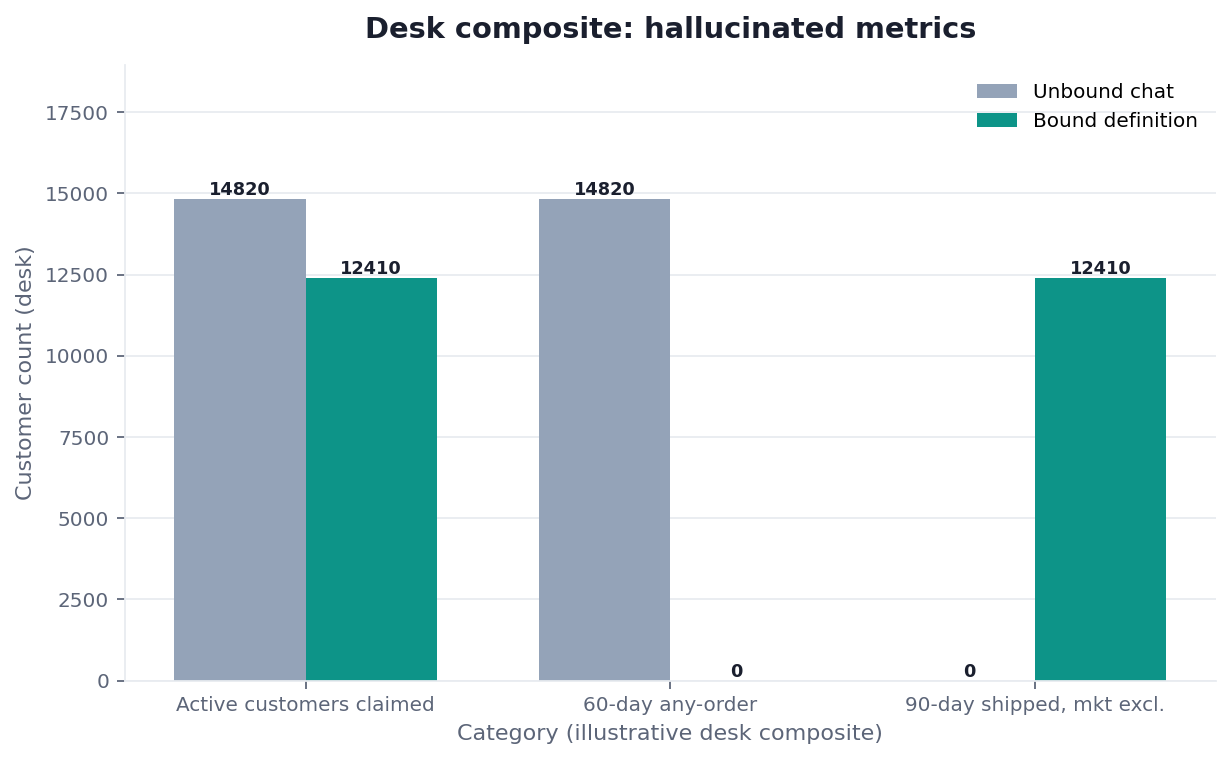
Figure. InfiniSynapse desk log ADR-HMT-20260825: unbound chat left 0 / 0 / 0 and 14,820 rows; pack bound left 1 / 1 / 1 and 12,410 rows. Published context: the independent sources linked in the body. Not a customer experiment, SLA, or official benchmark.
| Evidence class | What you can cite | What you cannot claim |
|---|---|---|
| Desk log on this page | Artifact counts 0/0/0 → 1/1/1, 14,820 vs 12,410 rows, ~27,230 lines on this run, ~9 min wall-clock, downloadable log | Customer uplift %, vendor bake-off win, named-logo case |
| Published authority (linked above) | Evaluation and format notes from AWS ML Lens, NCSC secure AI, Parquet docs, Stripe API, and IBM augmented analytics; adoption and risk from Stanford HAI, McKinsey, Gartner, NIST AI RMF, OWASP | That those sources ran this desk log |
| Homepage recognition | 2026 WAIC Future Tech OPC Excellence Award as published on the company homepage; self-described, not independently verified here | That WAIC, Gartner, or NIST scored this article |
Hallucinated metrics that survive a meeting usually survive because nobody ran the with-and-without test. That comparison is what the phrase looks like on a desk.
Scorecard: Did the Pack Supply the Sentence
Score each run, not the vendor. Hallucinated metrics are a property of the last answer.
| Check | Yes | No |
|---|---|---|
| A bound note supplies the metric sentence | Keep | Bind the pack before rerun |
| The plan uses the bound name | Keep | Reject cousin labels |
| SQL predicates match the bound sentence | Keep | Do not brief the number |
| Unbound and bound runs were compared | Keep | You have not tested invention |
| Artifact cites the bound sentence | Keep | You still have a chat label |
| Source is read-only and authorized | Keep | Stop; this is not an audit |
If three or more rows are “No,” you still have hallucinated metrics. You have a draft. That is a normal first pass. It is not a close.
Failure Modes That Look Official
Fluent failure is the reason hallucinated metrics exist. The paragraph is rarely the thing that breaks.
Prompting harder instead of binding
Someone adds “use our definition” to the prompt and calls it done. Hallucinated metrics ignore that instruction when the pack is missing. Bind the sentence.
Trusting a column comment as the pack
gm is not contribution. A one-line comment is not a locked sentence. Hallucinated metrics fill the gap with a fluent cousin.
Shipping the unbound run because it was first
The first paragraph arrived faster. The bound run arrived later and disagreed. Hallucinated metrics win when speed beats the pack. Persist both files, or you are back to folklore.
Before you brief anyone, check three things on the last answer you actually trust: the pack supplies the sentence, the SQL matches that sentence, and the unbound run was rejected if it drifted. If any of those is missing, do not take the paragraph into a meeting.
When the next missing object is not this page, open Agent Reasoning Trail: Plan, Repair, Rerun when The trail is the product; the sentence is a summary, Trust but Verify a Data Agent when Owners verify files; they do not bless paragraphs, or Reproducible Analysis: Same Goal, Same Grain when A rerun that changes the grain is not a rerun.
Ask one metric with and without the bound pack
Run the same goal twice on a source you already authorize—once unbound, once with the pack bound—and compare the metric sentence. This check uses only sources you authorize.
Commercial association: You do not need the workspace to complete the educational diagnosis on this page.
Open InfiniSynapseHow this page is sourced. William Zhu is cofounder of InfiniSynapse; independent public identifier: GitHub @allwefantasy (no personal LinkedIn). Institution: About InfiniSynapse. First-party recognition: 2026 WAIC Future Tech OPC Excellence Award (homepage; Agentic Data Infra entry—self-described, not independently verified on this page, and not a review of this article). Trust pages: Privacy · publishing terms · NIST Privacy Framework. Desk methodology note: 2026-07-29 attestation. Downloadable first-party run: desk log
ADR-HMT-20260825· aggregate CSV · verify script. Reviewed by analytics engineering · data platform · LLM security · editor. Editorial standards · corrections. Contact zhuhl@infinisynapse.com. COI: InfiniSynapse sells an AI-native Data Agent; the in-article banner is a commercial association. Fact-check: Stanford HAI AI Index · McKinsey State of AI · Gartner Peer Insights — Analytics & BI · NIST AI Risk Management Framework · OWASP Top 10 for LLM Applications · AWS Machine Learning Lens · NCSC secure AI guidelines · Parquet documentation · Stripe API reference · IBM augmented analytics · W3C DCAT · DataCite. First-party numbers on this page are desk logADR-HMT-20260825only.
How to cite this page
Page: Zhu, W., & InfiniSynapse Data Team. (2026). Hallucinated Metrics: Bind, Then Replay. InfiniSynapse
Run: InfiniSynapse Data Team. (2026). Desk log ADR-HMT-20260825 (sanitized composite)
Neither is an audit. Cite those published artifact counts when you quote hallucinated metrics figures from this first-party desk comparison. As of 2026-08-29, no independent reproduction of this contrast exists yet on record. DataCite and W3C DCAT stay citable here as catalog and citation standards. NIST, PROV-O, and Stanford remain linked only as published context. Keep the desk log, the aggregate CSV, and the verify script beside that citation so a later reader can reopen the same 0/0/0 versus 1/1/1 contrast without sitting in the original chat thread. Hallucinated metrics citations should name the run ID, not a fluent restatement of the unbound caption. Retain both folders. Keep the unbound caption beside the bound sentence and both row counts. A second reviewer can reopen the 14,820 versus 12,410 split from the published desk files as well. A later reviewer can inspect hallucinated metrics after they reopen those published desk artifacts. Name hallucinated metrics quotes. Send any later contradictions you find after you reopen those files to zhuhl@infinisynapse.com.
Frequently Asked Questions
Are wrong numbers the same thing as hallucinated metrics?
Bottom line: No. A wrong number can use the right definition. Hallucinated metrics are the wrong definition dressed as a house measure. Open the retrieved sentence before you argue about arithmetic.
Do I need a compiled semantic layer to stop hallucinated metrics?
Bottom line: No. A locked sentence in a bound note is enough to start. A semantic layer helps at scale. Hallucinated metrics appear as soon as chat has no pack.
What should a non-analyst look at first?
Bottom line: Open the bound sentence and the filter list, not the chart. If you cannot restate the metric in one sentence, you are looking at hallucinated metrics. Ask an analyst only after that restatement fails.
Can I catch hallucinated metrics if the source is a file?
Bottom line: Yes. Bind the pack to the file you authorize. Hallucinated metrics do not require a warehouse. They require a missing sentence.
What must a governed metric definition contain?
Bottom line: Record the numerator, denominator, grain, date window, exclusions, owner, and revision. Keep that sentence with its source lineage and the executable statement used for the result.
Does linking to a standard prove a run was grounded?
Bottom line: No. Standards provide useful vocabulary and evaluation criteria. Compliance requires run-level evidence such as the retrieved definition, query history, lineage, and reproducible output.
Did NIST, a news outlet, or a credentialing body recognize this page?
Bottom line: No. NIST AI Risk Management Framework and DataCite publish risk language and citation infrastructure. They did not evaluate InfiniSynapse. There is no independent award page for this article, no media citation of this metric guide on this page, no professional qualification certificate for the author, and there is no personal LinkedIn to add.
Conclusion
Hallucinated metrics are a review habit to catch: bind the pack, compare unbound and bound runs, reject cousin labels, keep the file. Unbound chat invents measures that look official. Teams that skip the pack will keep arguing about adjectives while the definition stays invented.
Use the scorecard on the next number you are tempted to paste into a deck. If hallucinated metrics are still possible, the number is not ready.