Alternatives to ChatGPT for data analysis: 7 Tools Compared
By William Zhu & the InfiniSynapse Data Team · Published: 2026-06-09 · Last updated: 2026-09-16 · Last verified: 2026-09-16 · About: Editorial standards · About / team
Author credentials: William Zhu — InfiniSynapse cofounder; public engineering profile GitHub @allwefantasy (InfiniSQL / open-source data systems). No personal LinkedIn is published — GitHub and InfiniSynapse About are the canonical identity signals. Desk contact: zhuhl@infinisynapse.com. Reviewers: data platform · analytics engineering.
Disclosure / COI: We build InfiniSynapse, an AI-native Data Agent platform listed in this comparison. Rankings below are first-party desk judgments on a fixed three-task pack—not a commissioned lab audit. InfiniSynapse is scored in the agent / recurring lane only; copilots can and do win ad-hoc lanes. The product CTA sits in a labeled commercial module. Peer-review archive: editorial standards.
Third-party anchors: OpenAI: Data analysis with ChatGPT, OpenAI: Improvements to data analysis, Wikipedia: ChatGPT, G2: ChatGPT reviews, Gartner Peer Insights — Analytics & BI Platforms, NIST AI Risk Management Framework, Stanford HAI AI Index, OWASP Top 10 for LLM Applications, CISA AI. Desk /12 scores remain first-party; those pages are independent product definitions and buyer-review markets, not a commissioned audit of this pack.
Version history: 2026-06-09 initial · 2026-07-23 matrix refresh · 2026-08-13 Person/Organization nodes, desk scorecard CSV, HowTo + ImageObject · 2026-08-14 third-party review anchors, DefinedTermSet, one-sentence recommendation · 2026-09-16 job + public-list-price table, Power BI Copilot / Tableau Pulse SERP gap, cluster FAQ. Build marker:
DESK-CDA-20260916A.Media note: No hosted InfiniSynapse walkthrough video. Lane diagram + desk SVG + CSV are the multimedia set. Desk rows are not a DOI dataset.
 Seven tools mapped by autonomy, governance, and whether the same analysis can run again next week.
Table of Contents
- TL;DR
- Best AI data analysis tools in 2026
- How We Evaluated Alternatives
- Key definitions
- Desk scorecard (Q1–Q2 2026)
- Why Teams Look Beyond ChatGPT
- 7 ChatGPT Alternatives for Data Analysis
- Tool Deep Dives
- Connector and deployment notes
- Decision Matrix
- 30-Day Evaluation Playbook
- Security and Compliance Comparison
- Common Pitfalls When Switching from ChatGPT
- Team Scenario Deep Dives
- Frequently Asked Questions
- Who wrote this
- References
- Conclusion
TL;DR
Direct answer: The best AI data analysis tools depend on the job. ChatGPT still wins one-off files (~6 min). The best AI for data analysis after that is Julius for charts (~5 min), Claude for long docs, Hex for notebooks, ThoughtSpot or Power BI Copilot for governed BI, and a Data Agent for next-week KPI replay.
ChatGPT remains excellent for fast exploratory analysis. Teams outgrow a chat session when they need repeatable metric definitions, connector-rich execution, and an audit trail a second analyst can replay.
The right alternatives to ChatGPT for data analysis are rarely one replacement. Mature stacks keep ChatGPT for exploration and add a specialist for production reporting.
Who this is for: analytics leads shortlisting the best AI data analysis tools after ChatGPT is already on the shortlist.
What you'll learn: a job + public-list-price table, a six-criterion rubric, labelled desk scores (composite /12, Task-1 minutes, week-2 drift), vendor-doc deep dives, a 30-day HowTo, and security checks. This page is the ChatGPT-baseline bake-off of the best AI data analysis tools. The separate software catalog is Best AI Tools for Data Analysis.
Related reads: SQL Data Analysis Tools: Best AI Options for 2026 · AI for Data Analysis · AI analysis tools.
Best AI data analysis tools in 2026
If the query is best AI data analysis tools, start here—then use the desk pack below to stress-test the two you shortlist. If the query is best AI for data analysis (singular), pick the row that matches the job, not the highest composite.
Public list prices are vendor-published entry seats as of 16 September 2026, not our /12 scores and not a quote. Confirm current SKUs on the vendor page before procurement. ThoughtSpot, Databricks Genie, Power BI Copilot, and Tableau Pulse are consumption or platform-tied; we do not invent a fake “from $X” for those rows.
| Tool | Best job (the “best AI for…” pick) | Public list / entry | Desk /12 | Lane |
|---|---|---|---|---|
| ChatGPT (ADA) | Ad-hoc files and first-pass SQL | Plus $20/mo | 9 | Copilot |
| Claude | Long-context docs + tables | Pro $20/mo | 9 | Copilot |
| Gemini | Google Workspace + BigQuery | Google AI / Workspace add-on | 8 | Copilot |
| Julius AI | Spreadsheet / CSV charts | Free / paid plans | 8 | Copilot |
| Hex Magic | Versioned SQL/Python notebooks | Free; paid editor seats | 10 | Notebook |
| ThoughtSpot Spotter | Governed self-service metrics | Enterprise / platform quote | 10 | Governed BI |
| Databricks Genie | Lakehouse NL inside Unity Catalog | Workspace consumption | 9 | Lakehouse |
| Power BI Copilot | Microsoft-centric BI | Power BI seat + Copilot capacity | — (not in desk pack) | Governed BI |
| Tableau Pulse | Tableau Cloud insight feed | Tableau Cloud seat | — (not in desk pack) | Governed BI |
| InfiniSynapse | Recurring multi-source KPI replay | Free to register | 10 | Data Agent |
 Illustrative: public entry price (USD/mo, where a seat exists) vs desk composite /12. Platform-quoted tools are omitted from the X axis. Not a customer ROI study.
How to read the table. ChatGPT is still on the best AI data analysis tools shortlist—it is the baseline, not the villain. Teams searching best AI for data analysis after a ChatGPT pilot are usually buying a complement: Julius or Claude for a different file motion, Hex for inspectable notebooks, a BI copilot if a semantic layer already exists, or a Data Agent when week-2 drift is the failure mode. Microsoft 365 workbook work is scored separately on best AI for Excel data analysis.
How We Evaluated Alternatives
We scored each tool after the pilot phase—not on a single demo prompt. Production access and review should follow the NIST AI Risk Management Framework when recurring queries touch live schemas. Market shape (buyer reviews, not our scores): Gartner Peer Insights — Analytics & BI Platforms. Industry adoption context: Stanford HAI AI Index.
| Criterion | What we checked |
|---|---|
| SQL and analysis quality | Accuracy on multi-table business questions |
| Visualization output | Chart clarity and presentation readiness |
| Governance | Audit logs, permissions, enterprise controls |
| Data connectivity | Files, databases, warehouses, semantic layers |
| Workflow durability | Reusability for recurring analysis |
| Team fit | Best-fit user profile and maturity stage |
We weighted workflow durability higher than single-prompt brilliance. alternatives to ChatGPT for data analysis should cut rework across reporting cycles, not only win one screenshot.
For a deeper buying framework, see AI for Data Analysis and the procurement companion Best AI Tools for Data Analysis in 2026: Top Picks.
Key definitions
Use these blocks when you shortlist alternatives to ChatGPT for data analysis. Entity names below match the schema DefinedTerm / SoftwareApplication nodes.
 Educational lane map. Not a vendor ranking and not a commissioned lab result.
| Term | Meaning in this article |
|---|---|
| ChatGPT data analysis (ADA) | OpenAI’s in-chat file + Python path. Product definition: OpenAI help and Improvements to data analysis. Encyclopedia: Wikipedia: ChatGPT. |
| Copilot | Analyst stays in the loop each step. ChatGPT, Claude, Gemini, and Julius sit here. |
| Data Agent | One stated goal, multi-step execution, replay next week with an audit trail and memory cards — see what a data agent is. InfiniSynapse is first-party in this lane only. |
| Semantic layer | Certified metric contract a governed BI assistant must honor (ThoughtSpot Spotter, Databricks Genie). |
| Week-2 metric drift | Same KPI, new period, different number or definition without a documented change. |
| Task-1 minutes | Desk wall-clock to a first usable artifact on the dirty-CSV profile. |
| Composite /12 | First-party desk sum across six criteria. Not a G2 or Gartner Peer Insights score. |
Independent buyer-review markets (G2, Gartner Peer Insights) and vendor/encyclopedia pages above are not this pack’s /12. We do not reprint star ratings or invent customer names.
Desk scorecard (Q1–Q2 2026)
Label: InfiniSynapse research-desk reconstruction of one fixed three-task pack across eight shortlisted tools (Q1–Q2 2026): (1) dirty CSV profile, (2) month-over-month narrative, (3) CSV + policy-PDF action list. Internal desk tally—not a named-customer case, not a commissioned market survey, not a product SLA. Use it to sanity-check alternatives to ChatGPT for data analysis before a bake-off.
On this labelled pack, Julius led Task-1 wall-clock (~5 min). Hex, ThoughtSpot, and InfiniSynapse led second-run stability. That split is the point of alternatives to ChatGPT for data analysis: fastest first chart ≠ best weekly KPI tool.
Downloadable rows (CC BY 4.0): desk-chatgpt-alternatives-scorecard.csv
| Tool | Composite /12 | Task-1 minutes | Week-2 metric drift | Lane win |
|---|---|---|---|---|
| ChatGPT (ADA) | 9 | ~6 | Medium (re-prompt) | Ad-hoc file speed |
| Claude | 9 | ~8 | Medium | Long-context + docs |
| Gemini | 8 | ~7 (Sheets path) | Medium | Google-stack ops |
| Julius AI | 8 | ~5 | High without templates | Chart-first CSV |
| Hex Magic | 10 | ~12 (notebook setup) | Low (cells versioned) | Reproducible notebooks |
| ThoughtSpot Spotter | 10 | N/A (semantic first) | Low on governed metrics | Governed BI |
| Databricks Genie | 9 | ~9 (in-lakehouse) | Low–medium | Lakehouse NL |
| InfiniSynapse | 10 | ~11 (first run) | Low (memory cards) | Recurring multi-source |
 Desk composites /12. InfiniSynapse is first-party and scored only in the agent lane.
 Task-1 minutes. ThoughtSpot omitted until a semantic model exists.
Why Teams Look Beyond ChatGPT
ChatGPT made natural-language analysis mainstream (OpenAI help: Data analysis with ChatGPT). Production analytics teams still hit four limits:
- Session memory is fragile for recurring business reviews.
- Governance controls vary by environment and subscription—treat prompt injection and data leakage with the OWASP Top 10 for LLM Applications and CISA AI guidance, not with a chatbot default.
- Warehouse-native workflows need a semantic contract closer to a data warehouse than to a paste-in CSV.
- Operational handoff is weak when one analyst is unavailable.
That is why the market split from “one best chatbot” to a portfolio. Teams searching for alternatives to ChatGPT for data analysis—or typing best AI for data analysis after a ChatGPT pilot—are usually solving one of those four gaps, not rejecting ChatGPT.
When ChatGPT is still the right tool
ChatGPT excels at rapid file profiling, first-pass SQL drafts, brainstorming hypotheses, and one-off executive questions. Many teams keep it even after they add alternatives to ChatGPT for data analysis for governed workflows.
The shift happens when the same analysis repeats every week and stakeholders expect consistent definitions, not only fast answers. Recurring extracts still look like ETL even when the front door is a chat box.
7 ChatGPT Alternatives for Data Analysis
Short profiles first; deep dives follow. Treat this as a map of alternatives to ChatGPT for data analysis, not a ranked “buy this one” list.
1) Claude — Best for long-context analysis combining documents and tables. Strength: reasoning depth and document grounding. Trade-off: still analyst-driven for repeat production workflows. Vendor: Anthropic Claude.
2) Google Gemini — Best for Google Workspace and BigQuery-centric teams. Strength: shared identity with Sheets/Slides. Trade-off: thinner outside Google-native estates. Vendor: Gemini.
3) Julius AI — Best for fast spreadsheet and CSV chart generation. Strength: low learning curve. Trade-off: limited governance and recurring-memory workflows. Vendor: Julius. Chart-type correctness and re-run drift versus copilots are scored on AI data visualization tools.
4) Hex Magic — Best for analyst-led notebooks with AI acceleration. Strength: collaboration and cell-level transparency. Trade-off: humans still orchestrate most steps. Vendor: Hex Magic.
5) ThoughtSpot Spotter — Best for governed semantic-layer BI. Strength: trusted metrics and enterprise self-service. Trade-off: modeling overhead. Vendor: ThoughtSpot Spotter.
6) Databricks Genie — Best for Unity Catalog-first lakehouse teams. Strength: native permissions and lineage. Trade-off: value drops if Databricks is not already standard. Vendor: Databricks Genie.
7) InfiniSynapse — Best for recurring multi-source analysis with autonomous execution. Strength: audit timeline + memory cards. Trade-off: new operating model versus chat-only tools. First-party; see COI.
Also on 2026 “best AI data analysis tools” SERPs (not in the eight-tool desk pack): Power BI Copilot for Microsoft-centric governed BI, and Tableau Pulse for Tableau Cloud insight feeds. Shortlist them when the estate is already Power BI or Tableau; do not treat them as generic ChatGPT replacements. We did not assign a /12 because they were not run on the same three-task CSV pack.
Tool Deep Dives
Claude as a ChatGPT alternative
Claude is often the first stop when teams need alternatives to ChatGPT for data analysis with stronger long-context reasoning. Mixed PDF + table inputs matter when policy documents sit beside CSV extracts.
Claude remains session-oriented. Without external process discipline, metric definitions still drift between monthly reviews.
Google Gemini for Google-native teams
Gemini reduces friction when Workspace and BigQuery already share one identity. Among alternatives to ChatGPT for data analysis for Google-centric ops, it is usually the lowest switching cost.
Outside Google environments, connectivity is thinner. Do not treat Gemini as a default among alternatives to ChatGPT for data analysis unless the estate is already Google-heavy. Spreadsheet sharing, ranges, and API quotas should follow Google Sheets documentation.
Julius AI for spreadsheet-first users
Julius targets business users who want charts without SQL. It is one of the fastest alternatives to ChatGPT for data analysis when the input is a single file and the output is a slide-ready visual. When that first-chart speed is no longer enough, compare Julius AI alternatives.
ChatGPT for Excel is now an in-grid add-in, not only an upload chat. For a scored bake-off of ai tools for Excel that stay in the workbook versus a pasted copy, see best AI for Excel data analysis.
It is weaker when analysis must join live warehouse tables, enforce RBAC, or preserve approved definitions across quarters. CSV intake should still respect RFC 4180 quoting rules—tools that guess delimiter badly fail Task-1 silently.
Hex Magic for analyst notebooks
Hex fits analytics engineering teams who want cell-level transparency. AI accelerates SQL and charts; humans keep orchestration. For notebook cultures, Hex is one of the alternatives to ChatGPT for data analysis that preserves reproducibility a chat thread cannot.
Expect higher skill requirements. Hex is not optimized for non-technical self-service alone. If your culture is notebooks, keep Hex on the alternatives to ChatGPT for data analysis shortlist even when a chat tool wins the demo. Seat-constrained teams should also check are there free alternatives to Hex before assuming every notebook path is a paid Editor SKU.
ThoughtSpot Spotter for governed BI
ThoughtSpot shines when a semantic layer already defines trusted metrics. Spotter translates questions into governed visuals instead of raw-table improvisation. Enterprise BI programs evaluating alternatives to ChatGPT for data analysis shortlist it when self-service must not bypass certified definitions.
Without modeling investment, Spotter cannot deliver that value. Do not shortlist it among alternatives to ChatGPT for data analysis until certified metrics already exist.
Databricks Genie for lakehouse teams
Genie aligns with Unity Catalog and lakehouse pipelines. If Databricks is already the analytics standard, Genie is a natural candidate among alternatives to ChatGPT for data analysis because permissions, lineage, and warehouse context are native.
Value drops sharply for teams not committed to that stack. Treat Genie as an extension of lakehouse strategy, not a generic member of alternatives to ChatGPT for data analysis you can drop onto any warehouse.
InfiniSynapse for recurring autonomous analysis
Product recommendation (commercial). InfiniSynapse is our Data Agent platform. Among alternatives to ChatGPT for data analysis built for recurring KPI delivery, it plans multi-step work, executes queries, surfaces intermediate artifacts, and distills approved logic into memory cards.
Adoption requires a shift from prompt-by-prompt chat to goal-driven tasks. Copilots still win one-off exploration on this desk pack (ChatGPT ~6 min Task-1 vs InfiniSynapse ~11 min). Use the agent lane when week-2 drift is the failure mode.
Connector and deployment notes
These notes replace the previous orphaned one-liners. Each citation matches the claim. Use them when alternatives to ChatGPT for data analysis actually connect to a warehouse, a cache, or a self-hosted runtime:
- Snowflake warehouses and roles: define warehouses, roles, and semantic views from Snowflake documentation before you point any NL2SQL agent at production.
- Cortex Analyst: Snowflake Cortex Analyst shows how a warehouse-native semantic layer changes grounding versus a generic chat upload.
- Redshift: connector rollouts should follow Amazon Redshift documentation for workload isolation and audit-friendly query logging.
- Self-hosted agents: isolate workloads, secrets, and rollouts with Kubernetes documentation.
- Postgres-compatible apps: multi-source designs that include Supabase still need explicit metric contracts as scope grows.
- Cache layers: low-latency result caches should follow MariaDB TTL/namespacing or Redis key design—neither document is a peer-reviewed LLM paper; they are ops manuals.
Decision Matrix
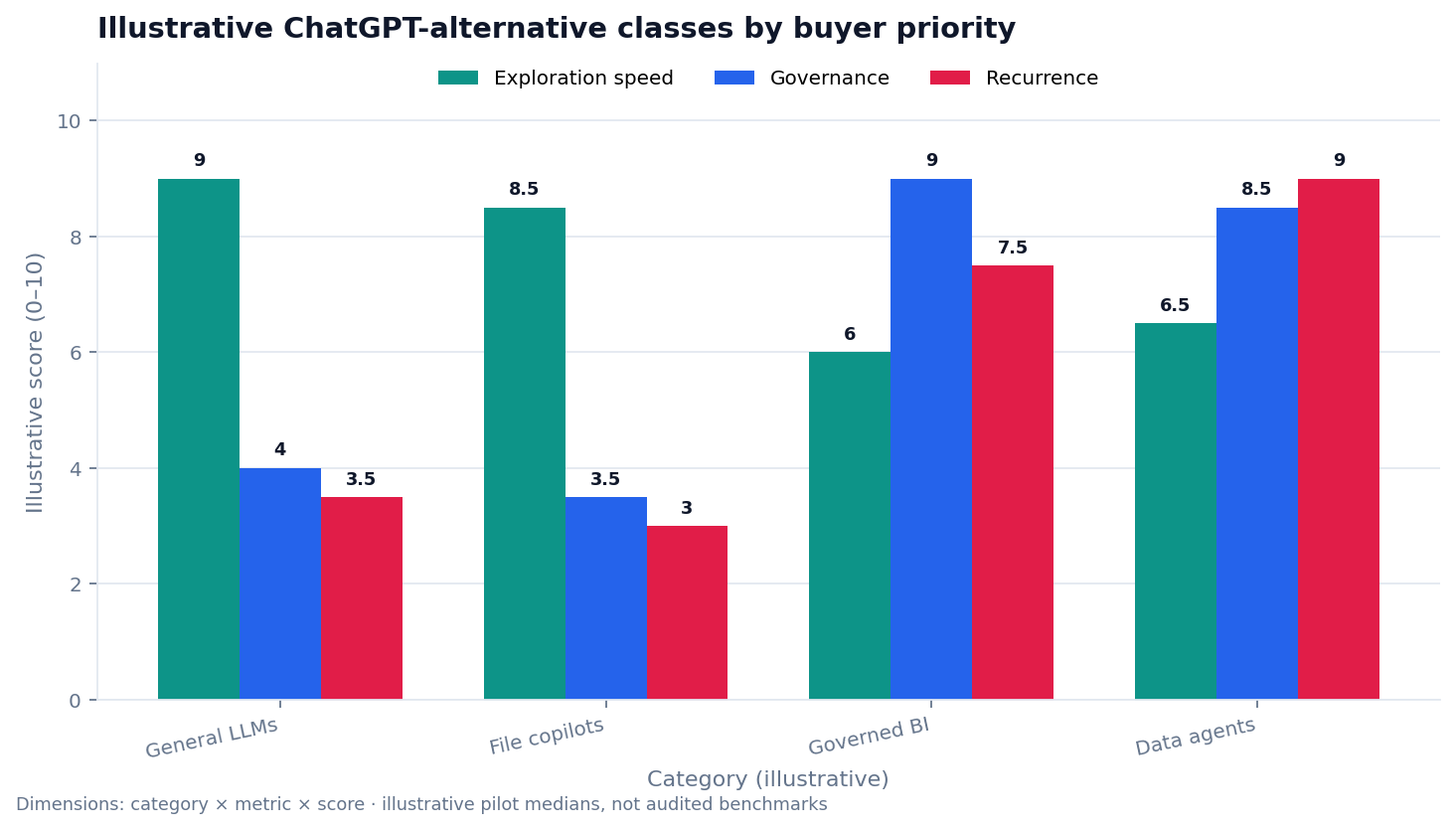 Illustrative class scores (exploration / governance / recurrence). Use the desk CSV for the numeric pack.
| If your priority is… | Consider first |
|---|---|
| One-off exploratory analysis | ChatGPT, Claude |
| Spreadsheet charting for business users | Julius AI |
| Notebook-centered analyst workflows | Hex Magic |
| Governed BI self-service | ThoughtSpot Spotter |
| Databricks-native enterprise analytics | Databricks Genie |
| Recurring analysis with memory and audit | InfiniSynapse |
| Already on Microsoft Power BI | Power BI Copilot (not in desk /12) |
| Already on Tableau Cloud | Tableau Pulse (not in desk /12) |
Two filter questions: (1) one-time answers or repeatable workflows? (2) conversational speed or operational governance? Speed-first teams add Claude or Julius; governance-first teams add ThoughtSpot, Genie, or InfiniSynapse. That is how to narrow alternatives to ChatGPT for data analysis without a twelve-vendor RFP.
Try a warehouse-connected data analyst with a bound knowledge base
Connect a Postgres, MySQL, Snowflake, or Supabase warehouse read-only. Seed a small knowledge base of business definitions. Ask one question that crossed two sources and watch the plan, SQL, and verification step before deciding whether to add an enterprise agent.
30-Day Evaluation Playbook
Use this HowTo for alternatives to ChatGPT for data analysis so every candidate answers the same recurring question.
 Weeks 1–4. Score 1–5 each week; org fit usually wins weeks 3–4.
Week 1 — Define a production-like scenario. Pick a question you already answer manually: pipeline conversion, cohort retention, or regional revenue variance. Every name on your alternatives to ChatGPT for data analysis shortlist must run that same goal.
Week 2 — Run exploratory parity tests. Compare first-session quality against ChatGPT on file uploads and ad-hoc SQL. Log reasoning depth and chart clarity.
Week 3 — Test governance and handoff. Can a second analyst reproduce the result without the original prompter? Are queries and assumptions logged?
Week 4 — Test recurrence. Simulate a new reporting period. Measure definition drift, time-to-output, and reviewer confidence. Memory-capable alternatives to ChatGPT for data analysis should beat session chat here.
Score each tool 1–5 across all four weeks. The best org fit wins weeks 3 and 4, not only week 2.
Security and Compliance Comparison
Security review is part of choosing alternatives to ChatGPT for data analysis, not an afterthought. Map these controls to NIST AI RMF functions (Govern / Map / Measure / Manage) and to CISA AI operational guidance. Prompt-injection and insecure plugin patterns are catalogued by OWASP LLM Top 10.
| Control area | ChatGPT baseline | What to verify in alternatives |
|---|---|---|
| Data residency | Varies by plan and region | Confirm where files and query results persist |
| Access management | Workspace and enterprise tiers differ | RBAC, SSO, and source-level permissions |
| Audit logging | Export options vary | Full prompt, query, and export trail |
| Training opt-out | Enterprise agreements may apply | Written data processing terms |
| Connector security | File-upload centric | Private link, VPC, and credential vault patterns |
Common Pitfalls When Switching from ChatGPT
These pitfalls recur when teams adopt alternatives to ChatGPT for data analysis.
Pitfall 1: Expecting one tool to replace the entire stack. ChatGPT is excellent at exploration. Most teams need complementary workflow classes, not a single swap.
Pitfall 2: Ignoring semantic layer prerequisites. BI-oriented tools amplify existing metric definitions. Fix definition chaos before migration.
Pitfall 3: Measuring only first-session speed. Tools that look slower on day one may save hours every month through memory and auditability (desk: Julius ~5 min Task-1 vs Hex ~12 min with low week-2 drift).
Pitfall 4: No change management for analysts. Switching from chat prompts to goal-driven Data Agent tasks requires training. Budget adoption time.
Pitfall 5: Abandoning ChatGPT completely. Keep it for brainstorming and quick drafts. Adopt alternatives to ChatGPT for data analysis where governance and recurrence matter; leave exploration where ChatGPT already wins.
Team Scenario Deep Dives
Procurement reviews may also include Best AI Tools for Data Analysis in 2026: Top Picks.
Scenario A: 10-person startup, CSV-heavy ops
The right alternatives to ChatGPT for data analysis depend on data complexity and recurrence, not headcount. Julius or Claude plus ChatGPT for exploration is pragmatic until warehouse connectivity and role separation matter.
Scenario B: Enterprise BI team with semantic models
ThoughtSpot or Power BI Copilot-class tools fit governed self-service. Among alternatives to ChatGPT for data analysis here, the requirement is certified metrics—not rogue SQL from raw tables.
Scenario C: Databricks-standardized data platform
Genie is the native path among alternatives to ChatGPT for data analysis on that estate. Evaluate inside Unity Catalog permissions before adopting external chat tools that bypass lineage.
Scenario D: Weekly executive KPI reviews across multiple sources
Data Agent platforms are the alternatives to ChatGPT for data analysis that address recurrence and audit a chat session cannot. Preserve definitions in memory and expose task timelines for reviewer sign-off.
Frequently Asked Questions
What are the best AI data analysis tools in 2026?
The best AI data analysis tools on this desk pack are ChatGPT (ADA) and Claude for ad-hoc files (both 9/12), Julius for the fastest first chart (~5 min), Hex and ThoughtSpot for low week-2 drift (10/12), Databricks Genie for lakehouse NL, and InfiniSynapse for recurring multi-source replay (10/12). Add Power BI Copilot or Tableau Pulse only if that BI estate is already standard.
What is the best AI for data analysis?
There is no single best AI for data analysis. Pick by job: ChatGPT or Julius for a spreadsheet tonight, Claude for mixed PDF + table reasoning, Hex when the notebook is the system of record, ThoughtSpot / Power BI Copilot / Genie when metrics are already certified, and a Data Agent when the same KPI must replay next week without the original prompter.
What are the best alternatives to ChatGPT for data analysis in 2026?
Top options include Claude, Google Gemini, Julius AI, Hex Magic, ThoughtSpot Spotter, Databricks Genie, and InfiniSynapse. Choose by one-off speed (Julius ~5 min Task-1 on this desk pack), enterprise governance (ThoughtSpot / Genie), or recurring workflow automation (Hex low week-2 drift; InfiniSynapse memory cards)—not by a single “best” label.
Which alternative is best for spreadsheet analysis?
Julius AI is often the easiest spreadsheet-first option for quick charting. ChatGPT and Claude are also strong for file analysis; Julius usually has the gentler chart-first workflow for business users.
Which tools are best for warehouse-native analytics teams?
ThoughtSpot Spotter and Databricks Genie are strong where a semantic layer or catalog already exists. They work when metric definitions are already standardized in those ecosystems.
Are there alternatives that support recurring analysis with memory?
Yes. AI-native Data Agent platforms such as InfiniSynapse combine autonomous execution, audit trails, and reusable memory cards. That class of alternatives to ChatGPT for data analysis is not a longer chat thread.
How should teams choose between copilots and Data Agents?
Choose copilots when analysts stay in the loop for each step. Choose Data Agents for one-goal execution, cross-source orchestration, and repeatable output across weekly or monthly reviews.
Is ChatGPT still useful in a modern analytics stack?
Yes. ChatGPT remains valuable for rapid exploration, quick SQL drafts, and ad-hoc brainstorming. Many teams keep it beside specialized alternatives to ChatGPT for data analysis for governed production reporting.
Who wrote this
Named author. William Zhu — InfiniSynapse cofounder (GitHub @allwefantasy). Accountable for this comparison of alternatives to ChatGPT for data analysis. Team: InfiniSynapse Data Team. About: editorial standards. Corrections: zhuhl@infinisynapse.com.
Desk scores are reconstructions on a fixed pack. Re-run on your messiest exports before buying seats.
References
Vendor docs first, then risk frameworks, then connector manuals. Claims in the body point at the matching row—not at unrelated ops docs. Use this list when you cite alternatives to ChatGPT for data analysis in a procurement memo.
- [Vendor] OpenAI. Data analysis with ChatGPT. help.openai.com/en/articles/8437071-data-analysis-with-chatgpt. Accessed 2026-08-13.
- [Vendor] Anthropic. Claude. anthropic.com/claude. Accessed 2026-08-13.
- [Vendor] Google. Gemini API docs. ai.google.dev/gemini-api/docs. Accessed 2026-08-13.
- [Vendor] Julius. julius.ai. Accessed 2026-08-13.
- [Vendor] Hex. Magic. learn.hex.tech/docs/explore-data/magic. Accessed 2026-08-13.
- [Vendor] ThoughtSpot. Spotter. docs.thoughtspot.com/software/latest/spotter. Accessed 2026-08-13.
- [Vendor] Databricks. Genie. docs.databricks.com/aws/en/genie/. Accessed 2026-08-13.
- [Standard] NIST. AI Risk Management Framework. nist.gov/itl/ai-risk-management-framework. Accessed 2026-08-13.
- [Standard] OWASP. Top 10 for LLM Applications. owasp.org/www-project-top-10-for-large-language-model-applications. Accessed 2026-08-13.
- [Agency] CISA. Artificial intelligence. cisa.gov/ai. Accessed 2026-08-13.
- [Independent] Stanford HAI. AI Index. hai.stanford.edu/ai-index. Accessed 2026-08-13.
- [Independent] Gartner. Peer Insights — Analytics and BI Platforms. gartner.com/reviews/market/analytics-and-business-intelligence-platforms. Accessed 2026-08-13.
- [Docs] Google. Sheets. support.google.com/docs/topic/9054603. Accessed 2026-08-13.
- [Docs] Snowflake. docs.snowflake.com/en/. Accessed 2026-08-13.
- [Docs] Snowflake. Cortex Analyst. docs.snowflake.com/en/user-guide/snowflake-cortex/cortex-analyst. Accessed 2026-08-13.
- [Docs] Amazon. Redshift. docs.aws.amazon.com/redshift/. Accessed 2026-08-13.
- [Docs] Kubernetes. kubernetes.io/docs/. Accessed 2026-08-13.
- [Docs] Supabase. supabase.com/docs. Accessed 2026-08-13.
- [Docs] MariaDB. mariadb.com/kb/en/documentation/. Accessed 2026-08-13.
- [Docs] Redis. redis.io/docs/. Accessed 2026-08-13.
- [Standard] IETF. RFC 4180 (CSV). rfc-editor.org/rfc/rfc4180. Accessed 2026-08-13.
- [Encyclopedia] Wikipedia. Extract, transform, load. en.wikipedia.org/wiki/Extract,_transform,_load. Accessed 2026-08-13.
- [Encyclopedia] Wikipedia. Data warehouse. en.wikipedia.org/wiki/Data_warehouse. Accessed 2026-08-13.
- [Internal hub] InfiniSynapse. SQL data analysis tools. infinisynapse.com/en/blog/sql-data-analysis-tools. Accessed 2026-08-13.
- [Internal hub] InfiniSynapse. AI for data analysis. infinisynapse.com/en/blog/ai-for-data-analysis. Accessed 2026-08-13.
- [Internal hub] InfiniSynapse. AI data analysis tools. infinisynapse.com/en/blog/ai-data-analysis-tools. Accessed 2026-08-13.
- [Internal hub] InfiniSynapse. Best AI tools for data analysis (use-cases). infinisynapse.com/use-cases/best-ai-tools-for-data-analysis. Accessed 2026-08-13.
- [Desk] InfiniSynapse Data Team. Three-task alternatives pack + CSV. Q1–Q2 2026. Desk scorecard · CSV. Marker
DESK-CDA-20260916A. - [Vendor] OpenAI. Improvements to data analysis in ChatGPT. openai.com/index/improvements-to-data-analysis-in-chatgpt. Accessed 2026-09-16.
- [Encyclopedia] Wikipedia. ChatGPT. en.wikipedia.org/wiki/ChatGPT. Accessed 2026-09-16.
- [Independent] G2. ChatGPT reviews (buyer market; not our /12). g2.com/products/chatgpt/reviews. Accessed 2026-09-16.
- [Vendor] OpenAI. ChatGPT pricing. openai.com/chatgpt/pricing. Accessed 2026-09-16.
- [Vendor] Anthropic. Pricing. anthropic.com/pricing. Accessed 2026-09-16.
- [Vendor] Hex. Pricing. hex.tech/pricing. Accessed 2026-09-16.
- [Vendor] Microsoft. Copilot in Power BI. learn.microsoft.com/en-us/power-bi/create-reports/copilot-introduction. Accessed 2026-09-16.
- [Vendor] Tableau. Tableau Pulse. help.tableau.com/current/online/en-us/pulse.htm. Accessed 2026-09-16.
Conclusion
One-sentence recommendation: Keep ChatGPT for ad-hoc files; pick the best AI data analysis tools by lane—Claude for long documents, Gemini for Google Workspace, ThoughtSpot, Power BI Copilot, or Genie for governed metrics, and a Data Agent when the same KPI must replay next week.
Analysts scaling this workflow should also skim AI data analysis tools before rollout.
The strongest alternatives to ChatGPT for data analysis strategy is layered: copilots for speed, governed BI assistants for trusted semantic access, and Data Agent systems when recurring analysis must be autonomous and inspectable. Run the 30-day playbook, compare security controls, and keep ChatGPT where it still wins—fast exploration.
Desk metrics and vendor citations above do not depend on any product trial. If you want to try the agent lane, the InfiniSynapse web app is free on registration.