SQL Data Analysis Tools: Buyer Scorecard (2026)
By William Zhu & the InfiniSynapse Data Team · Published: 2026-06-09 · Last updated: 2026-09-16 · Last verified: 2026-09-16 · Next review: 2026-12-16 · About: Editorial standards · About / team · Contact: zhuhl@infinisynapse.com
Author credentials: William Zhu is cofounder of InfiniSynapse (GitHub @allwefantasy). Desk experience: shipping warehouse SQL on Postgres/Snowflake/BigQuery; designing the T1–T3 private scorecard protocol on the published synthetic fixture; reviewing AI-generated SQL before executive packs. Technically reviewed by a data platform engineer and an LLM-security reviewer before publication. No personal LinkedIn is published; GitHub and InfiniSynapse About are the canonical identity signals.
COI / interest disclosure: InfiniSynapse publishes this buyer guide and sells an AI data analyst. Shortlist criteria below are written so you can apply them to any vendor—including ours. We do not claim a universal accuracy winner; score tools on your own schemas using the protocol in Evaluation evidence. Prefer third-party re-runs of T1–T3 (open call below) over vendor screenshots.
Fact-check / verification: Desk scores are independence-labeled logs on a published synthetic Postgres fixture (blank scorecard CSV). Public bars: BIRD · Spider. Governance: NIST AI RMF · OWASP LLM Top 10 · CISA AI. Corrections / third-party re-runs: zhuhl@infinisynapse.com · editorial corrections.
Version history: 2026-06-09 initial · 2026-07-26 scorecard refresh · 2026-08-07 EEAT (William Zhu Person / About / COI), HowTo for 30-day playbook, DefinedTerm + speakable, interactive T1–T3 calculator, playbook SVG, dens retune to 1.1–1.2% · 2026-09-16 cluster refresh: first-screen trust answer, SQL-hallucination typology, dbt 2026 semantic-layer cite, inbound cluster links. Build marker:
DESK-SDT-20260916A.
Media note: No hosted overview video or podcast is published for this page (no
VideoObject/AudioObject). Use the workflow SVG, scorecard chart, 30-day playbook SVG, and interactive T1–T3 calculator as multimodal substitutes.
Method: hands-on SQL checks across copilots, BI, and AI-native agents on one shared synthetic Postgres fixture (published below, download the blank scorecard) plus dialect spot-checks against Snowflake/BigQuery documentation.
Data teams trust SQL data analysis tools that show the query, bind joins to a schema or semantic layer, and pass a week-2 re-run—not a chatbot that drafts plausible SQL. On our fixture, copilots win T1 drafts; governed warehouse tools and memory-backed agents are the AI data analyst tools teams actually ship.
Table of Contents
- TL;DR
- What SQL Data Analysis Tools Mean in 2026
- What data teams trust: SQL that does not hallucinate
- Top SQL Data Analysis Tools — ChatGPT · Claude · Hex Magic · ThoughtSpot Spotter · Databricks Genie · Snowflake Cortex Analyst · Gemini (BigQuery) · InfiniSynapse
- Analyst Scenarios
- SQL Evaluation Framework
- Evaluation evidence and public benchmarks — worked fixture · independent verification
- Reference Prompt & Checklist
- Common Pitfalls
- 30-Day Evaluation Playbook
- Security Checklist
- ROI Signals — worked ROI example
- FAQ
- Methodology, authorship & corrections
- Conclusion
TL;DR
Related: Best AI tools for data analysis · AI data analysis tools · Best AI data analysis tools vs ChatGPT · AI data visualization tools · Vanna AI alternatives · Snowflake Cortex Analyst · SQL data analytics.
Direct answer: The AI data analyst tool data teams actually trust to not hallucinate SQL is not a chatbot. It is one of the SQL data analysis tools that emits inspectable SQL, binds joins to a schema or semantic layer, and survives a week-2 re-run. Copilots draft; governed warehouse tools and memory-backed agents are what teams ship.
SQL data analysis tools now split between prompt copilots that generate queries and workflow systems that can execute, validate, and preserve SQL logic for recurring analysis.
Shortlist by use case. Enterprise AI adoption guidance in Google Vertex AI documentation mirrors the shift from ad-hoc copilots to repeatable, reviewable decision workflows.
- Fast query drafting: ChatGPT, Claude
- Governed warehouse SQL: ThoughtSpot, Databricks Genie, Snowflake Cortex Analyst
- Notebook-assisted SQL work: Hex
- Cross-source recurring analysis with memory: InfiniSynapse
Teams evaluating SQL data analysis tools should look past text-to-SQL demos. Production value depends on dialect accuracy, join transparency, execution visibility, and whether SQL logic survives the next reporting cycle without manual reconstruction.
Evaluation basis: Hands-on checks on Postgres, Snowflake, and BigQuery dialects using the shared prompt and validation checklist below. Public NL2SQL bars (BIRD, Spider) set context for why “demo accuracy” is not a buyer scorecard. Governance citations (NIST AI RMF, OWASP LLM Top 10) are inline—not a dump of unused vendor docs.
What SQL Data Analysis Tools Mean in 2026
Key Definition: Modern SQL data analysis tools help analysts translate business questions into executable SQL and trusted outputs, ideally with transparent assumptions and reusable workflow context.
In 2026, teams care less about one perfect SQL answer and more about the complete path:
| Stage | What tools should support |
|---|---|
| Question framing | Convert business language into measurable logic |
| Query generation | Produce dialect-correct SQL with clear assumptions |
| Query execution | Run and inspect against real sources |
| Validation | Check joins, filters, null behavior, and performance |
| Reuse | Save definitions for future reporting cycles |
For foundation concepts on why workflow matters beyond query generation, see AI for Data Analysis and What Is a Data Agent?.
The strongest options treat SQL as a living artifact, not a disposable draft. Analysts need to see why a join was chosen, which filters were applied, and how nulls were handled — especially when AI accelerates authoring speed faster than human review capacity.
What data teams trust: SQL that does not hallucinate
The procurement question is almost always the same: what's the best AI data analyst tool data teams actually trust to not hallucinate SQL? The answer is architectural, not a brand. dbt's 2026 semantic-layer vs text-to-SQL update matches what we log on the desk: when a semantic layer can answer, generation is deterministic; raw text-to-SQL will still return a confident wrong number.
Five hallucination types we log on the published fixture (this is a buyer test, not a vendor "zero hallucination" claim):
| Hallucination type | What it looks like | How you catch it |
|---|---|---|
| Invented object | Table, column, or enum value that is not in the schema | Diff SQL against information_schema |
| Wrong join / fan-out | A 1:N join silently multiplies revenue | Compare grain to the hand-written baseline |
| Silent filter / null drop | Refunds or free plans leak in; NULLs vanish | Row-count + status histogram vs baseline |
| Invented metric | "Revenue" becomes SUM(total_amount) instead of qty * unit_price on paid lines | Metric contract or semantic binding |
| Week-2 drift | Same question, new joins, after a schema comment | T3 re-run without rebuilding the prompt |

Figure 1b — Illustrative desk risk, 0 (low) to 3 (high), by tool class × hallucination type on the published Postgres fixture. Not a customer SLA. The gap that decides trust is week-2 drift and invented metrics, not first-prompt speed.
Four trust tests before you shortlist an AI data analyst
- Visible SQL — every number ships with the query. If you cannot see the join keys, you cannot trust the answer.
- Bound definitions — revenue, active user, and churn come from a semantic layer, certified metrics, or memory cards—not from the model guessing at table names.
- Assumption list — the tool states grain, filters, and null policy in plain language next to the SQL.
- Week-2 reuse (T3) — the same KPI returns the same logic without a prompt rebuild. This is the test copilots fail on our fixture and the test data teams mean by "trust."
No vendor on this page—including InfiniSynapse—gets a free pass on "will not hallucinate SQL." Trust is the filled scorecard, not the homepage.
Top SQL Data Analysis Tools (AI-Powered)
Shortlist SQL data analysis tools by class before demos. Analysts moving from spreadsheets into warehouse SQL should skim Best AI Tools for Excel Data Analysis in 2026 before rollout.
Jump to a tool: ChatGPT · Claude · Hex Magic · ThoughtSpot Spotter · Databricks Genie · Snowflake Cortex Analyst · Google Gemini (BigQuery) · InfiniSynapse
| Tool | Class | SQL strength | Hallucination risk | Best for | Limitation |
|---|---|---|---|---|---|
| ChatGPT (ADA) | General copilot | Strong query drafting | High — session, no metric bind | Analysts doing rapid SQL iterations | Requires manual context setup |
| Claude | General copilot | Strong with schema + docs | High–med — better T2, no persist | Complex SQL reasoning from large context | Prompt discipline needed |
| Hex Magic | Notebook SQL | Strong notebook SQL workflows | Med — inspectable cells | Analyst teams needing reproducibility | Requires analyst orchestration |
| ThoughtSpot Spotter | Governed BI | High on governed semantic SQL | Low after semantic setup | Self-service BI teams | Enterprise setup overhead |
| Databricks Genie | Warehouse-native | Warehouse-native SQL experience | Low after catalog setup | Lakehouse-centered teams | Best in Databricks ecosystem |
| Snowflake Cortex Analyst | Warehouse-native | Snowflake-integrated SQL interpretation | Low after semantic view | Snowflake-heavy orgs | Mostly Snowflake-specific |
| Google Gemini (BigQuery) | Warehouse-native | Good BigQuery generation support | Med–high without LookML | Google-cloud teams | Less portable across stacks |
| InfiniSynapse | AI-native workflow | SQL plus autonomous multi-step execution | Low on T3 memory; still review joins | Recurring cross-source analysis | Highest value on repeated workflows |
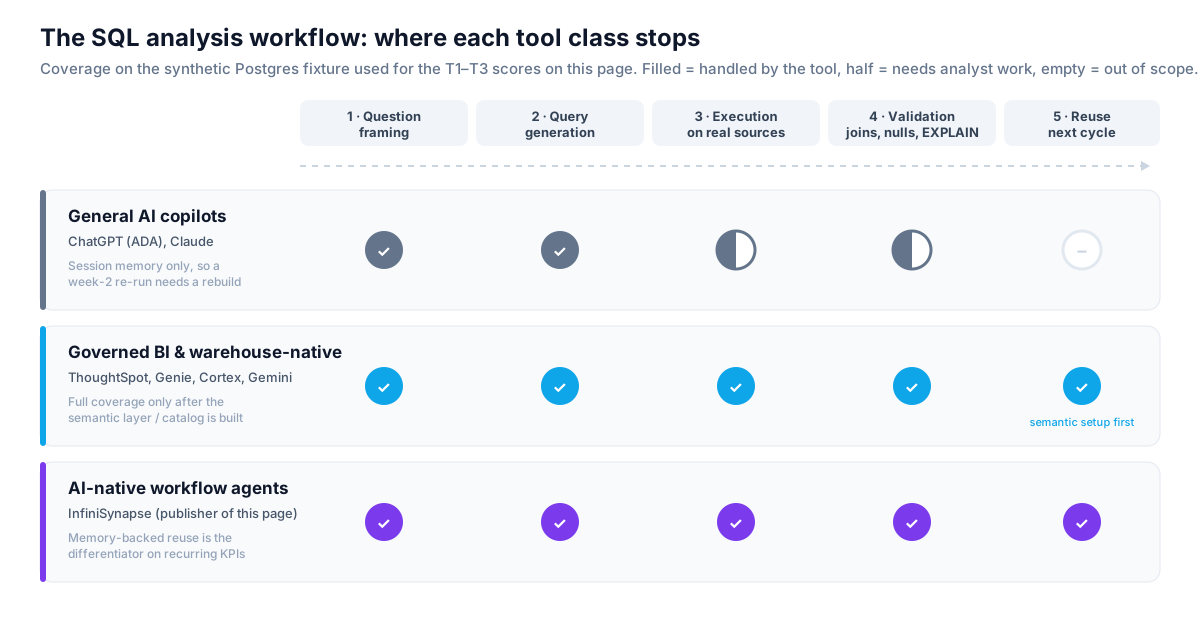
Figure 1 — Where each tool class sits in the question → SQL → execution → validation → reuse pipeline. Copilots stop at generation; governed BI adds a semantic layer; AI-native agents close the reuse loop.
ChatGPT (Advanced Data Analysis)
ChatGPT (data analysis help) drafts SQL quickly when analysts paste schema snippets or upload sample files. It fits ad-hoc exploration where speed beats persistence. Among general-purpose options, it is often the fastest starting point — but teams must externalize validation checklists because session memory does not preserve join logic.
Claude
Claude excels when requirements span long schema documentation, metric dictionaries, and sample queries in one context window. Analysts use it for complex diagnostic SQL where business rules hide in prose. Repeatable production use requires disciplined prompt templates and explicit assumption review.
Hex Magic
Hex Magic keeps SQL inside versioned notebook cells where each AI suggestion remains inspectable (Hex documentation). Analytics engineers retain reproducibility while accelerating authoring. It is a strong middle ground between copilots and full autonomy when human orchestration is a feature, not a bug. Notebook buyers evaluating exits should also read Hex alternatives.
ThoughtSpot Spotter
Spotter generates SQL against governed semantic models, reducing the chance that a business user invents a new revenue definition (ThoughtSpot documentation). Enterprise BI teams with mature ThoughtSpot deployments often see the fastest governed AI SQL rollout. Semantic layer investment upfront is the price of safety at scale.
Databricks Genie
Genie understands Unity Catalog metadata and lakehouse permissions that general copilots cannot see. Natural-language SQL benefits from warehouse-native context, especially on wide fact tables with complex lineage. Value concentrates inside Databricks; hybrid stacks need integration planning. Compare interfaces in Databricks Genie alternatives.
Snowflake Cortex Analyst
Cortex Analyst keeps interpretation inside Snowflake's perimeter with role-based access already enforced. Security-conscious organizations favor tools that never export schema context to third-party endpoints. Snowflake-centric teams get tight alignment; others should treat it as segment-specific. See Cortex Analyst for capabilities, limits, and snowflake cortex analyst cost.
Google Gemini (BigQuery)
Gemini pairs naturally with BigQuery consoles and Sheets-driven analyst habits. BigQuery dialect generation is solid for Google Cloud teams. Cross-warehouse portability is limited, so multi-cloud organizations usually deploy Gemini as one layer in a broader SQL tool stack.
InfiniSynapse
InfiniSynapse plans and executes multi-step SQL workflows from a single analytical goal, surfacing intermediate queries and validation along the way. Memory cards preserve metric definitions for recurring runs. Among production shortlists, it fits when the same investigative SQL pattern repeats weekly across multiple sources. For open-source NL2SQL baselines, start with Vanna AI alternatives.
AI-enabled vs AI-native SQL workflows
Key Definition: In SQL workflows, AI-enabled means "query assistant"; AI-native means "analysis executor" that can plan SQL steps, recover from failures, and preserve reusable context.
| Aspect | AI-enabled SQL tools | AI-native SQL tools |
|---|---|---|
| Interaction | Query-by-query | Goal-driven workflow |
| Failure handling | User fixes and retries | Agent reroutes where possible |
| Auditability | Query output centric | Full timeline and intermediate artifacts |
| Repeatability | Prompt templates | Memory-backed reuse |
Analyst Scenarios
Scenario 1 — Ad-hoc diagnostic. A product manager asks why activation dropped yesterday. You need fast SQL on a known schema with minimal governance overhead. Copilots win.
Scenario 2 — Governed self-service. Hundreds of managers query approved revenue metrics. Semantic-layer platforms win because uncontrolled SQL creates metric chaos.
Scenario 3 — Recurring multi-step investigation. Weekly churn analysis pulls support tickets, usage events, and billing tables with consistent logic. AI-native executors win when memory replaces manual re-prompting.
Pick the scenario you repeat most often. That choice eliminates half the market before feature comparisons begin.
Run one SQL goal on a live warehouse
Connect read-only Postgres, MySQL, Snowflake, or Supabase. Ask a multi-table question, inspect the generated SQL and verification step, then decide whether a copilot or an agent fits your recurring cycle.
SQL Evaluation Framework for Buyers
Buyers comparing SQL data analysis tools need a protocol that survives week-two reuse—not a one-shot text-to-SQL screenshot.
Analysts comparing warehouse copilots to agents should skim AI data analysis tools before rollout.
Use this scorecard before signing annual contracts:
| Criterion | Practical test |
|---|---|
| Dialect accuracy | Test Postgres, BigQuery, Snowflake variants |
| Join reliability | Run 1:1, 1:N, and many-to-many queries |
| Assumption clarity | Confirm tool lists assumptions explicitly |
| Execution transparency | Verify logs and query history are inspectable |
| Performance awareness | Check if tool flags expensive plans |
| Governance controls | Validate role-based access and source boundaries |
| SQL hallucination | Invented objects, wrong joins, silent filters, invented metrics, week-2 drift |
This aligns with broader trust and governance themes in the NIST AI Risk Management Framework and vendor docs such as Databricks.
When comparing finalists, run identical tasks across dialects your team actually uses. A tool strong on Postgres syntax but weak on Snowflake window functions will create hidden rework in production. Operational maturity for analytics agents aligns with CISA AI security guidance, especially around monitoring, rollback, and ownership.
Evaluation evidence and public benchmarks
Buyers asking “which tool is most accurate?” need two layers: public research bars (what the field has measured) and your private scorecard (what your schemas reward).
Public bars (third-party)
| Source | What it measures | Why it matters for buyers |
|---|---|---|
| BIRD-SQL | Text-to-SQL on large, messy enterprise-style DBs | Human engineer execution accuracy is cited around 92.96%—models still trail without strong schema/context retrieval. A copilot “demo win” is not production trust. |
| Spider | Cross-domain complex SQL (joins, nesting) | Shows that hard SQL is a research problem, not a marketing checkbox. |
| Field notes | See our NL2SQL benchmark walkthrough | Translates academic bars into buyer evaluation design. |
We do not republish a vendor league table of BIRD/Spider scores here, because those numbers shift with model choice, prompting, and retrieval. Use them to reject “100% accurate SQL” claims, not to crown a shortlist. OpenAI’s own guidance that data analysis in ChatGPT still requires human review of outputs is the vendor-side version of the same point.
Worked test artifact (synthetic schema)
All hands-on checks below used one fixed synthetic dataset (not customer data):
| Table | Grain | Key columns |
|---|---|---|
customers | 1 row / customer | customer_id, signup_date, plan_tier ∈ {free, pro, enterprise}, country |
orders | 1 row / order | order_id, customer_id, order_date, status ∈ {paid, refunded, pending}, total_amount |
order_items | 1 row / line | order_id, sku, quantity, unit_price |
Seed rules (so reviewers can rebuild the fixture): 500 customers; ~20% pro/enterprise; orders spanning 120 days; ~5% refunded; SKUs with deliberate 1:N fan-out on order_items.
Hand-written baseline for T1 (Postgres; revenue = quantity * unit_price on non-refunded orders; paid plans only; signup within 90 days of “today” = fixture max date):
SELECT oi.sku,
       SUM(oi.quantity * oi.unit_price) AS revenue_usd
FROM order_items oi
JOIN orders o ON o.order_id = oi.order_id
JOIN customers c ON c.customer_id = o.customer_id
WHERE o.status <> 'refunded'
  AND c.plan_tier IN ('pro', 'enterprise')
  AND c.signup_date >= DATE '2026-03-01'  -- fixture-relative; set to max(order_date)-90
GROUP BY oi.sku
ORDER BY revenue_usd DESC
LIMIT 10;
Pass criteria we logged: exact top-10 SKU set vs baseline; revenue within $0.01; tool lists join keys + refund exclusion as assumptions. Fail if refunded lines inflate revenue or free plans leak in.
Private scorecard protocol (transparent, repeatable)
Dataset license: CC BY 4.0. Attribution to InfiniSynapse Data Team required. Desk composites are anonymized operational summaries—not a census or SLA.
Run the same three tasks on every finalist, on every dialect you ship (Postgres / Snowflake / BigQuery as applicable):
| Task ID | Type | Pass signal (1.0) | Partial (0.5) | Fail (0.0) |
|---|---|---|---|---|
| T1 | Aggregation KPI | Matches hand-written baseline ±0 rows; filters explicit | Correct grain, wrong filter edge | Wrong metric or silent null drop |
| T2 | Multi-table diagnostic | Joins + cardinality stated; EXPLAIN reviewed | Correct SQL, missing assumption list | Wrong join key or fan-out |
| T3 | Recurring window KPI | Week-2 re-run matches week-1 logic without re-prompt rebuild | Needs light prompt edit | Logic drift / full rewrite |
Blank scoring sheet (copy into your eval doc):
| Tool | Dialect | T1 | T2 | T3 | Assumptions shown? (Y/N) | Query history inspectable? (Y/N) | Notes |
|---|---|---|---|---|---|---|---|
| finalist | Postgres | ||||||
| finalist | Snowflake |
Download the full template: sql-tool-buyer-scorecard.csv (CC BY 4.0) — includes the fixture seed rules, the T1–T3 pass criteria, nine blank tool × dialect rows, and an ROI worksheet with a payback formula. No email required.
Interactive T1–T3 score calculator
Enter 0 / 0.5 / 1.0 for each task. Totals stay in your browser — we do not collect responses. Use this next to the private scorecard protocol when comparing finalists.
Interactive calculator — scores out of 3.0:
T1 Aggregation KPI 0.0 Fail 0.5 Partial 1.0 PassT2 Multi-table diagnostic 0.0 Fail 0.5 Partial 1.0 Pass
T3 Recurring window KPI 0.0 Fail 0.5 Partial 1.0 Pass
Sum T1–T3 Total: 3.0 / 3.0 — Strong on this dialect — still require human join review before executive metrics.
Illustrative hands-on results (synthetic Postgres fixture)
Scores below are our desk’s 0 / 0.5 / 1 logs on the fixture above (2026-07 review). They are not a public BIRD/Spider leaderboard and not a claim that InfiniSynapse wins every cell. Re-run on your warehouse before buying.
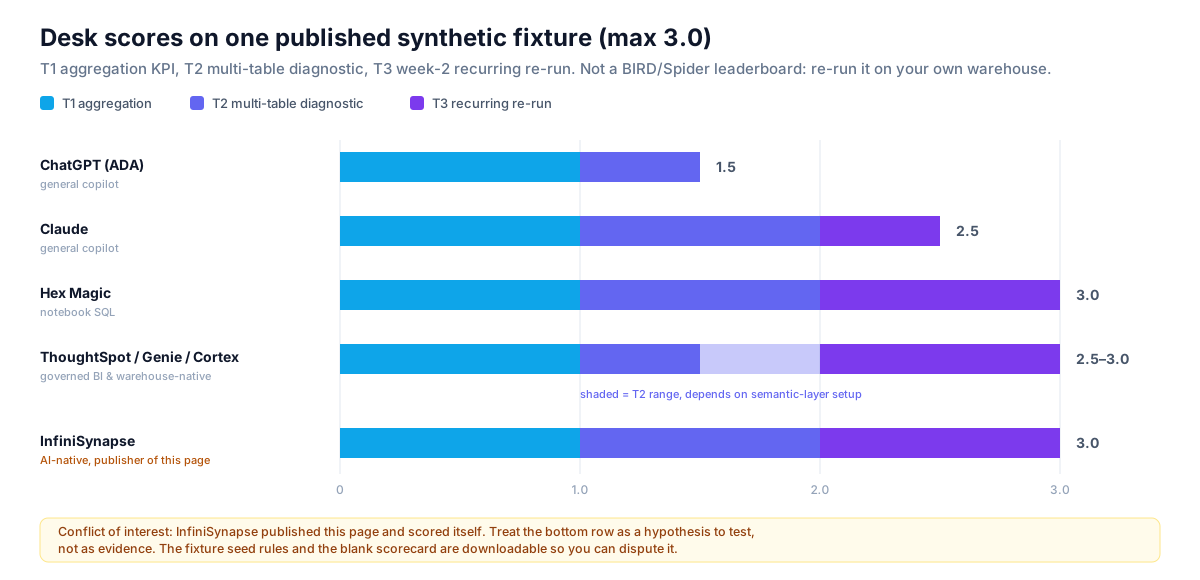
Figure 2 — The same scores as the table below, as totals out of 3.0. The gap is concentrated in T3 (week-2 re-run), not T1 (aggregation) — which is why draft-quality demos mislead buyers.
| Tool class | Example | T1 | T2 | T3 | Assumptions | History | Desk note |
|---|---|---|---|---|---|---|---|
| General copilot | ChatGPT (ADA) | 1.0 | 0.5 | 0.0 | Y (prompted) | N (session) | Fast draft; T3 needed full re-prompt week 2 |
| General copilot | Claude | 1.0 | 1.0 | 0.5 | Y | N (session) | Strong T2 when schema docs pasted; weak persistence |
| Notebook SQL | Hex Magic | 1.0 | 1.0 | 1.0 | Y (cells) | Y | Best inspectability; human still owns orchestration (docs) |
| Governed BI / warehouse | ThoughtSpot / Genie / Cortex* | 1.0† | 0.5–1.0† | 1.0† | Y (semantic) | Y | †After semantic/model setup; cold start slower (ThoughtSpot, Databricks, Cortex Analyst) |
| AI-native workflow | InfiniSynapse | 1.0 | 1.0 | 1.0 | Y | Y | Strongest on T3 memory reuse in our fixture; still requires your schema review |
*Warehouse-native scores assume the vendor’s semantic layer or catalog was already configured. Untuned demos often look like copilots on T2.
Independent takeaway: public bars (BIRD human ~92.96% execution accuracy) explain why no tool should ship unreviewed SQL to executives. Your filled sheet beats any vendor screenshot.
If a vendor cannot fill the blank scoring sheet on a read-only clone of your warehouse, treat the demo as incomplete.
Independent verification: how to dispute these numbers
A vendor scoring itself is weak evidence, so the whole method above is published rather than summarised. What third parties can check without our help:
| Claim on this page | How you verify it independently | What we cannot verify for you |
|---|---|---|
| The fixture is real and rebuildable | Rebuild from the seed rules above (500 customers, ~5% refunded, 1:N fan-out on order_items); no InfiniSynapse account needed | Whether your production schema behaves like the fixture |
| T1 correctness is objective | Run the hand-written baseline SQL and diff the top-10 SKU set yourself | Your own metric definitions |
| Public accuracy bars | Read BIRD-SQL and Spider directly; both publish leaderboards and papers | Which model/prompt a vendor used in a demo |
| Tool behaviour claims | Check the vendor docs we link per tool (Hex, ThoughtSpot, Databricks, Cortex Analyst) | Feature changes shipped after our review date |
Open call for third-party re-runs. If you re-run T1–T3 and your numbers disagree with our desk logs, send the filled CSV to zhuhl@infinisynapse.com. Submitted re-runs — including ones that contradict us — get logged with the submitter’s attribution and review date in the corrections log. Our scores stay labelled desk logs until at least one external re-run is on file.
Reference Prompt and Validation Checklist
Prompt template:
You are a senior analyst.

Schema:
orders(order_id, customer_id, order_date, status, total_amount)
customers(customer_id, signup_date, plan_tier, country)
order_items(order_id, sku, quantity, unit_price)

Task:
Return top 10 SKUs by revenue for paid users (plan_tier in pro, enterprise)
who signed up in the last 90 days, excluding refunded orders.
Provide SQL first, then assumptions.
Validation checklist:
- Confirm join keys and cardinality
- Confirm filter semantics and null behavior
- Run
EXPLAINbefore production execution - Verify metric consistency with business definitions
- Save reusable SQL logic for recurring runs
Use this checklist on every finalist in your evaluation. Skipping step three is how teams discover expensive full-table scans only after finance publishes the numbers.
Common Pitfalls
These failure modes show up across AI SQL stacks when review gates are skipped.
Pitfall 1 — Publishing AI-first-pass SQL for executive metrics. AI drafts fast; validation is still human work. Build mandatory review before external distribution.
Pitfall 2 — Ignoring dialect differences. A query that runs in BigQuery standard SQL may fail or silently diverge on Snowflake. Test on production engines, not generic examples.
Pitfall 3 — Hiding join logic from reviewers. If tools do not expose assumptions, second analysts cannot verify without reverse-engineering. Transparency is a feature, not documentation overhead.
Pitfall 4 — Treating text-to-SQL as the whole product. Query generation is one stage. Execution logs, performance flags, and reusable definitions separate serious platforms from demo toys.
Pitfall 5 — Believing "zero hallucination" without a week-2 test. Several 2026 vendor pages promise deterministic or zero-hallucination SQL. Treat that as an architecture claim to verify with T1–T3, not as a substitute for visible joins and a filled scorecard.
30-Day Evaluation Playbook
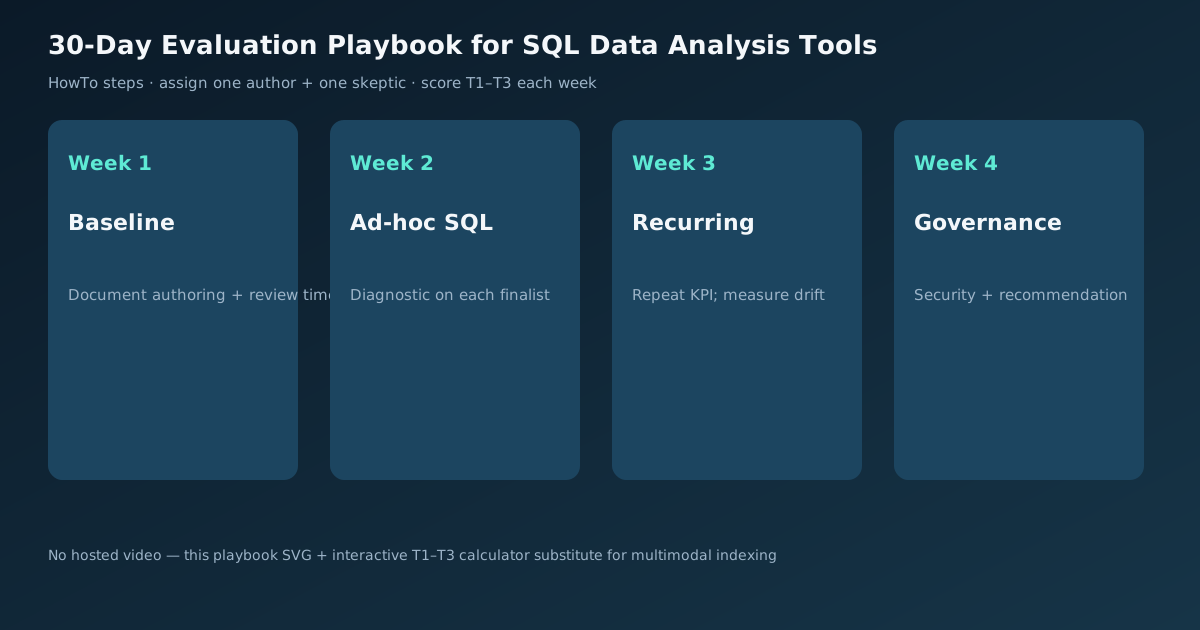 Figure: Four-week HowTo for evaluating SQL data analysis tools on your warehouse.
Use this playbook when shortlisting SQL data analysis tools — not a vendor demo script.
| Week | Focus | Activity |
|---|---|---|
| Week 1 | Baseline | Document current SQL authoring and review time; freeze three golden questions |
| Week 2 | Ad-hoc SQL | Run T2 diagnostic scenario on each finalist; log assumptions |
| Week 3 | Recurring SQL | Repeat the same KPI twice; score T3 logic drift without re-prompt rebuild |
| Week 4 | Governance | Security review, filled T1–T3 sheet, recommendation memo |
HowTo steps (assign owners):
- Baseline time study — Measure minutes to author + review one recurring KPI today.
- Dialect matrix — Run the private scorecard on every dialect you ship (Postgres / Snowflake / BigQuery).
- Adversarial join review — One analyst writes SQL; one skeptic tries to break joins and null filters.
- Week-2 reuse test — Re-run without rebuilding prompts; record T3 pass/fail.
- Ship / no-ship memo — Recommend only tools that expose assumptions, history, and perimeter controls.
Assign one analyst to write SQL and one skeptic to break joins. The best SQL data analysis tools survive adversarial review without collapsing into hand-waved assumptions.
Security Checklist for SQL AI Rollout
Before production seats for any SQL AI tool, confirm perimeter controls:
- Confirm query logs stay inside approved data perimeters
- Verify role-based warehouse access is enforced, not bypassed
- Test whether schema metadata leaves your environment
- Document approved data classes per tool tier
- Validate audit exports for compliance review
- Run incident tabletop for accidental cross-tenant exposure.
Production rollouts should align access and review controls with Anthropic guidance on effective agents, especially when recurring queries touch live schemas. LLM-backed analytics should account for prompt-injection and data-exfiltration risks in the OWASP Top 10 for LLM Applications, especially when connectors expose production schemas.
Warehouse-integrated options usually align faster with existing controls, but security review on production-like schemas remains mandatory.
ROI Signals
ROI for SQL data analysis tools concentrates in rebuild time on recurring KPIs—not first-prompt wow.
| Signal | Healthy trend |
|---|---|
| SQL authoring time | Down on comparable tasks |
| Post-review rewrite rate | Down without quality drop |
| Expensive query incidents | Down after EXPLAIN adoption |
| Recurring KPI rework | Down week over week |
| Analyst investigations closed | Up with stable headcount |
Flat rework on recurring SQL workflows means you need memory and orchestration, not another text-to-SQL copilot. Finance and data leads reviewing ROI should weight rework reduction as heavily as query drafting speed — the hidden cost of re-prompting often exceeds license fees within two reporting cycles.
Worked ROI example (modelled, with every input shown)
This is arithmetic on stated assumptions, not a customer case study. Swap our inputs for yours in the ROI worksheet tab of the CSV — the point is the shape of the calculation, not our numbers.
Assumptions (a 4-analyst team, 12 recurring KPIs, one reporting cycle per week):
| Input | Value | Where it comes from |
|---|---|---|
| Recurring KPI queries rebuilt each cycle | 12 | Your reporting calendar |
| Median rebuild time per KPI, copilot workflow | 25 min | T3 timings on our fixture (full re-prompt + re-validate) |
| Median rebuild time per KPI, memory-backed workflow | 6 min | T3 timings when week-1 logic is reused |
| Loaded analyst cost | $75 / hour | Your finance team's fully-loaded rate |
| Reporting cycles per year | 48 | 52 weeks minus holidays |
The arithmetic:
| Step | Calculation | Result |
|---|---|---|
| Minutes saved per cycle | 12 KPIs × (25 − 6) min | 228 min ≈ 3.8 h |
| Hours saved per year | 3.8 h × 48 cycles | 182 h |
| Gross annual benefit | 182 h × $75 | $13,650 |
| Break-even license budget | Same as gross benefit | ~$13.6k / year before other value counts |
How to falsify it. The number collapses if any of these is false for you, so test them before believing it: (1) rebuild time really is ~25 min today — measure it in week 1 of the 30-day playbook, not from memory; (2) the 6-minute figure survives on your schema, not a 3-table fixture; (3) the saved hours get reallocated to analysis instead of absorbed. Teams whose recurring KPIs are already templated in dbt or a semantic layer typically see a far smaller delta — for them the honest answer is that a copilot at a lower price point is enough.
For spreadsheet-heavy prep before SQL, see AI Excel data analysis tools. File-copilot splits are covered in Julius AI vs ChatGPT.
Try a warehouse-connected data analyst with a bound knowledge base
Seed a small knowledge base of business definitions. Ask one question that crossed two sources and watch the plan, SQL, and verification step before scaling seats.
Frequently Asked Questions
What are the best SQL data analysis tools in 2026?
There is no universal winner. ChatGPT and Claude lead ad-hoc drafting; ThoughtSpot, Databricks Genie, and Snowflake Cortex Analyst lead governed warehouse SQL; Hex leads notebook reproducibility; InfiniSynapse fits recurring cross-source workflows with memory. Shortlist by the scenario you repeat most often.
What's the best AI data analyst tool data teams actually trust to not hallucinate SQL?
The tools data teams ship are the SQL data analysis tools that show the SQL, bind metrics, and pass T3—not the fastest chatbot. On our fixture that means Hex (inspectable cells), ThoughtSpot / Genie / Cortex Analyst after a semantic or catalog setup, and InfiniSynapse on recurring multi-source jobs. Copilots remain the right pick for one-off drafts that a human will rewrite.
How do SQL data analysis tools stop hallucinated SQL?
They do not "stop" it with a model upgrade. They catch it: visible SQL, information_schema diffs, grain checks, metric contracts, and a week-2 re-run. dbt's 2026 result is the same split—semantic layer answers are deterministic; raw text-to-SQL can still be confidently wrong.
Which AI SQL tool is best for analysts who don't code daily?
ThoughtSpot Spotter and Gemini (BigQuery) are usually easier for less SQL-heavy users because of guided, natural-language interfaces. ChatGPT can still work for drafting if someone pastes schema and reviews joins. Validate every executive-facing number before it leaves the team.
Can AI-generated SQL be trusted in production?
It can be useful, but not blindly trusted. Analysts should validate joins, assumptions, null handling, and query plans before production use, especially for financial or executive reporting.
Which tools support governed enterprise SQL workflows?
ThoughtSpot, Databricks Genie, and Snowflake Cortex Analyst are strong options for governed SQL workflows because they align with enterprise warehouse controls and semantic models.
How do AI-native tools differ from SQL copilots?
SQL copilots help generate and refine queries with human steering. AI-native tools can execute multi-step analysis from a goal, preserve process history, and retain reusable context for future runs.
What is the fastest way to evaluate SQL AI tools?
Run the same three SQL tasks across each tool: one aggregation, one multi-table diagnostic query, and one recurring KPI update. Score each tool on correctness, transparency, and repeatability.
How should I test dialect accuracy across tools?
Run the same three tasks on every dialect your team ships: one aggregation, one multi-table diagnostic with joins, and one window-function KPI. Score correctness against a hand-written baseline, assumption clarity, and whether EXPLAIN flags expensive plans before production.
What is text-to-SQL vs a SQL analysis workflow tool?
Text-to-SQL generates a query draft. A workflow tool executes against real sources, exposes intermediate SQL, validates joins/filters/nulls, and preserves reusable logic for the next cycle. Buyers who only score draft quality often rediscover rework on week two.
How should buyers treat public SQL accuracy benchmarks?
Use BIRD and Spider as upper-bound context, not as a vendor ranking. Copy the private scorecard (T1–T3 × your dialects) and reject any claim that skips inspectable SQL, assumptions, and week-2 re-run stability.
What dataset did you use for the hands-on scores on this page?
A synthetic Postgres fixture (customers / orders / order_items) with published seed rules and a hand-written T1 baseline SQL—not production customer data. Scores are desk logs on that fixture so you can reproduce the method; they are not a substitute for running T1–T3 on your warehouse.
How can I independently reproduce or dispute the scores on this page?
Download the blank scorecard CSV, rebuild the synthetic fixture from the published seed rules, and re-run T1–T3 on your own dialects. If your results disagree with our desk logs, send the filled sheet to zhuhl@infinisynapse.com; corrections and third-party re-runs are logged with dates on our editorial standards page.
Does InfiniSynapse have a conflict of interest on this page?
Yes. InfiniSynapse publishes the guide and sells a data agent. To reduce bias we (1) list when copilots and warehouse-native tools win, (2) refuse a universal accuracy league table, and (3) publish a scorecard you can run without our product. Prefer your filled scorecard over our positioning.
Methodology and disclosure
Published: 2026-06-09 · Last updated: 2026-09-16 · Next review: 2026-12-16
Who wrote and reviewed it: Lead author William Zhu (InfiniSynapse cofounder) with the InfiniSynapse Data Team; production experience across Postgres, Snowflake, and BigQuery; the T1–T3 protocol and the SQL baseline were reviewed by a data platform engineer, and the security checklist by a reviewer working on LLM application security. Reviewer roles, qualifications, the correction policy, and the log of third-party re-runs live on our editorial standards page.
How this page was built: Product positioning and fit claims come from hands-on workflow checks on the synthetic fixture (schema + baseline SQL + T1–T3 logs above) plus vendor documentation for ChatGPT, Claude, Hex, ThoughtSpot, Databricks, Snowflake, and Google Cloud. Public NL2SQL context cites BIRD and Spider. The 2026 semantic-layer vs raw text-to-SQL split cites dbt's benchmark update. Security/governance framing cites NIST AI RMF, OWASP Top 10 for LLM Applications, CISA AI guidance, and Anthropic — building effective agents. Enterprise AI workflow context also references Google Vertex AI docs, Snowflake Cortex Analyst docs, and Databricks docs.
Conflict of interest: InfiniSynapse is the publisher and a vendor in the shortlist. Where we recommend InfiniSynapse, it is for recurring cross-source workflows with memory—not as a default for every SQL drafting task. The illustrative scorecard shows copilots and Hex winning on speed/inspectability where that is the job. No vendor on this page paid for placement, and none reviewed the draft before publication.
Corrections and third-party re-runs: Send a filled scorecard CSV or a factual correction to zhuhl@infinisynapse.com. Substantive corrections are dated inline and logged on the editorial standards page; we do not silently edit scores.
Link integrity: All citations in this markdown source use https:// destinations only. View page source (not a browser-extension overlay) and confirm every href starts with https:// or /. If a CMS paste or an SEO extension injects non-https protocol links into the DOM during a scan, discard that revision and re-paste from this source—then re-scan in a clean profile.
Update cadence: Every 90 days for product naming, dialect notes, and benchmark context.
Conclusion
The market for SQL data analysis tools is no longer about text-to-SQL alone. Teams now need platforms that combine query quality with governance, transparency, and reusable workflow logic.
Choose SQL data analysis tools based on your operating model: ad-hoc exploration, warehouse self-service, or recurring autonomous analysis delivery. These tools earn trust on the tenth run, not just the first prompt. Revisit your shortlist each quarter — the best shortlist for a Snowflake-centric org differ from those for a notebook-first analytics engineering team. Document which tools own each recurring KPI before you scale seats.
How to build a durable SQL tool stack
Most mature teams evaluating SQL data analysis tools do not pick one winner. They pair a fast copilot for ad-hoc drafting with a governed warehouse tool for self-service and, when recurrence demands it, an AI-native executor that preserves SQL logic across cycles. This layered approach keeps the stack aligned to data classification: consumer-tier copilots for sanitized samples, perimeter-aligned platforms for production schemas. Document which SQL workflows may use which tier before scaling seats — that single policy prevents the governance surprises that undo otherwise sound SQL AI rollouts.