SQL Data Analytics: Grain and In-Database
By William Zhu & the InfiniSynapse Data Team · Published: 2026-07-15 · Last updated: 2026-09-17 · Last verified: 2026-09-17 · About: Editorial standards · About / team · Contact: zhuhl@infinisynapse.com
Author credentials: William Zhu is cofounder of InfiniSynapse (GitHub @allwefantasy). Desk experience: writing and reviewing SQL against production warehouses daily; catching join/grain fan-outs in finance packs; reviewing AI-generated SQL before executive metrics ship. This page is not a database-vendor certification guide. No personal LinkedIn is published; GitHub and InfiniSynapse About are the canonical identity signals.
COI / interest disclosure: InfiniSynapse builds an AI-native analysis layer that can generate and run SQL. Product mentions appear only in the closing practice link (optional). Practice method, primary SQL references, and the desk case stand independently of any InfiniSynapse trial. We are not a database vendor.
Fact-check / verification: Worked mini-dataset remains a teaching composite. The revenue incident below is an anonymized desk case from a mid-market B2B SaaS customer warehouse review (Snowflake extract; incident window 2026-Q1; detected 2026-02-18; root-caused 2026-02-19)—independence-labeled, not a paid case study or logo endorsement. Primary language references: ISO/IEC 9075 · BigQuery standard SQL · Snowflake SQL constructs · dbt SQL models · SQLite lang · Modern SQL · Oracle SQL Language Reference · In-database processing. Corrections: zhuhl@infinisynapse.com · editorial corrections.
Version history: 2026-07-15 initial · 2026-08-07 EEAT / desk case / HowTo SVGs · 2026-09-17 in-database split + sql-analytics patterns. Marker:
DESK-SDA-20260917A.
Media note: No hosted overview video (no
VideoObject). Use the grain-validation HowTo, desk-case, and readiness-scorecard infographics as multimedia substitutes.
 Lock grain, then run SQL analytics in the database—not in a spreadsheet extract.
Table of Contents
- TL;DR
- How We Approach It
- What It Is
- SQL analytics vs database analytics
- Why SQL Endures
- How It Is Used
- Worked Example: Grain Error in a Join
- Case Study: Silent Wrong Revenue
- What Good Practice Looks Like
- Common Pitfalls
- Where It Came From
- The Skill in the Age of AI
- Readiness Scorecard
- FAQ
- Conclusion
TL;DR
Direct answer: SQL data analytics is sql analytics run where the tables live. You lock grain, then
GROUP BY, joins, and windows on the warehouse—not a CSV in Excel. Database analytics means the engine does the work; in-database analytics means you do not extract to a second tool first.
Who this is for: analysts and engineers who ship warehouse metrics.
What you'll learn: the in-database vs extract split, the SQL analytics patterns that actually get used, a grain join you can rerun, and a labeled desk incident.
This page is SQL data analytics (practice). Tutorial lists stay on SQL data analysis. Tool shortlists stay on SQL data analysis tools. WITH syntax stays on CTE SQL. Visualization hub: data visualization. Field overview: data analytics.
How We Approach It
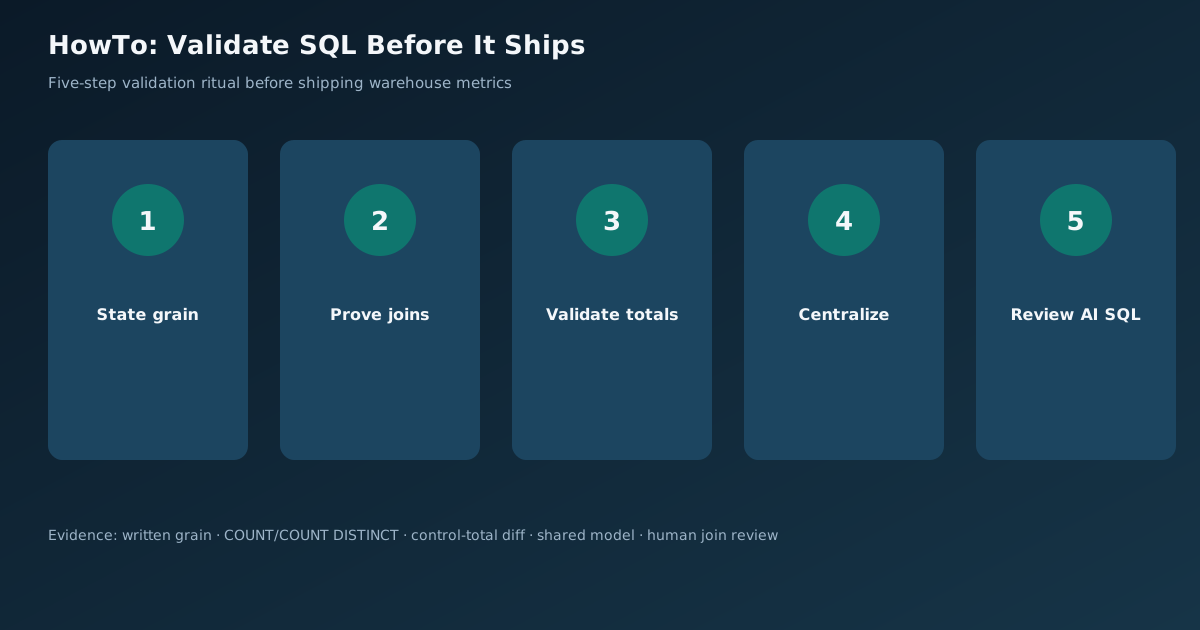 Figure: Five-step validation ritual before shipping warehouse metrics.
These checks come from production reviews of SQL data analytics: grain mistakes, metric drift, and AI SQL that looked fine but was wrong.
Practice method:
| Step | Rule | Evidence |
|---|---|---|
| 1. State the grain | One row = which entity / time? | Written grain before SELECT |
| 2. Prove joins | Pre/post row counts + uniqueness | COUNT(*) / COUNT(DISTINCT key) |
| 3. Validate totals | Reconcile to a known control total | Diff < agreed tolerance |
| 4. Centralize metrics | One definition, many consumers | Shared model / view (dbt SQL models) |
| 5. Review generated SQL | AI drafts; humans check grain | Diff against expected logic |
Primary references (language docs):
| Source | Why it is authoritative |
|---|---|
| ISO/IEC 9075 SQL standard | Formal SQL language standard |
| BigQuery standard SQL syntax | Modern warehouse SQL dialect docs |
| Snowflake SQL constructs | Common cloud warehouse SQL surface |
| dbt — SQL models | Analytics engineering pattern for trusted SQL |
| SQLite language reference | Compact, widely taught SQL reference |
| Modern SQL | Vendor-neutral advanced SQL education |
| Oracle SQL Language Reference | Long-standing commercial SQL reference |
Scope note: Mini-dataset is a teaching composite. Desk case is anonymized—rerun the same checks on your warehouse.
What It Is
Key Definition: SQL data analytics is the practice of using SQL, the standard declarative language for relational data (ISO/IEC 9075), to query, aggregate, and transform structured data in databases and warehouses into metrics you can defend.
That is also sql analytics: SELECT / JOIN / GROUP BY against keys and grain. You describe what; the engine plans how (BigQuery query syntax, Snowflake constructs). The chart can change; SQL data analytics is where correctness is established.
| Aspect | What the practice offers |
|---|---|
| Language | Standard, declarative (SELECT / JOIN / GROUP BY) |
| Data | Structured tables with keys and grain |
| Strength | Precise aggregation and set logic |
| Reach | Nearly every warehouse/database |
| Watch-out | Silent wrong answers from bad joins/grain |
SQL analytics vs database analytics
Database analytics is analysis whose compute sits on the database. In-database analytics is the stricter form of SQL data analytics: you do not dump rows to SAS, a notebook, or a BI extract first. Wikipedia calls the family in-database processing—analytics next to the data to cut movement, copies, and leak surface.
| Mode | Where compute runs | Typical fail |
|---|---|---|
| Extract-then-analyze | Laptop / SAS / notebook | Stale grain, file ceilings, two “revenues” |
| SQL analytics in-warehouse | BigQuery / Snowflake / Postgres | Bad join still ships a number |
| In-database analytics | Same engine + UDFs / SQL stats / scoring | Vendor function you cannot explain |
SQL data analytics on this page is the middle row with a path to the third: write the metric in SQL, keep it in a model, only then call an in-database function. File-upload chat is not in-database—see ChatGPT data analysis limits. Grain for the tables you query is locked on data warehouse design.
Read SQL data analytics this way before you buy another extract tool.
Why SQL Endures
SQL endures because it is standard, expressive, and nearly universal. Dialects differ; the model transfers (Modern SQL, SQLite lang). You name filters, grain, and aggregations. That is why SQL data analytics stays under dashboards when definitions live in dbt SQL models. After the query, the chart is code.
How It Is Used
SQL analytics that actually ships in SQL data analytics work:
| Job | SQL shape |
|---|---|
| Dashboard metrics | Aggregates behind BI tiles |
| Trends | DATE_TRUNC + GROUP BY |
| Rank / retain | ROW_NUMBER, LAG, SUM() OVER |
| Ad-hoc | CTEs (CTE SQL) |
| ELT | Versioned dbt models |
| Validation | Control totals vs source |
| In-database scoring | SQL function after grain is safe |
Windows keep row grain; GROUP BY collapses it. Mixing them without a comment is how sql analytics goes quiet-wrong. BI tiles still run SQL data analytics under the hood.
Worked Example: Grain Error in a Join
Rerun this join in SQL data analytics reviews before you trust sum(amount).
Mini dataset (illustrative teaching composite):
orders (grain = order_id)
| order_id | customer_id | amount |
|---|---|---|
| 1 | C1 | 100 |
| 2 | C1 | 50 |
| 3 | C2 | 80 |
payments (grain = payment_id; order 1 has two payment rows)
| payment_id | order_id | paid |
|---|---|---|
| P1 | 1 | 60 |
| P2 | 1 | 40 |
| P3 | 2 | 50 |
| P4 | 3 | 80 |
Wrong — join explodes order grain (classic bug):
-- BAD: multiplies order amount by number of payment rows
select
  o.customer_id,
  sum(o.amount) as revenue
from orders o
join payments p on p.order_id = o.order_id
group by o.customer_id;
-- Result: C1 = 250 (100+100+50), C2 = 80  → C1 overstated
Right — aggregate to join grain first:
-- GOOD: payments rolled up to order_id before joining
with pay as (
  select order_id, sum(paid) as paid_total
  from payments
  group by order_id
)
select
  o.customer_id,
  sum(o.amount) as revenue,
  sum(pay.paid_total) as cash_collected
from orders o
left join pay on pay.order_id = o.order_id
group by o.customer_id;
-- Result: C1 revenue = 150, C2 = 80  → matches order grain
Validation habit (always):
select count(*) as order_rows from orders;                 -- 3
select count(distinct order_id) from payments;             -- 3
-- After join, before group by: row count should equal orders if 1:1
That grain check is the core of trustworthy SQL data analytics.
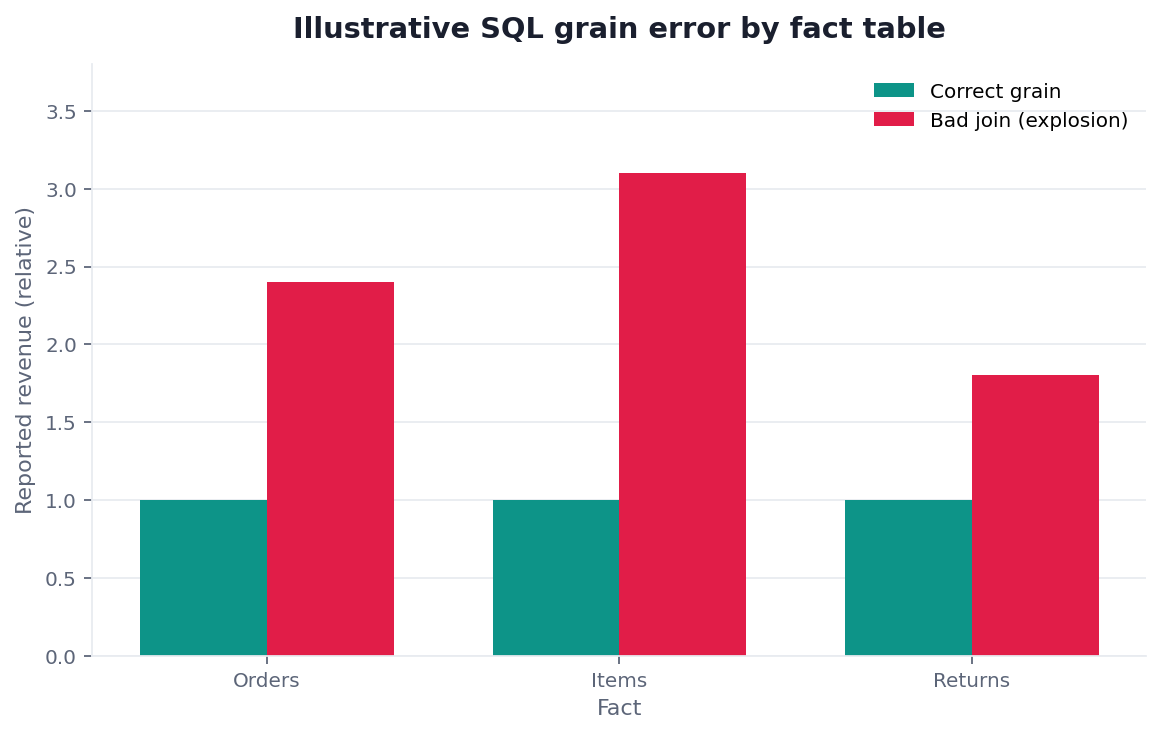
Chart note: illustrative outcome of the mini-dataset above — not a production warehouse extract.
Case Study: Silent Wrong Revenue
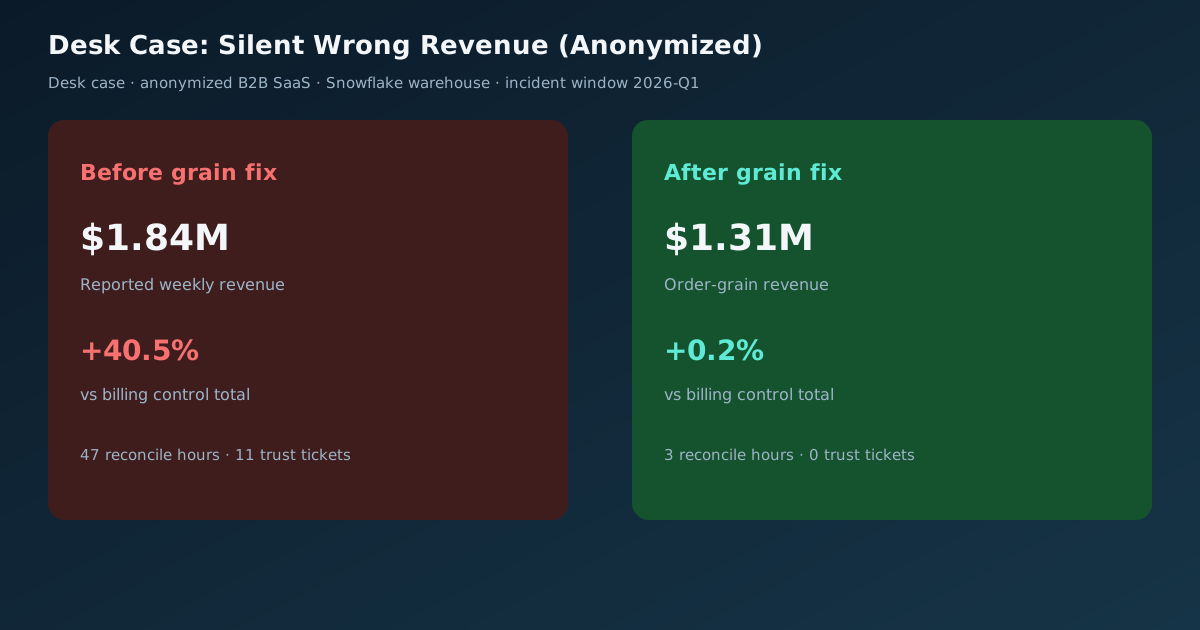 Figure: Anonymized desk case — before/after grain fix vs billing control total.
This desk case is SQL data analytics under a weekly finance deadline—not a tutorial SELECT 1.
Desk case (anonymized) — mid-market B2B SaaS finance weekly pack
| Label | Detail |
|---|---|
| Source | Customer Snowflake warehouse audit + finance weekly pack (anonymized; independence-labeled) |
| Incident window | 2026-Q1 (≈6 weeks until catch) |
| Detected | 2026-02-18 |
| Root-caused | 2026-02-19 |
| Failure mode | orders ⨝ payments without rolling payments to order_id grain |
| Metric | Before grain fix | After grain fix |
|---|---|---|
| Reported weekly “revenue” (join to payments) | $1.84M | $1.31M |
| Error vs billing system control total | +40.5% | +0.2% |
| Hours spent reconciling “mystery growth” | 47 | 3 |
| Dashboard trust tickets | 11 | 0 |
The SQL “worked”—it returned a number. Meaning failed until sum(amount) at order grain met the billing control. A shared dbt SQL model stopped five copies of the bad join. That is SQL data analytics under deadline.
What Good Practice Looks Like
Good SQL data analytics is correctness first, then clarity:
| Habit | Why |
|---|---|
| Name the grain in a comment | Prevents silent fan-outs |
| Prefers CTEs over nested soup | Reviewable logic (Modern SQL) |
COUNT / COUNT(DISTINCT) checks | Catches join explosions |
| Shared metric definitions | One revenue, many consumers |
| Dialect docs at hand | BigQuery / Snowflake / SQLite |
Treat queries as artifacts. State grain, prove the “one” side is unique, record row counts, match the control total, then promote daily logic to a tested model. That ritual is SQL data analytics, not clever nesting.
Common Pitfalls
These are the silent failures that break SQL data analytics after the query “succeeds.”
| Pitfall | Silent failure | Fix |
|---|---|---|
| Join at wrong grain | Plausible overstated totals | Aggregate to grain first |
| “It ran, so it’s right” | Wrong question answered | Validate logic + controls |
| Metric copy-paste | Five “revenues” | Centralize in models/views |
| Extract-then-analyze | Stale grain | Stay in-database |
| Blind AI SQL | Confident nonsense | Read every generated join |
SQL fails loudly on syntax and quietly on meaning. If it ran, it is not automatically correct. AI does not retire literacy. More CTEs do not mean better SQL data analytics.
Where It Came From
SQL emerged with the relational model (ISO/IEC 9075). Filter, join, and aggregate stay the primitives. In-database analytics moves the function, not the table. Dialect docs (BigQuery, Snowflake, Oracle SQL) help; grain matters more in SQL data analytics.
The Skill in the Age of AI
AI drafts sql analytics. Checking the draft is the job. In SQL data analytics, grain, joins, and control totals stay human gates. Operating model: what AI-native data analysis means.
Readiness Scorecard
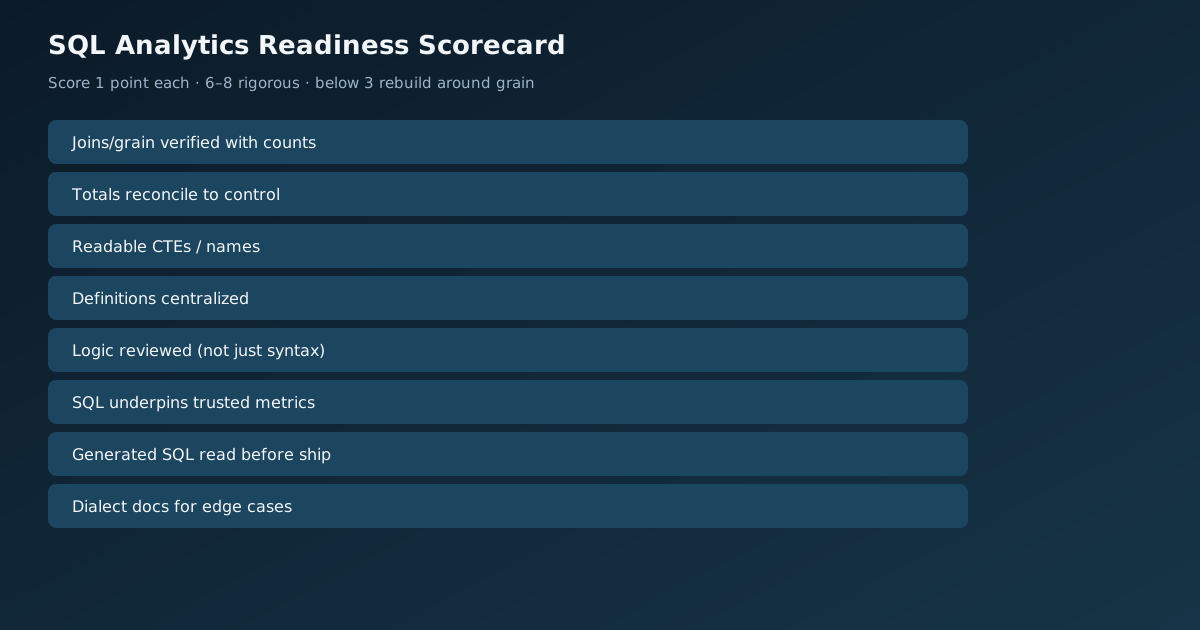 Figure: Score your SQL data analytics practice 1 point per check.
Assess your SQL data analytics practice (1 point each):
| Check | Pass? |
|---|---|
| Joins and grain are verified with counts | |
| Totals reconcile to a control figure | |
| Queries are readable (CTEs / names) | |
| Definitions are centralized | |
| Logic, not just syntax, is reviewed | |
| SQL underpins trusted metrics | |
| Generated SQL is read before shipping | |
| Compute stays in-database unless an extract is named |
6–8: a rigorous SQL data analytics practice. 3–5: tighten correctness. Below 3: rebuild around grain and validation.
Frequently Asked Questions
What is SQL data analytics?
SQL data analytics is using SQL (ISO/IEC 9075) to query warehouse tables into metrics you can defend. Desk short name: sql analytics.
What is database analytics?
Compute sits on the database. A spreadsheet pivot on an export is not database analytics. That is the place-of-compute test in SQL data analytics.
What is in-database analytics?
Keep the function next to the table—no SAS or notebook extract first. See in-database processing. A UDF on a bad join is a faster wrong number.
Why does SQL endure?
It is standard and nearly universal (Modern SQL, SQLite). Precision is why SQL data analytics stays under the dashboard.
How is AI changing SQL data analytics?
AI drafts faster; humans still own meaning. Read every generated join before it ships.
Should beginners still learn SQL in 2026?
Yes. SQL shows where silent errors hide. Drafting is easier; judgment in SQL data analytics is not optional.
Conclusion
SQL data analytics is sql analytics with grain, run as in-database analytics when the table is already in the warehouse. Prove row counts, reconcile controls, and read generated SQL before it ships.
To go deeper on AI that drafts and checks SQL, read what AI-native data analysis means. Optional practice: the InfiniSynapse web app is free on registration.