NL2SQL Benchmark Spider BIRD: What Matters in Production
By William Zhu & the InfiniSynapse Data Team · Published: 2026-06-09 · Last updated: 2026-07-31 · Next review: 2026-10-31 · About: Editorial standards / policy · About / team
Author credentials: William Zhu — InfiniSynapse cofounder; public engineering profile GitHub @allwefantasy (InfiniSQL / open-source data systems). Desk contact: zhuhl@infinisynapse.com. First-hand: accountable for private gold-set evaluation protocols used in our NL2SQL pilots. Reviewers: data platform. Social verification: GitHub @allwefantasy · GitHub InfiniSynapse (no personal LinkedIn claimed here).
Who we are (Authority): roles, reviewer qualifications, 90-day review cadence, and COI rules are on editorial standards — including who reviews. InfiniSynapse ships a production SQL agent; we do not claim neutral third-party authority on our own pilots.
Error correction (Trust): contradictions and accepted re-runs follow our corrections policy.
External validation (above the fold). Academic / public suites: Spider (Yale LILY) · Spider paper (arXiv:1809.08887) · BIRD benchmark · BIRD paper (arXiv:2305.03111). Governance / quality: Wikipedia data quality · NIST AI RMF · NIST Cybersecurity Framework (overview) · OWASP API Security Top 10 · ISO/IEC 27001 (overview) · EU approach to AI · IBM augmented analytics. Platform docs: Databricks · PostgreSQL · Apache Spark. Download: production scorecard template (CSV).
Table of Contents
- TL;DR
- Why this matters now
- Key Definition
- Evaluation Basis: Scorecard
- What Spider and BIRD Measure Well
- What Benchmark Scores Miss in Production
- InfiniSynapse Production Pattern
- Benchmark-to-Production Translation Scorecard
- HowTo: Phased Rollout After Benchmarking
- Framework Signals
- Common Failure Patterns
- Production Debugging Notes
- Frequently Asked Questions
- Who wrote this
- Conclusion
TL;DR
Teams treating benchmarking as a procurement shortcut should optimize for repeatable correctness, auditability, and business trust instead. We evaluate NL2SQL on real warehouse workflows, not isolated prompts. Production outcomes improve when generation, execution, validation, and review sit in one controlled system.
Public benchmarking on Spider and BIRD is directional. Production rollouts should still align access and review controls with the Apache Spark documentation, especially when recurring queries touch live schemas.
Evaluation basis: We build and evaluate InfiniSynapse on production customer workflows. Governance and security context is cited inline. Download the blank production scorecard template (CC BY 4.0) to reproduce the gates on your schema.
Why this matters now
For adjacent workflow depth, see Text to SQL agent for data visualization: 2026 Guide.
Reading a benchmarking scorecard correctly matters because enterprise teams must deliver faster analytics without losing governance. AI-assisted SQL unlocks productivity only when requests are grounded, generated, verified, and approved the same way every time. In our field work, the hard part is not getting SQL once; it is confidence across repeated runs as data changes. When you move from public bars to a buyer shortlist, use the SQL data analysis tools scorecard to test whether an AI data analyst hallucinates SQL on a published fixture.
A public benchmarking result is directional, not a production guarantee. As organizations scale, asks become more cross-functional. Finance, growth, operations, and product need consistent metric definitions — architecture and process matter as much as model capability.
Quality gates for agents should reference Wikipedia's data quality overview when defining completeness, accuracy, and timeliness checks.
Key Definition
Key Definition: In this article, benchmarking for NL2SQL means measuring whether a system maps natural-language intent to executable SQL under a published harness (Spider/BIRD) and whether the same discipline holds on your private gold set with metric contracts attached.
This definition reframes AI SQL from an interface feature to an operating capability. Outputs should be understandable, testable, and recoverable when edge cases appear. Ownership stays clear among analytics engineers, BI teams, and decision stakeholders.
Lakehouse integrations should use Databricks documentation for Unity Catalog, SQL warehouses, and agent grounding patterns.
Evaluation Basis: Scorecard
We use one production scorecard across pilots and post-launch reviews — the same rows as the downloadable CSV template. Warehouse vendors describe governed NL2SQL agents in Apache Spark documentation — compare memory depth and audit trails against your internal requirements.
| Criterion | Why it matters | Pass signal |
|---|---|---|
| Grounding quality | Prevents wrong-table SQL | Correct model of schema and metrics |
| Execution reliability | Protects delivery timelines | Recoverable failures and stable reruns |
| Result trustworthiness | Reduces business risk | Outputs match analyst-reviewed baselines |
| Governance fit | Enables enterprise rollout | Access controls and logs are complete |
| Operational effort | Controls total cost | Less manual rework after week four |
| Reusability | Improves long-run leverage | Repeated workflows get faster and safer |
We evaluate every candidate with a mixed workload: straightforward aggregation, multi-step diagnostics, and one recurring monthly report. That structure exposes whether benchmarking fluency survives operational pressure.
What Spider and BIRD Measure Well
Procurement and architecture reviews may include Integrate Natural Language Data Analysis with SQL and Python.
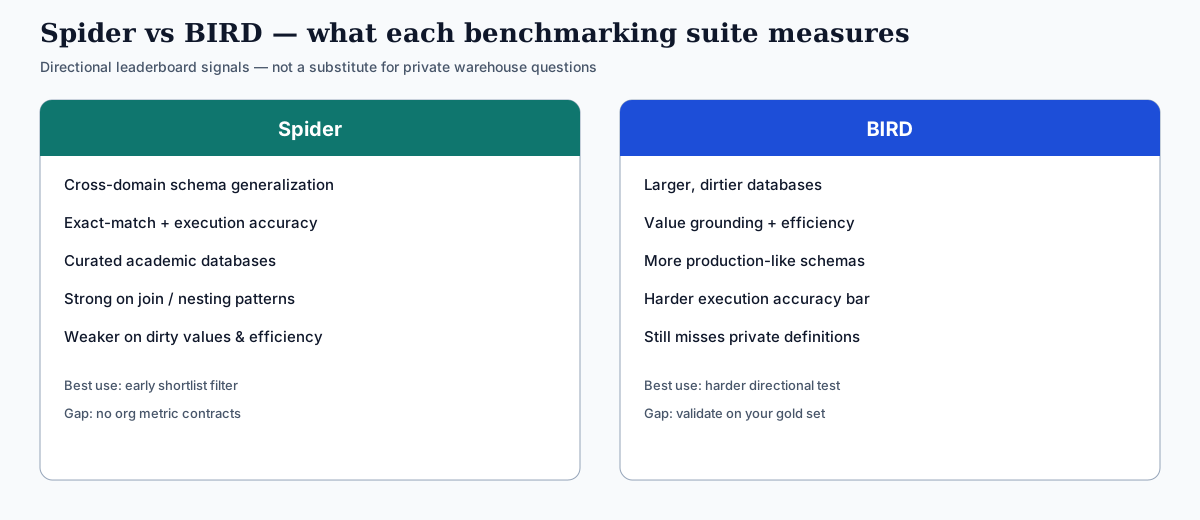
Spider (paper) stresses cross-domain schema generalization. BIRD (paper) adds larger, dirtier databases, value grounding, and efficiency. Together they are the strongest public benchmarking signals for text-to-SQL shortlists.
This phase focuses on where tools perform strongly and where they degrade. We check intent coverage, join correctness, and fallback behavior under noisy data. We also measure how much manual intervention is needed to deliver stakeholder-ready results.
Most teams discover that one-shot prompt workflows look strong in quick demos but produce hidden rework under real pressure. Systems with guided execution and transparent assumptions generally hold quality longer.
To keep benchmarking fair, we require identical question sets, fixed reviewer criteria, and explicit acceptance thresholds. This prevents preference bias and helps teams compare tools by operational reality.
What Benchmark Scores Miss in Production
Architecture decisions drive reliability. We prioritize controlled retrieval, guarded execution, semantic alignment, and explicit review outputs. Leaderboard scores from public benchmarking suites are a useful sanity check but rarely predict enterprise schema drift alone.
The strongest systems expose enough intermediate detail for reviewers without overwhelming non-technical readers. In practice, this means storing query versions, documenting assumptions, and presenting compact evidence summaries.
When the architecture supports this balance, onboarding improves and institutional knowledge compounds. LLM-backed analytics should account for prompt-injection and data-exfiltration risks in the NIST Cybersecurity Framework (overview) and NIST AI RMF, especially when connectors expose production schemas.
The move from dashboard-first BI to augmented workflows—described in IBM's augmented analytics overview—frames how teams should evaluate tooling here.
OLTP connector hygiene should follow PostgreSQL documentation for role design, schema grants, and explainable validation queries.
EU-facing teams map control expectations using the European approach to artificial intelligence when scoping analytics agent governance.
InfiniSynapse Production Pattern
InfiniSynapse is positioned as a production-grade SQL agent, not a prompt-only NL2SQL layer. After public benchmarking, we evaluate and build around five practical rules:
- Ground each request with current schema and metric context.
- Execute with fallback logic and explicit error classes.
- Validate results with semantic and statistical checks.
- Preserve end-to-end audit trails for reviewer sign-off.
- Distill reusable memory to improve next-run quality.
This pattern is intentionally operational. It aligns platform governance, analyst workflow, and business accountability in one repeatable loop.
Benchmark-to-Production Translation Scorecard
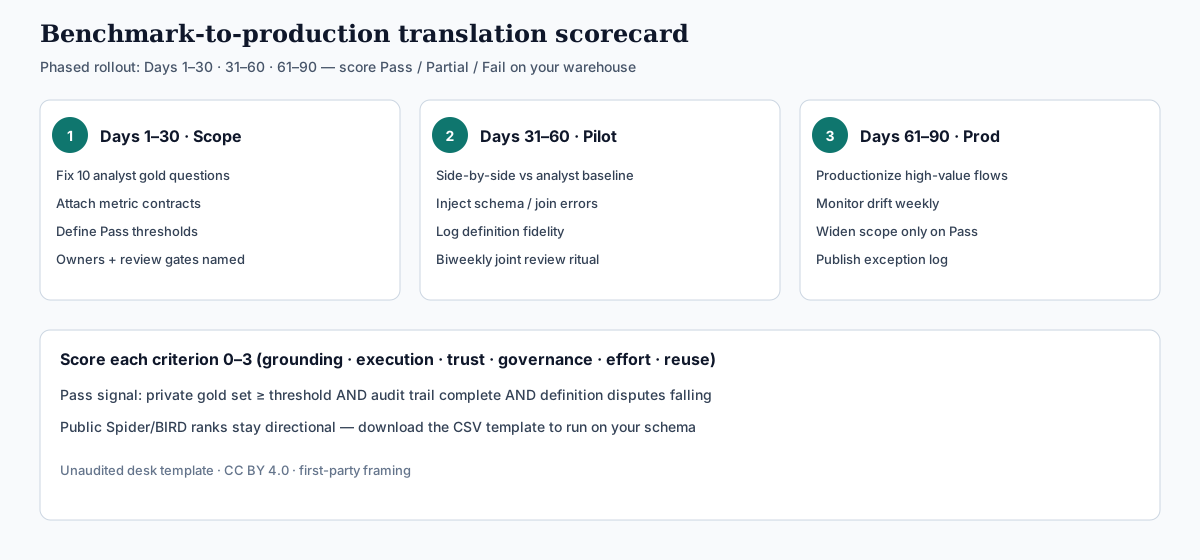
A practical rollout path works better than a broad all-at-once launch after benchmarking:
- Days 1-30: define scope, boundaries, and success criteria.
- Days 31-60: run side-by-side pilots with analyst baselines.
- Days 61-90: productionize high-value workflows and monitor drift.
Download the blank production scorecard template (CSV) and score each criterion 0–3 on your warehouse. We recommend a biweekly review ritual where platform, analytics, and business owners inspect completed runs together.
HowTo: Phased Rollout After Benchmarking
Use this HowTo when a vendor cites Spider/BIRD ranks and you need a production path:
- Freeze the private gold set — ten analyst-authored questions with gold SQL and metric contracts attached before any vendor demo.
- Run public benchmarking for context only — record Spider/BIRD split, metric (exact-match vs execution accuracy), and whether retries were allowed (Spider paper, BIRD paper).
- Score the CSV gates on your schema — grounding, execution, trust, governance, effort, reuse (template).
- Inject failures deliberately — missing columns, bad joins, dialect quirks; score recovery, not demos.
- Widen scope only on Pass — Days 61–90 productionize high-value workflows; log exceptions weekly under corrections.
Framework Signals
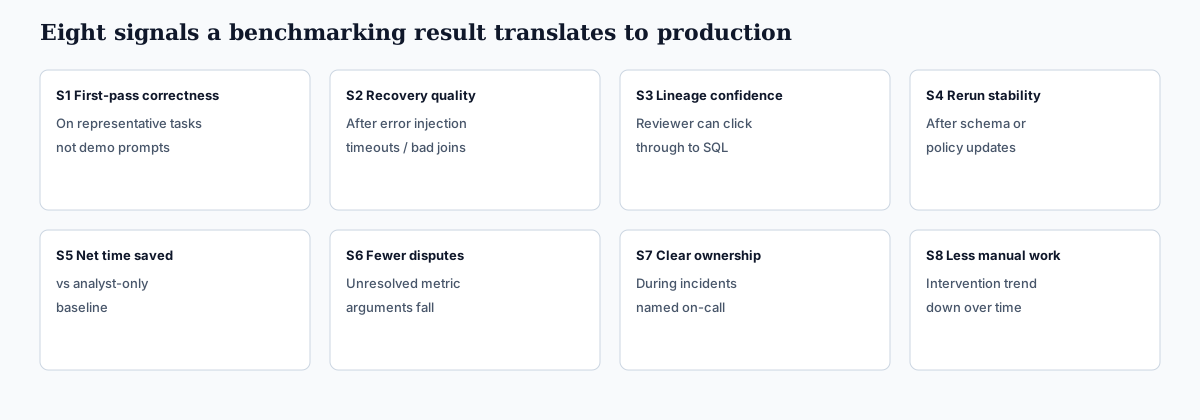
Use this signal checklist to keep a benchmarking-driven rollout grounded:
- Signal 1: correctness at first pass on representative tasks.
- Signal 2: recovery quality after deliberate error injection.
- Signal 3: reviewer confidence in output lineage.
- Signal 4: rerun stability after schema or policy updates.
- Signal 5: net time saved versus analyst-only baseline.
- Signal 6: reduction in unresolved metric disputes.
- Signal 7: clarity of ownership during incidents.
- Signal 8: trend of manual intervention over time.
A Benchmark Score That Misled Us
A concrete case shows why ranks deceive. A vendor we evaluated reported strong BIRD execution accuracy, and on the public schemas it was genuinely good. On our warehouse it produced a confident query for "net revenue by region last quarter" that silently summed gross line items, because our net_revenue is defined as gross minus refunds and platform fees held in a separate adjustments table the public benchmarking schema never contains. The SQL was syntactically perfect and the chart looked plausible; the number was nine percent too high.
Spider and BIRD measure whether a model maps a question to correct SQL given a known schema; they do not measure whether the model knows your metric contracts. Those are grounding and governance properties, so they live in the deployment, not the leaderboard.
What changed our evaluation was a private mini-benchmark: ten real questions with analyst-reviewed gold queries and metric definitions. We run any candidate against that set first — scoring execution accuracy and definition fidelity — and only then use public benchmarking for directional context. Since then the public score is a tiebreaker, and the private set has caught every silent-definition error before stakeholders saw it.
Predictive workflows should stay anchored to fundamentals in the Wikipedia machine learning overview when interpreting model-driven outputs.
Common Failure Patterns
For adjacent workflow depth, see three AI SQL generator classes.
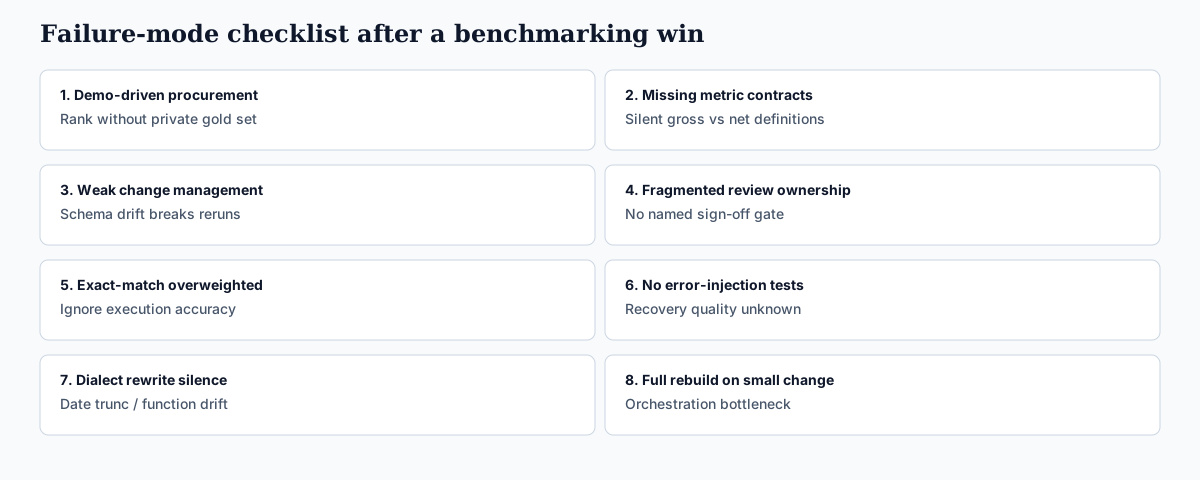
Across deployments, we repeatedly see preventable failure modes after a benchmarking win. Treat the list below as an ItemList checklist in reviews:
- Demo-driven procurement — buying on leaderboard rank without a private gold set.
- Missing semantic definitions — silent gross vs net (or three “revenue” columns).
- Weak change management — schema drift breaks reruns with no owner.
- Fragmented review ownership — no named sign-off gate for high-stakes reports.
- Exact-match overweighted — ignoring execution accuracy and definition fidelity.
- No error-injection tests — recovery quality unknown until week three.
- Silent dialect rewrites — date truncation / function drift across warehouses.
- Full rebuild on small changes — orchestration, not the model, is the bottleneck.
Most of these issues are process gaps, not model gaps. Teams that treat NL2SQL as production infrastructure outperform teams that treat it as a chat accessory. Document connector behavior the way the OWASP API Security Top 10 describes least-privilege access; keep verification-first checks consistent with ISO/IEC 27001.
Reading Spider and BIRD Results Without Being Misled
When a comparison cites a Spider or BIRD score, ask which split and metric: exact-match rewards syntactic similarity, while execution accuracy rewards correct rows even with different SQL. Production teams should weight execution accuracy, then discount it for the gap between curated schemas and their own dirty warehouse. Keep a short audit for any benchmarking claim — schema realism, value-grounding difficulty, and whether the harness allowed retries.
The recurring failure is treating a leaderboard rank as a procurement decision. A model that tops BIRD on academic schemas can still miss your account_flags join. Validate vendor claims against your own data before standardizing.
Governing Benchmark-Driven Rollouts
Turning a benchmarking win into a trustworthy rollout is an operating problem. Share weekly query accuracy, reviewer load, and schema-drift flags with platform owners. Confirm owners, metric contracts, and review gates before widening scope. The teams that excel at benchmarking and deploy well log exceptions weekly and fix definitions before chasing new connectors.
Production Debugging Notes
When NL2SQL pilots stall at week three after strong public benchmarking, the root cause is rarely the LLM. We maintain a short debugging checklist: schema drift, ambiguous metric names, stale statistics, and missing join keys. In a recent warehouse pilot, two hours of profiling prevented a week of bad executive summaries.
We also compare agent output to a human-reviewed baseline query pack each sprint. Disagreements become regression tests—not arguments.
Dialect quirks matter. Document function translations in memory so agents do not silently rewrite date truncations. Finally, measure partial reruns — if a small schema change forces a full rebuild, orchestration is the bottleneck.
Frequently Asked Questions
How do we evaluate an NL2SQL system for production readiness?
We evaluate production readiness with repeatable scorecards across correctness, recovery, governance, and rerun consistency. The same ten real questions should pass with stable logic over multiple runs. Start from the production scorecard template.
Why do prompt-only SQL demos fail later?
Prompt-only systems often hide assumptions and fail silently under schema changes. That is why benchmarking should be paired with execution logs, reviewer sign-off, and post-incident learning loops.
Is benchmark rank enough to choose a platform?
No. Public benchmarking provides useful directional signals, but deployment outcomes depend on context grounding, policy enforcement, and operational controls.
When should teams involve human reviewers?
Human review is essential for high-stakes reporting, regulated domains, and any workflow where business definitions are ambiguous or recently updated.
Why position InfiniSynapse as a SQL agent, not just a text-to-SQL app?
Because production teams need complete workflow traceability. InfiniSynapse focuses on auditable execution paths, reusable memory, and safer recurring operations after benchmarking shortlists are done.
What is the difference between Spider and BIRD?
Spider is the long-standing cross-domain text-to-SQL suite focused on schema generalization (Spider site). BIRD adds larger, dirtier databases, value grounding, and execution efficiency (BIRD site). Neither encodes your organization's metric definitions — treat both as directional and validate any candidate against your own analyst-reviewed questions.
Who wrote this, corrections, and replication
Authority — who wrote this. Named accountability: William Zhu (GitHub @allwefantasy) with the InfiniSynapse Data Team. About: editorial standards. We sell a SQL agent and disclose COI; public benchmarking papers and suites are cited above for independent context.
Replication. Re-run the CSV gates on your schema; email contradictory results to zhuhl@infinisynapse.com for attribution under corrections.
Conclusion
The main lesson from production deployments is straightforward: model quality matters, but operating design matters more. Public benchmarking on Spider and BIRD is a useful filter; private gold sets, scorecards, and audit trails decide whether AI SQL scales safely.
For InfiniSynapse, the positioning remains explicit: production-grade SQL agent with inspectable workflows and reusable memory, contrasted with prompt-only approaches that struggle under recurring business pressure.
For adjacent depth in this topic cluster, see nl2sql for the definition and four-layer pipeline before you read another leaderboard.