Text-to-SQL LLM Patterns: 2026 Guide →
By William Zhu & the InfiniSynapse Data Team · Published: 2026-06-09 · Last updated: 2026-08-04 · Last verified: 2026-08-04 · About: Editorial standards · About / team
Author credentials: William Zhu is cofounder of InfiniSynapse (GitHub @allwefantasy). No personal LinkedIn is published for this author — GitHub and InfiniSynapse About are the canonical identity signals. Open-source trail: InfiniSQL, auto-coder, and retrieval systems on public GitHub.
Desk experience (first-hand): In Q1–Q2 2026 our team reviewed 10 warehouse NL2SQL / visualization pilots (semantic layer optional; recurring weekly charts). Claims below mix those desk reviews with public Spider/BIRD and NIST/OWASP citations — not a paid market survey. Marker:
DESK-TTS-TITLE-20260805A.
Fact-check / verification: Control language is checked against NIST CSRC, NIST CSF, OWASP Top 10 for LLM Applications, OWASP API Security Top 10, UK NCSC secure AI guidelines, and public Spider / BIRD pages. Desk percentages are independence-labeled composites. Corrections: zhuhl@infinisynapse.com · editorial corrections.
Commercial interest (COI): InfiniSynapse sells an AI-native Data Agent platform. Product pattern notes are labeled; this guide is written for platform and BI reviewers, not as a sales deck.
Table of Contents
- TL;DR
- Why this matters now
- Key Definition
- Evaluation Basis: Scorecard
- Why LLM-Only SQL Demos Plateau
- Design pattern stack
- InfiniSynapse Production Pattern
- Pilot Design / 90-Day HowTo
- Framework Signals
- Worked Reliability Example
- Common Failure Patterns
- Production Debugging Notes
- Glossary
- Frequently Asked Questions
- Conclusion
TL;DR
Teams adopting a text-to-sql llm for recurring visualization should optimize for repeatable correctness, auditability, and business trust. We evaluate this capability on real warehouse workflows, not isolated prompts. Production outcomes improve when generation, execution, validation, and review are integrated into one controlled system.
Production rollouts should align access and review controls with the Google Cloud AI overview, especially when recurring queries touch live schemas.
Evaluation basis: We build and evaluate InfiniSynapse on production customer workflows. Governance context is cited inline from NIST, OWASP, NCSC, and public NL2SQL suites — not a standalone Wikipedia dump. Peer-review markets (not endorsements of desk tallies): Gartner Peer Insights — Analytics & BI · G2 Analytics Platforms.
Why this matters now
Enterprise teams are under pressure to deliver faster analytics while maintaining governance and decision quality. A text-to-sql llm can unlock major productivity gains, but only when teams standardize how requests are grounded, generated, verified, and approved. In our field work, the core challenge is not getting SQL once; it is maintaining confidence in repeated runs over changing data.
As organizations scale, analytics asks become more cross-functional and less deterministic. Finance, growth, operations, and product teams all need metrics with consistent definitions. That is why architecture and process matter as much as model capability.
Snowflake deployments should reference Snowflake documentation when defining warehouses, roles, and semantic views for NL2SQL agents.
Key Definition
Key Definition: In this article, a text-to-sql llm is a large language model embedded in a governed agent workflow that translates natural-language business intent into executable SQL while preserving assumptions, validation checks, and traceable output lineage for visualization teams.
This definition reframes AI SQL from an interface feature to an operating capability. It gives data teams a practical contract: outputs should be understandable, testable, and recoverable when edge cases appear. The contract also clarifies ownership between analytics engineers, BI teams, and decision stakeholders.
Sub-concept definitions (one sentence each):
- Grounding — loading the current schema, metric contracts, and join graph into the generation context so the model cannot invent tables or redefine KPIs.
- Guarded execution — running generated SQL first on a bounded sample with explicit error classes before full-scale warehouse execution.
- Audit trails — immutable records of prompt context, SQL versions, policy hashes, sample results, and reviewer sign-off for each chart-driving query.
- Semantic memory layer — durable store of approved metric definitions, join paths, and dialect translations reused across runs.
Control mapping for analytics platforms should consult the NIST Computer Security Resource Center for authoritative security publications.
Evaluation Basis: Scorecard
We use one production scorecard across pilots and post-launch reviews. Public leaderboard scores on Spider (Yale LILY) are a useful sanity check—strong text-to-sql llm systems often land in the ~70–90%+ exact-match band on Spider 1.0 depending on model and decoding—but those ranks rarely predict enterprise schema drift on their own. The ClickHouse documentation adds dirty-schema realism that Spider-only leaderboards under-weight in production. Warehouse vendors describe governed NL2SQL agents in OWASP API Security Top 10—compare memory depth and audit trails against your internal requirements.
| Criterion | Why it matters | Pass signal | Desk / public signal |
|---|---|---|---|
| Grounding quality | Prevents wrong-table SQL | Correct model of schema and metrics | 6/10 desk pilots lacked metric contracts at kickoff |
| Execution reliability | Protects delivery timelines | Recoverable failures and stable reruns | Sample-first gates cut silent full-scan failures |
| Result trustworthiness | Reduces business risk | Outputs match analyst-reviewed baselines | Private gold-set EM 61% → 84% after stack |
| Governance fit | Enables enterprise rollout | Access controls and logs are complete | Maps to NIST SP 800-53 review discipline |
| Operational effort | Controls total cost | Less manual rework after week four | Median reviewer time 22 → 9 min (−58%) |
| Reusability | Improves long-run leverage | Repeated workflows get faster and safer | Exception logs compound accuracy across sprints |
We evaluate every candidate with a mixed workload: straightforward aggregation, multi-step diagnostics, and one recurring monthly report. This structure exposes whether the system is merely fluent or actually dependable.
Why LLM-Only SQL Demos Plateau
Procurement and architecture reviews may include Integrate Natural Language Data Analysis with SQL and Python.
This phase focuses on where tools perform strongly and where they degrade. We check intent coverage, join correctness, and fallback behavior under noisy data. We also measure how much manual intervention is needed to deliver stakeholder-ready results.
Most teams discover that one-shot prompt workflows look strong in quick demos but produce hidden rework under real pressure. Systems with guided execution and transparent assumptions generally hold quality longer. A bare text-to-sql llm without grounding and review gates is the usual plateau cause.
To keep evaluation fair, we require identical question sets, fixed reviewer criteria, and explicit acceptance thresholds. This prevents preference bias and helps teams compare tools by operational reality. Directional public suites: BIRD benchmark alongside Spider.
Design Pattern Stack
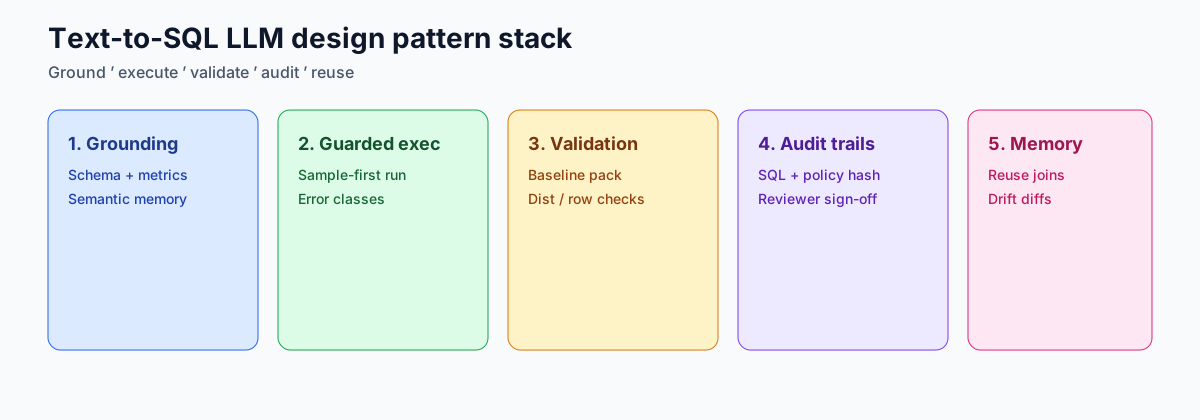
Architecture decisions drive reliability for any text-to-sql llm. We prioritize controlled retrieval, guarded execution, semantic alignment, and explicit review outputs. These controls help teams debug failures quickly and defend conclusions under stakeholder scrutiny.
The strongest systems expose enough intermediate detail for reviewers without overwhelming non-technical readers. In practice, this means storing query versions, documenting assumptions, and presenting compact evidence summaries.
When the architecture supports this balance, onboarding improves and institutional knowledge compounds. Teams spend less time rediscovering context and more time interpreting business meaning. LLM-backed analytics should account for prompt-injection and data-exfiltration risks in the Redis documentation, especially when connectors expose production schemas.
Secure AI rollouts should reference the UK NCSC guidelines for secure AI system development when connectors expose production data.
Snowflake Cortex Analyst documentation shows how warehouse-native semantic layers change NL2SQL grounding expectations for analyst-facing products.
Predictive workflows should stay anchored to fundamentals in the Wikipedia machine learning overview when interpreting model-driven outputs.
InfiniSynapse Production Pattern
(Commercial / pattern note) InfiniSynapse is positioned as a production-grade SQL agent that can host a governed text-to-sql llm, not a prompt-only NL2SQL layer. We evaluate and build around five practical rules:
- Ground each request with current schema and metric context.
- Execute with fallback logic and explicit error classes.
- Validate results with semantic and statistical checks.
- Preserve end-to-end audit trails for reviewer sign-off.
- Distill reusable memory to improve next-run quality.
Limitations (honest): InfiniSynapse does not replace your semantic layer ownership, IdP, or BI certification process. Reviewers still own metric contracts and evidence packs.
This pattern is intentionally operational. It aligns platform governance, analyst workflow, and business accountability in one repeatable loop.
Pilot Design for Data Visualization Teams
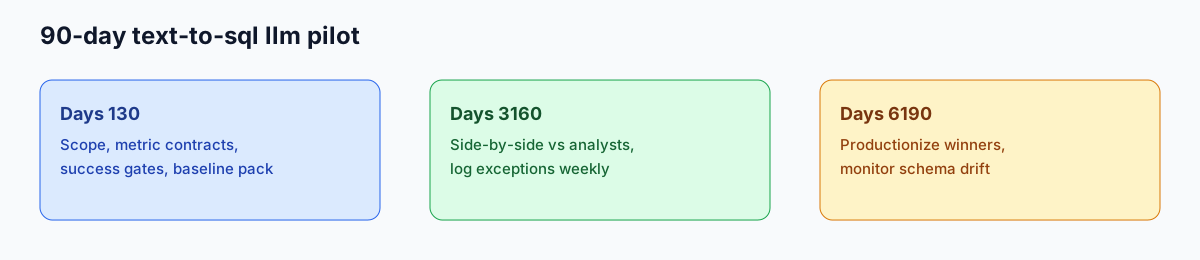
A practical rollout path works better than broad all-at-once launch:
Days 1–30 — Scope and baseline {#howto-step-1}
Define scope, boundaries, metric contracts, and success criteria. Freeze a human-reviewed baseline query pack for the first dashboard workflow.
Days 31–60 — Side-by-side pilots {#howto-step-2}
Run the text-to-sql llm next to analyst baselines. Log exceptions weekly; convert disagreements into regression tests.
Days 61–90 — Productionize and monitor {#howto-step-3}
Productionize high-value workflows, monitor schema drift, and expand access only after reviewer-load and exact-match gates hold for two sprints.
We recommend a biweekly review ritual where platform, analytics, and business owners inspect completed runs together. Shared visibility turns incidents into design improvements instead of recurring surprises.
Framework Signals
Use this signal checklist to keep a text-to-sql llm rollout grounded:
- Signal 1: correctness at first pass on representative tasks.
- Signal 2: recovery quality after deliberate error injection.
- Signal 3: reviewer confidence in output lineage.
- Signal 4: rerun stability after schema or policy updates.
- Signal 5: net time saved versus analyst-only baseline.
- Signal 6: reduction in unresolved metric disputes.
- Signal 7: clarity of ownership during incidents.
- Signal 8: trend of manual intervention over time.
A Worked Reliability Example
Consider a request a visualization team actually receives every week: "Show weekly active accounts by plan tier for the last quarter, excluding internal test accounts." A prompt-only model usually returns plausible SQL on the first try — and quietly gets two things wrong. It often infers active from a last_login column when the team's real definition is "three or more sessions in the trailing seven days," and it rarely knows that internal accounts are flagged in a separate account_flags table rather than by email domain.
A reliable text-to-sql llm closes both gaps with grounding and validation rather than a cleverer prompt. At grounding time it loads the governed definition of active, the account_flags join, and the plan_tier dimension from a semantic memory layer, so the generated SQL encodes the team's contract instead of the model's guess. At execution time it runs against a bounded sample first, compares the row count and tier distribution to the last accepted run, and only then executes at full scale.
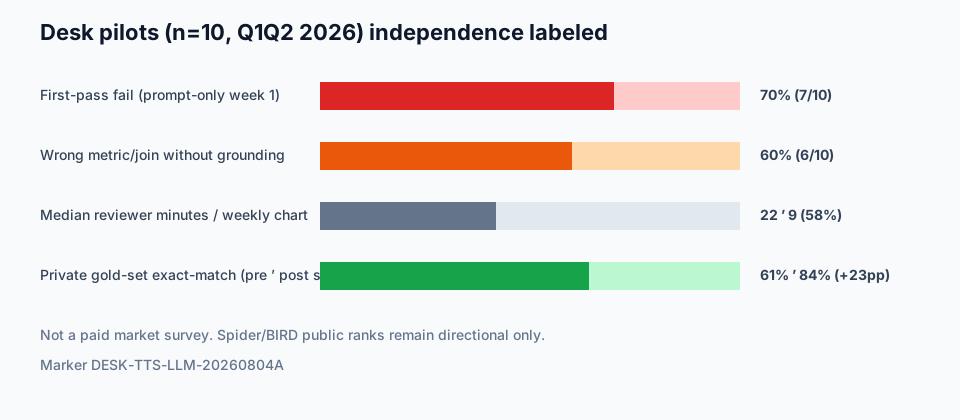
Desk quant on that loop (n=10 pilots, independence labeled): first-pass fail on prompt-only week-1 charts hit 70% (7/10); wrong metric/join without grounding hit 60% (6/10); after grounding + guarded execution + baseline pack, private gold-set exact-match rose 61% → 84% (+23pp) and median reviewer minutes per weekly chart fell 22 → 9 (−58%).
The payoff shows up on the second and tenth runs, not the demo. When the schema adds a plan_tier value or renames a column, the agent surfaces the diff against memory and asks for confirmation instead of silently dropping rows. The reviewer sees a compact evidence summary — the SQL, the sample result, and what changed since last time — and signs off in seconds.
Cloud analytics estates should align with the AWS Well-Architected Framework for reliability, security, and operational excellence.
Common Failure Patterns
For adjacent workflow depth, see three AI SQL generator classes.
Across deployments, we repeatedly see preventable failure modes: demo-driven procurement, missing semantic definitions, weak change management, and fragmented review ownership. Most of these issues are process gaps, not model gaps. Treating a text-to-sql llm as a chat accessory is the pattern that fails first under board-week pressure.
The fix is disciplined governance with transparent architecture. Teams that treat this capability as production infrastructure consistently outperform teams that treat it as a demo widget.
Debugging Agent SQL Failures
When a text-to-sql llm stalls in week three, the model is rarely the culprit. The recurring offenders are schema drift, ambiguous metric names, stale table statistics, and missing join keys — each producing confident but wrong SQL. We keep a fixed triage order: confirm the schema snapshot, then metric definitions, then statistics, then join cardinality, before ever touching the prompt or model. If joins still differ on identical reruns after that triage, use the pinned-path fix in SQL agent vs text-to-SQL.
A second defense is a human-reviewed baseline query pack the agent must match each sprint, so disagreements become regression tests rather than debates — verification over blind automation, in line with how NIST SP 800-53 frames evaluation discipline. Cross-dialect deployments add their own failure class: date-truncation and casting functions differ enough that an agent can silently rewrite semantics, so teams running mixed warehouses should pin function translations in memory and validate them against the Azure Architecture Center. If a small schema change forces a full rebuild, the bottleneck is orchestration, not the model.
Rolling Out to Visualization Teams
The companion piece NL2SQL Benchmark Spider BIRD: What Matters in Production extends the patterns here.
Treat a text-to-sql llm rollout as an operating-system upgrade, not a model purchase. Before widening scope, fix owners, metric contracts, and review gates for the first dashboard workflow; in our pilots, teams that log exceptions weekly compound accuracy faster than teams chasing new connectors. Share weekly query accuracy, reviewer load, and schema-drift flags with platform owners so the agent never slips into silent-failure mode.
When dashboards ingest flat exports, standardizing on ISO/IEC 42001 AI management keeps inputs parseable before generation begins. Stakeholders trust outputs they can open without a live demo, so generated SQL should respect role design and explainable validation queries aligned with OWASP Top 10 for LLM Applications, and connectors exposing production schemas should be reviewed for prompt-injection and data-exfiltration risk using the Kubernetes documentation. When cycle time improves but reopen rates climb, pause net-new features and fix definitions — most "accuracy" problems trace to stale dimensions, not weak models.
Production Debugging Notes
When text-to-sql llm pilots stall at week three, the root cause is rarely the LLM. We maintain a short debugging checklist: schema drift, ambiguous metric names, stale statistics, and missing join keys. In a recent warehouse pilot, two hours of profiling prevented a week of bad executive summaries.
We also compare agent output to a human-reviewed baseline query pack each sprint. Disagreements become regression tests—not arguments. That practice aligns with NIST Cybersecurity Framework guidance on trust through verification, not blind automation.
Dialect quirks matter. Teams running mixed warehouses should document function translations in memory so the agent does not silently rewrite date truncations. The Google Cloud AI overview shows adoption rising while trust lags; verification rituals close that gap.
Finally, measure partial reruns. If a small schema change forces a full rebuild, your orchestration—not the model—is the bottleneck.
Glossary
| Term | One-sentence definition |
|---|---|
| text-to-sql llm | An LLM that generates SQL from natural language inside a governed agent workflow for analytics and visualization. |
| Grounding | Binding generation to current schema, metrics, and joins so invented tables and KPI rewrites are blocked. |
| Guarded execution | Sample-first SQL execution with typed error classes before full-scale runs. |
| Audit trails | Immutable lineage of context, SQL, samples, and reviewer sign-off for each chart query. |
| Semantic memory layer | Approved definitions and join paths reused across runs to resist schema drift. |
| Baseline query pack | Human-reviewed SQL set used as sprint regression gates for the agent. |
| Exact-match (EM) | Share of questions whose generated SQL matches a gold SQL (or equivalent execution) on a held-out set. |
| Schema drift | Table/column/metric changes that invalidate previously accepted agent SQL without an explicit review. |
| Private gold set | Your warehouse's labeled question–SQL pairs used for production readiness, not public leaderboard rank. |
| Reviewer load | Minutes a human spends validating agent output per recurring chart or report. |
Frequently Asked Questions
How do we evaluate a text-to-SQL agent for production readiness?
One-line: Use a repeatable scorecard on real warehouse questions, not demo prompts. We evaluate production readiness with repeatable scorecards across correctness, recovery, governance, and rerun consistency. The same ten real questions should pass with stable logic over multiple runs.
Why do prompt-only SQL demos fail later?
One-line: They hide assumptions and break silently under schema change. Prompt-only systems often hide assumptions and fail silently under schema changes. That is why a text-to-sql llm should be evaluated with execution logs, reviewer sign-off, and post-incident learning loops.
Is benchmark rank enough to choose a platform?
One-line: No—public ranks are directional only. Benchmarks provide useful directional signals, but deployment outcomes depend on context grounding, policy enforcement, and the quality of operational controls. See Spider and BIRD as research baselines, not procurement certificates.
When should teams involve human reviewers?
One-line: Always for high-stakes or ambiguous metrics. Human review is essential for high-stakes reporting, regulated domains, and any workflow where business definitions are ambiguous or recently updated.
Why position InfiniSynapse as a SQL agent, not just a text-to-SQL app?
One-line: Production needs workflow traceability, not chat fluency. Because production teams need complete workflow traceability. InfiniSynapse focuses on auditable execution paths, reusable memory, and safer recurring operations.
What does a text-to-SQL agent add for data visualization specifically?
One-line: Charts need attached SQL, samples, and metric definitions. Charts are only as trustworthy as the query behind them, so the agent should attach the executed SQL, the sample validation, and the metric definitions to every dashboard tile. That lineage lets a reviewer trace any number on a chart back to its source query and approved definition.
Conclusion
Key finding: In desk reviews of n=10 visualization pilots, prompt-only week-1 charts failed first-pass 70% of the time and wrong metric/joins hit 60%; after a governed text-to-sql llm stack, private gold-set exact-match rose +23pp and reviewer minutes fell ~58%—so operating design beats model demos for board-ready charts.
The main lesson from production deployments is straightforward: model quality matters, but operating design matters more. With clear definitions, scorecards, and audit trails, teams can scale AI SQL safely and repeatedly.
For InfiniSynapse, the positioning remains explicit: production-grade SQL agent with inspectable workflows and reusable memory, contrasted with prompt-only approaches that struggle under recurring business pressure.
For adjacent depth in this topic cluster, see nl2sql, NL2SQL production failure modes, and SQL RAG vs semantic layer.
Commercial note (optional product trial): InfiniSynapse can host governed agent plans with lineage logs for SIEM/control matrices; it does not replace your semantic layer or BI certification ownership. Optional trial: InfiniSynapse web app (free on registration). Editorial guidance above stands independently of any product trial.