GPT Data Analyst Alternatives to ChatGPT
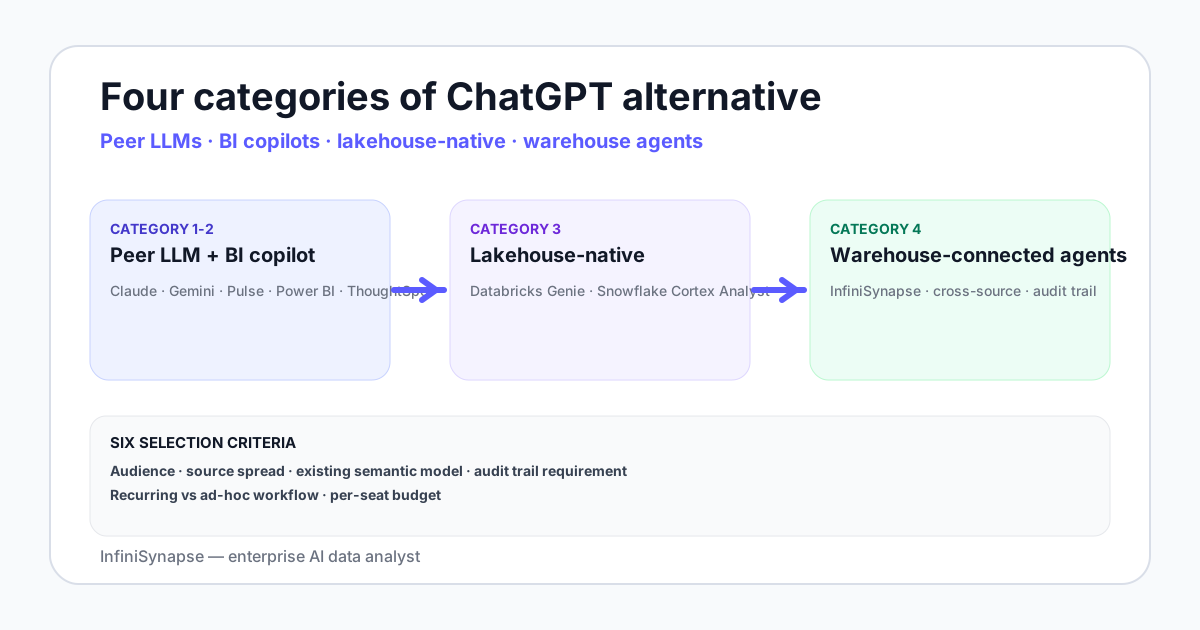
- Alternatives to ChatGPT for data analysis split into four categories: peer LLMs (Claude, Gemini) with similar single-file workflows, BI copilots (Tableau Pulse, Power BI Copilot, ThoughtSpot Spotter), lakehouse-native (Databricks Genie, Snowflake Cortex Analyst), and warehouse-connected data agents (InfiniSynapse and peers).
- Peer LLMs match ChatGPT shape with different model behavior — useful when single-file workflows continue but you want a different mix of capability or price.
- BI copilots cover non-technical audiences who already use a BI tool with a semantic model — Tableau, Power BI, ThoughtSpot — and want conversational access.
- Lakehouse-native is the right fit when your data lives in Databricks or Snowflake and you want governance to inherit the lakehouse posture.
- Warehouse-connected data agents add a deeper planner-executor-verifier loop and a bound knowledge base for cross-source ad-hoc analysis with an audit trail.
Where ChatGPT stops, and GPT data analyst alternatives start
ChatGPT is fast on a file you upload. GPT data analyst alternatives are the tools you open when that file has to stay current for more than one person. Five limits show up together:
- No live database. You export a CSV and analyze a snapshot.
- Nothing is saved as a dashboard. Close the tab and the chart is gone.
- No scheduled refresh. Daily data means a daily upload.
- No shared thread. A colleague cannot open the same result next week.
- Upload size. Large files hit the cap. The byte limits are on ChatGPT data analysis limits.
Those five are why the four categories below exist. They do not replace the cases where ChatGPT is still the right tool, listed further down.
Four GPT data analyst alternatives, by how they connect
| Category | Examples | Best fit | Live connection | Someone else can open it next week |
|---|---|---|---|---|
| Peer LLMs | Claude, Gemini, Llama-based assistants, Julius AI | Single-file analysis with different model behavior | File only | Chat thread |
| BI copilots | Tableau Pulse, Power BI Copilot, ThoughtSpot Spotter | Non-technical audiences on existing semantic models | Yes, inside the BI tool | Yes, the dashboard |
| Lakehouse-native | Databricks Genie, Snowflake Cortex Analyst | Data lives in one warehouse, governance posture matters | Yes, that platform | Yes, if the workspace is shared |
| Warehouse-connected data agents | InfiniSynapse and peers | Cross-source ad-hoc analysis with audit trail | Yes, across sources | Yes, with the evidence trail |
Which GPT data analyst alternative fits the source
Peer LLMs
Choose a peer LLM when you still want a single file and a different model. Claude — strong on long-form code reasoning. Gemini — tight integration with Google Sheets and BigQuery. Julius AI — consumer-friendly chart-driven UX (see Julius AI review). All three share ChatGPT's single-file ceiling, so the switch is about model behavior, not architecture.
BI copilots
Choose a BI copilot when a semantic model already exists. Tableau Pulse — fits Tableau-resident teams with a semantic model. Power BI Copilot — fits Microsoft-resident teams. ThoughtSpot Spotter — search-driven BI independent of Tableau or Power BI. See best AI data visualization tools for deeper coverage.
Lakehouse-native
Choose lakehouse-native when the data already sits in one platform. Databricks Genie — Databricks-resident teams (see Genie review). Snowflake Cortex Analyst — Snowflake-resident teams. Both inherit the lakehouse governance posture, which is their strongest fit signal.
Warehouse-connected data agents
InfiniSynapse — cross-source, planner-executor-verifier loop, bound knowledge base, evidence trail. The category-level read is at best agentic analytics for data-driven insights.
Where ChatGPT actually still wins
Three honest patterns where ChatGPT remains the right tool:
- Single-file one-off exploration. A vendor sent a CSV. ChatGPT is fast.
- Pre-analysis sketching. Test an idea on a sample before writing the production model.
- Personal learning. A new analyst learning SQL or pandas on toy data.
Not every analysis is a team workflow on a warehouse. The companion ChatGPT data analysis limits page walks the wall.
When to switch from ChatGPT
Three signals say it is time:
- You have re-explained the same business definitions across more than three ChatGPT sessions in a week.
- The CSV you upload now lives in a warehouse you could query directly.
- An auditor or finance reviewer asked how a number was produced and the chat log will not pass review.
Any one is enough; all three together is overdue.
A 10-minute selection rubric
- Who is the primary audience — engineer, analyst, business stakeholder, executive?
- Where does the data live — single warehouse, multiple sources, file uploads only?
- Does a semantic model already exist in a BI tool?
- Is an audit trail required for any answer that leaves your team?
- Is the workflow recurring (dashboard) or ad-hoc (agent)?
- What is the budget per seat per year?
"File uploads, no semantic model, personal use, no audit" → peer LLM. "BI-resident, semantic model exists, non-technical audience" → BI copilot. "Single-warehouse, governance matters, technical audience" → lakehouse-native. "Cross-source, audit-grade, ad-hoc" → warehouse-connected agent.
Compare a warehouse-connected alternative on your data
Connect a Postgres, MySQL, Snowflake, or Supabase warehouse read-only. Seed a small business glossary. Ask one question that does not fit a CSV upload — the cross-source kind ChatGPT cannot reach — and read the plan, SQL, and verification step before deciding.
Try InfiniSynapse onlineFAQ
Methodology and review notes
Last updated: 2026-09-24 · Next scheduled review: 2026-12-24
This buyer guide synthesizes vendor documentation for ChatGPT Advanced Data Analysis, Claude, Gemini, Julius AI, Tableau Pulse, Power BI Copilot, ThoughtSpot Spotter, Databricks Genie, Snowflake Cortex Analyst, and InfiniSynapse; hands-on testing of each category in 2026; field experience with teams that picked one or more alternatives; and public benchmark studies. Reads aim for fair tradeoff descriptions rather than promotional language.
Conflict of interest: InfiniSynapse publishes this guide and sells an enterprise AI data analyst. To reduce bias, the page leads with the topic itself, treats InfiniSynapse as one option among many, and links to external sources for every numeric claim.
Update cadence: Reviewed every 90 days for accuracy and link health.
Sources and references
- [Vendor] OpenAI. ChatGPT Advanced Data Analysis help center. help.openai.com.
- [Vendor] Anthropic. Claude product reference. anthropic.com/claude.
- [Vendor] Google. Gemini for Workspace reference. workspace.google.com/solutions/ai.
- [Vendor] Databricks. AI/BI Genie documentation. docs.databricks.com/genie.
- [Vendor] Snowflake. Cortex Analyst documentation. docs.snowflake.com/cortex-analyst.
- [Independent] Yao et al. ReAct: Synergizing Reasoning and Acting in Language Models. arxiv.org/abs/2210.03629.
- [Vendor] Anthropic. Building Effective Agents. anthropic.com/research/building-effective-agents.
- [Standard] NIST. AI Risk Management Framework. nist.gov/itl/ai-risk-management-framework.
- [Independent] BIRD-SQL benchmark. bird-bench.github.io.