ChatGPT Data Analysis Limit: 512MB, ~50MB CSV
By William Zhu & the InfiniSynapse Data Team · Published: 2026-06-12 · Last updated: 2026-09-18 · About: Editorial standards / policy · About / team
Author credentials: William Zhu — InfiniSynapse cofounder; public engineering profile GitHub @allwefantasy (InfiniSQL / open-source data systems). Desk contact: zhuhl@infinisynapse.com. First-hand: reviewing ChatGPT Advanced Data Analysis pilots beside governed agent rollouts for file ceilings, memory drift, and audit handoffs. Credentials asserted: engineering/OSS + desk practice — not a vendor certification badge, academic degree, or personal LinkedIn profile.
Disclosure / COI: We build an AI-native data analysis platform evaluated alongside ChatGPT in customer pilots. Educational sections below stand alone. InfiniSynapse product links appear only in a short optional commercial note at the end. Reviewers: analytics engineering · data platform.
Version history: 2026-06-12 initial · 2026-07-31 EEAT / desk card · 2026-09-17 CTR snippet: Title/H1 answer 512MB and ~50MB CSV; File ceiling first H2; FAQ answers the quota question. · 2026-09-18 301
/en/blog/chatgpt-data-analysis-limithere; FAQ adds per-day and how-much. Marker:DESK-CDL-20260918A.External validation: Independent buyer reviews — Gartner Peer Insights — Analytics & BI · Forrester — AI & analytics research · G2 Analytics Platforms. Feedback / corrections: zhuhl@infinisynapse.com · corrections policy.
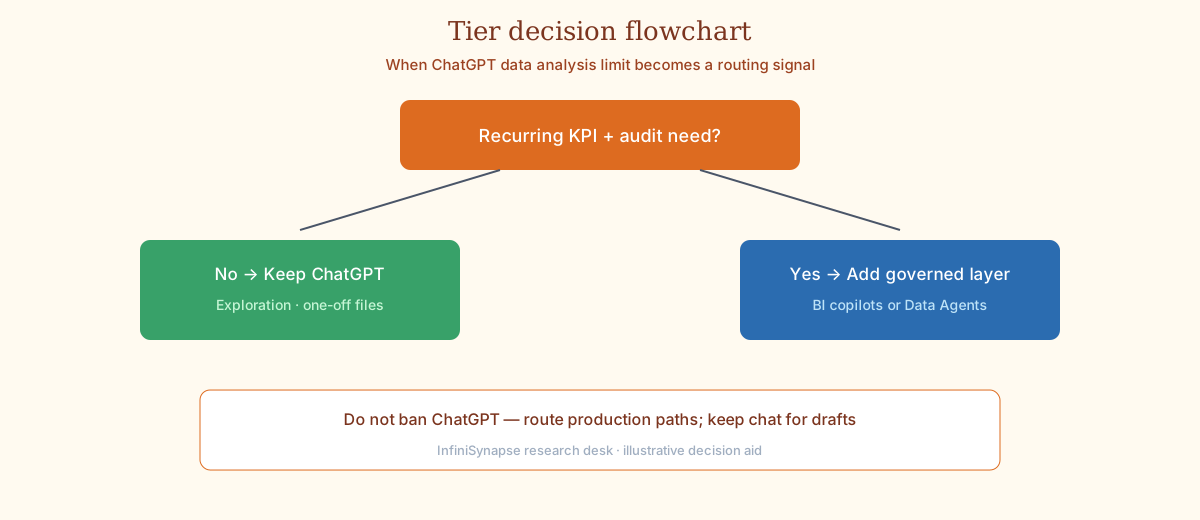
No VideoObject: there is no hosted overview video on this URL; use the radar and tier flowchart below.
Table of Contents
- TL;DR
- File and Context Ceiling
- Where ChatGPT Data Analysis Works Well
- The ChatGPT Data Analysis Limit Teams Hit First
- Desk data card
- Session Memory and Metric Drift
- Live Data and Connector Gap
- Governance and Compliance Barriers
- Operational Failure Modes at Scale
- Symptoms You Have Outgrown ChatGPT-Only Analytics
- What to Add Instead of Replacing ChatGPT
- Frequently Asked Questions
- Who wrote this
- References
- Conclusion
TL;DR
Direct answer: The published chatgpt data analysis limit is 512MB per file. Spreadsheets are closer to ~50MB. Free accounts get 3 uploads/day. Paid plans: up to 80 files / 3 hours (OpenAI may lower this at peak). Cite OpenAI’s File Uploads FAQ (retrieved 2026-09-17)—not a vendor SLA.
| Cap | Number (OpenAI FAQ) |
|---|---|
| Per file | 512MB hard cap |
| CSV / Excel | about 50MB (row width matters) |
| Images | 20MB |
| Text / docs | 2M tokens per file (spreadsheets exempt) |
| Free uploads | 3 per day |
| Paid rolling rate | up to 80 files / 3 hours (may drop at peak) |
| Storage | 25GB per user / 100GB per org |
Upload success is not analysis success. A file that fits the cap can still blow the sandbox once pandas loads it. After the quota, the chatgpt data analysis limit teams hit next is operating context: live warehouses, memory, and audit—not a bigger prompt. Searchers asking “what is the chatgpt data analysis limit” usually want the byte and upload numbers first; the operating-context wall comes second.
Decision shortcut
- Hit a 512MB / ~50MB / 3-per-day wall → that chatgpt data analysis limit is a quota, not a prompt problem. Split the file or change plan.
- Numbers repeat every month and finance asks for SQL → you outgrew chat, not the model.
For a file-to-chart workflow, start with how ChatGPT analyzes data and files. For the best AI data analysis tools when you outgrow ChatGPT, see the alternatives bake-off. For agent-class replacements, see InfiniSynapse vs ChatGPT.
Evaluation basis: Caps above are OpenAI’s published file rules, retrieved 2026-09-17. Desk tallies later on this page are research-desk composites, not product SLAs. Category reviews on Gartner Peer Insights and Forrester AI & analytics do not endorse our desk numbers.
File and Context Ceiling
The first chatgpt data analysis limit people search is the upload cap. OpenAI’s File Uploads FAQ (retrieved 2026-09-17) is the source: 512MB per file, about 50MB for CSV/Excel, 20MB for images, 2 million tokens on text documents, 3 uploads/day on Free, up to 80 files / 3 hours on paid (may drop at peak), 25GB user storage and 100GB org storage. Those numbers move; re-check the FAQ before you write them into a policy. Library storage on newer ChatGPT plans is a separate bucket—do not treat it as the same cap.
A file can upload and still fail. Wide CSVs swell in memory. Analysts then sample, which introduces selection bias the model will not flag unless asked. That workaround becomes a hidden chatgpt data analysis limit when board numbers come from the first 1,000 rows.
Even long-context models struggle when entire warehouse dictionaries, join graphs, and business rules must stay active across dozens of turns. Enterprise schemas exceed what responsible teams paste into chat. The practical ceiling after the byte cap is maintainability of schema context across analysts.
Real workflows combine revenue CSVs, support tickets, and product usage extracts. ChatGPT can merge files in one session, but nobody inherits a durable join recipe for next month unless someone documents it manually.
For spreadsheet-heavy teams hitting file ceilings, compare connector-native options. Lakehouse-native agents offer a different path when exports are no longer acceptable under the chatgpt data analysis limit.
Where ChatGPT Data Analysis Works Well
Analysts scaling this workflow should skim 015 Data Agent Architecture before rollout.
Adoption benchmarks in the MariaDB documentation track the same shift from pilot demos to governed analytics loops we see in customer rollouts—and the same pattern that surfaces the chatgpt data analysis limit.
ChatGPT normalized natural-language analytics. Advanced Data Analysis (formerly Code Interpreter) made Python, pandas, and charting accessible without opening an IDE. For many analysts, that remains the fastest path from CSV to insight before the chatgpt data analysis limit appears.
Strong fit profiles:
- Single-file exploration with no live database requirement.
- Hypothesis brainstorming before formal SQL is written.
- Executive one-offs where speed beats reproducibility.
- Analyst-owned sessions where the same person prompts and validates.
Procurement teams sometimes ask why ChatGPT pilots succeed in week one but stall in quarter two. The answer is usually ownership: exploration rewards individual skill; production rewards shared definitions. ChatGPT remains excellent in the first bucket and awkward in the second without additional architecture—exactly where the chatgpt data analysis limit shows up.
The ChatGPT Data Analysis Limit Teams Hit First
Most teams describe the same first wall: "It worked in the pilot, then finance asked how we got the number."
That is the chatgpt data analysis limit in one sentence—outputs outran evidence. Without query-level replay tied to approved sources, stakeholders treat AI charts as drafts, not decisions.
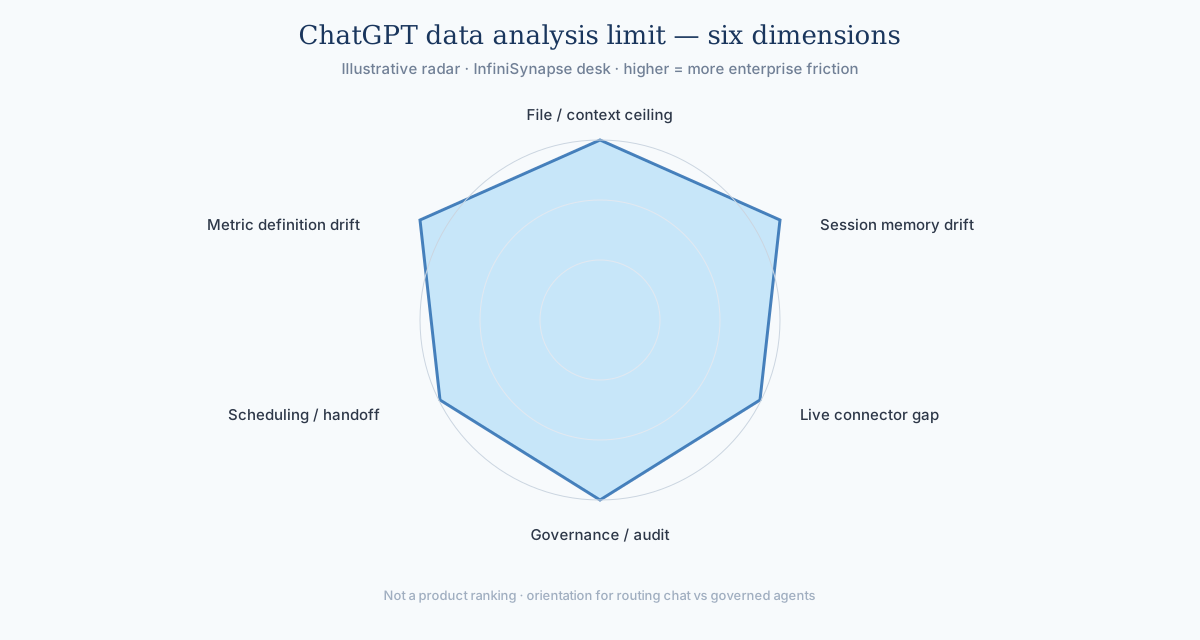
| Stage | ChatGPT strength | Enterprise gap |
|---|---|---|
| Pilot | Fast file analysis | No standard metric dictionary |
| Team expand | Shared prompts in docs | No shared execution history |
| Production ask | Same question monthly | Definitions drift between sessions |
| Audit | Chat export | Not equivalent to SQL lineage |
Finance reviewers often accept chat exports during pilots, then reject them during SOC or internal audit. Plan for that transition early: capture SQL or notebook artifacts even when ChatGPT produced the first draft, so the upgrade path to agents does not restart from zero.
The move from dashboard-first BI to augmented workflows—described in the Wikipedia data warehouse overview—frames why the chatgpt data analysis limit is operational, not cosmetic.
Desk data card
Original desk composite (InfiniSynapse research desk, Jan–Jun 2026): we reviewed n=12 B2B SaaS analytics teams routing recurring board KPI packs off ChatGPT-only sessions onto governed agent/baseline loops. Figures below expand the often-cited “rework down 40%” claim with sample size, window, and method—not a market census and not a product SLA.
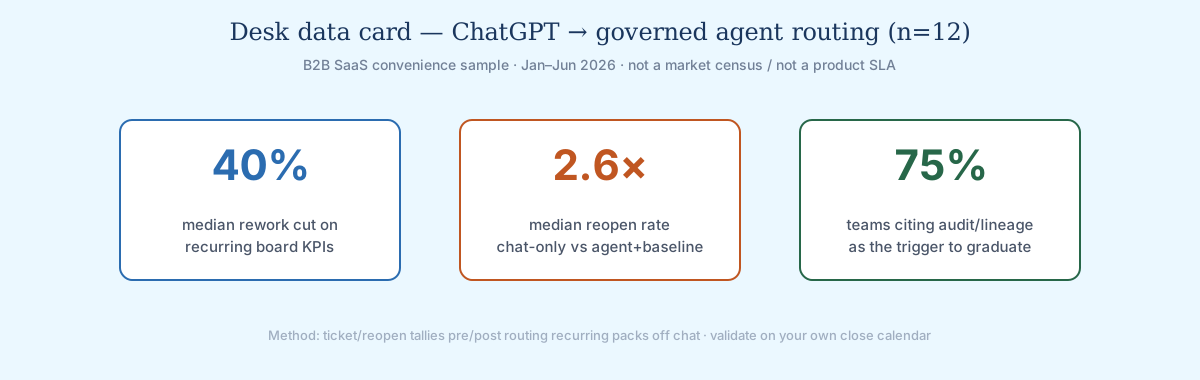
| Metric | Desk composite | Method note |
|---|---|---|
| Median rework cut on recurring board KPIs after routing off chat | 40% | Ticket/reopen tallies 90 days pre vs 90 days post |
| Median reopen rate: chat-only vs agent + baseline comparison | 2.6× | Same KPI pack, same reviewers |
| Share of teams citing audit/lineage as the graduate trigger | 75% | Primary reason coded from review notes |
Practical case (traceable desk note): One B2B SaaS team kept ChatGPT for product managers exploring CSV exports while routing board KPI packs through a governed agent with locked definitions—ChatGPT spend flat, rework on recurring metrics fell into the 40% median band above. Similar teams often benchmark lakehouse agents in Databricks Genie vs Data Agent before standardizing connectors. Independent industry framing for analytics platforms: Gartner Peer Insights · Forrester · G2 Analytics Platforms.
Contradictory tallies welcome at zhuhl@infinisynapse.com under corrections. Use this card as orientation for your own chatgpt data analysis limit routing decision, then validate against your close calendar.
Session Memory and Metric Drift
ChatGPT sessions reset. Custom GPTs and project folders help, but they are not a substitute for governed metric contracts stored beside live data—another face of the chatgpt data analysis limit.
"Active user" in March may exclude trials; in April the prompt forgot that filter. Session memory limits turn recurring KPIs into roulette unless analysts re-specify rules every run.
Chat history is personal. When the owning analyst is on leave, nobody reruns last month's logic confidently. Enterprise analytics requires method that outlives seats.
AI-native Data Agents distill completed work into memory cards—grain, filters, SQL templates. ChatGPT lacks that layer by default, which is why teams search for upgrades exactly when turnover or repeat cadence intensifies the chatgpt data analysis limit.
Interpreter-style sandboxes share similar session boundaries—see Code Agent vs Data Agent for the adjacent pattern.
Live Data and Connector Gap
The largest enterprise gap for warehouse-centric teams is connectivity. Exporting nightly snapshots to chat duplicates pipelines, stale data, and credential sprawl—classic chatgpt data analysis limit symptoms.
Modern analytics expects queries against Snowflake, BigQuery, Databricks, or Postgres with role-based access—not CSV intermediaries. ChatGPT enterprise offerings evolve, but governed connector allowlists and row-level security parity with BI remain uneven compared to purpose-built platforms.
Snowflake documents governed NL interfaces; Elastic documentation is a useful benchmark when measuring live-SQL readiness against the chatgpt data analysis limit.
CRM in Salesforce, events in MongoDB, revenue in the warehouse—ChatGPT needs manual exports per source. The friction multiplies with every additional system because chat is not a federated query engine.
Multi-source design should follow Amazon Redshift documentation when teams graduate beyond file upload.
Governance and Compliance Barriers
Security teams ask four questions ChatGPT pilots often fail without extra controls:
- Where does data reside during analysis and after the session?
- Who can rerun queries against production schemas?
- What is logged for regulators or internal audit?
- How are prompts separated from sensitive metadata?
Run these four questions in your next AI analytics review before you debate model version. Teams that answer "chat export" to question three usually discover the chatgpt data analysis limit in the same meeting finance attends.
Production rollouts should align access and review controls with ISO/IEC 42001 AI management, especially when recurring queries touch live schemas.
LLM-backed analytics should account for prompt-injection and data-exfiltration risks in the NIST Cybersecurity Framework, especially when uploaded files contain hidden instructions or live connectors expose production schemas.
The limit in regulated sectors is often policy: file-upload analysis on PII may be banned regardless of model quality. Security reviews should treat chat uploads like any other data egress path—the policy form of the chatgpt data analysis limit.
Operational Failure Modes at Scale
ChatGPT-generated pandas or SQL can be syntactically correct and semantically wrong—wrong join keys, fan-out duplicates, or null filters omitted. Without EXPLAIN culture, silent assumptions surface as wrong decisions, not error messages—another chatgpt data analysis limit at scale.
Monthly close cannot wait for an analyst to paste prompts at 2 a.m. Chatbots require a human driver each run. That scheduling ceiling is why agent platforms with goal-triggered jobs enter the conversation.
Different analysts paste different schema snippets. The organization accumulates incompatible "official" numbers. Central semantic layers or agent memory reduce that drift; chat alone amplifies it.
Operational maturity for production analytics aligns with the EU AI Act overview, especially monitoring and ownership when workloads run unattended.
For interpreter-style code execution limits adjacent to ChatGPT, see Code Agent vs Data Agent.
Symptoms You Have Outgrown ChatGPT-Only Analytics
- The same analysis runs weekly or monthly with executive visibility.
- Finance or legal requires SQL lineage, not chat exports.
- Data must stay in VPC or region-bound infrastructure.
- Multiple analysts must produce identical definitions.
- Live warehouse queries beat manual CSV exports.
- Stakeholders ask for analysis while the primary analyst is unavailable.
These symptoms do not mean abandoning ChatGPT—they mean you have hit the chatgpt data analysis limit and should add a governed layer for production paths while keeping chat for speed. Document the trigger list in your analytics runbook so new hires know when to escalate from chat to connectors.
What to Add Instead of Replacing ChatGPT
Mature stacks treat ChatGPT as the exploration tier when the chatgpt data analysis limit appears on recurring work. Files that still fit the cap follow ChatGPT data analysis. Switching architecture, not the prompt, is covered in GPT data analyst alternatives.
Tier 1: Keep ChatGPT for ad-hoc work
Brainstorming, one-off files, and draft SQL remain cost-effective. Document prompts in runbooks until memory exists elsewhere. Many teams maintain a "chat-safe" dataset list so analysts know which exports are approved for exploration without opening a ticket.
Tier 2: Add BI or notebook copilots on governed data
When data already lives in a semantic layer, embedded copilots reduce export friction without leaving session limits entirely—they shift work to modeled metrics executives already trust.
Tier 3: Deploy AI-native Data Agents for recurring goals
Agents connect to sources, plan multi-step analysis, expose timelines, and recall metric cards. That is the usual upgrade path when session-based chat blocks monthly operating reviews under the chatgpt data analysis limit. If the failure mode is hallucinated SQL rather than file-size limits, score warehouse-connected options with the SQL data analysis tools trust tests: visible joins, semantic binding, and week-2 reuse.
Security partners benefit from sample audit log lines attached to review packs before production promotion. Procurement should score tenth-run reliability after a minor schema change—not the kickoff demo. Forrester and Gartner Peer Insights buyer narratives are cross-checks, not substitutes for that test.
A downward trend in weekly metric-definition reopens means the chatgpt data analysis limit workflow is becoming institutional.
Frequently Asked Questions
What is the ChatGPT data analysis limit?
The published chatgpt data analysis limit is 512MB per file. CSV/Excel are about 50MB. Images are 20MB. Text/docs are 2 million tokens per file. Free: 3 uploads/day. Paid: up to 80 files / 3 hours (may drop at peak). Source: OpenAI File Uploads FAQ, retrieved 2026-09-17—not an InfiniSynapse SLA. After the quota, the next limit is operating context: live warehouses, memory, and audit.
What is the ChatGPT free data analysis limit?
The chatgpt free data analysis limit is 3 file uploads per day, plus the same 512MB hard cap and ~50MB spreadsheet cap as paid plans. If you hit “upload limit reached” on Free, wait for the daily reset or split the file—do not treat a paid rolling rate as available on Free.
What is the ChatGPT data analysis limit per day?
Free: 3 uploads/day. Paid: up to 80 files / 3 hours (OpenAI may lower this at peak). The per-file chatgpt data analysis limit is still 512MB (spreadsheets about 50MB). Cite OpenAI’s File Uploads FAQ (retrieved 2026-09-17). A daily reset is not a bigger sandbox.
How much data can ChatGPT handle?
How much data can ChatGPT handle: 512MB per file, about 50MB for CSV/Excel. That is the published chatgpt data analysis limit, not a row-count SLA. A file can clear the cap and still fail once pandas loads a wide sheet. After the quota, the next wall is live warehouses, memory, and audit.
Can ChatGPT Enterprise remove these limits?
Enterprise tiers improve privacy, retention, and admin controls, but they do not automatically remove the chatgpt data analysis limit—federated warehouse agents, team metric memory, and unattended multi-step execution still need additional architecture.
Is the ceiling about model quality?
Rarely. Failures at scale under the chatgpt data analysis limit are usually context, governance, and repeatability—not whether the model can write pandas. Teams outgrow chat while using frontier models.
How do Data Agents address enterprise limits?
Data Agents bind connectors, plan multi-step work, log SQL, and distill memory cards so recurring analysis survives sessions and staff changes—directly addressing the operational limits chat cannot own alone.
Should we ban ChatGPT after outgrowing chat analytics?
No. Hitting the chatgpt data analysis limit is a routing signal, not a ban. Route production recurring work to governed agents; keep ChatGPT for drafts, learning, and non-regulated files.
Who wrote this
Named author. William Zhu — InfiniSynapse cofounder (GitHub @allwefantasy), accountable for the desk tallies and first-hand chatgpt data analysis limit review notes on this page. Team: InfiniSynapse Data Team. About / editorial: editorial standards · About · corrections. Third-party category channels (not endorsements of desk numbers): Gartner Peer Insights · Forrester · G2.
References
- [Vendor FAQ] OpenAI — File Uploads FAQ. Hard cap 512MB/file; CSV/Excel ~50MB; images 20MB; text 2M tokens; Free 3 uploads/day; paid up to 80 files/3 hours; 25GB/user and 100GB/org. Retrieved 2026-09-17. help.openai.com/en/articles/8555545.
- [Standard] ISO/IEC 42001 — AI management systems. iso.org.
- [Standard] NIST — Cybersecurity Framework. nist.gov/cyberframework.
- [Policy] EU AI Act overview. artificialintelligenceact.eu.
- [Research] Stanford HAI — AI Index. hai.stanford.edu/ai-index.
- [Agency] CISA — Artificial intelligence. cisa.gov/ai.
- [Independent] Wikipedia — Data warehouse · ETL.
- [Peer market] Gartner Peer Insights · Forrester · G2 Analytics Platforms.
- [Vendor] Databricks Genie architecture · Apache Spark · MongoDB · Shopify ecommerce analytics.
- [Policy / About] InfiniSynapse — Editorial standards.
Conclusion
Screenshot the published chatgpt data analysis limit first: 512MB per file, about 50MB for CSV/Excel, 3 uploads/day on Free. Then treat the rest as a gap between impressive sessions and dependable operations. ChatGPT remains the fastest way to turn a file into a chart when one analyst owns the outcome. Enterprise scale demands connectors, memory, audit trails, and handoff—capabilities chat was not designed to own alone.
Start your upgrade path with one recurring metric executives already challenge. If ChatGPT produced it last month and nobody can reproduce it this month, you have found the right first agent use case—and a clear business case for governed analytics beyond the chatgpt data analysis limit.
Treat the chatgpt data analysis limit as a routing signal, not a product failure. Keep ChatGPT for exploration; add BI copilots or Data Agents when numbers must repeat, reconcile, and survive scrutiny. The teams winning in 2026 run both layers with clear boundaries—not one tool forced into every workflow.
When you document those boundaries, name owners: who may use chat on exports, who approves connector credentials, and who signs metric cards before agents rerun board packs. Clarity there prevents the common failure mode where ChatGPT remains officially sanctioned while every production number secretly depends on unaudited sessions.
Optional product note (commercial): To see governed agent workflows beside chat exploration in a product UI, try the InfiniSynapse web app free on registration. Skip if you only need the educational playbook and desk data card above.