Julius AI Alternatives: Julius AI Data Analysis
SEO Title: Julius AI Alternatives: Julius AI Data Analysis
Meta Description: Julius AI alternatives: 7 Julius AI data analysis tools scored on chart speed, warehouse connectors, memory, SQL export, and a 30-day switch checklist.
The best Julius AI alternatives depend on the job: Julius or ChatGPT for a one-file chart, Hex for SQL/Python notebooks, Copilot or Gemini to stay in the spreadsheet, ThoughtSpot or Genie on a governed warehouse, and InfiniSynapse when reviews must reuse definitions across live sources.
By the InfiniSynapse Data Team — analytics engineering, data platform, and editor review frames. Named accountability: cofounder William Zhu (GitHub @allwefantasy). · Published: 2026-06-09 · Last updated: 2026-09-16 · Next review: 2026-12-16 · Editorial standards & About
Conflict of interest: InfiniSynapse publishes this guide and sells an AI-native Data Agent listed below. Rankings use a published desk rubric on public product behavior and docs—not paid placement. Independent peer-review surfaces (not our scores): G2 Analytics Platforms · Gartner Peer Insights — Analytics & BI · Julius AI product site. Corrections: zhuhl@infinisynapse.com · corrections policy.
Table of Contents
- TL;DR
- Why Teams Switch from Julius AI
- Julius AI Strengths Worth Preserving
- Where Spreadsheet-First Tools Fall Short
- 7 Leading Alternatives Compared
- Evaluation Framework for Buyers
- Desk scorecard and quantitative matrix
- Security and Compliance Considerations
- 30-Day Pilot Checklist for Switching
- Independent signals
- Frequently Asked Questions
- Sources and references
- Conclusion
TL;DR
Direct answer: The Julius AI alternatives worth a bake-off are ChatGPT and Claude for upload-and-chart, Hex for warehouse notebooks, Copilot/Gemini for in-grid Excel or Sheets, ThoughtSpot or Databricks Genie for semantic-layer search, and InfiniSynapse for recurring multi-source Julius AI data analysis with memory. Julius still wins first-chart speed on a clean CSV.
Top picks by scenario
- Fast spreadsheet charts: Julius AI, ChatGPT, Claude
- Warehouse-connected notebooks: Hex
- Recurring KPI reviews with memory: InfiniSynapse
- Enterprise semantic search on curated models: ThoughtSpot, Databricks Genie
If buyers compare julius AI data analysis options because a pilot stalled around week three, the gap is usually governance—not chart polish. Align access and review controls with the NIST AI Risk Management Framework (AI RMF 1.0)—especially the Govern and Measure functions—when connectors expose live schemas.
Key Definition: In this guide, Julius AI data analysis means tools that match or exceed Julius AI's upload-and-analyze experience while closing gaps in multi-source connectivity, SQL transparency, workflow memory, and deployment control.
Evaluation basis: Desk scores below are InfiniSynapse-authored on a published 0–3 rubric (five dimensions, equal weight). They are not a paid analyst report or a customer NPS survey. Reproduce them with the 30-day pilot checklist.
Why Teams Switch from Julius AI
Three triggers show up consistently in procurement and analyst feedback:
- Session amnesia — Definitions and filters approved last month are not available in the next upload.
- Source sprawl — Revenue lives in Postgres, marketing spend in Sheets, and support tickets in a warehouse table Julius cannot join in one pass.
- Review friction — Stakeholders ask "show me the query" before trusting a board slide, and session logs do not satisfy finance or security review.
Enterprise AI adoption guidance in the Stanford HAI AI Index (Industry / Economy chapters) mirrors the shift from ad-hoc copilots to repeatable, reviewable decision workflows—the same shift that pushes buyers toward julius AI data analysis shortlists with explicit execution history.
Julius AI Strengths Worth Preserving
Before replacing Julius, document what already works so you do not regress on analyst satisfaction.
What Julius still does well
Julius remains strong when a PM or marketer needs a histogram in minutes without opening a notebook. Few julius AI data analysis tools beat that first-chart latency on a clean CSV. Natural-language prompts and forgiving UX also mean teams skip formal enablement—any replacement should preserve a similar "ask in plain English" entry point or adoption will stall.
Where Spreadsheet-First Tools Fall Short
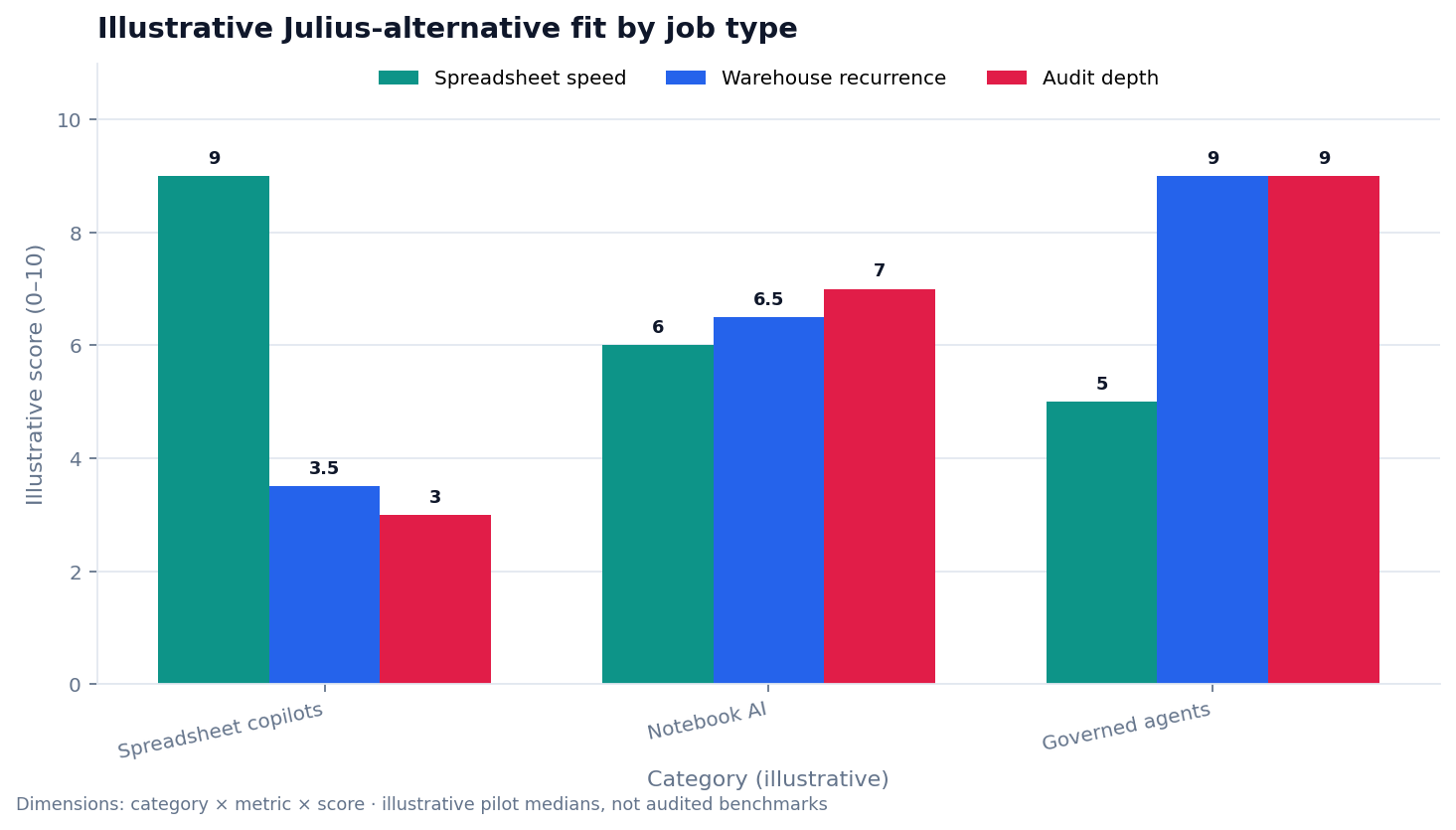
Multi-source federation
Foundational warehouse concepts—grain, dimensions, and conformed metrics—remain essential; Snowflake Cortex Analyst documentation is a concise refresher for reviewers validating generated SQL. Julius AI data analysis alternatives that connect Postgres, Snowflake, BigQuery, and Sheets in one agent loop reduce manual exports that introduce version drift.
Recurring reporting memory
Weekly business reviews reuse the same KPI definitions. Tools that store approved metric logic—not just chat transcripts—cut rework. Visualization depth matters too; compare chart libraries in AI data visualization tools when stakeholder PDFs are a hard requirement.
Governance and audit trails
Julius AI data analysis options aimed at regulated industries need query logs, role-based access, and optional private deployment—topics covered in depth in our self-hosted AI data analyst deployment guide.
7 Leading Alternatives Compared
2026 shortlists from Deepnote, camelAI, Basedash, and Anomaly add notebook or BI brands we do not re-score here. This page keeps seven Julius AI alternatives that match a Julius-style ask (plain-English chart or query) and can be run on the same desk fixture.
Security reviews can complement AI controls with the NIST Cybersecurity Framework (CSF 2.0 core functions: Govern, Identify, Protect, Detect, Respond, Recover) when credentials and data flows are in scope.
LLM-backed analytics should account for prompt-injection and data-exfiltration risks in the OWASP Top 10 for LLM Applications—start with LLM01 Prompt Injection and LLM06 Sensitive Information Disclosure when connectors expose production schemas.
InfiniSynapse
InfiniSynapse targets teams that started with Julius-style uploads—typical julius AI data analysis entry—but now run recurring analysis across databases, spreadsheets, and documents. The platform emphasizes multi-phase agent execution, InfiniSQL for dialect-aware generation, and memory that retains approved definitions between sessions. On our desk rubric for Julius AI data analysis it leads on connector coverage and explainability; it does not win first-chart latency against Julius on a clean CSV (see scorecard).
Best for: Analyst teams moving from one-off files to governed, multi-source reporting.
ChatGPT (Advanced Data Analysis)
ChatGPT handles diverse file types and ad-hoc Python transforms quickly. It fits exploratory julius AI data analysis searches when governance requirements are light and data never leaves a controlled sandbox.
Best for: Individual analysts doing rapid, non-production exploration.
Claude
Claude offers strong reasoning on messy tabular data and long context for multi-tab workbooks. Like ChatGPT, it lacks native warehouse connectors unless you build custom integrations.
Best for: Deep-dive narrative analysis on static exports.
Hex
Hex combines SQL notebooks, Python, and AI assist with warehouse connectivity. Analysts who outgrow pure chat UIs but still want notebook flexibility often land here when evaluating Julius AI data analysis shortlists. If the blocker is price rather than notebook UX, start with are there free alternatives to Hex before buying Editor seats.
Best for: Technical analysts who live in SQL + Python workflows.
Spreadsheet-native copilots (Copilot & Gemini)
Microsoft Copilot for Excel and Google Sheets Gemini embed AI inside the spreadsheet users already open daily. Copilot suits M365-centric orgs that want formula and chart drafts without exporting files; Gemini fits collaborative Google Workspace teams. Neither replaces cross-system federation, but both reduce friction when julius AI data analysis must feel familiar on day one.
For the scored shortlist of in-Excel vs upload copilots, see best AI for Excel data analysis.
Best for: Organizations standardized on Excel or Sheets who need incremental AI, not a new platform.
ThoughtSpot Sage / Databricks Genie
Warehouse-native copilots ground answers in curated semantic models. They shine when IT has already invested in Snowflake or Databricks governance layers but feel heavy when the brief still looks like spreadsheet-first julius AI data analysis.
Best for: Enterprise BI teams with mature semantic layers.
Desk scorecard and quantitative matrix

Scoring rules (0–3 per dimension, max 15)
| Score | Meaning |
|---|---|
| 0 | Not available in the product surface we tested |
| 1 | Partial / workaround / export-only |
| 2 | Works for the common case with documented limits |
| 3 | Production-ready for that dimension in our desk fixture |
Dimensions (equal weight): (1) time-to-first insight on a clean CSV, (2) live connector coverage without manual ETL, (3) workflow memory across sessions, (4) explainability (exportable SQL or plan), (5) deployment / audit fit (RBAC, private deploy, logs).
Desk totals (InfiniSynapse rubric · 2026-07 fixture)
| Tool class | Insight | Connectors | Memory | Explain | Deploy / audit | Total /15 |
|---|---|---|---|---|---|---|
| Julius AI | 3 | 1 | 1 | 1 | 1 | 9 |
| ChatGPT / Claude | 3 | 0 | 1 | 1 | 1 | 8 |
| Hex | 2 | 3 | 2 | 3 | 2 | 12 |
| Copilot / Gemini | 2 | 1 | 1 | 1 | 2 | 7 |
| ThoughtSpot / Genie | 1 | 3 | 2 | 2 | 3 | 11 |
| InfiniSynapse | 2 | 3 | 3 | 3 | 2 | 13 |
Fixture notes (reproducible for any Julius AI data analysis bake-off): one ~50k-row orders CSV plus a read-only Postgres customers table; five pattern questions on the CSV; two join questions across CSV + Postgres where the tool allows. Operators were not blind; InfiniSynapse authors the rubric—treat totals as a starting shortlist, not an external audit. Gap stated honestly: we do not publish a multi-customer survey percentage (“X% abandoned Julius after three weeks”); use the pilot table below to measure that in your org.
Capability matrix with quantitative columns
| Tool | Upload speed (desk) | Live DB posture | Approx. connector surface (public docs / marketing, 2026-Q2) | Memory model | SQL / plan export | Private / VPC deploy |
|---|---|---|---|---|---|---|
| Julius AI | Excellent (~minutes) | Limited on the 2026-07 fixture | File-first; Pro+ now advertises live DB (Postgres, BigQuery, Snowflake)—re-test before you buy | Session | Partial | Basic SaaS; Enterprise adds SSO / audit |
| ChatGPT / Claude | Excellent | Custom only | 0 native warehouse connectors | Session | Code / chat only | Enterprise tiers vary |
| Hex | Good | Strong | Warehouse + notebook stack (multi) | Notebook | Full SQL cells | Team / org plans |
| Copilot / Gemini | Good (in-app) | Ecosystem-bound | Excel / Sheets ecosystem | Limited | Formula / sheet trail | M365 / Google admin |
| ThoughtSpot / Genie | Moderate | Native warehouse | 1 primary warehouse / lakehouse | Model-dependent | Semantic + SQL varies | Enterprise |
| InfiniSynapse | Good | Multi-source | Multi-source read-only agents | Agent memory | Plan + SQL + verify | Private deployment option |
Use this matrix when shortlisting Julius AI data analysis tools for a formal RFP: weight columns by your compliance tier, not demo flashiness. Re-check vendor connector pages before any julius AI data analysis procurement—counts drift between releases.
Evaluation Framework for Buyers
Run a structured bake-off instead of relying on vendor demos alone. Score each julius AI data analysis candidate on the five dimensions above and weight them by how your team actually publishes numbers.
Single file or connected sources?
If four in five questions touch one CSV, Julius or ChatGPT may suffice. If joins across CRM, billing, and product are weekly, prioritize connectors when you compare julius AI data analysis platforms. Hidden ETL often doubles true license cost.
Ad-hoc or recurring?
One-off exploration favors chat copilots. Monthly board packs and ops reviews need memory, scheduling, and diff-friendly outputs—capabilities common in a data agent. Ask each vendor on your julius AI data analysis shortlist to reproduce last month's KPI pack without re-uploading files; the rework minutes reveal whether the tool earns a recurring slot.
Who reviews SQL before publish?
Operational maturity for analytics agents aligns with the Apache Airflow documentation on monitoring, rollback, and ownership. Ask vendors to demo query explainability and failure recovery, not just a polished chart. Finance and security reviewers should attend week-two of any pilot—not the kickoff demo.
Security and Compliance Considerations
Regulated rollouts often anchor access reviews to Google BigQuery documentation when credentials, retention policies, and audit logs are in scope. When comparing options in the Julius AI data analysis category, confirm:
- Data residency and whether files are used for model training
- Role-based access for connectors versus upload-only modes
- Export controls for generated SQL and intermediate datasets
- Incident response when a prompt attempts schema exfiltration
Map vendor answers to NIST AI RMF 1.0 Map (context & risks) and Measure (metrics & monitoring), and to ISO/IEC 27001:2022 information-security controls for credentials and retention. Spreadsheet-first pilots frequently skip these checks; warehouse-connected pilots cannot.
Align vendor answers with your usual SaaS BI questionnaire: subprocessors, encryption at rest, break-glass access, and training-data opt-out.
30-Day Pilot Checklist for Switching
| Week | Action | Success signal | Metric to record |
|---|---|---|---|
| 1 | Run three real questions in Julius and two julius AI data analysis tools on identical files | Output quality parity on ad-hoc tasks | Median minutes to first draft |
| 2 | Repeat last month's KPI pack in each tool | Time-to-first-draft and rework count | Rework minutes; definition reuse Y/N |
| 3 | Connect one production read replica (if applicable) | Join accuracy across two sources | Join errors per 10 questions |
| 4 | Security review + stakeholder sign-off | Documented query trail acceptable to finance | SQL export present Y/N |
Teams abandon julius AI data analysis switches when the UX feels like more steps for the same chart. Stop if definitions reset each session or exports omit SQL. Expand a julius AI data analysis rollout when analysts reuse saved definitions and reviewers cite logs.
Product trial (optional, separate from the rubric): If you want a warehouse-connected agent with a bound knowledge base, connect Postgres, MySQL, Snowflake, or Supabase read-only, seed a small glossary, and ask one cross-source question. Inspect plan, SQL, and verification before expanding scope. Try InfiniSynapse online → — this block is a product invitation, not part of the desk scorecard.
Enterprise AI adoption guidance in Google Cloud's AI overview also mirrors the move from one-off copilots to reviewable workflows. Operational maturity for agent sessions aligns with the AWS Well-Architected Machine Learning Lens.
For a category shortlist before you buy, start with Best AI Tools for Data Analysis, then compare Julius AI vs ChatGPT on the same file pack.
Independent signals
Authority for this Julius AI data analysis guide rests on sources we do not control plus the desk rubric: NIST AI RMF 1.0, NIST CSF 2.0, ISO/IEC 27001:2022, OWASP LLM Top 10, Stanford HAI AI Index, G2 Analytics Platforms, Gartner Peer Insights, Julius AI, and Snowflake Cortex Analyst. We do not publish abandonment rates or paid lab latency—run week-1/week-2 yourself.
Frequently Asked Questions
What are the best Julius AI alternatives?
For one CSV: Julius, ChatGPT, or Claude. For Excel/Sheets without a new app: Copilot or Gemini. For SQL/Python teams: Hex. For governed warehouse search: ThoughtSpot or Genie. For recurring multi-source Julius AI data analysis: InfiniSynapse. Pick by job, not by a single “best” logo.
What are the best options for spreadsheet users?
ChatGPT, Claude, Microsoft Copilot for Excel, and Google Sheets Gemini cover most upload-and-chart scenarios. For recurring spreadsheet-driven reviews with memory, InfiniSynapse and Hex are stronger long-term picks on our desk scorecard for Julius AI data analysis buyers.
Can these tools connect to Snowflake or Postgres?
Yes. Hex, ThoughtSpot, Databricks Genie, and InfiniSynapse offer warehouse connectors. General chat tools require custom pipelines or manual exports unless you add integration middleware.
Is InfiniSynapse a good Julius AI replacement?
InfiniSynapse fits teams that outgrew session-based file analysis and need multi-source federation, agent memory, and optional private deployment. It is less ideal when users only need a one-time chart from a single CSV with zero IT involvement—Julius still scores higher on raw upload speed in our desk fixture.
How much do alternatives typically cost?
License is only the sticker. Add rework when memory and connectors are missing.
| Product | Public starting price (verify on vendor page) | What you actually buy |
|---|---|---|
| Julius AI | Free; Plus ~$20/mo; Pro ~$45/mo; Business ~$450/mo (julius.ai/pricing) | Credits + seats; live DB and team features sit on higher tiers |
| ChatGPT / Claude | Free / ~$20 Pro | File chat; no native warehouse |
| Hex | Free community; paid editor seats | Notebook + warehouse |
| Copilot / Gemini | M365 / Workspace SKU | In-grid AI, not a new store |
| ThoughtSpot / Genie | Enterprise / consumption | Semantic layer on the warehouse |
| InfiniSynapse | Trial + quoted private deploy | Multi-source agent + memory |
Re-check prices before an RFP—Julius AI alternatives rate cards move by quarter.
Do I need SQL skills to switch tools?
No for pure chat and spreadsheet tools. Yes—or at least a reviewer who reads SQL—when connectors touch production warehouses. Most failures in julius AI data analysis rollouts come from undefined metrics, not from analysts lacking Python.
How should I cite this page's scores?
Cite them as “InfiniSynapse desk rubric, five equal-weight dimensions, 2026-07 fixture” and link to this URL. Do not cite them as Gartner/G2 ratings or as a multi-customer survey.
Sources and references
- [Standard] NIST. AI Risk Management Framework (AI RMF 1.0). nist.gov/itl/ai-risk-management-framework.
- [Standard] NIST. Cybersecurity Framework (CSF 2.0). nist.gov/cyberframework.
- [Standard] ISO. ISO/IEC 27001:2022 Information security. iso.org/isoiec-27001-information-security.html.
- [Independent] OWASP. Top 10 for LLM Applications (LLM01, LLM06). owasp.org/www-project-top-10-for-large-language-model-applications.
- [Independent] Stanford HAI. AI Index. hai.stanford.edu/ai-index.
- [Vendor] Snowflake. Cortex Analyst documentation. docs.snowflake.com/.../cortex-analyst.
- [Vendor] Google Cloud. BigQuery documentation. cloud.google.com/bigquery/docs.
- [Independent] Apache Airflow. Documentation. airflow.apache.org/docs.
- [Vendor] AWS. Well-Architected Machine Learning Lens. docs.aws.amazon.com/wellarchitected/latest/machine-learning-lens/welcome.html.
- [Vendor] Google Cloud. What is artificial intelligence? cloud.google.com/discover/what-is-artificial-intelligence.
- [Directory] G2. Analytics Platforms category. g2.com/categories/analytics-platforms.
- [Directory] Gartner Peer Insights. Analytics and Business Intelligence Platforms. gartner.com/reviews/market/analytics-business-intelligence-platforms.
- [Vendor] Julius AI. Product site. julius.ai.
- [Policy / About] InfiniSynapse. Editorial standards. infinisynapse.com/en/editorial-standards.
Conclusion
Choosing Julius AI alternatives is not about a prettier chart engine. Match depth to how you decide: one-off exploration, recurring KPI reviews, or governed warehouse self-service. Julius remains the fastest CSV-to-chart start among julius AI data analysis options; the upgrade opens when memory, federation, and auditability become non-negotiable.
Run three questions from last month's review through two shortlisted Julius AI alternatives and score rework hours—not demo applause. For the category view see Best AI Tools for Data Analysis; for a brand pair see Julius AI vs ChatGPT.