Keyword Strategy from Search Console Data
Build a keyword strategy from your Search Console export: four quadrants, striking distance, and ±2σ alerts. Numbers stay in the browser; AI only narrates.
Author credentials: William Zhu is cofounder of InfiniSynapse (GitHub @allwefantasy · auto-coder). Desk: shipping SEO Health and the /en/tool/ visibility pages. No personal LinkedIn published. About: team / editorial standards.
Publisher credentials: InfiniSynapse has public profiles on GitHub, YouTube, and X. A 2026 WAIC Future Tech OPC excellence award covers the Agentic Data Infra entry (WAIC; third-party recap: Xinhua / Caohejing). That award does not review this page or SEO Health. Method CLI: infinitegrowth on npm. Archive: recognition and scope notes.
On this page
By William Zhu · Cofounder, InfiniSynapse · Last updated: 2026-08-18 · Last verified: 2026-08-18 · Methods: Search Console Performance exports scored in-browser — not a claimed Google keyword score.
Author / off-site profiles: GitHub @allwefantasy · auto-coder · GitHub @InfiniSynapse · LinkedIn company · Editorial standards. No personal LinkedIn, award, or vendor badge.
Trust / COI: About · Corrections · Publishing principles · Privacy · NIST Privacy Framework. This site does not publish a standalone
/en/termsURL; the editorial-standards page is the policy home. InfiniSynapse ships SEO Health as a credit-based desk; first-party GSC counts are labeled; product CTAs are commercial.
Fact-check: Search Console Performance report · Search Console help · Stanford HAI AI Index 2025 · Gartner Peer Insights · G2 SEO tools · AgentSpot listing. Corrections: zhuhl@infinisynapse.com.
TL;DR
Direct answer: A keyword strategy in 2026 is a ranked plan of which queries to pursue on which URLs, built from your own Search Console export — four quadrants, striking-distance positions, and ±2σ outliers — not from a purchased difficulty database. Clicks, impressions, and positions are computed in the browser; a model only narrates which bucket to fix first.
What you'll learn
- A 45-word definition of keyword strategy you can quote
- The four GSC quadrants: high-impression / low-click, striking distance, decline, and over-concentration
- Why third-party volume and difficulty are weaker than your own impressions
- How to map primary, secondary, and business queries onto one URL
- An export → upload → quadrant → brief loop you can run monthly
If you already have a Performance CSV, run the GSC analysis. Do not wait for a difficulty score you cannot verify.
What keyword strategy means when you already have GSC data
Key Definition: A keyword strategy is ownership math on your Performance export: one primary per URL, four quadrants, and a brief you can assign. A purchased difficulty list is not that plan.
Key terms
People type keyword strategy when they want a list, a score, or a calendar. Those are three different jobs. This hub is the plan: which queries you already appear for, which pages should own them, and which edits move clicks. The vocabulary of query vs page vs brand term lives in What Are SEO Keywords?. The selection rules live in How to Choose Keywords for SEO.
A background on how pages get listed sits in the Wikipedia overview of web indexing. Use it as vocabulary, not as a scoring spec. Google’s public Search Console help is the right door for the export this keyword strategy uses — not a difficulty meter you can buy.
Public desk packet: one property, four quadrants
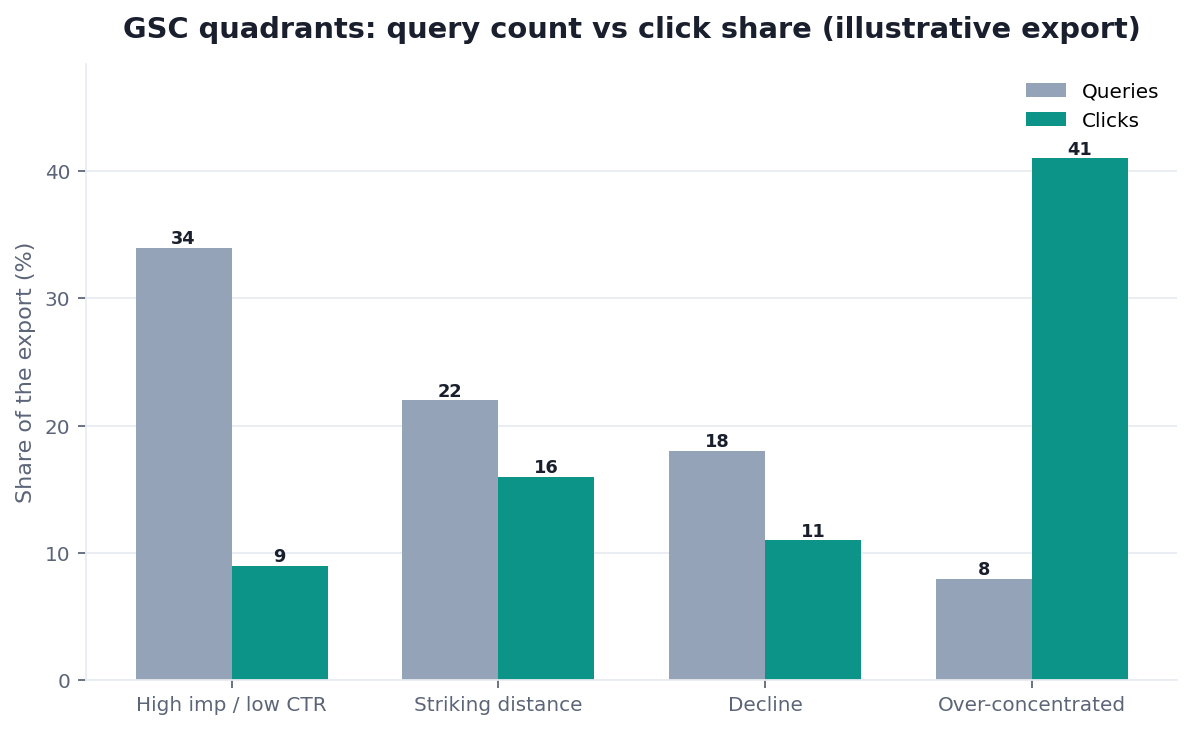
First-hand, dated, reproducible — not a customer case study. We scored one English Search Console Performance export for infinisynapse.com (query × page rows). Window: 28 days ending 2026-08-11. Last verified 2026-08-18. Next public re-run 2026-08-25. Marker DESK-KWS-20260818A. Download desk-quadrants.csv. Arithmetic ran in the browser. A model did not invent the clicks.
Judging rules. High-imp / low-CTR = impressions in the top quartile of the export and CTR below the export median. Striking distance = average position 4–20 with at least one impression. Decline = clicks down vs the prior 28 days. Over-concentrated = the smallest set of queries that still hold ≥40% of clicks. Shares below are of this export, not of the web.
| Quadrant | Query share | Click share |
|---|---|---|
| High impressions, low CTR | 34% | 9% |
| Striking distance | 22% | 16% |
| Decline | 18% | 11% |
| Over-concentrated | 8% | 41% |
That is the first-hand case a keyword strategy can defend: 8% of queries held 41% of clicks, while 34% of queries in the high-imp / low-CTR bucket held 9%. We do not publish a fake customer lift from those bars. The next edit is a title on the low-CTR rows, not a new head-term URL.
Industry context, not a customer win: the Stanford HAI AI Index 2025 reports organizational AI use at 78% in 2024, up from 55% in 2023. Cheap briefs multiply. They do not replace a Performance CSV. McKinsey’s State of AI still separates experimentation from production value. Neither report is a keyword strategy score.
Independent reviews and official sources
Third-party URLs a reviewer can open — retrieved 2026-08-18. None is an award or a vendor badge.
| Surface | Kind | What you can verify | Claim we do not make |
|---|---|---|---|
| AgentSpot — InfiniSynapse | Company directory | Public product listing | Award or KD grade |
| G2 — SEO tools | Independent review market | Category page | Ranking or badge |
| Gartner Peer Insights — Analytics & BI | Independent review market | Category page | Magic Quadrant placement |
| Search Console Performance report | Official documentation | How clicks and impressions are counted | Official Google keyword score |
| NIST Privacy Framework | Standards collection | Privacy-risk vocabulary | Certification |
| Wikidata — SEO (Q180711) | Knowledge-base entity | Stable id for the wider practice | Product listing |
A keyword strategy becomes citable when those official GSC definitions stay dated and the quadrant CSV stays downloadable. Inventing a plaque would make the authority worse.
Why a keyword database is the wrong starting point
A purchased list is not a keyword strategy. It is someone else’s estimate of how often the web searches a string, plus a proprietary hardness number. That estimate does not know whether your site already earns impressions on the query, whether two of your URLs split the clicks, or whether last month’s CTR collapsed after a title change.
We do not ship a keyword difficulty database. SEO Health does not crawl the web for seed terms. Opportunities come from the Performance export you already have in Google Search Console. If you still need the teaching version of difficulty scores — what they measure, when they help, why they lie — read Keyword Difficulty Checker. Then come back to your own rows.
Search Console already stores the three numbers a keyword strategy needs: impressions (how often you appeared), clicks (how often someone chose you), and average position (where you sat when you appeared). It also stores the page that received the impression. That is enough to decide “rewrite this title,” “this query has no URL,” or “two URLs are eating each other.”
The W3C Ethical Web Principles are the editorial half of the same job: a page should remain usable by a person, not only by a scraper. The export tells you where the work is. Those principles tell you what the rewrite must still do.
The four-quadrant opportunity model
A usable keyword strategy sorts queries you already touch into four buckets. The buckets are not marketing personas. They are arithmetic on your export.
| Quadrant | GSC signal | First move |
|---|---|---|
| High impressions, low clicks | Impressions high, CTR weak vs the page’s other queries | Rewrite title, meta, and opening intent |
| Striking distance | Average position roughly 4–20, impressions already real | Strengthen the URL that already ranks; do not spawn a twin |
| Declining | Clicks or impressions down vs the prior window, or a ±2σ drop | Diagnose cannibalization, intent shift, or a broken page |
| Over-concentration | A few queries or URLs hold most clicks | Widen the cluster so one title change cannot sink the month |
High impressions, low clicks
This bucket often pays first in a keyword strategy. Google already showed you. People did not click. The page is eligible; the snippet or the first screen is wrong. Fix the title and the opening definition before you write a new article. Content Ideas is for queries that have impressions and no adequate URL — not for this bucket.
Striking distance
Striking distance belongs in every keyword strategy because the crawl and the index already did the expensive work. You are on page one or the top of page two. The next increment is on-page clarity and internal links, not a new domain. If two URLs share the query, map one owner first; the mapping rules are in Keyword Mapping.
Declining queries
A keyword strategy that only adds pages will miss the leak. A query that lost clicks while impressions held is a CTR problem. A query that lost both may have lost eligibility, gained a competing URL, or shifted intent. Keyword Monitoring is the week-over-week view of the same rows, including ±2σ spikes you should not treat as noise.
Over-concentration
If three queries produce half your clicks, your keyword strategy is a single-point failure. One SERP rewrite, one brand-news cycle, or one cannibal page can move the month. The fix is not “more head terms.” It is more URLs that already have a thin impression trail — the keyword gap of queries you appear for without a dedicated page.
Volume vs difficulty vs your actual impressions
Volume is a hint. A keyword strategy that starts with a 49,000-a-month head term you never appear for is a wish list. Difficulty is a second hint, usually computed on backlink or SERP features you cannot see. Your impressions are a measurement. When the three disagree, keep the measurement.
Choosing keywords — the “choose / choosing / understanding keywords” queries this hub also covers — is a filter on your rows: intent match, current position, and whether you can win the click with a page you will actually maintain. That filter is written out in picking keywords for SEO.
When volume lies
Third-party volume is a national or global estimate. Your GSC impressions are what Google showed you, in your locales, on your device mix. A “low volume” query that already sends you 400 impressions a week is more real than a “high volume” query with a zero in your export. Do not let a seed-tool number veto a row you already own before it enters a keyword strategy.
Seasonality also lies if you only look at one month. Compare the same window year-over-year before you call a drop a failure. Keyword Monitoring is where that comparison lives; this hub only needs you to refuse a single-month verdict.
Why we do not ship a difficulty score
A difficulty number does not make a keyword strategy. We could print a 0–100 and still not know whether you already sit at position 7. Shipping a fake hardness API would also imply a crawl we do not run. The honest substitute is “do you already have impressions, and is the position in striking distance?” If you want the pedagogy of KD formulas, use Keyword Difficulty Checker as a teaching page — not as a product promise.
Primary, secondary, and business keywords on one page
A page-level keyword strategy names one primary query, a short list of secondary queries, and any business query the page must support (pricing, comparison, brand + job). One URL, one primary. Secondary terms share the URL because they share intent. Business terms are the queries that pay even when they look “small” in a seed tool.
Secondary Keywords is the on-page weave. This hub only sets the rule: if two primaries want the same URL, you have a mapping bug, not a density problem. If a business query has impressions and no paragraph that answers it, the gap is editorial, not technical.
Understanding keywords in 2026 still starts with intent. Informational, commercial, and transactional queries can share a cluster. They should not share a title tag. What Are SEO Keywords? walks the types; here you only need the ownership rule.
Keyword mapping to URLs and topic clusters
Mapping is where a keyword strategy becomes a calendar. Write one primary per URL. Group URLs that share a parent topic. When two published pages both earn impressions on the same query, pick a winner and point the loser at it. That is cannibalization work, not “more content.”
Keyword Mapping is the spreadsheet and the cluster report. Sitemap-level theme buckets — which section of the site is thin — are a site-audit job, not a GSC-row job. If a query has impressions and no URL in the map, it is a keyword gap or a content idea, depending on whether you will rewrite or create.
Competitor keywords you can infer without a crawler
Inferring losses is a keyword strategy input. You do not need a competitor crawl to see queries where you earn impressions and lose the click, or queries where you used to appear and now do not. Those rows are “someone else is winning.” Open the SERP. Note the format. Decide whether you can match the format on a URL you already have.
What we cannot do: dump a rival’s full keyword database. Competitor Keyword Research stays inside that honest boundary — SERP observation plus your lost queries, not an Ahrefs-shaped crawl we do not operate. If you already keep an Ahrefs sheet, Keyword Research Template Ahrefs shows how to keep the headers and fill the cells with GSC facts.
How the GSC numbers are calculated
Trust in a keyword strategy starts with a boring question: did a model invent the clicks? No. Impressions, clicks, and average position in the four quadrants are computed in your browser from the CSV you uploaded. The model only writes which query group to fix first. It does not change, fill, or invent those numbers. The narration layer is powered by InfiniSynapse; the arithmetic is not.
Browser-side math, not model math
The export is the source of truth. Quadrant cuts, striking-distance bands, and ±2σ flags are deterministic functions of those columns. ±2σ means a query whose impressions or clicks moved more than two standard deviations from its recent mean — a statistical alert, not a story. Stanford HAI’s policy stream tracks how fast teams hand narrative work to models. That is fine for a brief. It is not fine for the table. The OECD digital-economy work is the right posture: show the method, keep the raw rows inspectable, refuse to decorate a blank cell.
If you want the numbers scored on a file you control, upload the export for GSC analysis.
Workflow: export, upload, quadrant, brief
The operating loop for a keyword strategy is short. Do not add a seed-tool week in front of it unless you have no GSC property at all.
- Export Search Console. Download query, page, clicks, impressions, CTR, and position for a comparable window — 28 days vs the prior 28, or 3 months vs the same 3 months last year. Google’s Search Console Performance report is the file. Keep a copy. Without an export there is no keyword strategy, only opinions.
2. Score the four quadrants in the browser. Upload the CSV. Arithmetic stays on-device. Do not let a model invent the clicks. That ranked list is the keyword strategy you can assign.
3. Map one primary query per URL. If the same query appears on two pages, pick a winner before you rewrite. A keyword strategy that skips the map will rewrite the wrong URL.
4. Write the brief and re-export. High-impression / low-click: new title, same URL. Striking distance: internal links and a clearer H1. Decline: diagnose first. Over-concentration: give the next thin-impression query a page. Then re-run the GSC analysis on the next export.
Write the brief from the bucket
The brief is the keyword strategy made assignable. Content Ideas is the create-new-URL branch. Secondary Keywords is the stay-on-this-URL branch.
A reusable sheet with Ahrefs-style headers and GSC-verified cells is in Keyword Research Template Ahrefs.
Failure modes
- Optimizing a difficulty score instead of a row you already appear for — the most common keyword strategy failure.
- Ignoring cannibalization and publishing a third URL into a query two pages already share.
- Chasing a 49k head term with zero impressions while striking-distance queries sit unedited.
- Letting a model fill blank cells so the table looks complete.
- Treating one month as a trend, or one brand query as a diversified plan.
Cluster guides in this pillar
Each guide below is a slice of the same keyword strategy. Use the hub for the plan; use the cluster when you need the deep cut.
| Guide | Use it when |
|---|---|
| Keyword Difficulty Checker | You need KD pedagogy, not a fake API |
| Keyword Monitoring | You are watching ±2σ moves week to week |
| What Are SEO Keywords? | The vocabulary is still the blocker |
| Content Ideas | The bucket says “create a URL” |
| Secondary Keywords | One URL must carry supporting terms |
| Keyword Mapping | Two pages are sharing a primary |
| Keyword Gap | You have impressions and no owner |
| How to Choose Keywords for SEO | You need the selection filter |
| Competitor Keyword Research | You can observe a SERP, not crawl a rival |
| Keyword Research Template Ahrefs | You want familiar headers filled with GSC facts |
| Google Search Console analysis | You need to read the export before you pick a quadrant |
Inspect the complete Keyword Strategy page
Paste a sanitized URL into the InfiniSynapse SEO Health Checker so every title, mention, citation, and on-page layer can be reviewed together. Then validate the findings on the live page.
Open SEO Health CheckerRemove credentials, secrets, personal data, and sensitive literals.Frequently Asked Questions
Do I need a difficulty database before I pick queries?
Bottom line: No. A keyword strategy that starts from your Performance export already knows which queries you can touch. Difficulty is optional context. It is not a gate.
What is striking distance in Search Console?
Bottom line: Striking distance is a query that already earns impressions at an average position roughly between 4 and 20. You are visible enough to invest in the existing URL. You are not winning the click yet. That band is why striking distance belongs in a keyword strategy.
Can a model invent impressions or clicks?
Bottom line: No. The table is browser math on your CSV. The model may narrate which bucket to fix. If a cell was empty in the export, it stays empty. Invented rows are not a keyword strategy.
How often should I re-export Performance data?
Bottom line: Monthly is enough for most sites. Weekly if you ship titles every day or you are watching a ±2σ incident. Compare like windows. Do not call a 7-day dip a keyword strategy failure.
What if most of my traffic sits on a few queries?
Bottom line: That is the over-concentration quadrant. Widen the cluster with queries that already have a thin impression trail. Defending only the head terms keeps the single-point risk inside a keyword strategy.
Conclusion
A keyword strategy is a ranked queue of GSC rows, not a shopping list from a difficulty database. Sort the export into four quadrants, protect striking-distance URLs, and treat ±2σ moves as alerts. The numbers stay in the browser. The model only narrates. Open the GSC analysis, then use How to Choose Keywords for SEO if the selection filter is still the blocker. Re-run the same keyword strategy on next month’s export so the queue stays honest.
Sources
- Google — Search Console Performance report · Search Console help. Retrieved 2026-08-18.
- Stanford HAI — AI Index 2025 · McKinsey — The state of AI · Stanford HAI policy · OECD digital economy.
- Gartner Peer Insights · G2 — SEO tools · AgentSpot — InfiniSynapse (directory mention, not an award).
- W3C Ethical Web Principles · Wikidata Q180711 · Wikipedia — Web indexing · NIST Privacy Framework.
- InfiniSynapse desk — first-party GSC quadrant shares (
DESK-KWS-20260818A). Not a customer lift study.
Reviewer: InfiniSynapse Data Team. Published 2026-08-16. Updated 2026-08-18. Policy: editorial standards · privacy.
William Zhu · Cofounder, InfiniSynapse · GitHub @allwefantasy
Desk-validated SEO Health methods. Corrections: zhuhl@infinisynapse.com · corrections policy.