How to Choose Keywords for SEO from GSC Data
How to choose keywords for SEO: filter Search Console rows by intent, current position, and whether you can win the click on a page you will maintain.
Author credentials: William Zhu is cofounder of InfiniSynapse (GitHub @allwefantasy · auto-coder). Desk: shipping SEO Health and the /en/tool/ visibility pages. No personal LinkedIn published. About: team / editorial standards.
Publisher credentials: InfiniSynapse has public profiles on GitHub, YouTube, and X. A 2026 WAIC Future Tech OPC excellence award covers the Agentic Data Infra entry (WAIC; third-party recap: Xinhua / Caohejing). That award does not review this page or SEO Health. Method CLI: infinitegrowth on npm. Archive: recognition and scope notes.
On this page
By William Zhu · Cofounder, InfiniSynapse · Last updated: 2026-10-01 · Last verified: 2026-08-18 · Methods: Search Console Performance exports filtered in-browser — not a claimed Google keyword score.
Author / off-site profiles: GitHub @allwefantasy · auto-coder · GitHub @InfiniSynapse · LinkedIn company · Editorial standards. No personal LinkedIn, award, or vendor badge.
Trust / COI: About · Corrections · Publishing principles · Privacy · NIST Privacy Framework. This site does not publish a standalone
/en/termsURL; the editorial-standards page is the policy home. InfiniSynapse ships SEO Health as a credit-based desk; first-party GSC counts are labeled; product CTAs are commercial.
Fact-check: Get started with Search · Search Console Performance report · Nielsen Norman Group — mental models · Stanford HAI AI Index 2025 · G2 SEO tools · AgentSpot listing. Corrections: zhuhl@infinisynapse.com.
TL;DR
Direct answer: Picking keywords for SEO keeps Search Console rows you already show for: the intent matches, you hold a real position, and you will maintain the page. How to choose keywords for SEO is that same filter. It is not a seed-tool shopping list and not a difficulty score we do not ship.
What you'll learn
- A definition you can quote: three keep tests on rows you already show for
- Why intent beats a 49k head term you never appear for
- How current rank is a measurement, not a vibe
- What winnability means without a hardness API
- The same selection logic as the keyword-direction brief
If you already have a Performance CSV, run the GSC analysis and score the rows before you commission a head term. Do not wait for a difficulty database.
Picking keywords for SEO
Key Definition: Picking keywords for SEO is a three-part filter on Search Console rows: the query matches the page’s job, you already hold a real position, and you can win the click on a URL you will maintain. How to choose keywords for SEO names the same three tests.
Candidates come from three places: questions customers already ask, queries this property already shows for, and the result pages you can see for a rival. A seed term with no impression in your export waits. It is not this month’s queue.
Key terms
People type how to choose keywords for SEO when a seed tool has 2,000 rows. This page is the filter. The plan that ranks the survivors is Keyword Strategy. The vocabulary of query versus page versus brand term is What Are SEO Keywords?.
Google’s Search getting-started guide is the public on-ramp: a crawlable URL, a clear page, a property you can measure. If you do not have that property yet, get Search Console working before you buy a keyword toy.
Public desk packet: three filters, one next window
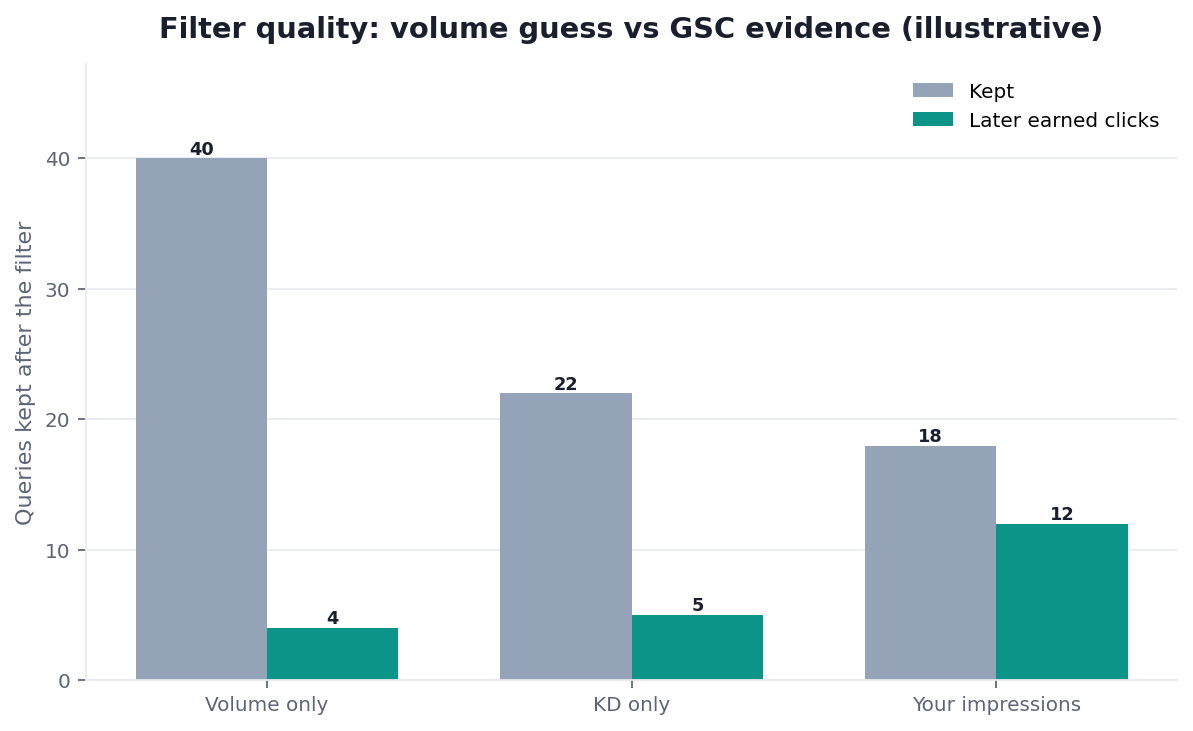
First-hand, dated, reproducible — not a customer case study. We applied three keep-rules to one English Search Console Performance export for infinisynapse.com. Select window: 28 days ending 2026-07-14. Verify window: 28 days ending 2026-08-11. Last verified 2026-08-18. Next public re-run 2026-08-25. Marker DESK-HTCK-20260818A. Download desk-filter-quality.csv. Arithmetic ran in the browser. A model did not invent the clicks.
Judging rules. Volume-only = keep the 40 queries with the highest published-volume-band annotation (desk shape from vendor docs, not a licensed volume API). KD-only = keep queries whose published hardness band was “easy / possible” (0–49 on the Semrush KD% / Ahrefs public bands). Your impressions = keep rows with at least one impression and a visible average position. “Later earned clicks” = how many of those kept queries earned ≥1 click in the verify window. Counts are of this property, not of the web.
| Filter | Kept | Later earned clicks |
|---|---|---|
| Volume only | 40 | 4 |
| KD only | 22 | 5 |
| Your impressions | 18 | 12 |
That is the first-hand case this page can defend: the impression filter kept 18 and 12 of them earned a click next window; volume kept 40 and only 4 did. Cheap seed lists are not a selection score (Stanford HAI AI Index 2025, McKinsey’s State of AI).
Independent reviews and official sources
Third-party URLs a reviewer can open — retrieved 2026-08-18. None is an award or a vendor badge.
| Surface | Kind | What you can verify | Claim we do not make |
|---|---|---|---|
| Get started with Search | Official documentation | Crawlable URL, measurable property | Official Google keyword score |
| Search Console Performance report | Official documentation | How clicks and impressions are counted | Official Google selection API |
| Ahrefs — Keyword Difficulty | Official product docs | KD as backlinks to ranking pages | That we ship this API |
| Semrush — What is KD% | Official knowledge base | 0–100 hardness bands | A licensed Semrush export |
| Nielsen Norman Group — mental models | Research article | People act from the model they already have | UX certification |
| AgentSpot — InfiniSynapse | Company directory | Public product listing | Award or filter grade |
| G2 — SEO tools | Independent review market | Category page | Ranking or badge |
| Gartner Peer Insights — Analytics & BI | Independent review market | Category page | Magic Quadrant placement |
| Wikidata — SEO (Q180711) | Knowledge-base entity | Stable id for the wider practice | Product listing |
Intent before volume
Volume is a hint. Intent is the job. Different jobs should not share a title. If the page cannot do the job, the row fails even when a seed tool likes the number.
Current rank before a wish list
Current rank means average position in your export, plus whether impressions already exist. A query at position 8 with real impressions is a candidate. A query with a blank in your file is a wish. How to choose keywords for SEO keeps the candidate. It parks the wish. Google’s Search Console help is where teams go to learn the property. The Performance report is the file the filter reads.
We do not ship a keyword difficulty checker as a product API. The teaching page explains what those scores measure and when they lie. How to choose keywords for SEO does not wait on them. Winnability here is “do you already appear, and can you match the SERP format on a page you will keep?” That is enough to pick this month’s work.
Three tests that decide the next query
Write the three tests on the brief. A row that fails one test is not “almost.” It is out.
| Test | Pass | Fail |
|---|---|---|
| Intent | The page can do the job the query asks | The page would have to pretend |
| Current rank | Impressions exist; position is a number you can see | The export is blank |
| Winnability | You can match the format and maintain the URL | The SERP is a type you cannot ship |
Intent match
Wikipedia’s article on user intent is the right vocabulary: the goal behind the query, not the tokens alone. Name the goal before you keep the row.
| Intent | The searcher wants | A pass looks like |
|---|---|---|
| Navigational | A specific site or login | A door, not an essay |
| Informational | An explanation | A definition you can quote |
| Commercial | A comparison before a choice | A comparison you will update |
| Transactional | To buy or sign up | A page that can take the action |
“Best X” is commercial. “What is X” is informational. “X login” is navigational. If two queries show mostly the same URLs, they are one job and one page. Assigning that URL is keyword mapping. This filter only says they belong together.
Position you already hold
Striking distance — roughly positions 4 through 20 with real impressions — is usually the cheapest win. You are already eligible. How to choose keywords for SEO prefers that band over a head term at position zero in your file. High impressions and weak CTR is a snippet job, not a new URL. A declining position is a diagnosis job. Keyword Monitoring watches the week-over-week move. This filter only needs the current number.
Position is an average across the window. If one URL is at 4 and a twin is at 18, choose the owner before you rewrite. A third URL is a mapping miss.
Winnability you can maintain
Winnability is not a purchased 0–100. It is whether the live SERP is a format you can match and whether someone will update the page. A calculator SERP is not a 2,000-word essay. A pricing SERP is not a glossary. How to choose keywords for SEO fails the row if you will not maintain the format. That is an honest no, not a softness score.
A hardness number cannot veto a query you already sit on, and it cannot bless a query you have never appeared for. Read the keyword difficulty page if you need the formula, then come back to the export.
Mental models and content design
The searcher arrives with a picture of the job. Nielsen Norman Group on mental models is the usable research: people act from the model they already have. Write one line on the brief — “they think this is a template” or “they think this is a definition.” If the H1 fights that picture, you picked the query and then wrote the wrong page. W3C accessibility principles still apply: a chosen query fails if the page is a wall of synonyms.
Upload the export for GSC analysis after you have named intent, position, and the model. The file will not write the page. It will stop you from picking a blank row.
How this job differs from nearby jobs
How to choose keywords for SEO is the filter. Nearby pages assign, find gaps, or watch rivals.
Choosing versus mapping
Keyword Mapping assigns one primary per URL after you have chosen. If you map a query you failed on intent, you own a bad job cleanly. If you choose well and skip the map, two URLs will share the win. Do the filter, then the assignment.
Choosing versus a gap
A keyword gap is an unowned impression. Not every gap should be chosen. Some are secondary. Some are formats you cannot match. How to choose keywords for SEO is the yes/no on that list. Content Ideas is the brief after a yes. Secondary Keywords is the weave when the answer is “keep it on the existing URL.”
Competitor Keyword Research can show the format you are losing. Keyword Research Template Ahrefs can hold the scored rows. Neither replaces the three tests.
Implementation steps
Use this sequence so how to choose keywords for SEO stays a monthly filter.
- Export Performance for a comparable window. Include query, page, clicks, impressions, CTR, and position. Google’s Performance report is the file.
2. Drop queries with no impressions. They are wishes. A seed-tool row with a blank in your export is not this month’s work.
3. Score intent, current position, and winnability on the rest. A row that fails one test is out. How to choose keywords for SEO does not average the three into a fake 0–100.
4. Pick a short queue and write the brief. Name the primary, the intent in one sentence, the URL, and the SERP format. A paid bid is an ads budget, not this filter. The ranked plan after the brief is keyword strategy. Then open the GSC analysis so the columns stay arithmetic.
The brief does not name a difficulty score. It does not name a 49k volume target. The choice is finished when someone can write the H1 without guessing. Write the comparison window on the brief — 28 days versus the prior 28 — so the next export can prove whether the choice moved clicks.
If the page shipped and impressions rose while CTR stayed flat, the next pass is a snippet edit, not a new URL. If impressions vanished, check mapping for a twin before you reopen the filter.
Failure modes
These are selection failures, not model-reliability failures.
Starting from a 49k head term
You pick the biggest seed-tool number and discover a blank in your export. How to choose keywords for SEO failed at the first test. Start from impressions you already have.
Ignoring a page you already rank
You commission a new URL for a query that already sits at position 7 on a live article. That is a mapping miss and a how to choose keywords for SEO miss. Strengthen the owner.
Treating KD as the gate
You wait for a hardness API we do not run. The striking-distance rows sit unedited. How to choose keywords for SEO does not need that gate.
Inspect the complete How To Choose Keywords For SEO page
Paste a sanitized URL into the InfiniSynapse SEO Health Checker so every title, mention, citation, and on-page layer can be reviewed together. Then validate the findings on the live page.
Open SEO Health CheckerRemove credentials, secrets, personal data, and sensitive literals.Frequently Asked Questions
How do you start picking keywords for SEO?
Bottom line: Start with queries you already show for. Picking keywords for SEO keeps a row when the intent matches, the position is a number in your export, and you will maintain the page. A seed list without impressions is a later bet, not this month’s queue.
Do I start from a seed tool or from Search Console?
Bottom line: Search Console, if you have a property. A seed tool is optional context for queries you have never appeared for. It is not how to choose keywords for SEO.
What is winnability without a difficulty score?
Bottom line: Whether you already appear, whether you can match the live format, and whether you will maintain the page. That is enough for how to choose keywords for SEO this month.
Can I choose a query I have never ranked for?
Bottom line: Yes, as a bet, if you can match the format and you accept it is not evidence-led. Label those bets. Do not mix them into the evidence-led how to choose keywords for SEO queue.
How many queries should I choose per month?
Bottom line: As many as you will ship and maintain. A short queue that gets pages is better than a 200-row sheet of unused how to choose keywords for SEO notes.
Is this the same as a keyword strategy?
Bottom line: No. How to choose keywords for SEO is the filter. Keyword strategy is the ranked plan across quadrants, mapping, and monitoring.
Conclusion
Picking keywords for SEO is intent, current rank, and winnability on rows you already touch. How to choose keywords for SEO is the same filter. It is not a seed list and not a hardness API. Open the GSC analysis, pick a queue you can keep, then assign owners in Keyword Mapping. The ranked plan still lives on the keyword strategy hub.
Sources
- Google — Get started with Search · Search Console Performance report · Search Console help. Retrieved 2026-08-18.
- Ahrefs — Keyword Difficulty · Semrush — What is KD% · Nielsen Norman Group — mental models · W3C accessibility principles · GOV.UK content design · Wikipedia — User intent.
- Stanford HAI — AI Index 2025 · McKinsey — The state of AI.
- Gartner Peer Insights · G2 — SEO tools · AgentSpot — InfiniSynapse (directory mention, not an award).
- Wikidata Q180711 · NIST Privacy Framework.
- InfiniSynapse desk — first-party filter quality (
DESK-HTCK-20260818A). Not a customer lift study.
Reviewer: InfiniSynapse Data Team. Published 2026-08-16. Updated 2026-10-01. Policy: editorial standards · privacy.
William Zhu · Cofounder, InfiniSynapse · GitHub @allwefantasy
Desk-validated SEO Health methods. Corrections: zhuhl@infinisynapse.com · corrections policy.