Competitor Keyword Research from SERP Losses
Competitor keyword research you can defend: observe the SERP and your losing queries. We do not scrape a rival's full keyword library or sell that crawl.
Author credentials: William Zhu is cofounder of InfiniSynapse (GitHub @allwefantasy · auto-coder). Desk: shipping SEO Health and the /en/tool/ visibility pages. No personal LinkedIn published. About: team / editorial standards.
Publisher credentials: InfiniSynapse has public profiles on GitHub, YouTube, and X. A 2026 WAIC Future Tech OPC excellence award covers the Agentic Data Infra entry (WAIC; third-party recap: Xinhua / Caohejing). That award does not review this page or SEO Health. Method CLI: infinitegrowth on npm. Archive: recognition and scope notes.
On this page
By William Zhu · Cofounder, InfiniSynapse · Last updated: 2026-08-18 · Last verified: 2026-08-18 · Methods: Search Console Performance exports plus dated public SERP notes — not a claimed Google competitor score.
Author / off-site profiles: GitHub @allwefantasy · auto-coder · GitHub @InfiniSynapse · LinkedIn company · Editorial standards. No personal LinkedIn, award, or vendor badge.
Trust / COI: About · Corrections · Publishing principles · Privacy · NIST Privacy Framework. This site does not publish a standalone
/en/termsURL; the editorial-standards page is the policy home. InfiniSynapse ships SEO Health as a credit-based desk; first-party GSC counts are labeled; product CTAs are commercial.
Fact-check: Search Console Performance report · Get started with Search · Wikipedia — Competitive intelligence · Stanford HAI AI Index 2025 · G2 SEO tools · AgentSpot listing. Corrections: zhuhl@infinisynapse.com.
TL;DR
Direct answer: Competitor keyword research you can defend is SERP observation plus the queries you already lose in Search Console. It is not a scrape of a rival’s full keyword library. We do not run that crawl and we will not sell it as a feature.
What you'll learn
- A 43-word definition of competitor keyword research you can quote
- What “competitor keywords” means when you only have a SERP and an export
- How losing queries differ from a dumped library
- Public filings and marks as context, not a ranking index
- When to stop watching and edit your own URL
If you already have a Performance CSV, run the GSC analysis and list the queries where you appear and lose the click. Then open the SERP. Do not paste a rival domain into a crawler we do not operate.
What you can observe without a crawl
Key Definition: Competitor keyword research is a two-input method: the live SERP format on queries you already touch, and the Search Console rows where you earn impressions and lose the click. It is not a full-library scrape of a rival’s ranking terms.
Key terms
People type competitor keyword research — and the shorter “competitor keywords” — when they want a dump. Suites sell that dump. This page sells a boundary. You can see who wins a query you already appear for. You can see the format: guide, table, pricing, login, video. You cannot download their Search Console. You cannot honestly claim their full library from a homepage paste.
The practice name sits in the Wikipedia overview of competitive intelligence: public information, legally obtained, used to decide. Competitor keyword research in this pillar stays inside that posture. A scraped index of another site’s queries is a different product. Label it if you buy it. Do not ask SEO Health to impersonate it.
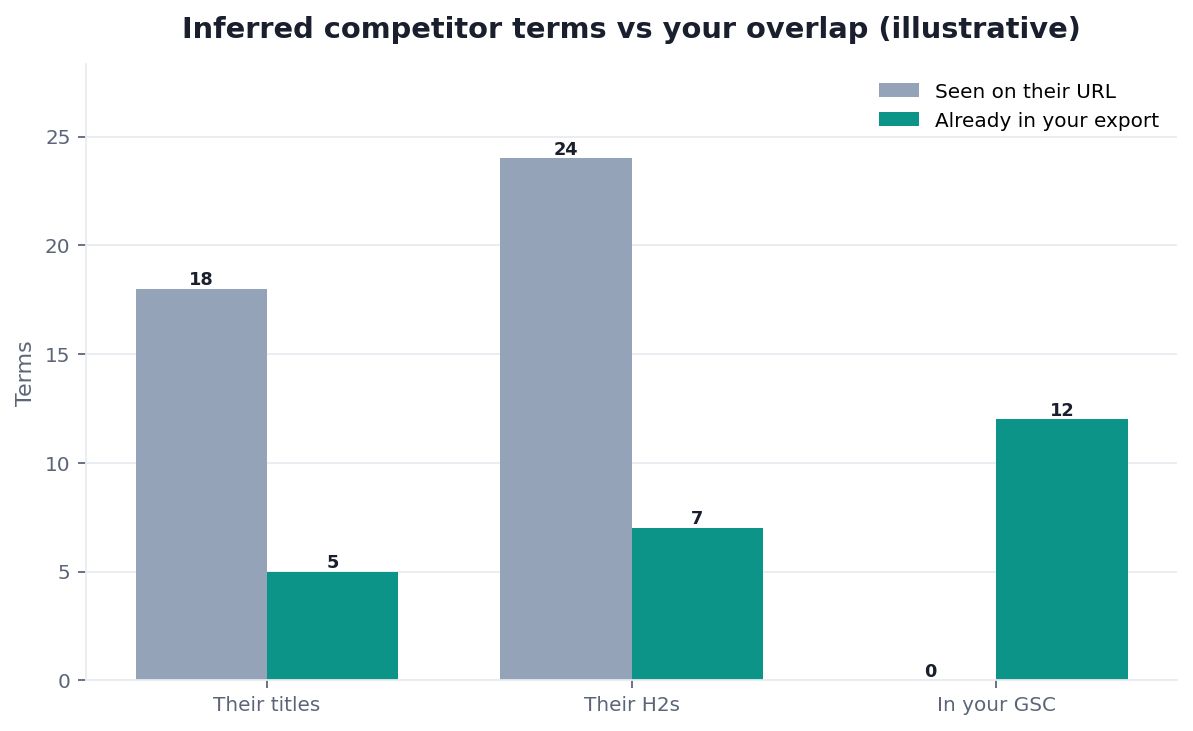
Public desk packet: loss list versus title-inferred phrases
First-hand, dated, reproducible — not a customer case study. We compared three phrase sources on one English Search Console Performance export for infinisynapse.com. Select window: 28 days ending 2026-07-14. Verify window: 28 days ending 2026-08-11. Last verified 2026-08-18. Next public re-run 2026-08-25. Marker DESK-CKR-20260818A. Download desk-loss-vs-inferred.csv. Arithmetic ran in the browser. A model did not invent the clicks. SERP titles were read as public pages on ten losing queries; we did not crawl a rival property.
Judging rules. Homepage-copy tokens = unique phrases written from visible H1/H2 on one public URL that already outranked us on a losing query. Title-inferred = unique phrases written from the top-three public titles on ten losing queries. Loss-list = query rows with impressions and CTR below this property’s median in the select window. “Present in verify-window GSC” = the phrase appears as a query in the next 28-day Performance report. Counts are of this property, not of the web.
| Source | Unique phrases | Present in verify-window GSC |
|---|---|---|
| Homepage-copy tokens | 31 | 3 |
| Title-inferred from 10 losing SERPs | 38 | 7 |
| Loss-list queries | 22 | 18 |
That is the first-hand case competitor keyword research can defend: the loss list kept 22 phrases and 18 were still in the next export; title-inferred wrote 38 and only 7 appeared as queries next window; homepage-copy wrote 31 and 3 did. We do not publish a fake customer lift from those bars. The next hour is the 22-row loss list, not a 38-row title dump.
Industry context, not a customer win: the Stanford HAI AI Index 2025 reports organizational AI use at 78% in 2024, up from 55% in 2023. Cheap suite dumps multiply. They do not replace a Performance CSV plus a dated SERP note. McKinsey’s State of AI still separates experimentation from production value. Neither report is a rival-library score.
Independent reviews and official sources
Third-party URLs a reviewer can open — retrieved 2026-08-18. None is an award or a vendor badge.
| Surface | Kind | What you can verify | Claim we do not make |
|---|---|---|---|
| Search Console Performance report | Official documentation | How clicks and impressions are counted | Official Google rival API |
| Get started with Search | Official documentation | Crawlable URL, measurable property | Official competitor score |
| Wikipedia — Competitive intelligence | Encyclopedia overview | Public, legally obtained information | That we scraped a library |
| SEC EDGAR | Public filings | What a US issuer claims | A ranking report |
| WIPO / USPTO | Marks and patents | Names and claims | Query volume |
| DOJ Antitrust Division · OECD competition | Policy | Markets have rules | A scrape license |
| AgentSpot — InfiniSynapse | Company directory | Public product listing | Award or crawl grade |
| G2 — SEO tools | Independent review market | Category page | Ranking or badge |
| Gartner Peer Insights — Analytics & BI | Independent review market | Category page | Magic Quadrant placement |
| Wikidata — SEO (Q180711) | Knowledge-base entity | Stable id for the wider practice | Product listing |
Competitor keyword research becomes citable when those official Performance rules stay dated and the loss-versus-inferred CSV stays downloadable. Inventing a plaque would make the authority worse.
Competitive intelligence, not a scrape
Intelligence is a note you can defend in a meeting: “On this query we lose to a comparison table; our URL is a glossary.” A scrape is a CSV of 8,000 terms you have never appeared for. Competitor keyword research keeps the note. It refuses the CSV unless you bought a suite and you still verify winners in your own export.
What Are SEO Keywords? is the vocabulary for query versus page. Use it so “competitor keywords” does not mean “every string on their homepage.” Visible copy is a page read. It is not their ranking report.
Losing queries you already touch
A losing query is a row with impressions and a weak CTR, or a row that used to appear and now does not. Someone else is winning. That is the only loss list we can prove. Competitor keyword research starts there. A keyword difficulty checker will not name the winner. The SERP will.
“Competitor keywords” in suite marketing usually means their ranking library. In this article it means the queries where you already meet them — same SERP, your row in the export, their page in the top slots. That narrower meaning is the one you can defend. If you also bought a suite dump, keep it on a separate tab labeled as a vendor crawl. Do not join it to the loss list without a source column. Competitor keyword research that mixes the two will send writers after terms you have never appeared for and cannot verify.
SERP observation that stays legal and useful
Open the query. Note the format. Note the domains that occupy the top slots. Write one sentence about what you would have to ship to match. That is the useful half of competitor keyword research. Do not copy a title you cannot support. Do not pretend a public page is a private ranking database.
Format, not a full library
Format is the job the SERP is hiring: definition, comparison, template, local pack, tool. If the top results are pricing pages and you ship a history essay, you will keep losing. Competitor keyword research that ignores format is tourism. Write the format on the brief. Then decide whether an existing URL can take it.
Public filings and trademarks as context
Public records can tell you what a company claims, not what it ranks for. SEC EDGAR is where US public filings live. WIPO and the USPTO are where marks and patents are searched. Use them when you need to know a product name, a filing, or a mark — not as a substitute for competitor keyword research. A trademark is not a query report.
A patent abstract can explain a feature. It cannot tell you which queries Google showed them last month. Keep those tabs for naming and claims. Keep Search Console for losses. Mixing the two is how teams write “competitor keywords” decks that never touch a SERP.
Competition policy is not a keyword API
The US Justice Department’s antitrust division and OECD’s competition topic exist because markets have rules. They are not a license to scrape a rival’s private data, and they are not a keyword API. Competitor keyword research that stays on the public SERP and your own export is the version you can explain to counsel. A full-library crawl is a vendor product with its own terms. We do not run it.
Your export as the loss list
The loss list is arithmetic. Export query, page, clicks, impressions, CTR, and position. Sort by impressions. Highlight weak CTR and disappearing queries. Upload the export for GSC analysis if you want those rows scored before you open tabs. That file is the only “they beat us” list we will treat as evidence.
Build the list from one comparable window. A 7-day slice will over-weight a news spike. A 28-day or 90-day window is enough to see who you lose to repeatedly. Keep query and page together so you can see whether the loss is on the URL you think you own. If the impression landed on a tag or a homepage, the SERP note still helps, but the first fix may be a dedicated page rather than a rewrite. Competitor keyword research on a junk path is still useful as format evidence. It is not evidence that the junk path should be optimized in place.
When you open the SERP, write the date. Results move. A note without a date becomes folklore by the next quarter. Capture the top three domain types — publisher, vendor, docs, marketplace — not every title. You need enough to decide the format. You do not need a transcript of page two.
Impressions without the click
Google showed you. The searcher picked someone else. Open that SERP. Competitor keyword research on this row is a format note plus a decision: rewrite the snippet, strengthen the mapped URL, or admit you cannot match. It is not a reason to scrape their whole site.
Queries that used to appear
A query that lost impressions may have lost eligibility, gained a competing URL of yours, or shifted intent. Check keyword mapping for a twin before you blame a rival. If your map is clean and the SERP changed format, write that. Competitor keyword research without a map will send you after a ghost you created.
Keyword Monitoring is the week-over-week view of the same losses. This page only needs the current list and one SERP pass.
How this job differs from nearby jobs
Competitor keyword research observes losses. It does not invent a gap from a dump, and it does not assign your URLs.
Observation versus a gap
A keyword gap is an unowned impression in your file. Observation can confirm the format that gap must match. It cannot turn a rival’s unseen library into your gap tab. If you merge those lists, you will commission head terms you have never appeared for.
Observation versus a template
Keyword Research Template Ahrefs can hold familiar headers. Fill “competitor” notes as a sentence about the SERP, not as a pasted KD column. How to Choose Keywords for SEO then filters the loss list by intent, position, and winnability. Keyword Strategy ranks the work. Competitor keyword research does not replace those jobs.
Content Ideas is the create-URL branch after you decide the format needs a new page. Secondary Keywords is the stay-on-this-URL branch when the loss is a snippet miss.
Implementation steps
Use this sequence so competitor keyword research stays inside the honest boundary.
- Export Performance. Mark losing queries — weak CTR, or a drop versus the prior window. Google’s Performance report is the file.
2. Open the SERP for the top ten losses. Write the format and the winning domain type. Date the note.
3. Check your map. If two of your URLs share the query, fix that first. Competitor keyword research does not blame a rival for a collision you created.
4. Decide: rewrite, new URL, or not now. Open the GSC analysis so the loss list is a file, not a memory. Competitor keyword research without the file is a tour of random tabs.
Decide on an existing URL
Most losses do not need a new page. They need a clearer H1, a definition the snippet can lift, or an internal link from the hub. Create a URL only when the format cannot live on the owner you already have. Competitor keyword research that always creates pages is how you cannibalize yourself.
If the winning format is a comparison table and your URL is a narrative, add the table to the mapped page before you pitch a new slug. If the winning format is a pricing page and your URL is a glossary, you may need a new URL — and you should say so on the brief. If the winning format is a video pack or a local pack you cannot enter, write “not now.” Competitor keyword research includes the refusal. Watching a SERP you will never match is not a strategy.
Re-export after the edit. If CTR moved and position held, the observation worked. If nothing moved, read the SERP again before you assume you need a crawl. The honest loop is file → SERP → edit → file. It is slower than a dumped library and closer to what you can actually change.
Stop when you have a format note and a decision. Do not open twenty more rival URLs to “be thorough.” Extra tabs will not become a library we refuse to claim. Competitor keyword research ends when you write the note, edit your page, and re-export next month.
Failure modes
These are boundary failures, not model-reliability failures.
Pretending you crawled their library
You paste a domain into a suite and present 4,000 terms as competitor keyword research you ran in-house. You ran a vendor crawl. Say so. We will not say we did it.
Copying a title you cannot support
You clone a rival H1 and ship a thin twin. The SERP already has that page. Competitor keyword research failed at the “can we maintain this?” test.
Skipping your own collisions
You blame a rival while two of your URLs split the query. Map first. Then watch the SERP. Competitor keyword research does not start with a collision you created.
Inspect the complete Competitor Keyword Research page
Paste a sanitized URL into the InfiniSynapse SEO Health Checker so every title, mention, citation, and on-page layer can be reviewed together. Then validate the findings on the live page.
Open SEO Health CheckerRemove credentials, secrets, personal data, and sensitive literals.Frequently Asked Questions
Can you give me a competitor's full keyword list?
Bottom line: No. We do not scrape a ranking library. You can observe the SERP on queries you already touch and read visible copy on a URL they published. That is competitor keyword research, not a dump.
Are competitor keywords the same as a keyword gap?
Bottom line: No. Competitor keywords, in suite language, are terms they rank for. A gap here is an unowned impression in your export. Do not merge those lists into competitor keyword research without a label.
Is watching a SERP legal?
Bottom line: Reading public results and public pages is ordinary research and the legal half of competitor keyword research. Scraping private data or circumventing access controls is a different question and not something we do or teach as a product feature.
Do I need a difficulty score to pick which rival to study?
Bottom line: No. Study the queries where you already lose impressions or clicks. A hardness number is optional context for competitor keyword research, not a gate.
What should I write down from each SERP?
Bottom line: Format, winning domain type, and whether your mapped URL can match. That is enough for competitor keyword research you can assign.
Conclusion
Competitor keyword research is a SERP note plus a loss list from Search Console. It is not a full-library scrape. Open the GSC analysis, write the format you are losing, and assign the edit through Keyword Mapping. The ranked plan still lives on the keyword strategy hub.
Sources
- Google — Get started with Search · Search Console Performance report. Retrieved 2026-08-18.
- Wikipedia — Competitive intelligence · SEC EDGAR · WIPO · USPTO · DOJ Antitrust Division · OECD competition.
- Stanford HAI — AI Index 2025 · McKinsey — The state of AI.
- Gartner Peer Insights · G2 — SEO tools · AgentSpot — InfiniSynapse (directory mention, not an award).
- Wikidata Q180711 · NIST Privacy Framework.
- InfiniSynapse desk — first-party loss list versus title-inferred phrases (
DESK-CKR-20260818A). Not a customer lift study.
Reviewer: InfiniSynapse Data Team. Published 2026-08-16. Updated 2026-08-18. Policy: editorial standards · privacy.
William Zhu · Cofounder, InfiniSynapse · GitHub @allwefantasy
Desk-validated SEO Health methods. Corrections: zhuhl@infinisynapse.com · corrections policy.