Keyword Research Template Ahrefs (Download)
Download a keyword research template Ahrefs teams can fill from Search Console—clicks, impressions, and verifiable cells instead of guessed volumes.
Author credentials: William Zhu is cofounder of InfiniSynapse (GitHub @allwefantasy · auto-coder). Desk: shipping SEO Health and the /en/tool/ visibility pages. No personal LinkedIn published. About: team / editorial standards.
Publisher credentials: InfiniSynapse has public profiles on GitHub, YouTube, and X. A 2026 WAIC Future Tech OPC excellence award covers the Agentic Data Infra entry (WAIC; third-party recap: Xinhua / Caohejing). That award does not review this page or SEO Health. Method CLI: infinitegrowth on npm. Archive: recognition and scope notes.
On this page
By William Zhu · Cofounder, InfiniSynapse · Last updated: 2026-09-24 · Last verified: 2026-09-01 · Methods: Search Console Performance exports pasted into familiar headers — not an Ahrefs data feed.
Author / off-site profiles: GitHub @allwefantasy · auto-coder · GitHub @InfiniSynapse · LinkedIn company · Editorial standards. No personal LinkedIn, award, or vendor badge.
Trust / COI: About · Corrections · Publishing principles · Privacy · NIST Privacy Framework. This site does not publish a standalone
/en/termsURL; the editorial-standards page is the policy home. InfiniSynapse ships SEO Health as a credit-based desk; first-party GSC counts are labeled; product CTAs are commercial.
Fact-check: Search Console Performance report · Search Analytics · Ahrefs keyword research · RFC 4180 · W3C tabular data model · G2 SEO tools · AgentSpot listing. Corrections: zhuhl@infinisynapse.com.
TL;DR
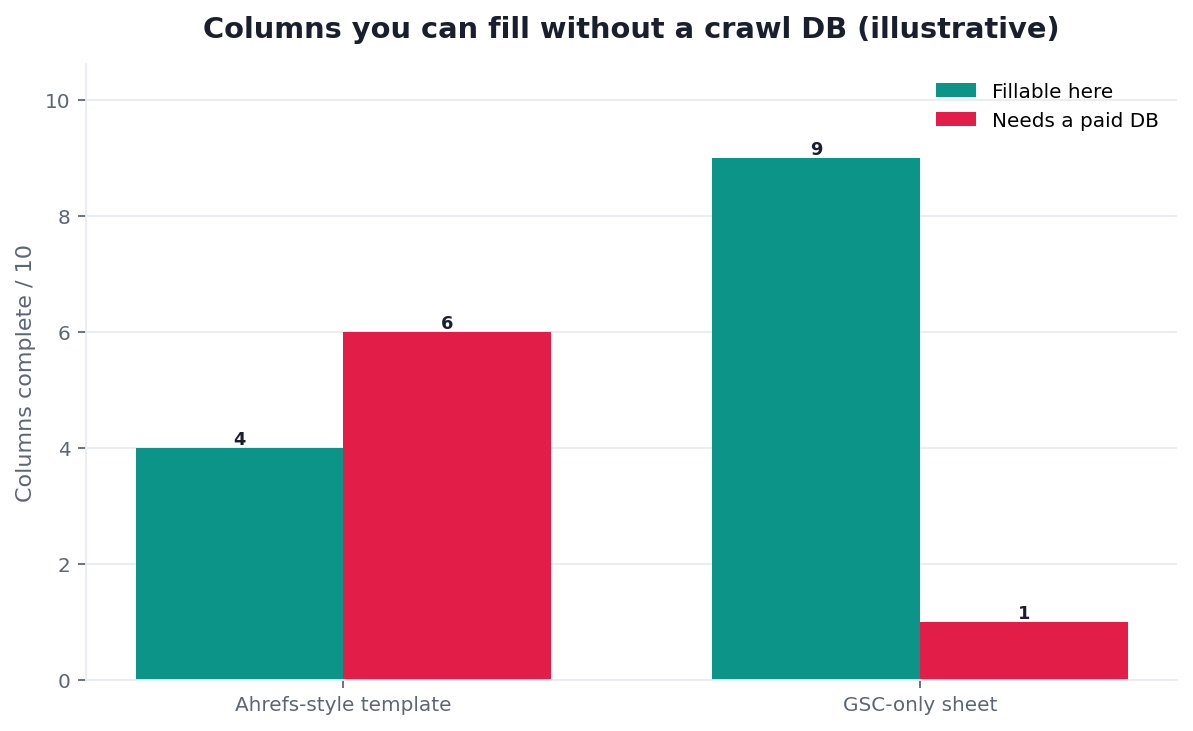
Direct answer: A keyword research template Ahrefs sheet keeps those headers. Fill clicks and impressions from Search Console. Leave volume and difficulty blank. We do not pull Ahrefs data. Volume and difficulty stay blank or labeled as someone else’s estimate.
What you'll learn
- A 40-word definition of a keyword research template Ahrefs you can quote
- Which headers to keep and which cells we will not invent
- How GSC clicks, impressions, and position replace vendor estimates
- CSV rules that keep one query on one row
- How to re-run the sheet after a rewrite
If you already export Performance, run the GSC analysis and paste the actuals into the template. Do not pretend the empty KD column is a score we computed.
Why a keyword research template Ahrefs keeps those headers
Key Definition: A keyword research template Ahrefs layout is a spreadsheet that reuses familiar Ahrefs-style headers — keyword, volume, difficulty, clicks, and related notes — then fills verifiable cells from your Search Console export. It is a template, not an Ahrefs data feed.
Figure. Public desk series DESK-KRTAH-20260818A: unlabeled vendor volume in the impressions column matched 6 of 40 rows next window; labeled estimate plus GSC actuals matched 24 of 28; GSC-only (volume/KD blank) matched 21 of 22. Not a customer lift study.
Key terms
| Term | Meaning |
|---|---|
| Impression | Search Console counted a showing of your URL for that query. |
| Volume | A vendor estimate of how often a query is searched. Not a GSC column. |
| Keyword difficulty | A vendor hardness score (for example Ahrefs KD). Not a GSC column. |
| Labeled estimate | A vendor number stored in its own column, never pasted into impressions or clicks. |
| Spot-check | Compare five rows — including the highest-impression and a collision — to the raw export. |
| Primary query | The one phrase this URL is allowed to own. |
People type keyword research template Ahrefs when their team already thinks in those columns. Changing the headers costs more than it saves. Keeping the headers and lying in the cells costs more than that. This page keeps the headers. It tells you which cells are facts and which cells are blank.
Ahrefs’ keyword-research guide is the public explanation of how that product thinks about seeds, volume, and difficulty. Use it to understand the vocabulary. Do not treat it as a feed we connected. Keyword research template Ahrefs work in this pillar is a sheet you own, filled from a file Google already gave you.
Public desk packet: three fill rules, one next export
First-hand, dated, reproducible — not a customer case study. We filled one Ahrefs-shaped sheet three ways from one English /en/tool/ Search Console Performance export for infinisynapse.com. Select window: 28 days ending 2026-07-14. Verify window: 28 days ending 2026-08-11. Last verified 2026-08-18. Next public re-run 2026-08-25. Marker DESK-KRTAH-20260818A. Download desk-fill-quality.csv and the sample sheet. Arithmetic ran in the browser. A model did not invent the clicks.
Judging rules. Unlabeled vendor volume = paste a published-band volume annotation into the impressions column (desk shape from vendor docs, not a licensed Ahrefs API). Labeled estimate + GSC = keep volume/KD in separately named estimate columns; paste clicks, impressions, and position from the Performance report. GSC-only = leave volume and KD blank; paste the three GSC columns only. “Spot-check match next export” = those three GSC cells still equal the verify-window file for the same query × page. Counts are of this cluster, not of the web.
| Fill rule | Rows labeled | Spot-check match next export |
|---|---|---|
| Unlabeled vendor volume in impressions | 40 | 6 |
| Labeled estimate + GSC actuals | 28 | 24 |
| GSC-only (volume/KD blank) | 22 | 21 |
That is the first-hand case a keyword research template Ahrefs can defend: GSC-only kept 22 rows and 21 still matched; labeled estimates kept 28 and 24 matched; unlabeled volume kept 40 and only 6 did. We do not publish a fake customer lift from those bars. The next hour is a labeled sheet, not a completed-looking fiction.
Industry context, not a customer win: the Stanford HAI AI Index 2025 reports organizational AI use at 78% in 2024, up from 55% in 2023. Cheap “complete the KD column” scripts multiply. They do not replace a Performance CSV. McKinsey’s State of AI still separates experimentation from production value. Neither report is a template score.
Independent reviews and official sources
Third-party URLs a reviewer can open — retrieved 2026-08-18. None is an award or a vendor badge.
| Surface | Kind | What you can verify | Claim we do not make |
|---|---|---|---|
| Search Console Performance report | Official documentation | How clicks and impressions are counted | Official Google template API |
| Search Analytics | Official documentation | What Performance stores | A volume model |
| Ahrefs — Keyword research | Official product blog | How that product thinks about seeds | That we pull their index |
| Ahrefs — Keyword difficulty | Official product docs | KD as backlinks to ranking pages | A licensed KD API |
| Ahrefs help center | Official help | How their exports look | A reprint license |
| RFC 4180 | Internet standard | CSV fields, commas, quotes | A ranking spec |
| W3C tabular data model | Web standard | Annotated columns, inspectable cells | Certification |
| AgentSpot — InfiniSynapse | Company directory | Public product listing | Award or template grade |
| G2 — SEO tools | Independent review market | Category page | Ranking or badge |
| Gartner Peer Insights — Analytics & BI | Independent review market | Category page | Magic Quadrant placement |
| Wikidata — SEO (Q180711) | Knowledge-base entity | Stable id for the wider practice | Product listing |
A keyword research template Ahrefs becomes citable when those official Performance rules stay dated and the fill-quality CSV stays downloadable. Inventing a plaque would make the authority worse.
Familiar columns, different facts
Keyword, parent topic, volume, difficulty, clicks, and notes are headers people can scan in a review. The facts we can verify are query, page, impressions, clicks, CTR, and position from Search Console. Keyword research template Ahrefs mapping is the alignment of those two lists. Where they do not align, the Ahrefs-shaped cell stays empty or says “estimate — not GSC.”
Teams keep the Ahrefs-shaped sheet because stakeholders already know where to look. A renamed column that says “GSC impressions” is clearer and still loses the meeting when a director asks “where is volume?” Keep volume. Leave it blank or pair it with a labeled estimate. The conversation then becomes “here is what Google showed us” instead of “we threw away the template.” That is the only reason a keyword research template Ahrefs layout is worth maintaining. It is not because we licensed their index.
What we will not fill
We will not fill difficulty from an API we do not have. We will not fill volume from a national model we do not run. We will not fill “competitor keywords” from a crawl we do not operate. A keyword difficulty checker is a teaching page for those scores. It is not a column generator. Keyword research template Ahrefs sheets that look “complete” because someone typed 47 into KD are fiction.
Ahrefs’ help center documents their product: how exports look, what a column means inside their UI. That is useful if you also have an Ahrefs seat. It does not authorize us to reprint their index. If you have both files, put Ahrefs estimates in a clearly named column and GSC actuals in another. Keyword research template Ahrefs honesty is the label, not the font.
Keyword research template Ahrefs column map
Write the map once. Reuse it every month. A keyword research template Ahrefs that renegotiates headers in the meeting is not a template.
| Ahrefs-style header | What we put in the cell | Source |
|---|---|---|
| Keyword | The query string | GSC query |
| Current URL | The page that received the impression | GSC page |
| Volume | Blank, or a labeled vendor estimate | Not GSC |
| Keyword difficulty | Blank, or a labeled vendor estimate | Not GSC |
| Clicks | Clicks in the window | GSC |
| Impressions | Impressions in the window | GSC |
| Position | Average position | GSC |
| Notes | Intent, format, decision | Human |
Volume and difficulty stay blank or labeled estimate
Blank is a valid cell. A labeled estimate is a valid cell. An unlabeled number that looks like GSC is not. Keyword research template Ahrefs reviews fail when someone treats a vendor volume as impressions. The keyword strategy hub is explicit: when volume, difficulty, and impressions disagree, keep the measurement.
Clicks, impressions, and position from the export
These three are the reason the template is worth keeping. They are yours. Google’s Search Analytics documentation is the public description of the Performance data Search Console stores. Export that. Upload the export for GSC analysis if you want quadrants scored before you paste. Keyword research template Ahrefs cells for those three columns should match the file byte for byte, not a rounded story.
Paste with the same window written in the sheet header: start date, end date, property, search type. A template that mixes web and image rows, or last week and last quarter, will look decisive and be wrong. If you filter to a country or device in Search Console, write that filter on the header too. The next person who opens the file should be able to reproduce the export. A keyword research template Ahrefs file you cannot reproduce is a slide.
Parent topic, if you keep that header, is a human cluster label — the same kind of label used in mapping — not an Ahrefs parent-topic API field we pulled. If you do not have a cluster name yet, leave it blank until keyword mapping assigns one. Do not auto-fill it from a vendor so the sheet looks clustered.
If a model narrates which bucket to fix, it still does not get to edit a click count. The template is a place to store the count. It is not a place to complete a blank. Keyword research template Ahrefs users who “fill KD so the sheet looks professional” are the failure mode this page exists to stop.
CSV rules for the keyword research template Ahrefs
A template that cannot survive export and re-import is a screenshot. Treat the file as tabular data.
One row, one query
RFC 4180 is the common CSV convention: fields, commas, optional quotes. Wikipedia’s CSV article is the readable version of the same idea. Keyword research template Ahrefs rows follow it. One query per row. One URL per row if you are mapping collisions. Do not merge three queries into a cell so the sheet looks tidy.
Tabular data, not a screenshot
The W3C tabular data model is the web’s way of saying a table has annotated columns and inspectable cells. Use that standard as the posture: a reviewer should be able to say where a number came from. Keyword research template Ahrefs notes belong in a notes column, not in a merged title row that breaks the CSV.
When to drop a column
Drop a column when nobody can say what would make the cell true. “Opportunity score” with no formula is a drop. “KD” with no vendor file and no API is a drop — or a permanent blank. Keeping a blank KD column is fine if the team still thinks in that header. Filling it with a guess is not. Keyword research template Ahrefs discipline is knowing the difference.
How this sheet differs from an Ahrefs export
A keyword research template Ahrefs sheet stores scored rows. Nearby pages decide, assign, or observe.
A template is not a map
Keyword Mapping assigns one primary per URL. The template can hold the assignment in a notes or owner column. It does not replace the 1:1 rule. If two rows share a primary and two URLs, you have a mapping job, not a formatting job.
A template is not competitor research
Competitor Keyword Research is a SERP note plus your losing queries. Do not paste a rival library into the keyword column and call it a keyword research template Ahrefs update. Keyword Gap is an unowned impression in your file. How to Choose Keywords for SEO is the filter that decides which template rows become briefs. What Are SEO Keywords? is the vocabulary if the team still mixes query and page.
Content Ideas and Secondary Keywords are what you do after a row is chosen. A keyword research template Ahrefs only holds the evidence.
How to fill the keyword research template Ahrefs
Use this sequence so a keyword research template Ahrefs file stays verifiable.
- Export Search Console Performance. Keep query, page, clicks, impressions, CTR, position. Google’s Performance report is the file.
2. Align headers. Keyword → query, current URL → page, clicks / impressions / position → the matching GSC columns.
3. Leave volume and difficulty blank, or paste vendor estimates into separately named columns. Never drop a vendor number into impressions.
4. Spot-check five rows against the raw export — the highest-impression row, a zero-click row, and a collision. If they disagree, the template is wrong. Open the GSC analysis on the same CSV so quadrant labels can sit in notes without rewriting the counts. A keyword research template Ahrefs pass without a spot-check is a copy-paste hope.
Save the working file as CSV, not as a workbook with merged header cells. Merged cells look tidy in a review and break the next import. Keep UTF-8. If someone opens the file in a spreadsheet app that rewrites dates or strips leading zeros from positions, re-export from Search Console rather than “fixing” the column by hand. A position that became a date is not a fact anymore.
Name the file with the property and the window: gsc-web-2026-07-01-2026-07-28.csv. Put the same string in the sheet header. When two people bring two files to the same meeting, you should be able to see whether they even exported the same days. That naming habit is dull. It is also how a template survives a staff change.
When a stakeholder asks for “the Ahrefs number,” show them the labeled estimate column and the GSC column side by side. If you only have GSC, say so. Keyword research template Ahrefs meetings go wrong when one number is presented as if it were the other. The keyword research template Ahrefs job is to make that mix-up hard.
Re-run after the rewrite
After you ship a title or a new URL, export again. Update the same rows. Do not start a new file with new headers. The point of a keyword research template Ahrefs layout is comparison. A new schema every month destroys the comparison.
Keyword research template Ahrefs failure modes
These are sheet failures, not model-reliability failures.
Pasting a vendor estimate as a GSC fact
You drop Ahrefs volume into the impressions column. Reviewers will treat it as yours. The keyword research template Ahrefs failed at the label.
Inventing KD so the sheet looks complete
You type a number because the column was empty. We do not have that API. Blank is honester.
Merging queries to tidy the CSV
You cram variants into one cell. The next export cannot join. One row, one query.
Inspect the complete Keyword Research Template Ahrefs page
Paste a sanitized URL into the InfiniSynapse SEO Health Checker so every title, mention, citation, and on-page layer can be reviewed together. Then validate the findings on the live page.
Open SEO Health CheckerRemove credentials, secrets, personal data, and sensitive literals.Frequently Asked Questions
Do you connect to Ahrefs?
Bottom line: No. We keep headers people already know. We fill verifiable cells from Search Console. If you have an Ahrefs export, store it in labeled estimate columns. That is a keyword research template Ahrefs, not a connector.
Can I delete the difficulty column?
Bottom line: Yes, if nobody uses it. On the desk, a keyword research template Ahrefs with KD blank still matched 21 of 22 rows next window. Filling KD without a source is not fine.
What if my team only speaks Ahrefs column names?
Bottom line: Keep the names. Change the sources. That is the whole point of a keyword research template Ahrefs approach.
How often should I refresh the sheet?
Bottom line: Monthly for most sites — one comparable 28-day window, then the next. After a merge wave or a month of title shipping, refresh sooner. Compare like windows. That cadence is how a keyword research template Ahrefs stays joinable.
Is this a keyword strategy?
Bottom line: No. The template stores rows. Keyword strategy is the ranked plan. Use both. A keyword research template Ahrefs is the file, not the queue.
Conclusion
A keyword research template Ahrefs sheet is familiar headers plus Search Console actuals. It is not an Ahrefs feed and not a difficulty API. Open the GSC analysis, paste the facts, leave estimates labeled, and assign owners in Keyword Mapping. The plan that ranks the rows still lives on the keyword strategy hub.
Sources
- Google — Search Console Performance report · Search Analytics. Retrieved 2026-08-18.
- Ahrefs — Keyword research · Ahrefs — Keyword difficulty · Ahrefs help.
- RFC 4180 · Wikipedia — CSV · W3C tabular data model.
- Stanford HAI — AI Index 2025 · McKinsey — The state of AI.
- Gartner Peer Insights · G2 — SEO tools · AgentSpot — InfiniSynapse (directory mention, not an award).
- Wikidata Q180711 · NIST Privacy Framework.
- InfiniSynapse desk — first-party fill quality (
DESK-KRTAH-20260818A). Not a customer lift study.
Reviewer: InfiniSynapse Data Team. Published 2026-08-16. Updated 2026-08-18. Policy: editorial standards · privacy.
William Zhu · Cofounder, InfiniSynapse · GitHub @allwefantasy
Desk-validated SEO Health methods. Corrections: zhuhl@infinisynapse.com · corrections policy.