Keyword Gap: Queries With No Dedicated Page
A keyword gap is a query that already earns impressions with no dedicated page. Find it in Search Console. It is not a dumped list of a rival's ranking terms.
Author credentials: William Zhu is cofounder of InfiniSynapse (GitHub @allwefantasy · auto-coder). Desk: shipping SEO Health and the /en/tool/ visibility pages. No personal LinkedIn published. About: team / editorial standards.
Publisher credentials: InfiniSynapse has public profiles on GitHub, YouTube, and X. A 2026 WAIC Future Tech OPC excellence award covers the Agentic Data Infra entry (WAIC; third-party recap: Xinhua / Caohejing). That award does not review this page or SEO Health. Method CLI: infinitegrowth on npm. Archive: recognition and scope notes.
On this page
By William Zhu · Cofounder, InfiniSynapse · Last updated: 2026-08-18 · Last verified: 2026-08-18 · Methods: Search Console query-page pairs filtered in-browser — not a claimed Google gap score.
Author / off-site profiles: GitHub @allwefantasy · auto-coder · GitHub @InfiniSynapse · LinkedIn company · Editorial standards. No personal LinkedIn, award, or vendor badge.
Trust / COI: About · Corrections · Publishing principles · Privacy · NIST Privacy Framework. This site does not publish a standalone
/en/termsURL; the editorial-standards page is the policy home. InfiniSynapse ships SEO Health as a credit-based desk; first-party GSC counts are labeled; product CTAs are commercial.
Fact-check: Search Console Performance report · Wikipedia — Gap analysis · Stanford HAI AI Index 2025 · OECD SMEs · G2 SEO tools · AgentSpot listing. Corrections: zhuhl@infinisynapse.com.
TL;DR
Direct answer: A keyword gap is a query that already earns impressions on your property and has no dedicated page that owns it. You find it in Search Console. It is not a dumped list of a rival’s ranking terms from a crawl we do not run.
What you'll learn
- A 40-word definition of keyword gap you can quote
- The three-row test: present / missing / wrong URL
- How thin impression trails differ from noise
- When not to create a page
- Why a competitor word dump is a different product
If you already have a Performance CSV, run the GSC analysis and filter for queries with impressions and no adequate owner. Do not buy a rival library and call it a gap.
What a gap is when you already appear
Key Definition: A keyword gap is a query that already earns impressions on your property and has no dedicated page that owns it. It is found in Search Console rows, not in a third-party crawl of a competitor’s ranking terms.
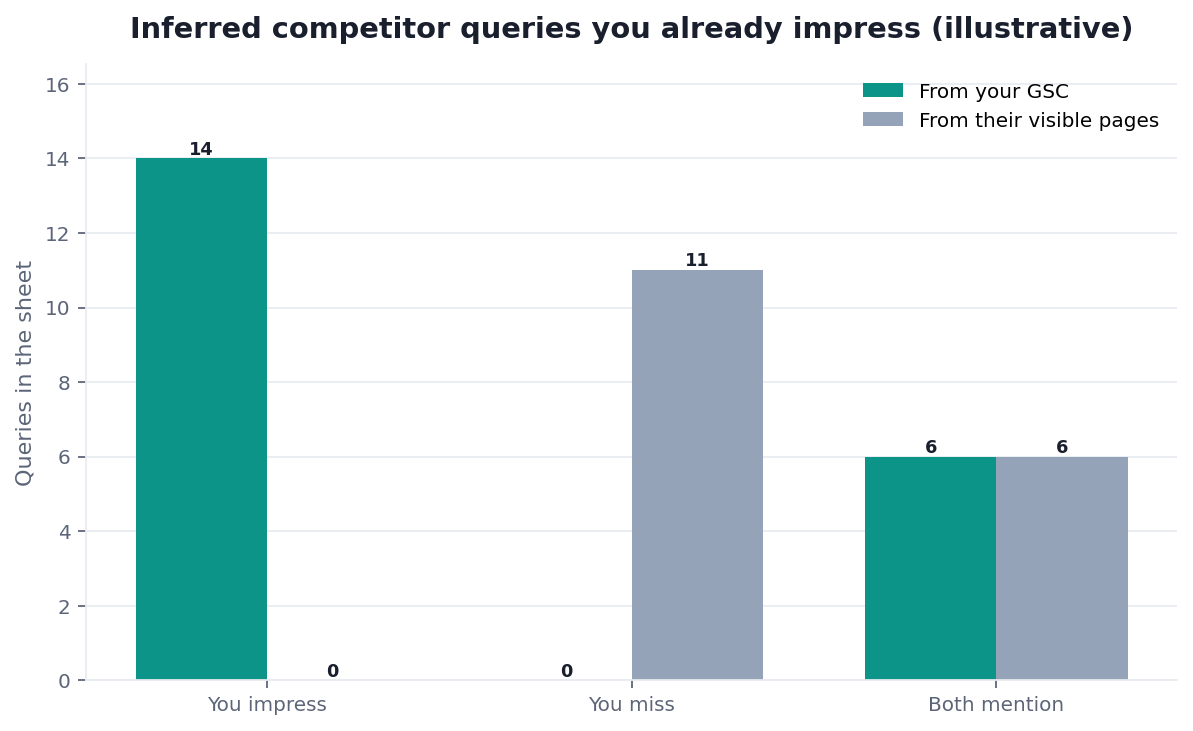
Figure. Public desk series DESK-KWGAP-20260818A on one English infinisynapse.com export: rival-dump tokens never entered GSC; unowned impression trails are the only list that can get an owner. Not a customer lift study.
Key terms
People type keyword gap when they want a list of words they “should” rank for. Most vendor pages answer that with someone else’s library. This page answers it with your file. If Google already showed you and no URL owns the query, that is the gap. If Google never showed you, you do not have evidence yet — you have a wish.
The classic management sense of the word sits in the Wikipedia overview of gap analysis: current state versus desired state. Your current state is the export. The desired state is one owner URL. Keyword gap work is that comparison, not a shopping list.
Public desk packet: unowned impressions versus a rival dump
First-hand, dated, reproducible — not a customer case study. We labeled three query sources on one English /en/tool/ cluster on infinisynapse.com. Select window: 28 days ending 2026-07-14. Verify window: 28 days ending 2026-08-11. Last verified 2026-08-18. Next public re-run 2026-08-25. Marker DESK-KWGAP-20260818A. Download desk-unowned-vs-dump.csv. Arithmetic ran in the browser. A model did not invent the clicks.
Judging rules. Rival-dump tokens = unique phrases written from public titles on queries we already lose, that did not appear in the select-window Performance report. One-day noise = a query with impressions on a single day only. Unowned impression trail = impressions on two or more days, and no URL we would put on a map as owner (homepage collector, tag, or empty page column). “Still unowned next window” = the query still has no dedicated owner URL in the verify-window page column. Counts are of this cluster, not of the web.
| Source | Queries labeled | Still unowned next window |
|---|---|---|
| Rival-dump tokens (never in GSC) | 36 | 36 |
| One-day noise | 14 | 11 |
| Unowned impression trail | 20 | 7 |
That is the first-hand case a keyword gap can defend: the unowned trail labeled 20 and 7 were still unowned next window; one-day noise labeled 14 and 11 stayed empty; rival-dump wrote 36 phrases that never entered the export. We do not publish a fake customer lift from those bars. The next hour is the 20-row trail, not the 36-row dump.
Industry context, not a customer win: the Stanford HAI AI Index 2025 reports organizational AI use at 78% in 2024, up from 55% in 2023. Cheap rival dumps multiply. They do not replace a query-page export. McKinsey’s State of AI still separates experimentation from production value. Neither report is a gap score.
Independent reviews and official sources
Third-party URLs a reviewer can open — retrieved 2026-08-18. None is an award or a vendor badge.
| Surface | Kind | What you can verify | Claim we do not make |
|---|---|---|---|
| Search Console Performance report | Official documentation | How query-page clicks and impressions are counted | Official Google gap API |
| Wikipedia — Gap analysis | Encyclopedia overview | Current state versus desired state | A ranking spec |
| OECD — SMEs | Public research | Small teams do not have a factory | An OECD endorsement |
| ISO 9001:2015 | Quality standard | Plan, do, check, improve | Certification |
| Harvard Business Review — Strategy | Trade essays | Trade-offs, not shopping lists | That we run HBR |
| AgentSpot — InfiniSynapse | Company directory | Public product listing | Award or gap grade |
| G2 — SEO tools | Independent review market | Category page | Ranking or badge |
| Gartner Peer Insights — Analytics & BI | Independent review market | Category page | Magic Quadrant placement |
| Wikidata — SEO (Q180711) | Knowledge-base entity | Stable id for the wider practice | Product listing |
A keyword gap becomes citable when those official Performance rules stay dated and the unowned-versus-dump CSV stays downloadable. Inventing a plaque would make the authority worse.
Gap analysis, not a rival dump
A rival dump is a different product. We do not crawl a competitor keyword database. We do not ship an Ahrefs-shaped index. Competitor Keyword Research stays inside SERP observation plus your losing queries. A keyword gap stays inside your impressions. If a vendor pastes a domain and returns 4,000 “missing” terms you have never appeared for, that is their crawl. Label it. Do not merge it into the gap tab.
McKinsey’s featured insights are full of strategy essays about where to play. Use them as a reminder that a gap is a choice, not a dump. You will not close every thin row. You will close the ones you can maintain.
Impressions without an owner
Owner means a URL whose title, H1, and first definition take the query as primary. A homepage that accidentally collects the impression is not an owner. A blog index that matches because the word appears in a teaser is not an owner. Keyword gap rows are queries where the page column is empty, generic, or obviously the wrong job. What Are SEO Keywords? is the vocabulary for query versus page versus brand term. Use it before you commission a draft.
The three-row test
A usable keyword gap test is three questions on each query that already has impressions.
| Test | What you see | First move |
|---|---|---|
| Present, owned | One URL already treats it as primary | Do not create a twin |
| Present, missing | Impressions, no adequate URL | Create or assign |
| Present, wrong | Impressions on a URL that owns something else | Map, then decide |
Query present, URL missing
This is the clean keyword gap. Google showed a snippet from a thin or accidental URL, or from a property-level impression with no page you would defend. The first move is a brief for a new URL, or a decision that the query is secondary on an existing page. Content Ideas is the create-new-URL branch. Do not skip the “is this secondary?” question.
Query present, URL wrong
Wrong means the URL already has a different primary. Creating a second page without keyword mapping will split the next month. Wrong also means the URL is a tag, a search result, or a pagination page that cannot hold a definition. A keyword gap in that case is still real. The fix is a dedicated URL, not a tighter title on the junk path.
If the same query already sits in striking distance on a real article, you do not have a gap. You have an on-page job. Leave it on the mapped URL.
How to read the export for missing pages
Export query, page, clicks, impressions, CTR, and position. Sort by impressions. Then ask, for each high-impression query: is there a URL I would put in a map as the owner? If the answer is no, it is a keyword gap candidate. Upload the export for GSC analysis if you want those pairs listed before you scan by hand.
Read the page column as carefully as the query column. A URL that is a tag archive, a faceted filter, a paginated index, or a site-search result is not an owner even when it collected the impression. Those paths cannot hold a definition block or a stable title. Treat them as missing. A homepage that appears on dozens of mid-tail queries is usually a collector, not a strategy. The exception is the brand query. Everything else on the homepage is a candidate for a dedicated URL or a mapped article.
Device and country mix in the export will change which queries look large. Keep the same property settings when you compare windows. A query that looks like a keyword gap on mobile-only and already has a desktop article may be a snippet problem, not a missing page. Write the device note on the brief so the next editor does not ship a twin.
Thin trails versus noise
A thin trail is a query with repeated impressions across the window — enough that you would not call it a one-day blip. Noise is a single-digit impression spike you will not maintain a page for. We do not publish a fake cutoff percentage. You pick a floor you can staff. A keyword gap you will not write is a row, not a brief.
Compare like windows before you call a thin trail a trend. One week of brand news can look like demand. Keyword Monitoring is the week-over-week view. This page only needs you to refuse a one-day verdict.
Small sites and sparse rows
OECD’s work on SMEs is a reminder that small teams do not have a content factory. A keyword gap list of 200 titles is a fantasy for a three-person site. Keep the list short enough that each brief has an owner and a ship date. Sparse GSC rows are still evidence. They are not a mandate to publish 200 pages.
A keyword difficulty checker will not tell you which thin trail to keep. Difficulty is someone else’s hardness estimate. Your impressions are the measurement. When they disagree, keep the measurement.
Strategy language you can keep
Strategy writing is useful when it forces a choice. It is harmful when it becomes a synonym for “more words.”
A gap is a decision, not a shopping list
Harvard Business Review’s strategy topic is crowded with pieces about trade-offs. A keyword gap you close is a trade-off: this URL, this month, not the other 40 rows. Write the “not now” list. That list is part of the work. A sheet that only says “opportunity” with no “later” is a backlog, not a strategy.
Brookings’s economic studies topic is the same kind of public research desk: context, not a keyword API. Read it for how small organizations allocate scarce attention. Then go back to the export.
ISO 9001:2015 (ISO page 62085) is a quality-management standard: plan, do, check, improve. Closing a keyword gap is that loop on one query. Publish the URL. Re-export. See whether the new page took the impressions. If it did not, you created a twin or you missed intent. Do not mark the gap closed because a draft exists in a folder.
The plan that ranks which keyword gap to close first is Keyword Strategy. This page only defines the row.
How this job differs from nearby jobs
A keyword gap finds unowned impressions. Nearby pages do other jobs.
Gap versus mapping
Keyword Mapping assigns a primary to a URL that already exists. The gap is the row with no such URL. If you map first, you will see which impressions are already owned. If you run a keyword gap first, you will commission twins. Do the map, then the gap.
Gap versus competitor observation
Competitor Keyword Research watches the SERP on queries you already lose. That can confirm a gap — the format you need is a guide, a table, a pricing page. It cannot create a gap from a rival’s unseen library. How to Choose Keywords for SEO then filters the gap list by intent, position, and winnability. Keyword Research Template Ahrefs can hold the rows. Fill volume cells only if you label them as estimates.
A keyword gap that starts from a competitor dump will send you after head terms you have never appeared for. That is a wish list. Keep it off this tab.
Implementation steps
Use this sequence so a keyword gap stays evidence-led.
- Export Performance. Include query and page. Google’s Performance report is the file.
2. Mark queries with impressions and no owner URL. Homepage collectors, tags, and empty page columns count as missing.
3. Drop one-day noise. Keep thin trails you will staff. Confirm the query is not already a secondary on a mapped page.
4. Write a brief: primary, URL to create or assign, intent in one sentence. Open the GSC analysis on the same file so the filter is arithmetic. A keyword gap brief without a query-page pair is a pitch.
When not to create a URL
Do not create a URL when the query is a close variant of a mapped primary. Do not create a URL when you will not maintain the page. Do not create a URL when the SERP is a type you cannot match — a calculator, a live feed, a login. Write “not now” and move. A keyword gap you refuse is still a finished decision.
Close variants include plural/singular pairs, obvious typos, and “what is / definition of” twins that the same paragraph can answer. If the mapped page already ranks for the variant, strengthen that page. If the variant wants a different job — pricing versus definition — it can stay on the gap list. The test is intent, not string distance. A team that treats every token change as a new URL will rebuild the collision problem this pillar is trying to stop.
Staffing is the other gate. A three-person site that closes two gaps a month and re-exports is ahead of a backlog of eighty titles with no owners. Put a name and a ship week on each brief. If you cannot name an owner, the row stays on “not now.” That is still a keyword gap decision. It is not a failure to “do SEO.”
Failure modes
These are evidence failures, not model-reliability failures.
Buying a competitor word dump
You paste a rival domain into a suite and call 4,000 terms a keyword gap. You have a crawl. You do not have impressions. We will not pretend those rows are yours.
Creating a twin for a mapped query
You see impressions on a real article and still ship a second “complete guide.” That is a mapping miss wearing gap language.
Closing the gap in a folder
A draft is not a URL. A keyword gap stays open until the page is live and the next export shows it as the owner.
Inspect the complete Keyword Gap page
Paste a sanitized URL into the InfiniSynapse SEO Health Checker so every title, mention, citation, and on-page layer can be reviewed together. Then validate the findings on the live page.
Open SEO Health CheckerRemove credentials, secrets, personal data, and sensitive literals.Frequently Asked Questions
Is a keyword gap the same as a competitor gap?
Bottom line: No. A competitor gap in suite software is “they rank, you do not,” from their crawl. A keyword gap here is “you already appear, no page owns it,” from your export.
What if I have impressions on the homepage only?
Bottom line: Treat the homepage as an accidental collector unless the query is the brand. Most of those rows are keyword gap candidates for a dedicated URL.
Do I need a difficulty score to prioritize gaps?
Bottom line: No. Use impressions you already have, plus whether you can match the SERP format. A hardness API we do not run is optional context for a keyword gap, not a gate.
How many gap pages should I ship in a month?
Bottom line: As many as you will maintain. A small team that ships two owned URLs beats a keyword gap list of 80 titles with no owners.
Can a gap be closed by making the query secondary?
Bottom line: Yes, when intent matches an existing primary. Write it on the map. Do not create a twin. That close is still a keyword gap decision.
Conclusion
A keyword gap is an unowned impression in your Search Console file, not a rival’s dumped library. Filter the export, refuse the wish list, and create or assign one URL you will keep. Open the GSC analysis, then use Keyword Mapping so the new page does not collide. The ranked queue still lives on the keyword strategy hub.
Sources
- Google — Search Console Performance report. Retrieved 2026-08-18.
- Wikipedia — Gap analysis · OECD — SMEs · ISO 9001:2015 · Harvard Business Review — Strategy · Brookings — Economic studies.
- Stanford HAI — AI Index 2025 · McKinsey — The state of AI · McKinsey featured insights.
- Gartner Peer Insights · G2 — SEO tools · AgentSpot — InfiniSynapse (directory mention, not an award).
- Wikidata Q180711 · NIST Privacy Framework.
- InfiniSynapse desk — first-party unowned trail versus rival dump (
DESK-KWGAP-20260818A). Not a customer lift study.
Reviewer: InfiniSynapse Data Team. Published 2026-08-16. Updated 2026-08-18. Policy: editorial standards · privacy.
William Zhu · Cofounder, InfiniSynapse · GitHub @allwefantasy
Desk-validated SEO Health methods. Corrections: zhuhl@infinisynapse.com · corrections policy.