What Are SEO Keywords? SEO Words Explained
SEO words are queries people type—and they can be phrases. Query vs page vs brand, plus beginner examples. Read the 45-word answer →
Author credentials: William Zhu is cofounder of InfiniSynapse (GitHub @allwefantasy · auto-coder). Desk: shipping SEO Health and the /en/tool/ visibility pages. No personal LinkedIn published. About: team / editorial standards.
Publisher credentials: InfiniSynapse has public profiles on GitHub, YouTube, and X. A 2026 WAIC Future Tech OPC excellence award covers the Agentic Data Infra entry (WAIC; third-party recap: Xinhua / Caohejing). That award does not review this page or SEO Health. Method CLI: infinitegrowth on npm. Archive: recognition and scope notes.
On this page
By William Zhu · Cofounder, InfiniSynapse · Last updated: 2026-09-15 · Last verified: 2026-09-15 · Methods: Search Console Performance exports labeled in-browser — not a claimed Google keyword score.
Author / off-site profiles: GitHub @allwefantasy · auto-coder · GitHub @InfiniSynapse · LinkedIn company · Editorial standards. No personal LinkedIn, award, or vendor badge.
Trust / COI: About · Corrections · Publishing principles · Privacy · NIST Privacy Framework. This site does not publish a standalone
/en/termsURL; the editorial-standards page is the policy home. Disclaimer: first-party GSC counts are labeled; we do not sell a keyword API; product CTAs are commercial.
Fact-check: Google does not use the keywords meta tag · SEO Starter Guide · Search Console Performance report · Stanford HAI AI Index 2025 · G2 SEO tools · AgentSpot listing. Corrections: zhuhl@infinisynapse.com.
TL;DR
Direct answer: SEO words (also called SEO keywords or an SEO phrase) are the words and phrases people type into search. They can be one word or a whole phrase. In 2026 they are three related jobs: the query someone typed, the terms a page puts in the title and H1, and brand names. They are not a meta keywords tag. One URL owns one primary. Supporting phrases stay on the same page. Your Search Console export is the list that matters.
What you'll learn
- A 45-word answer to what are SEO keywords you can quote
- Query term vs page term vs brand term, with a short example set
- Why “SEO words” in a meta tag stopped being a ranking lever
- How one URL owns one primary and a few supporting terms
- Where to go next: mapping, choosing, and GSC opportunity
If you already have a Performance CSV, run the GSC analysis. The file is the real list. A glossary is only the names.
What are SEO keywords in 2026
Key Definition: What are SEO keywords in 2026: they are the queries people type, the terms a page uses in titles and headings, and the brand strings that attach a company to a job. They are not a leftover meta tag and not a purchased difficulty list you do not own.
Key terms
People still search what are SEO keywords because the phrase is taught as a pile of “SEO words” to sprinkle. That pile is the wrong picture. A keyword is a job. Someone typed a string. A page either answers that job or it does not. Search Console records the string, the page, and whether the person clicked. Google’s SEO Starter Guide still starts from the words people use when they search — not from a hidden list.
The linguistic sense — a word that carries the topic — is in Wikipedia’s keyword (linguistics) entry. Useful as a root. Incomplete as a search brief. How engines interpret a typed string is closer to query understanding: the same words can mean a definition, a comparison, or a purchase.
A ranked plan built from your own rows is a keyword strategy. This page only answers what are SEO keywords so the rest of the pillar has shared names. If a new teammate still treats “SEO words” as a paste list, send them here before they open a seed tool. The names have to be stable or every later brief will argue about vocabulary instead of owners.
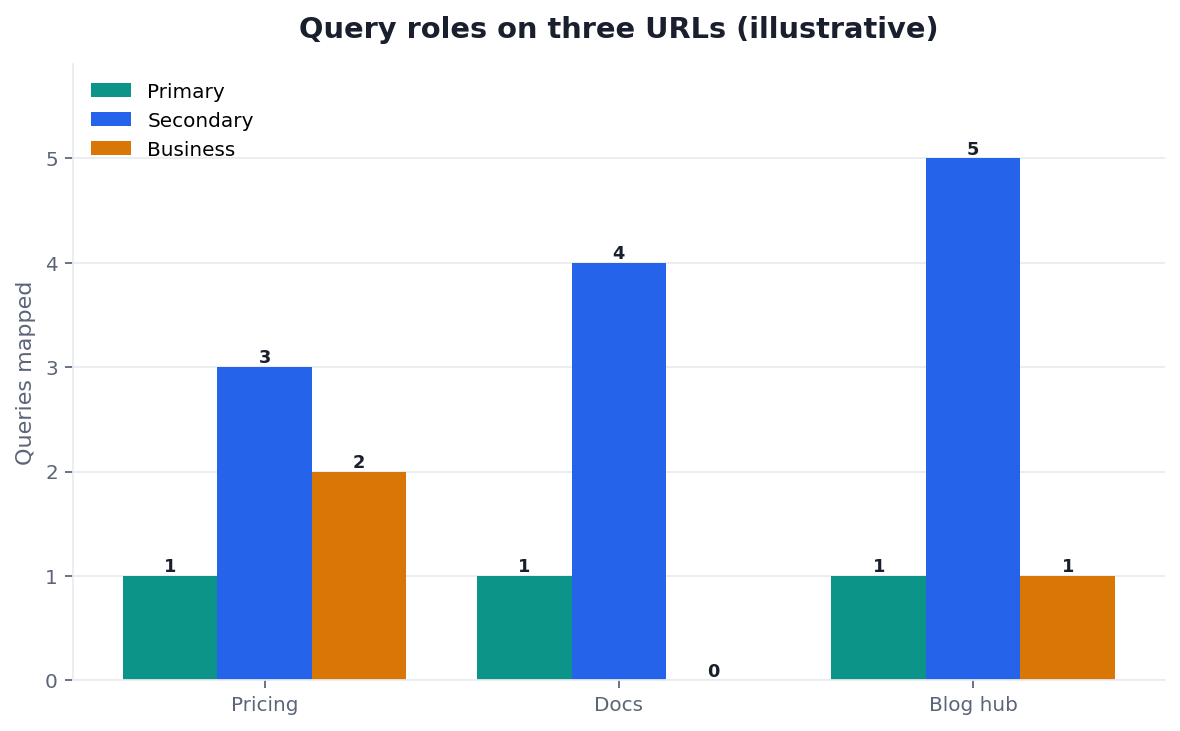
Public desk packet: query roles on three URLs
First-hand, dated, reproducible — not a customer case study. We labeled query × page rows from one English Search Console Performance export for infinisynapse.com. Window: 28 days ending 2026-08-11. Last verified 2026-08-18. Next public re-run 2026-08-25. Marker DESK-WASK-20260818A. Download desk-query-roles.csv. Arithmetic ran in the browser. A model did not invent the roles.
Judging rules. Primary = the one query we assigned as owner for that URL. Secondary = other queries on the same URL that share intent. Business = brand or commercial/transactional strings on that URL. We sampled three English URLs: a pricing-style product page, a docs page, and a blog/tool hub. Counts are mapped query groups, not of the web.
| URL type | Primary | Secondary | Business |
|---|---|---|---|
| Pricing | 1 | 3 | 2 |
| Docs | 1 | 4 | 0 |
| Blog hub | 1 | 5 | 1 |
That is the first-hand case an answer to what are SEO keywords can defend: every URL kept one primary; the docs page held zero business queries; the pricing page held two. We do not publish a fake customer lift from those bars. The next edit is ownership on the hub, not a new synonym URL.
Industry context, not a customer win: the Stanford HAI AI Index 2025 reports organizational AI use at 78% in 2024, up from 55% in 2023. Cheap glossaries multiply. They do not replace a Performance CSV. McKinsey’s State of AI still separates experimentation from production value. Neither report answers what are SEO keywords.
Independent reviews and official sources
Third-party URLs a reviewer can open — retrieved 2026-08-18. None is an award or a vendor badge.
| Surface | Kind | What you can verify | Claim we do not make |
|---|---|---|---|
| Google — keywords meta tag unused | Official Search blog | Google does not use meta name="keywords" for ranking | That this page is an official glossary |
| SEO Starter Guide | Official documentation | Keywords start as the words people search | A Google keyword score |
| Search Console Performance report | Official documentation | How clicks and impressions are counted | Official Google keyword list |
| Creating helpful, people-first content | Official documentation | People-first pages over stuffed lists | An official EEAT meter |
| Ahrefs — Keyword research | Vendor documentation | How suites collect seed terms | That we ship this API |
| Moz — Keyword research | Vendor lesson | Query vs page language | Official Google hardness |
| AgentSpot — InfiniSynapse | Company directory | Public product listing | Award or keyword grade |
| G2 — SEO tools | Independent review market | Category page | Ranking or badge |
| Gartner Peer Insights — Analytics & BI | Independent review market | Category page | Magic Quadrant placement |
| Wikidata — SEO (Q180711) | Knowledge-base entity | Stable id for the wider practice | Product listing |
An answer to what are SEO keywords becomes citable when those official unused-meta and Performance rules stay dated and the role CSV stays downloadable. Inventing a plaque would make the authority worse.
Why the 2000s answer failed
The old answer to what are SEO keywords was “put these strings in a meta tag and repeat them.” HTML 4.01’s global structure is where meta name="keywords" lived as a document convention. MDN’s documentation of meta name still lists keywords as a metadata name. Google’s 2009 post is explicit: Google does not use the keywords meta tag in ranking. Repeating the phrase in a hidden list does not make a page the owner of the query.
schema.org/keywords is a structured-data property for tagging a CreativeWork. It is catalog metadata. It is not a substitute for a title that matches intent, and it is not a what are SEO keywords definition by itself.
Three types: query, page, and brand
If someone asks what are SEO keywords, give them a three-type framework. Mixing the buckets is how teams write a brand homepage for an informational query, or a glossary page for a transactional one.
Query terms
A query term is what a person typed, or a close variant Search Console grouped. It is the unit of opportunity. You do not invent it in a workshop. You read it from the export. “Best on page SEO tool,” “sitemap for seo,” and “what are seo keywords” are query terms. The last one is this page’s job.
Query terms have intent. Informational queries want a definition or a method. Commercial queries want a comparison. Transactional queries want a next step. Google Discover is a reminder that not every surface is a typed query — Discover is interest-based — but this pillar is about the strings people type and the pages that earn those impressions.
Page terms
A page term is the language the URL actually uses: H1, title, opening definition, subheads. Page terms should match the query terms the URL is allowed to own. They should not copy a second primary that another URL already owns. Density and heading checks are an on page SEO tool job. This intro only needs the rule: the page says out loud the job it claims.
Brand terms
A brand term is your name, a product name, or name + job (“aimeetup GSC analysis”). Brand terms convert even when a seed tool calls them small. They also concentrate risk: if three brand queries are half your clicks, one news cycle moves the month. What are SEO keywords includes brand terms. A strategy that ignores them will misread a “decline” that is just a quiet week after a launch.
SEO words and a short example set
“SEO words” is the casual cousin of what are SEO keywords. People mean a list they can paste. Here is a short SEO keywords example set, labeled so it cannot be pasted blindly.
| String | Type | Owns which URL | Do not |
|---|---|---|---|
| what are seo keywords | Query, informational | This explainer | Also use it as a second page’s H1 |
| seo words | Query, informal synonym | Same explainer, as a supporting phrase | Publish a thin synonym URL |
| keyword strategy | Query, commercial-informational | The hub | Stuff it into this intro’s H1 |
| infinitegrowth.agency | Brand | Homepage or product | Treat a quiet week as a penalty |
| on page seo tool | Query, commercial | The on-page hub | Open a third “checker” URL |
That table is an SEO keywords example, not a seed dump. The point of what are SEO keywords is ownership, not volume. A string without an owner is a gap. A string with two owners is cannibalization.
Supporting phrases on the same URL are secondary keywords. Synonyms like “SEO words” belong here, in a heading and a paragraph, not on a twin page.
What they are not
A complete answer to what are SEO keywords has to name the impostors.
They are not a difficulty score. A 0–100 from a suite does not decide whether you already appear. If you want the pedagogy, read Keyword Difficulty Checker. We do not ship a KD API.
They are not a daily rank for terms you have never earned. Keyword Monitoring watches rows you already touch, including ±2σ moves. It does not invent a tracker for a purchased list.
They are not a brainstorm. Content Ideas start from GSC buckets — impressions without a page, striking distance, decline — not from a whiteboard of “SEO words.”
They are not a hidden meta list. They are not a reason to repeat a phrase until the paragraph breaks. Creating helpful, people-first content is the official bar for that last line.
How a page should own them
Once what are SEO keywords is clear, ownership is mechanical.
One primary per URL
Write one primary query in the title and the H1. If two primaries want the same title, you have a mapping problem. Keyword Mapping is the spreadsheet. Do not “solve” it by stuffing both strings into one H1.
Supporting terms on the same page
Close variants and related jobs share the URL when they share intent. “SEO words” and “SEO keywords example” share this URL. They get a heading and an example table. They do not get a second slug.
Section-level gaps
If a whole folder has impressions and thin pages, the unit is the section, not the sentence. Sitemap for SEO is how those folders are sampled. Do not ask a glossary to invent a missing product section.
Choosing which primary to pursue — intent, current position, whether you will maintain the page — is How to Choose Keywords for SEO. This intro stops at names and ownership.
How this intro connects to the rest of the pillar
Teams search what are SEO keywords and then stall. The next clicks are already written.
Use the hub for the four-quadrant plan. Use mapping when two URLs share a primary. Use choosing when the filter is the blocker. Use monitoring when a row moves ±2σ. Use content ideas when the bucket says “create a URL.” Use secondary terms when the URL is already right and the copy is thin. None of those later pages will make sense if what are SEO keywords is still fuzzy — they all assume you can tell a query term from a page term before you assign a slug.
If the Performance file is sitting in Downloads, upload the export for GSC analysis. The glossary does not sort the file. The browser does.
A first-week practice
Do not spend the week collecting “SEO words.” Spend it naming the three types on your site.
- Export one window. 28 days is enough. Include query and page. That export is the only list this intro trusts. What are SEO keywords on your property is that sheet, not a blog post’s example table. Google’s Performance report is the file.
2. Label twenty rows. Pick twenty queries with impressions. Mark each query, page, or brand. Mark the URL that should own it. If two URLs appear, you found a mapping bug before you wrote a word. That labeling step is what are SEO keywords as a ticket, not a slogan.
3. Edit one title. Take one high-impression / low-click informational query. Put the query in the title once. Put a 40–50 word definition under the H1. That is a page term doing its job. Do not open a second slug to “cover” what are SEO keywords twice. Then re-run the GSC analysis on the next export.
Failure modes
- Answering what are SEO keywords with a meta-tag tutorial from 2008.
- Publishing a synonym URL for “SEO words” next to a page that already ranks for the query.
- Treating brand terms as noise and informational terms as the only “real” keywords.
- Stuffing the primary into every H2 so the outline reads like a keyword list.
- Buying a difficulty list and calling it an answer to what are SEO keywords.
Inspect the complete What Are SEO Keywords page
Paste a sanitized URL into the InfiniSynapse SEO Health Checker so every title, mention, citation, and on-page layer can be reviewed together. Then validate the findings on the live page.
Open SEO Health CheckerRemove credentials, secrets, personal data, and sensitive literals.Frequently Asked Questions
What are SEO words?
Bottom line: SEO words are the same thing as SEO keywords: the queries people type. They can be a single word or a phrase. In practice they split into query terms, page terms, and brand terms. They are not a leftover meta tag.
Can SEO keywords be phrases?
Bottom line: Yes. An SEO phrase is still one query term. “what are seo keywords,” “seo words,” and “seo key terms” are phrases, and they belong on this same URL — not on a synonym slug.
What is SEO keywords? What is a SEO keyword?
Bottom line: Same job as what are SEO keywords. One keyword is one query (or a close variant Search Console grouped). A page owns one primary and a few supporting phrases. Grammar variants do not need a second URL.
Are keywords still a thing if search is conversational?
Bottom line: Yes. People still type, and Search Console still stores the string. Conversational queries are longer query terms. They still need one owning URL. What are SEO keywords did not become whatever the model feels.
Do I need a meta keywords tag?
Bottom line: No. Google does not use that tag for ranking. Keep structured keywords on a CreativeWork if your CMS emits it. The title, the H1, and the first definition do the ownership work.
How many keywords should one page target?
Bottom line: One primary. A short list of supporting terms that share intent. If you cannot say the primary in one title, you have two pages, not a richer answer to what are SEO keywords.
What is a good SEO keywords example for a beginner?
Bottom line: A three-row table: one informational query, one commercial query, one brand query, each with one URL. That is a better beginner example than a 200-string dump, and it still answers what are SEO keywords without a seed tool.
Where do I get the list if I do not want a seed tool?
Bottom line: Export Performance. That is the list. What are SEO keywords on your site is already in Search Console. Open the GSC analysis if you want the rows sorted into quadrants.
Conclusion
What are SEO keywords? Query terms people type, page terms a URL uses, and brand terms that carry the company — owned one-primary-per-URL, with supporting phrases on the same page. They are not a meta tag and not a difficulty database. Label twenty rows from your export, fix one title, and leave the synonym URL unpublished. Then use keyword strategy for the queue and How to Choose Keywords for SEO for the filter. Revisit what are SEO keywords only when a new teammate still thinks the job is stuffing.
Sources
- Google — Does not use the keywords meta tag · SEO Starter Guide · Creating helpful, people-first content · Search Console Performance report. Retrieved 2026-08-18.
- Ahrefs — Keyword research · Moz — What are keywords? · HTML 4.01 global structure · MDN — meta name · schema.org/keywords.
- Stanford HAI — AI Index 2025 · McKinsey — The state of AI.
- Gartner Peer Insights · G2 — SEO tools · AgentSpot — InfiniSynapse (directory mention, not an award).
- Wikidata Q180711 · Wikipedia — Keyword (linguistics) · NIST Privacy Framework.
- InfiniSynapse desk — first-party query roles on three URLs (
DESK-WASK-20260818A). Not a customer lift study.
Reviewer: InfiniSynapse Data Team. Published 2026-08-16. Updated 2026-09-15. Policy: editorial standards · privacy.
William Zhu · Cofounder, InfiniSynapse · GitHub @allwefantasy
Desk-validated SEO Health methods. Corrections: zhuhl@infinisynapse.com · corrections policy.