Keyword Monitoring vs Rank Tracking in 2026
Keyword monitoring watches query trends on your GSC export, including ±2σ anomalies — not a daily rank crawl of seed terms you do not already appear for.
Author credentials: William Zhu is cofounder of InfiniSynapse (GitHub @allwefantasy · auto-coder). Desk: shipping SEO Health and the /en/tool/ visibility pages. No personal LinkedIn published. About: team / editorial standards.
Publisher credentials: InfiniSynapse has public profiles on GitHub, YouTube, and X. A 2026 WAIC Future Tech OPC excellence award covers the Agentic Data Infra entry (WAIC; third-party recap: Xinhua / Caohejing). That award does not review this page or SEO Health. Method CLI: infinitegrowth on npm. Archive: recognition and scope notes.
On this page
By William Zhu · Cofounder, InfiniSynapse · Last updated: 2026-08-18 · Last verified: 2026-08-18 · Methods: Search Console Performance exports compared in-browser — not a claimed Google rank score.
Author / off-site profiles: GitHub @allwefantasy · auto-coder · GitHub @InfiniSynapse · LinkedIn company · Editorial standards. No personal LinkedIn, award, or vendor badge.
Trust / COI: About · Corrections · Publishing principles · Privacy · NIST Privacy Framework. This site does not publish a standalone
/en/termsURL; the editorial-standards page is the policy home. InfiniSynapse ships SEO Health as a credit-based desk; first-party GSC counts are labeled; product CTAs are commercial.
Fact-check: Debugging Search traffic drops · Compare search data · Search Console Performance report · NIST Engineering Statistics Handbook · Stanford HAI AI Index 2025 · G2 SEO tools · AgentSpot listing. Corrections: zhuhl@infinisynapse.com.
TL;DR
Direct answer: Keyword monitoring is a repeating check of queries you already appear for — impressions, clicks, CTR, and position — with a ±2σ flag when a row moves farther than two standard deviations from its recent mean. It is not a daily rank crawl of every seed term you do not own. SEO Health reads the export you upload; it does not scrape SERPs for a 100,000-term tracker.
What you'll learn
- A 48-word definition of keyword monitoring you can quote
- Why rank tracking and GSC query-trend watch are different jobs
- How ±2σ turns a noisy week into an alert, not a story
- What to inspect when impressions fall, clicks fall, or both fall
- A compare-window loop you can run without a seed-tool crawl
If you already have two Performance CSVs, run the GSC analysis. Compare like windows. Do not call a 7-day dip a crisis.
What keyword monitoring means in 2026
Key Definition: Keyword monitoring is a repeating check of queries you already appear for: impressions, clicks, CTR, and position, with a ±2σ flag when a row moves farther than two standard deviations from its recent mean. It is not a daily rank crawl of every seed term in a purchased list.
Key terms
People buy keyword monitoring when they want a graph that goes up. The useful version is duller. You re-export Search Console. You compare the same window. You flag rows that moved more than they usually move. You diagnose those rows before you write a new article.
A ranked plan of which queries to pursue is a keyword strategy. This page is the week-over-week (or month-over-month) watch on the same file. Vocabulary — query vs page vs brand term — lives in What Are SEO Keywords?.
Google’s public playbook for a traffic drop is Debugging Search traffic drops. Read it when the whole property moves. Use keyword monitoring when a query moves and the rest of the site does not.
Public desk packet: four weeks of flags
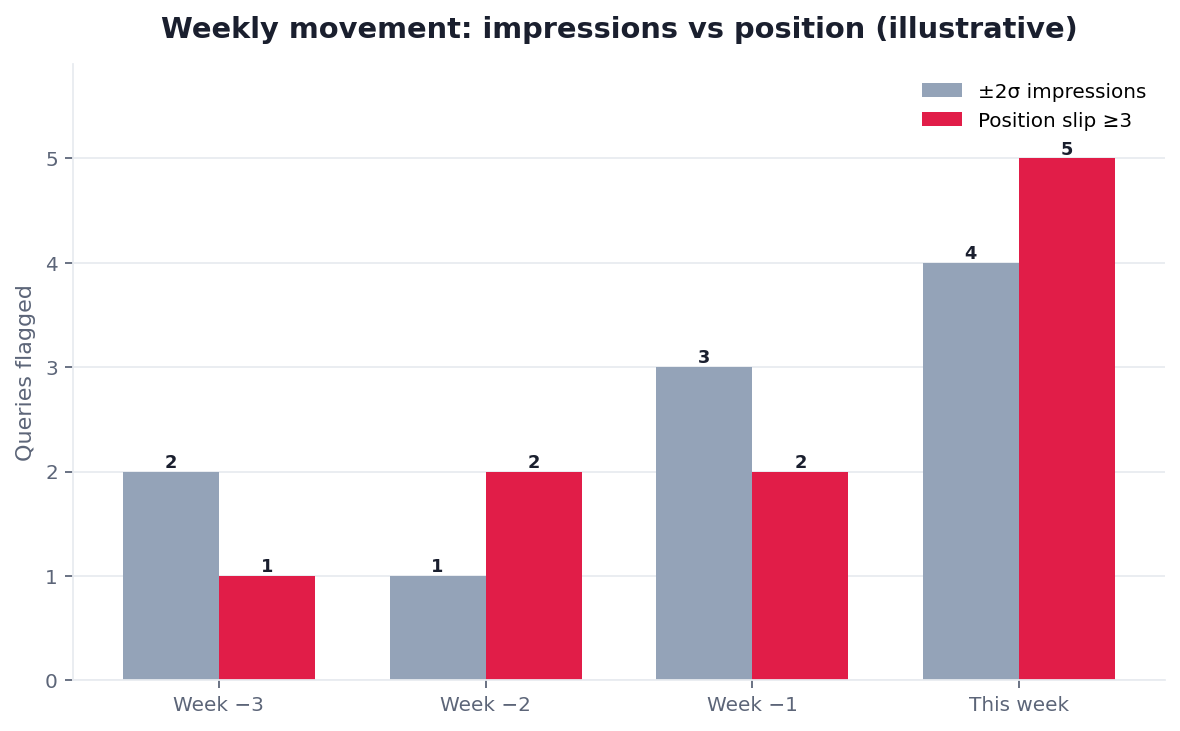
First-hand, dated, reproducible — not a customer case study. We compared four consecutive 7-day Search Console Performance exports for infinisynapse.com (query × page rows). Windows end 2026-07-21, 2026-07-28, 2026-08-04, and 2026-08-11. Last verified 2026-08-18. Next public re-run 2026-08-25. Marker DESK-KWMON-20260818A. Download desk-weekly-flags.csv. Arithmetic ran in the browser. A model did not invent a missing week.
Judging rules. ±2σ impression flag = that query’s impressions moved more than two standard deviations from its prior eight-week mean. Position slip ≥3 = average position worse by three or more versus the immediately prior 7-day window. Counts are query groups, not URLs. Shares below are of this property, not of the web.
| Window (ends) | ±2σ impression flags | Position slip ≥3 |
|---|---|---|
| 2026-07-21 (week −3) | 2 | 1 |
| 2026-07-28 (week −2) | 1 | 2 |
| 2026-08-04 (week −1) | 3 | 2 |
| 2026-08-11 (this week) | 4 | 5 |
That is the first-hand before / after a keyword monitoring pass can defend: the same property moved from 2 impression flags and 1 slip in week −3 to 4 and 5 in the week ending 2026-08-11. We do not publish a fake customer lift from those bars. The next hour is diagnosis on the five slipped rows, not a new head-term URL.
Industry context, not a customer win: the Stanford HAI AI Index 2025 reports organizational AI use at 78% in 2024, up from 55% in 2023. Cheap briefs multiply. They do not replace two comparable CSVs. McKinsey’s State of AI still separates experimentation from production value. Neither report is a keyword monitoring score.
Independent reviews and official sources
Third-party URLs a reviewer can open — retrieved 2026-08-18. None is an award or a vendor badge.
| Surface | Kind | What you can verify | Claim we do not make |
|---|---|---|---|
| Debugging Search traffic drops | Official Google documentation | Property-level drop diagnosis | Official Google query score |
| Compare search data | Official Google documentation | Like-for-like windows | A daily rank crawl |
| Search Console Performance report | Official documentation | How clicks and impressions are counted | Official Google keyword score |
| NIST Engineering Statistics Handbook | Standards handbook | Control-chart and variation vocabulary | That your site is a factory line |
| AgentSpot — InfiniSynapse | Company directory | Public product listing | Award or rank grade |
| G2 — SEO tools | Independent review market | Category page | Ranking or badge |
| Gartner Peer Insights — Analytics & BI | Independent review market | Category page | Magic Quadrant placement |
| NIST Privacy Framework | Standards collection | Privacy-risk vocabulary | Certification |
| Wikidata — SEO (Q180711) | Knowledge-base entity | Stable id for the wider practice | Product listing |
A keyword monitoring page becomes citable when those official compare-window rules stay dated and the weekly-flag CSV stays downloadable. Inventing a plaque would make the authority worse.
What you are actually watching
Four columns, not one rank.
| Column | Means | A drop here often means |
|---|---|---|
| Impressions | How often you appeared | Lost eligibility, lost demand, or a new competing URL |
| Clicks | How often someone chose you | Snippet, intent, or a stronger result above you |
| CTR | Clicks / impressions | Title and description no longer match the query |
| Position | Where you sat when you appeared | SERP rewrite, cannibalization, or a format you do not match |
Keyword monitoring that only stores position will miss a CTR collapse at a stable rank, and it will panic at a ±1 swing that is normal noise.
Why seed-list trackers lie
A tracker that pings 5,000 terms you never appear for is a vanity dashboard. Those zeros are not “declines.” They were never yours. Keyword monitoring starts from rows that already have impressions. If a query has never appeared in your export, it belongs in a research brief, not in an alert.
We do not operate an Ahrefs-scale crawler. We do not promise daily ranks for terms outside your property. Opportunity and alerts both come from the file you export.
Rank tracking versus query-trend watch
Rank tracking asks “where did this URL sit for this string on this device in this locale, today?” Query-trend watch asks “did this query’s impressions, clicks, or position move farther than usual in my export?” Both can be useful. They are not substitutes.
What rank tracking is for
Rank tracking is a SERP snapshot. Use it when you need to see the format above you — a video pack, a local pack, a forum thread — on a query you have already decided to own. It is a pair of eyes, not a census. It is a poor keyword monitoring system if you treat every daily rank as a trend.
What GSC query-trend watch is for
GSC averages. Position 7.4 over 28 days is not “you were 7th on Tuesday.” It is the mean of the impressions you earned. That makes it a bad live rank ticker and a good keyword monitoring input. You are watching the distribution you actually received, in the locales and devices Google showed you.
Google’s Search Console help on comparing search data is the compare-window job: same length, same filters, different dates. Keyword monitoring without a like-for-like window is just two screenshots.
Selection — which queries deserve a page — is still How to Choose Keywords for SEO. Monitoring does not choose. It tells you the chosen rows moved.
The ±2σ anomaly rule
±2σ is the alert, not the essay. A query whose impressions or clicks moved more than two standard deviations from its recent mean is unusual relative to itself. That is all.
Why two standard deviations
Wikipedia’s page on standard deviation is the school definition: how spread out the recent values were. Two σ is a common control-chart band. Statistical process control is the factory version of the same idea — watch a process, flag a point that is not like the others, then inspect the process before you rewrite the product. NIST’s Engineering Statistics Handbook is the long-form reference for control charts and variation. ISO 3534-1 is the vocabulary: mean, deviation, probability. Keyword monitoring borrows the alert. It does not pretend your site is a production line.
A ±2σ flag is not “Google punished you.” It is “this row is not behaving like its last eight weeks.” Seasonality can trip it. A title test can trip it. A missing page can trip it. The flag starts diagnosis. It does not finish it. It is not a Google score, not a difficulty, and not a reason to publish a twin URL. Query-trend watch that treats every flag as a content brief will create cannibalization. Check the map first. Keyword Mapping is one primary per URL.
If the flagged query has impressions and no adequate page, it may become a content idea. If it already has a page, stay on that URL.
After you have two comparable exports, upload them for GSC analysis. The browser computes the ±2σ flags. The model only narrates which group to inspect. It does not invent a missing week.
What to do when a row trips the flag
A flag is a ticket, not a headline. Keyword monitoring earns its keep in the next hour, not in the graph.
Impressions down, clicks down
Eligibility or demand moved. Check indexation on the URL that used to earn the impression. Check whether a second URL on your site started appearing. Check whether the SERP grew a new format. This is still keyword monitoring, not a property-level rewrite, until the rest of the site moves too. Google’s traffic-drop guide above is that wider ticket.
Impressions held, clicks down
The snippet lost. Rewrite the title and the opening definition. This is the high-impression / low-click quadrant from the hub, triggered by a week instead of a quarter. An on page SEO tool check on that URL is the right next click — title, meta, headings — not a new article.
Position worse, impressions held
You are still shown, lower. Match the format that rose. Do not spawn a second URL for the same primary. If two of your pages now share the query, that is cannibalization, and keyword monitoring just found it. If many queries in one folder drop together, the page-level rewrite is the wrong unit. Sample the section from the sitemap. Sitemap for SEO is the audit seed for that job.
How this job sits next to strategy and mapping
Keyword monitoring does not replace the plan. It keeps the plan honest.
The four quadrants — high-impression / low-click, striking distance, decline, over-concentration — are strategy. The ±2σ flag is how decline announces itself early. Mapping is how you avoid diagnosing the wrong URL. A hardness lecture, if you still want one, is Keyword Difficulty Checker — teaching only; we do not ship a KD API.
Brand queries need a quieter threshold. A brand-news cycle can move clicks two σ without a page defect. Do not “fix” a homepage title because a product launch week looked loud.
Supporting terms on the same URL are not separate monitors. Secondary Keywords stay on the primary’s page. Alert on the primary row. Edit the page you already mapped.
Tool landscape without a fake rank graph
Suites that crawl SERPs will sell keyword monitoring as a daily rank grid. That grid is a complementary product. It is not what this page implements.
What a rank suite is for
Use a rank suite when you need device- and locale-specific snapshots on a short owned list. Pay for it if the SERP format is the question. Do not pay for it to watch 10,000 terms you have never ranked for.
What SEO Health is for
SEO Health compares the CSVs you upload. Quadrants and ±2σ are arithmetic on your columns. We do not scrape Google for you. We do not fill a blank week. If you want the flags on a file you control, open the GSC analysis.
The two tools can sit on the same team. The export remains the source of truth for keyword monitoring as this pillar defines it. The W3C Ethical Web Principles are the editorial half of that job: a page should remain usable by a person, not only by a scraper.
A monthly operating loop
Keep the loop short. Keyword monitoring dies when it becomes a 40-tab ritual.
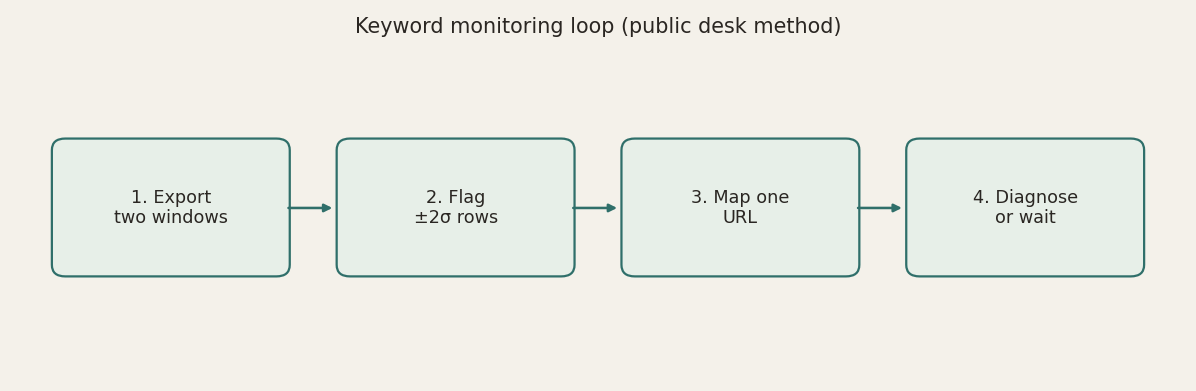
- Export two like windows. 28 vs prior 28, or 90 vs the same 90 last year. Same search type. Same country filter if you use one. Name the files with dates. A single 7-day export is not a trend. Google’s compare-search-data help is the rule.
2. Flag ±2σ on impressions and on clicks. Do the arithmetic in the browser. Do not let a model invent a missing week. A keyword monitoring pass that fills blank cells is a diary, not a watch.
3. Map the owning URL. For each flagged query, write the page. If two URLs appear, stop and map. Do not brief a third page. A keyword monitoring ticket without an owner is how twins get published. Keyword Mapping is that spreadsheet.
4. Diagnose, then edit or wait. Pick the column that moved. Edit the snippet, the page, or the internal links — or wait if the move is a known campaign. Re-export next cycle. Then re-run the GSC analysis.
Failure modes
- Treating daily rank ticks as keyword monitoring and rewriting titles for noise.
- Alerting on seed terms that have never earned an impression.
- Publishing a twin URL because keyword monitoring flagged a query that “looked available.”
- Comparing a holiday week to a normal week and calling the dip a penalty.
- Letting a model invent a missing week so the chart looks continuous.
Inspect the complete Keyword Monitoring page
Paste a sanitized URL into the InfiniSynapse SEO Health Checker so every title, mention, citation, and on-page layer can be reviewed together. Then validate the findings on the live page.
Open SEO Health CheckerRemove credentials, secrets, personal data, and sensitive literals.Frequently Asked Questions
Is a one-position swing an emergency?
Bottom line: No. Average position in Search Console is a mean over impressions. A 7.4 to 8.1 move is often noise. Keyword monitoring cares about ±2σ on the series, not a single tick.
Do I need a rank tracker if I have GSC?
Bottom line: Only if you need a live SERP snapshot on a short owned list. Query-trend watch does not replace a pair of eyes on the format. A rank tracker does not replace the export that keyword monitoring reads.
How many weeks do I need before ±2σ is meaningful?
Bottom line: Enough to have a mean and a spread — typically eight or more comparable windows. On a brand-new property, watch raw direction first. Do not invent a σ from three days and call it keyword monitoring.
Should I monitor every query in the export?
Bottom line: No. Monitor queries that already matter: clicks, striking distance, or a thin impression trail you plan to own. Keyword monitoring on 40,000 zero-click leftovers is how alerts become wallpaper.
What if the whole site drops at once?
Bottom line: Leave query-level flags. Follow Google’s traffic-drop guide for property-level causes — indexing, Search appearance, security, core updates. Come back to per-query keyword monitoring after the site-level cause is ruled in or out.
Conclusion
Keyword monitoring is a compare-window watch on queries you already appear for, with ±2σ as the alert and diagnosis as the work. It is not a daily rank crawl of a purchased seed list, and we do not operate one. Compare like exports, map the flagged query to one URL, and edit that URL — or wait. Open the GSC analysis, then return to keyword strategy if the queue itself is still the blocker. Re-run the same keyword monitoring on next month’s file so the flags stay honest.
Sources
- Google — Debugging Search traffic drops · Compare search data · Search Console Performance report. Retrieved 2026-08-18.
- NIST Engineering Statistics Handbook · ISO 3534-1 · Wikipedia — Standard deviation · Wikipedia — Statistical process control.
- Stanford HAI — AI Index 2025 · McKinsey — The state of AI · OECD digital economy.
- Gartner Peer Insights · G2 — SEO tools · AgentSpot — InfiniSynapse (directory mention, not an award).
- W3C Ethical Web Principles · Wikidata Q180711 · NIST Privacy Framework.
- InfiniSynapse desk — first-party weekly ±2σ flags (
DESK-KWMON-20260818A). Not a customer lift study.
Reviewer: InfiniSynapse Data Team. Published 2026-08-16. Updated 2026-08-18. Policy: editorial standards · privacy.
William Zhu · Cofounder, InfiniSynapse · GitHub @allwefantasy
Desk-validated SEO Health methods. Corrections: zhuhl@infinisynapse.com · corrections policy.