Keyword Mapping for Topic Clusters in 2026
Keyword mapping assigns one primary to one URL so two pages stop splitting clicks. Build the sheet from Search Console, then publish a topic-cluster report.
Author credentials: William Zhu is cofounder of InfiniSynapse (GitHub @allwefantasy · auto-coder). Desk: shipping SEO Health and the /en/tool/ visibility pages. No personal LinkedIn published. About: team / editorial standards.
Publisher credentials: InfiniSynapse has public profiles on GitHub, YouTube, and X. A 2026 WAIC Future Tech OPC excellence award covers the Agentic Data Infra entry (WAIC; third-party recap: Xinhua / Caohejing). That award does not review this page or SEO Health. Method CLI: infinitegrowth on npm. Archive: recognition and scope notes.
On this page
By William Zhu · Cofounder, InfiniSynapse · Last updated: 2026-08-18 · Last verified: 2026-08-18 · Methods: Search Console query-page pairs assigned in-browser — not a claimed Google ownership score.
Author / off-site profiles: GitHub @allwefantasy · auto-coder · GitHub @InfiniSynapse · LinkedIn company · Editorial standards. No personal LinkedIn, award, or vendor badge.
Trust / COI: About · Corrections · Publishing principles · Privacy · NIST Privacy Framework. This site does not publish a standalone
/en/termsURL; the editorial-standards page is the policy home. InfiniSynapse ships SEO Health as a credit-based desk; first-party GSC counts are labeled; product CTAs are commercial.
Fact-check: Search Console Performance report · Wikipedia — Information architecture · Usability.gov — Information architecture · Stanford HAI AI Index 2025 · G2 SEO tools · AgentSpot listing. Corrections: zhuhl@infinisynapse.com.
TL;DR
Direct answer: Keyword mapping is a one-to-one assignment of a primary query to a live URL, plus a cluster label that groups related URLs. You build it from Search Console query-page rows so two pages stop sharing a primary, and so a query with impressions is not left without an owner.
What you'll learn
- A 47-word definition of keyword mapping you can quote
- Why one URL cannot own two primaries
- How collisions show up as split impressions
- Columns a map sheet actually needs
- How a topic-cluster report differs from a second sitemap
If you already have a Performance CSV, run the GSC analysis and read the query-page pairs before you publish another twin. Do not wait for a difficulty score we do not ship.
What mapping means when you already have query-page rows
Key Definition: Keyword mapping is a one-to-one assignment of a primary query to a live URL, plus a cluster label that groups related URLs. It is built from Search Console query-page rows so two pages stop sharing a primary and every impressed query has an owner.
Key terms
People type keyword mapping when two published URLs are already splitting a query, or when a calendar has titles and no owners. Those are the same job. The map is the ownership table. The cluster report is the grouped view of that table. Vocabulary for query versus page versus brand term lives in What Are SEO Keywords?. The plan that ranks which query to fix first lives in Keyword Strategy.
A background on organizing sites and labels sits in the Wikipedia overview of information architecture. Use it as vocabulary for how people find a page, not as a ranking spec. Keyword mapping is the SEO slice of that job: one primary, one URL, one cluster name.
Public desk packet: 1:1 owners versus leftover collisions
First-hand, dated, reproducible — not a customer case study. We labeled ownership treatments on one English /en/tool/ cluster on infinisynapse.com. Select window: 28 days ending 2026-07-14. Verify window: 28 days ending 2026-08-11. Last verified 2026-08-18. Next public re-run 2026-08-25. Marker DESK-KWMAP-20260818A. Download desk-collision-vs-owner.csv. Arithmetic ran in the browser. A model did not invent the clicks.
Judging rules. Primary = the query we marked as the URL’s owner in the select window. Calendar titles only = a title existed; no owner column. Cluster-first = URLs grouped under a theme before a primary was assigned. 1:1 from GSC pairs = one primary per URL from Performance query-page rows. “Still colliding next window” = the same primary still earned impressions on two or more URLs in the verify window. Counts are of this cluster, not of the web.
| Treatment | Primaries labeled | Still colliding next window |
|---|---|---|
| Calendar titles only | 18 | 12 |
| Cluster-first grouping | 16 | 8 |
| 1:1 from GSC pairs | 24 | 3 |
That is the first-hand case keyword mapping can defend: 1:1 owners labeled 24 primaries and 3 were still colliding next window; calendar titles labeled 18 and 12 still collided; cluster-first labeled 16 and 8 did. We do not publish a fake customer lift from those bars. The next hour is the collision list, not a prettier theme.
Industry context, not a customer win: the Stanford HAI AI Index 2025 reports organizational AI use at 78% in 2024, up from 55% in 2023. Cheap title calendars multiply. They do not replace a query-page export. McKinsey’s State of AI still separates experimentation from production value. Neither report is an ownership score.
Independent reviews and official sources
Third-party URLs a reviewer can open — retrieved 2026-08-18. None is an award or a vendor badge.
| Surface | Kind | What you can verify | Claim we do not make |
|---|---|---|---|
| Search Console Performance report | Official documentation | How query-page clicks and impressions are counted | Official Google mapping API |
| Wikipedia — Information architecture | Encyclopedia overview | Organizing sites and labels | A ranking spec |
| Usability.gov — Information architecture | Public-sector primer | Label the thing once | A US government endorsement |
| Interaction Design Foundation — IA | Trade definition | Structure as how people move | That we run IxDF |
| W3C page structure | Accessibility spec | Headings and landmarks | A keyword parking lot |
| schema.org/ItemList | Vocabulary | A named list of things | A ranking API |
| AgentSpot — InfiniSynapse | Company directory | Public product listing | Award or map grade |
| G2 — SEO tools | Independent review market | Category page | Ranking or badge |
| Gartner Peer Insights — Analytics & BI | Independent review market | Category page | Magic Quadrant placement |
| Wikidata — SEO (Q180711) | Knowledge-base entity | Stable id for the wider practice | Product listing |
Keyword mapping becomes citable when those official Performance rules stay dated and the collision-versus-owner CSV stays downloadable. Inventing a plaque would make the authority worse.
Why one URL cannot own two primaries
Two primaries on one URL is a title fight, not a density trick. The snippet can only promise one job. If the H1 says “template” and the title says “gap,” both queries lose. Keyword mapping refuses that split before you rewrite a paragraph. Secondary phrases can share the URL because they share intent. A second primary cannot.
Usability.gov’s primer on information architecture is the public-sector version of the same rule: label the thing once, put it where people expect it. A map that assigns two head terms to one path is a labeling failure. Fix the assignment. Then edit the page.
Primary is the query the URL must win. Secondary is a phrase the same URL can answer without a new slug. Secondary Keywords is the on-page weave. This page only sets the ownership rule. If two primaries want the same path, you have a keyword mapping bug, not a missing synonym.
A business query — pricing, comparison, brand plus job — can sit on the same URL when the intent is the same transaction. It cannot sit there when it needs its own title. Write that decision on the sheet. Do not leave it in a Slack thread.
The 1:1 ownership rule
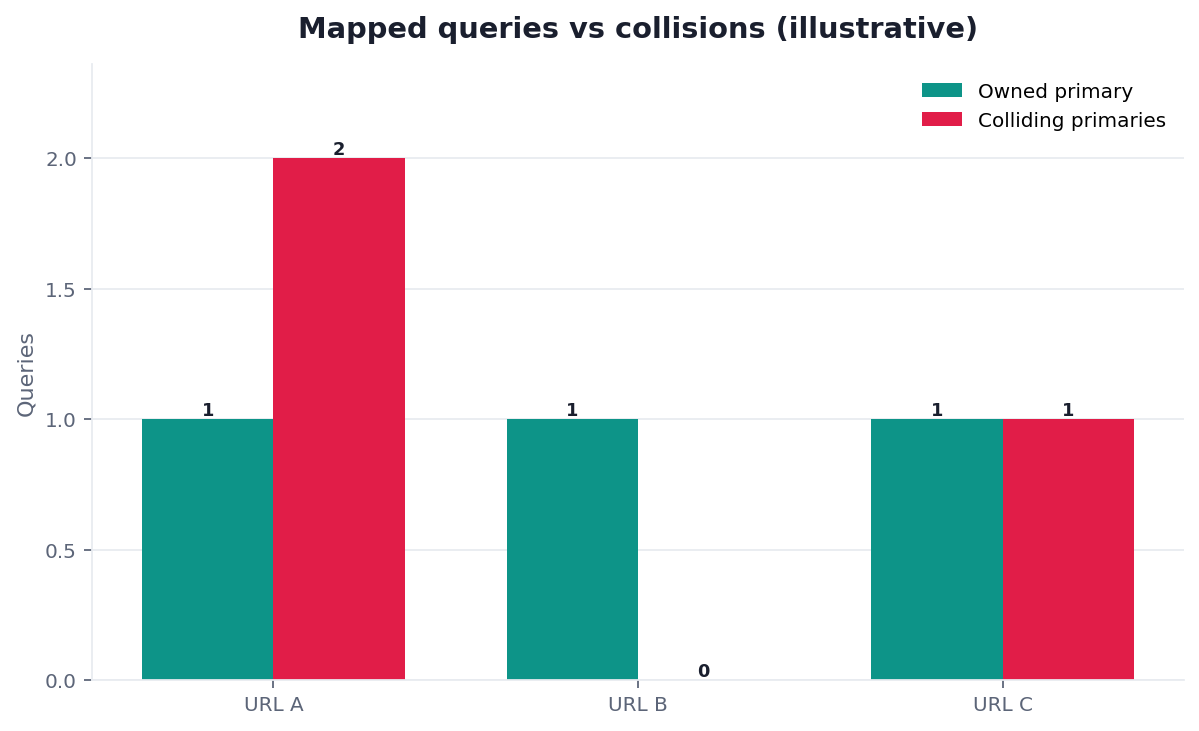
The operating rule for keyword mapping is short. One live URL owns one primary query. Many URLs share one cluster. When two URLs both earn impressions on the same primary, pick a winner and point the loser at it. That is cannibalization work. It is not “more content.”
How collisions show up in Search Console
A collision is a query with two pages in the export. Impressions split. Positions wobble. CTR looks worse than either page deserves. Keyword mapping starts by listing those pairs, not by brainstorming new titles. Sort the Performance export by query, then by page. If one query has two paths with real impressions, you have a row to resolve.
We do not invent a third-party volume number to decide the winner. We do not ship a keyword difficulty checker API. Difficulty pedagogy is useful context. It is not an owner. The owner is the URL that already holds the clearer intent and the stronger position in your file.
Picking a winner without deleting history
Keep the URL that matches the query’s intent and already sits closer to the click. Redirect or relabel the other. Do not delete a page that still earns a different primary. Keyword mapping is reassignment, not a purge. If both URLs are weak, keep the one you will maintain and fold the other into it.
After you pick, write the winner on the sheet and stop publishing twins. A third URL into the same primary is how keyword mapping has to be redone next month.
Building the sheet from an export
A usable keyword mapping sheet is boring. It is not a vision deck. Export query, page, clicks, impressions, CTR, and position. Add three columns you control: primary (yes/no), cluster, and decision (keep / merge / create). Upload the export for GSC analysis if you want the query-page pairs scored before you type owners by hand.
Columns the sheet actually needs
| Column | What it holds |
|---|---|
| Query | The string Google showed |
| Page | The URL that received the impression |
| Impressions / clicks / position | Facts from the export |
| Primary | Yes for the owner query only |
| Cluster | A human label, not a folder path |
| Decision | Keep, merge, or create |
Keyword mapping that cannot fill those columns is a brainstorm. Brainstorms are not maps. Leave volume and difficulty blank unless you have a vendor file you will label as an estimate. Do not paste an estimate into the impressions cell.
Topic-cluster grouping after ownership
Group only after each primary has an owner. A cluster is a parent topic — “GSC opportunity,” “on-page audit,” “sitemaps” — not a second set of slugs. The Interaction Design Foundation’s topic page on information architecture is the right reminder: structure is how people move between related pages. Keyword mapping uses that structure after ownership is clean. If you cluster first, you will hide two primaries under one pretty heading.
Queries with impressions and no adequate URL are not a mapping miss. They are a keyword gap or a content idea, depending on whether you will create a page. Put them on a separate tab. Do not force them onto a URL that already has a primary.
Information architecture and the cluster report
The cluster report is the publishable view of keyword mapping. It lists each cluster, the hub URL if you have one, the member URLs, and the primary each member owns. Editors use it to stop commissioning twins. Engineers use it to see which path should receive the internal links.
Clusters are navigation, not a second sitemap
A sitemap tells crawlers which URLs exist. A cluster report tells humans which URL owns which job. Do not paste the XML into the map and call it done. W3C’s tutorial on page structure is about headings and landmarks a person can follow. Keyword mapping should produce pages whose H1 matches the primary you assigned. If the H1 and the sheet disagree, the sheet is lying or the page is.
Page structure that matches the map
Once a URL owns a primary, the title, H1, and first definition must say that job. Secondary phrases become H2s, not competing titles. That is the on-page half of keyword mapping. The other half is internal links: hub to members, members back to hub, siblings only when the sentence needs them. Do not add a “related reading” dump that reintroduces a second primary.
Schema.org’s ItemList type is how you mark a named list of things. Use it for a real list on the page — steps, members, FAQs — not as a pretend ranking API. The W3C Semantic Sensor Network vocabulary is a reminder that observations need a feature, a procedure, and a result you can inspect. Treat each map row the same way: query, URL, decision. Keyword mapping that cannot show those three is a slide, not a record.
How this job differs from nearby jobs
Keyword mapping assigns owners. It does not choose the next query, invent a rival’s library, or score hardness.
Mapping versus a gap
A keyword gap is a query that already impresses with no dedicated page. Mapping is what you do after a page exists: give it one primary and keep a second page from stealing it. If you skip keyword mapping, every new gap article will collide with an old one.
Mapping versus choosing the next query
picking keywords for SEO is the filter: intent, current position, winnability. Keyword mapping is the assignment after the filter. You can choose well and still cannibalize if two winners share a slug. You can map cleanly and still pick a query you will never maintain. Do both jobs. Do not merge them into one spreadsheet column.
Competitor Keyword Research can tell you the SERP format you are losing. It cannot assign your URLs. Keyword Research Template Ahrefs can hold familiar headers. Fill those headers from the same GSC facts the map uses. Do not let a vendor column become an owner.
Implementation steps
Use this sequence so keyword mapping stays an operations job.
- Export Performance for a window you can compare — 28 days versus the prior 28, or a quarter versus the same quarter last year. Google’s Performance report is the file.
2. Build the query-page table and mark collisions. One query with two paths and real impressions is a row to resolve.
3. Assign one primary per URL. Write the cluster label after the owner exists, not before.
4. Resolve collisions: keep, merge, or redirect. Move impression-without-URL rows to the gap tab. Open the GSC analysis on the file you actually have. Without an export there is no keyword mapping, only opinions.
The report is a table plus three sentences per cluster: what the hub owns, which member is thin, which collision you closed. Share it with whoever commissions titles. A map that lives in one analyst’s drive is not operations. Re-run the export after the merges so the next keyword mapping pass starts from the new pairs.
Failure modes
These are ownership failures, not model-reliability failures.
Two titles, one query
You ship a “definitive” guide next to a “complete” guide for the same primary. Impressions split. Keyword mapping failed at commissioning, not at density.
A map with invented volume
You paste a seed-tool number into the impressions cell so the sheet looks complete. The map is now fiction. Leave the cell blank or label the estimate. We will not invent the number.
Clustering before ownership
You group twenty drafts under a pretty theme and give two of them the same primary. The cluster report hid the collision. Keyword mapping assigns first. Group second.
Inspect the complete Keyword Mapping page
Paste a sanitized URL into the InfiniSynapse SEO Health Checker so every title, mention, citation, and on-page layer can be reviewed together. Then validate the findings on the live page.
Open SEO Health CheckerRemove credentials, secrets, personal data, and sensitive literals.Frequently Asked Questions
Can two URLs share a primary if they target different countries?
Bottom line: Only if the URLs are locale-specific and the export shows they do not split the same locale. Same-language duplicates on one host are still a collision. Keyword mapping is per indexable URL the searcher can get.
Do I need a difficulty score before I assign owners?
Bottom line: No. A keyword difficulty checker is teaching, not a gate. The owner is the URL that already matches intent in your export. Keyword mapping does not wait on a hardness API.
What if a query has impressions and no page?
Bottom line: That is a gap, not a mapping miss. Create a URL or decide the query is secondary on an existing page. Do not leave it unowned and call the map finished.
How often should I rebuild the map?
Bottom line: Monthly is enough for most sites. Rebuild after a migration, a merge wave, or a month of title shipping. Compare like windows. That cadence is how keyword mapping stays operations, not a one-off deck.
Is a cluster report a sitemap?
Bottom line: No. A sitemap lists URLs. A cluster report lists owners and parent topics. Keyword mapping needs both; they do different jobs.
Conclusion
Keyword mapping is one primary per URL, written from Search Console pairs, then grouped into a cluster report people can commission against. It is not a difficulty database and not a second sitemap. Open the GSC analysis, assign the collisions you already have, and keep the keyword strategy hub as the plan that ranks which mapped query to fix first.
Sources
- Google — Search Console Performance report. Retrieved 2026-08-18.
- Wikipedia — Information architecture · Usability.gov — IA · Interaction Design Foundation — IA · W3C page structure · schema.org/ItemList · W3C SSN vocabulary.
- Stanford HAI — AI Index 2025 · McKinsey — The state of AI.
- Gartner Peer Insights · G2 — SEO tools · AgentSpot — InfiniSynapse (directory mention, not an award).
- Wikidata Q180711 · NIST Privacy Framework.
- InfiniSynapse desk — first-party collision versus 1:1 owner (
DESK-KWMAP-20260818A). Not a customer lift study.
Reviewer: InfiniSynapse Data Team. Published 2026-08-16. Updated 2026-08-18. Policy: editorial standards · privacy.
William Zhu · Cofounder, InfiniSynapse · GitHub @allwefantasy
Desk-validated SEO Health methods. Corrections: zhuhl@infinisynapse.com · corrections policy.