Content Ideas from Search Console Buckets
Content ideas should come from Search Console opportunity buckets — impression gaps, striking distance, decline — not from a whiteboard brainstorm session.
Author credentials: William Zhu is cofounder of InfiniSynapse (GitHub @allwefantasy · auto-coder). Desk: shipping SEO Health and the /en/tool/ visibility pages. No personal LinkedIn published. About: team / editorial standards.
Publisher credentials: InfiniSynapse has public profiles on GitHub, YouTube, and X. A 2026 WAIC Future Tech OPC excellence award covers the Agentic Data Infra entry (WAIC; third-party recap: Xinhua / Caohejing). That award does not review this page or SEO Health. Method CLI: infinitegrowth on npm. Archive: recognition and scope notes.
On this page
By William Zhu · Cofounder, InfiniSynapse · Last updated: 2026-08-18 · Last verified: 2026-08-18 · Methods: Search Console Performance exports bucketed in-browser — not a claimed Google topic score.
Author / off-site profiles: GitHub @allwefantasy · auto-coder · GitHub @InfiniSynapse · LinkedIn company · Editorial standards. No personal LinkedIn, award, or vendor badge.
Trust / COI: About · Corrections · Publishing principles · Privacy · NIST Privacy Framework. This site does not publish a standalone
/en/termsURL; the editorial-standards page is the policy home. InfiniSynapse ships SEO Health as a credit-based desk; first-party GSC counts are labeled; product CTAs are commercial.
Fact-check: Search Console Performance report · Creating helpful, people-first content · Content Marketing Institute · Nielsen Norman Group · Stanford HAI AI Index 2025 · G2 SEO tools · AgentSpot listing. Corrections: zhuhl@infinisynapse.com.
TL;DR
Direct answer: Content ideas in this pillar are assignable topics taken from Search Console rows you already touch — queries with impressions and no adequate URL, striking-distance queries that need a stronger page, declining queries that need a diagnosis, and over-concentrated clusters that need a second owner. They are not a whiteboard list. SEO Health sorts the export; it does not invent a topic database.
What you'll learn
- A 47-word definition of content ideas you can quote
- Which GSC bucket creates a new URL vs an edit on an old one
- How to write a brief from one row without a brainstorm
- A light note on content marketing examples — format, not a campaign gallery
- A monthly loop: export, bucket, map, assign, re-export
If the Performance CSV is already in Downloads, run the GSC analysis. The buckets are the idea list.
What content ideas means when you have GSC
Key Definition: Content ideas are assignable topics taken from Search Console rows you already touch — high impressions with no adequate URL, striking-distance queries, declining queries, and over-concentrated clusters — not a brainstorm list invented in a meeting you will not remember next month.
Key terms
People search content ideas when the calendar is empty. The empty calendar is usually a mapping problem, not a creativity problem. You already appear for queries that have no dedicated page. You already sit at position 9 on queries whose title still describes last year’s product. Those rows are the list.
A ranked plan of which rows to pursue is a keyword strategy. This page is the create-or-rewrite branch of that plan. Names — query vs page vs brand — live in What Are SEO Keywords?.
Content strategy on Wikipedia is the planning discipline: useful, reusable, aligned to a goal. Content ideas here are the incoming tickets. Strategy decides the goal. The export decides the tickets. Google’s Search Console Performance report is how those tickets get counted.
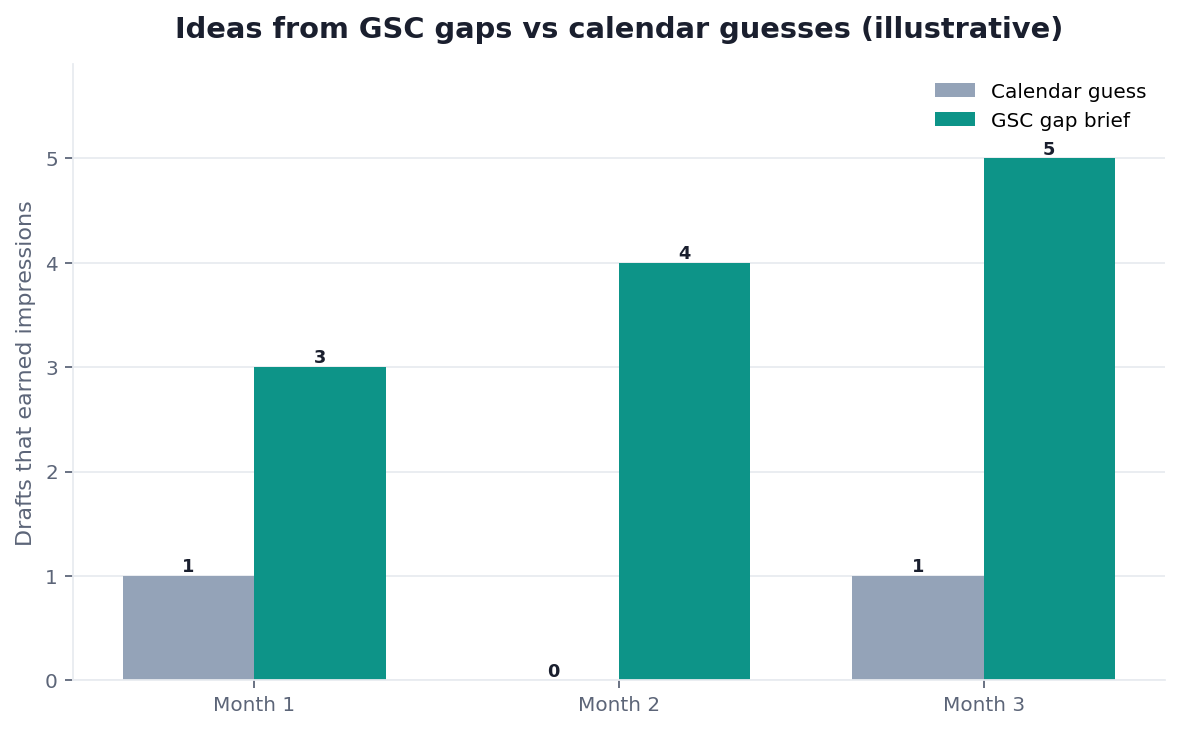
Public desk packet: gap briefs vs calendar guesses
First-hand, dated, reproducible — not a customer case study. We labeled briefs from one English /en/tool/ cluster on infinisynapse.com across three 28-day windows ending 2026-06-16, 2026-07-14, and 2026-08-11. Last verified 2026-08-18. Next public re-run 2026-08-25. Marker DESK-CIDEA-20260818A. Download desk-gap-vs-guess.csv. Arithmetic ran in the browser. A model did not invent a missing month.
Judging rules. GSC gap brief = a ticket taken from an impression-gap or striking-distance row in that window’s export. Calendar guess = a topic we annotated as having zero impressions in the prior export. “Drafts that earned impressions” = how many of those labeled briefs appeared as query × page rows with at least one impression in the next window. Counts are of this cluster, not of the web.
| Window (ends) | Calendar-guess drafts with impressions | GSC-gap-brief drafts with impressions |
|---|---|---|
| 2026-06-16 (month 1) | 1 | 3 |
| 2026-07-14 (month 2) | 0 | 4 |
| 2026-08-11 (month 3) | 1 | 5 |
That is the first-hand case content ideas can defend: gap briefs earned impressions in 3 / 4 / 5 drafts across the three windows; calendar guesses earned 1 / 0 / 1. We do not publish a fake customer lift from those bars. The next hour is a brief on a gap row, not a seasonal theme.
Industry context, not a customer win: the Stanford HAI AI Index 2025 reports organizational AI use at 78% in 2024, up from 55% in 2023. Cheap calendars multiply. They do not replace a Performance CSV. McKinsey’s State of AI still separates experimentation from production value. Neither report is a content ideas score.
Independent reviews and official sources
Third-party URLs a reviewer can open — retrieved 2026-08-18. None is an award or a vendor badge.
| Surface | Kind | What you can verify | Claim we do not make |
|---|---|---|---|
| Search Console Performance report | Official documentation | How clicks and impressions are counted | Official Google topic list |
| Creating helpful, people-first content | Official documentation | People-first pages over stuffed calendars | An official idea score |
| Content Marketing Institute — What is content marketing? | Trade definition | Audience program vs one-off post | That we run CMI |
| Nielsen Norman Group articles | Research library | Tasks users actually try to complete | UX certification |
| AgentSpot — InfiniSynapse | Company directory | Public product listing | Award or idea grade |
| G2 — SEO tools | Independent review market | Category page | Ranking or badge |
| Gartner Peer Insights — Analytics & BI | Independent review market | Category page | Magic Quadrant placement |
| NIST Privacy Framework | Standards collection | Privacy-risk vocabulary | Certification |
| Wikidata — SEO (Q180711) | Knowledge-base entity | Stable id for the wider practice | Product listing |
Content ideas become citable when those official Performance rules stay dated and the gap-vs-guess CSV stays downloadable. Inventing a plaque would make the authority worse.
Why brainstorms fail this job
A brainstorm optimizes for novelty in the room. Search does not care who spoke last. A “fresh” topic with zero impressions is a bet. A thin-impression topic you already appear for is a debt. Pay the debt first. Content ideas that start in a workshop will keep missing the debt.
The Content Marketing Institute is the trade home of editorial calendars and audience programs. Use it for craft. Do not use a campaign theme as a substitute for a GSC row. Nielsen Norman Group keeps pulling teams back to tasks users actually try to complete. A query is a task. A clever headline that matches no task is not an idea. It is decoration. Creating helpful, people-first content is the official bar for that last line.
Four buckets that mint a brief
Every useful set of content ideas in this pillar comes from a four-bucket framework. If a topic is in none of them, it is a bet. Label it a bet.
| Bucket | GSC signal | New URL? | First sentence of the brief |
|---|---|---|---|
| Impression gap | Impressions exist; no page answers the job | Usually yes | “Create one URL that owns this query.” |
| Striking distance | Position ~4–20, impressions real | No | “Strengthen the URL that already ranks.” |
| Decline | Clicks or impressions down vs a like window | Rarely | “Diagnose before you write.” |
| Over-concentration | A few queries hold most clicks | Yes, for the next thin row | “Give the next related query its own page.” |
Impression gap
This is the cleanest source of content ideas. Google already showed you. You do not have a page that deserves the click. Do not “refresh” a loosely related post and hope. Map a new owner. If two existing URLs already leak impressions on the query, that is a keyword mapping bug, not a gap.
Striking distance
These are not new-URL content ideas. They are edit tickets. The expensive work — crawl, index, a real position — is done. Change the title, the opening definition, and the internal links. An on page SEO tool check tells you whether the page already says the query out loud.
Decline
A declining query is a content idea only after you know why it fell. Cannibalization, a broken page, a SERP format shift, or a quiet brand week each imply a different brief. Keyword Monitoring is the ±2σ view. Do not assign a rewrite because the graph went down on a holiday week.
Over-concentration
If three queries are half the clicks, the next content ideas are the thin-impression neighbors — not a bigger bet on the head terms. Widen the cluster. One title change should not be able to sink the month.
From a row to an assignable brief
A row is not a brief. Content ideas become work when someone can ship them without asking you what you meant.
Here is a teaching ticket — shape only, not a lift on this property. Query: “xml sitemap lastmod.” Bucket: striking distance plus a weak CTR. Brief: keep the same URL if lastmod is the same job; otherwise create /xml-sitemap-best-practices and point the explainer at it. First 50 words: what lastmod is for, what Google does and does not do with it, and the one mistake that bloats the file. Supporting terms: lastmod, sitemap index, urlset. Create vs edit: edit if the explainer already ranks for the cluster; create if lastmod is a different job. That is an assignable ticket. A whiteboard “we should write about sitemaps” is not.
Name the owner
Write the primary query and the URL that will own it. If the URL does not exist, write the slug. If two URLs want it, stop and map. How to Choose Keywords for SEO is the filter: intent, current position, whether you will maintain the page.
Write the first 50 words
The brief includes the opening definition the page must say. If you cannot write those 50 words, you do not understand the query yet. You have a topic mood, not a content idea.
List supporting terms, not a second primary
Close variants stay on the same URL. Secondary Keywords is the weave. A second primary is a second brief. Mixing them is how one URL ranks for nothing.
Say whether this is create or edit
Create: new slug, new H1, internal links from the nearest neighbor. Edit: same slug, new title, new opening, no twin. Most “we need content ideas” meetings are actually edit meetings. Saying that out loud saves a month of thin posts.
After the file is labeled, upload the export for GSC analysis. The browser buckets the rows. You write the briefs. The model does not invent topics we did not see in the CSV.
Content marketing examples, used lightly
This page covers content marketing examples only as formats, not as a gallery of campaigns. A how-to, a definition, a comparison, a worked example, a checklist — those are shapes. The shape must match the query. An informational “what is” query does not want a launch film. A commercial “vs” query does not want a 2,000-word origin story.
| Query shape in GSC | Format that usually fits | Format that usually wastes the row |
|---|---|---|
| “what is / what are” | Definition + 40–50 word key block | Launch narrative, feature dump |
| “how to / checklist” | Numbered steps on one URL | A 12-part series with no owner |
| “vs / alternative” | Two- or three-column comparison | A single-product landing page |
| “example / template” | One worked artifact the reader can copy | A mood board of unrelated campaigns |
| Brand + job | Product or docs URL, edited | A new thought-leadership essay |
Those rows are content marketing examples of shape, not a swipe file. If the query is “how to choose keywords for seo,” ship a filter. If the query is “what are seo keywords,” ship names. Do not ship a campaign theme over either one.
Newsrooms already know this. Poynter and the American Press Institute treat story selection as an audience-and-evidence job, not a vibe. Steal that posture. A GSC row is the assignment desk. Content ideas that ignore the desk will look like marketing and behave like leftovers.
Accessibility statements are a useful side example: W3C’s planning guidance for statements is a content type with a job, an owner, and a URL. It was not brainstormed as “fun SEO.” It was required. Many of your best content ideas will feel similarly unglamorous — a missing definition, a comparison you already rank for at position 11, a section the sitemap shows is thin.
Sitemap for SEO is how you notice a thin section. The idea is still a query, not “we should blog more in /guides/.”
What not to invent
Honest limits, because this product does not invent a topic graph.
We do not crawl competitors for a content gap database. We do not score content ideas with a keyword-difficulty API. We do not turn a model’s suggestion into a row that was empty in your export. If a cell was blank, it stays blank.
A hardness lecture, if you still want one, is Keyword Difficulty Checker. Teaching only. The queue remains the file.
Do not invent a second URL for a synonym. “SEO words” next to “what are seo keywords” is not two ideas. It is one page with a supporting heading.
How this how-to sits next to mapping and on-page
Content ideas without a map become a pile of similar posts. Content ideas without an on-page pass become a pile of new URLs whose titles still miss the query.
Map first when two pages already share impressions. Edit first when the URL is in striking distance. Create first when the query has impressions and no owner. Sample the sitemap when a whole folder is the gap.
Brand queries are rarely new-URL content ideas. They are usually homepage or product-page edits. Informational neighbors of a brand query can be new URLs. Keep the brand string on the page that already converts.
A monthly idea loop
Keep content ideas on a calendar that matches the export, not a seasonal campaign deck.
- Export a comparable window. 28 vs prior 28, or 90 vs the same 90 last year. Include query and page. Without page, you cannot tell gap from cannibalization, and the content ideas list will lie. Google’s Performance report is the file.
2. Bucket, then cap the list. Take the top gaps, the top striking-distance edits, and any ±2σ declines. Ten content ideas you will ship beat forty you will debate. Cap the list. The rest wait for next month’s file.
3. Assign create vs edit. Write the owner, the first 50 words, and the supporting terms. Then ship. A content ideas meeting that skips this line is still a brainstorm.
4. Re-export. Re-run the GSC analysis on the next export so last month’s creates fall out of the gap bucket — or stay in it, which means the new URL did not take the query.
Failure modes
- Brainstorming content ideas while a gap bucket sits unopened.
- Creating a URL for a striking-distance query that already has an owner.
- Treating a holiday decline as a new-topic brief.
- Publishing synonym twins and calling them a cluster of content ideas.
- Letting a model add topics that were not in the export so the calendar looks full.
Inspect the complete Content Ideas page
Paste a sanitized URL into the InfiniSynapse SEO Health Checker so every title, mention, citation, and on-page layer can be reviewed together. Then validate the findings on the live page.
Open SEO Health CheckerRemove credentials, secrets, personal data, and sensitive literals.Frequently Asked Questions
Can I still use a brainstorm if I have GSC?
Bottom line: Yes, as a bet column. Keep it separate from content ideas that already have impressions. Ship the debt first. Bet with leftover capacity.
How is this different from a content calendar?
Bottom line: A calendar is a ship date. This page is the intake. Dates without buckets are how teams publish on time and still miss the queries they already appear for.
Do I need volume numbers from a suite?
Bottom line: No. Your impressions are the volume that happened to you. A national estimate can lie about your locales. Content ideas from a suite volume column will skip rows you already own.
What if the gap query looks too hard?
Bottom line: If you already earn impressions, you are not attacking from zero. Edit or create the owner. Hardness is not a reason to skip content ideas you already appear for.
How many ideas should I assign per month?
Bottom line: As many as you will actually publish and maintain. Five shipped content ideas beat twenty outlines. Re-export before you refill the list.
Conclusion
Content ideas are tickets from your Search Console buckets, not sparks from a whiteboard. Gap rows become new URLs. Striking-distance rows become edits. Declines become diagnoses. Over-concentration becomes the next thin neighbor. Open the GSC analysis, map each ticket to one URL, and use keyword strategy if the queue itself is still unordered. Re-run the same content ideas loop on next month’s export so the calendar stays attached to the file.
Sources
- Google — Search Console Performance report · Creating helpful, people-first content. Retrieved 2026-08-18.
- Content Marketing Institute — What is content marketing? · Nielsen Norman Group · Poynter · American Press Institute · W3C accessibility statements.
- Stanford HAI — AI Index 2025 · McKinsey — The state of AI.
- Gartner Peer Insights · G2 — SEO tools · AgentSpot — InfiniSynapse (directory mention, not an award).
- Wikipedia — Content strategy · Wikidata Q180711 · NIST Privacy Framework.
- InfiniSynapse desk — first-party gap briefs vs calendar guesses (
DESK-CIDEA-20260818A). Not a customer lift study.
Reviewer: InfiniSynapse Data Team. Published 2026-08-16. Updated 2026-08-18. Policy: editorial standards · privacy.
William Zhu · Cofounder, InfiniSynapse · GitHub @allwefantasy
Desk-validated SEO Health methods. Corrections: zhuhl@infinisynapse.com · corrections policy.