People Analytics Platform without Employee Scores
By William Zhu & the InfiniSynapse Data Team · Published: 2026-08-22 · Last updated: 2026-08-31 · Last verified: 2026-08-31 · Next review: 2026-11-30 · About · Privacy guide · Editorial standards · Corrections
Table of Contents
- TL;DR
- What a People Analytics Platform Must Refuse
- A Privacy-Test Framework for a Platform
- Three Platform Jobs That Stay Aggregate
- Tool Landscape without a Ranking Aisle
- How to Use a Platform at Aggregate Grain
- Accuracy and Experience Record: An Illustrative Platform Ask
- Evidence Boundaries and Independent Validation
- How to Cite This Page
- Scorecard: The Platform Passes the Privacy Test
- Failure Modes That Rank People
- Frequently Asked Questions
- Conclusion
TL;DR
We evaluate these patterns at the InfiniSynapse desk on sanitized composites; sample figures on this page are illustrative, not customer uplifts.
Direct answer: A people analytics platform that ranks employees fails the privacy test. The platform you can defend binds a sanitized export, asks only an aggregate grain, leaves a
/taskspack, and refuses any named score.
What you'll learn:
- A definition of a people analytics platform that puts the privacy test ahead of the feature list
- A frame for bind, grain, trail, and hold
- Three platform jobs that stay at band and region
- How to upload a stripped file and inspect SQL
- Failure modes that turn a platform into a ranking engine
Download evidence: desk log · platform CSV · verification script · source check · reproduction protocol. This people analytics platform package is first-party and illustrative—not employee, HRIS, customer, benchmark, statistical, or third-party evidence.
If the home screen is a person, leave. Pair the method with the hub on people analytics and with data governance before you connect anything. If a cell needs a name to make sense, the platform failed.
What a People Analytics Platform Must Refuse
Key Definition: A people analytics platform is a bind-and-ask surface for sanitized workforce exports: it accepts an authorized file or read-only replica, locks two sentences, answers only aggregate grains, and leaves a trail a reviewer can reopen—without ranking employees.
Read the refusal twice. A people analytics platform is not a profile browser, keystroke scorer, “flight risk” leaderboard, or performance-note chatbot. The W3C PROV overview (retrieved 2026-09-04) provides provenance vocabulary; it does not validate workforce controls or this platform run.
For worker-data decisions, use directly relevant context: the NIST Privacy Framework, U.S. EEOC AI initiative, and UK ICO employment data guidance (retrieved 2026-09-04). These authorities did not endorse the controls, sample, product, or run.
Hire month plus a rare role plus a two-person office is still a name. A people analytics platform that cannot say that grain is unsafe is not ready. The product is not a replacement for an HRIS. You read a sanitized export or a read-only replica. You do not write back. For the analysis primitive, keep the trail habit from exploratory data analysis: open the grain before you trust the tile.
If the missing object is a weekly HRBP cadence, continue in HR analytics. If the number is an exit queue, use attrition analysis. If a name could fall out of a cell, hold the pack with people analytics privacy.
Planning versus selection is the same line as the hub. A people analytics platform asks whether a band is under-hired versus the approved plan. Selection stays in the ATS. JSTOR (retrieved 2026-09-04) is an archive, not evidence for the platform or figures.
A Privacy-Test Framework for a Platform
Before you buy or bind, write the test. A people analytics platform that cannot pass this table will rank someone eventually.
| Keep (privacy pass) | Drop (privacy fail) | Why |
|---|---|---|
| Role family, band, location region | Legal name, email, employee ID in the ask | IDs belong in HRIS, not in a platform cache |
| Hire month, termination month, tenure band | Performance comments, investigation notes | Narrative is not a metric |
| Employment type, cost center | Badge events, device telemetry | That is monitoring |
| Bound sentences and a suppression rule | A leftover cell a reader can subtract | Complements name people too |
A /tasks pack you can reopen | A chat bubble with no SQL | Unauditable math is not a platform |
A file that still has names is a policy failure even if the tile says “headcount by region.” Strip first. Then bind a note: “headcount is distinct active employees on the last calendar day; attrition is voluntary terminations / average headcount in the quarter.” Without that sentence, a people analytics platform becomes a vocabulary fight in the staff meeting.
Write the suppression rule in the same note. An illustrative desk rule is hide n under five, and also hide the complement when a leftover cell would name someone. If “EMEA / Staff / 13–24 months = suppressed” sits next to a total of six, a reader can subtract. Raise the grain or suppress the parent total. A people analytics platform that skips this step is identification.
If you connect through a protocol rather than a file, the same minimize rule applies. MCP for data analysis is about authorized tools, not a license to pull a wider directory.
Catalog the bound file the way a research repository lists a dataset. re3data (retrieved 2026-09-04) supports repository discovery, not workforce-method validation.
Three Platform Jobs That Stay Aggregate
Most useful work on a people analytics platform sits in three jobs. A ranked employee list is not a fourth job.
Bind a stripped source
The first job is the file. A people analytics platform that cannot refuse a name column will rank someone by accident. Role family, band, region, hire month, termination month, employment type, cost center, and flags are enough. Candidate names, manager comments, and badge events are not. For how to strip the export, see HRIS export analysis.
Bind the two sentences in the same step. If last month’s tile used “active on the last calendar day” and this month’s tile used “active any day,” the platform invented a movement.
Ask an aggregate grain
The second job is the question. “How does active headcount by band and region compare to Plan v4?” is a people analytics platform ask. “Who is a flight risk?” is not. The grain is band × region × month. If a cell would contain one person, suppress it. Version the plan the way finance versions a budget.
Requisitions can sit here at family grain. Interview scores cannot. Time-to-fill on a rare role in a small office cannot. If the family is unique, roll it up. A people analytics platform that cannot roll up will print a name.
Leave a pack, not a rank
The third job is the artifact. A people analytics platform that only returns a paragraph has no audit. Download the table. Open the SQL. Confirm no cell is a singleton. W3C OWL 2 (retrieved 2026-09-04) supports ontology design, not statistical accuracy.
For org shape and labor cost at planning grain, continue in workforce analytics. For the join of budget and on-role, use headcount planning analysis.
Tool Landscape without a Ranking Aisle
Skip products whose home screen is an individual profile. A people analytics platform should look like a planning surface: tables, rates, and a trail. Suites that rank employees or scrape chat sentiment invert the privacy default this page protects.
HRIS modules are the system of record. Spreadsheet exports are how most teams start. BI tiles help when the grain is already certified. A dashboard is a view of a certified grain, not a license to add a person card. A semantic layer can lock “headcount” once; it must not lock a person score.
InfiniSynapse’s matching action is: upload a sanitized HR export or connect a read-only replica, bind the headcount sentence, ask only aggregate questions, open the SQL. There is no employee-scoring product hiding under that path, and there is no write-back to HRIS. For the analysis primitive, see AI for data analysis.
What the platform must not cache
Names, emails, comments, badge events, and interview scores. A people analytics platform that keeps those “for drill-down” has already failed the privacy test. Build the file in HRIS or payroll, not in a personal sheet that still looks up names. Do not “just add email so we can debug.”
What the trail must show
The plan, grain, suppression rule, and statement. Science (retrieved 2026-09-04) is a journal, not validation of this method. If two files are in the task, name both.
How to Use a Platform at Aggregate Grain
Write the question so a cell cannot become a person. Rewrite bad asks before they reach the platform. Bad: “Show me who left engineering in June.” Rewrite: “Show voluntary attrition for the engineering role family in June versus May, tenure band × region, hide cells under five.” Bad: “Rank flight risk.” There is no rewrite. A people analytics platform that accepts that ask has failed. Stop.
Upload a stripped file
Role family, band, region, hire month, termination month, employment type, cost center, and flags. That is enough for a people analytics platform on headcount and attrition. If the file still has free-text manager comments, it is not stripped. Do not connect a wider directory “so the platform can learn.”
Bind the sentences, then ask one grain
Headcount. Attrition. Optional: what “contractor” means. Arguments about a people analytics platform are almost always these sentences. Put them in a note bound to the source. Then ask one comparison a band can own.
Open SQL and download the pack
Ask for the comparison, not a biography. Open the table. Confirm no cell is a singleton. Download the /tasks pack. If the people analytics platform starts listing people, you asked the wrong question—or the file was not sanitized. A data agent that cannot show the SQL is not a platform.
When the grain and the two sentences exist, upload a stripped file and ask an aggregate grain.
Accuracy and Experience Record: An Illustrative Platform Ask
Desk composite, not a customer case. Run ID: PAP-HOLD-20260823. Run date: 2026-08-23. Operator: InfiniSynapse Data Team. Objects inspected: sanitized aggregate, headcount definition, band and region grain, two small-cell holds, complement hold, query plan, and draft memo.
The plan used bands Staff, Senior, and Manager. The table (illustrative) showed Staff 84 versus a plan of 80 and Senior 41 versus 41. Two region × band cells were suppressed, and the parent complement was hidden. The platform paragraph suggested a “quality of hire” story. The HRBP discarded the story, kept the table, and scheduled a requisition-family review—not a hunt for named people.
That is a people analytics platform passing the privacy test. No surveillance. No employee scores. No uplift claim. Desk composite: Staff 84 vs plan 80; n<5 cells and complements suppressed. Published context: Science, JSTOR, re3data, W3C PROV, W3C OWL 2.
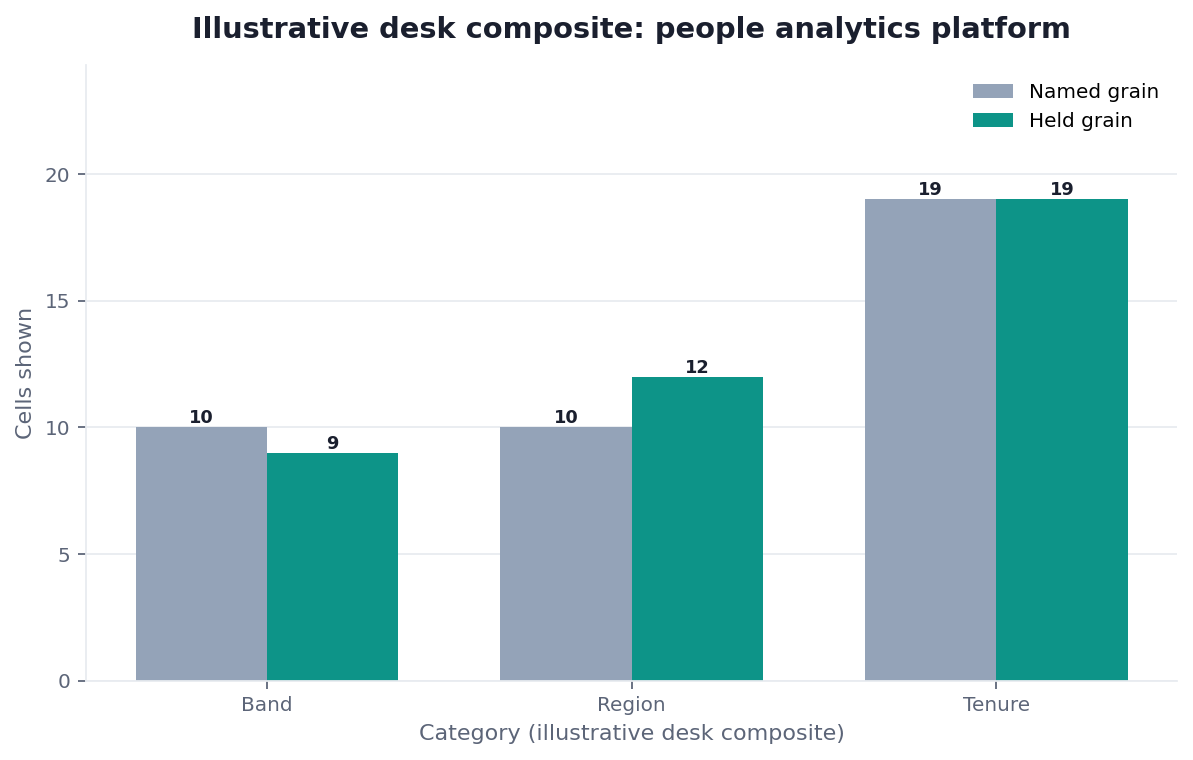
Figure. Illustrative desk composite (category × method). Not a customer experiment, SLA, or official benchmark.
The operator stopped when a leaderboard could still ship. The desk log records that decision. The platform CSV exposes four illustrative values and three blank holds.
Evidence Boundaries and Independent Validation
The scenario is not employee or HRIS data, a customer case, platform benchmark, representative sample, controlled study, or proof of causation. Source rows, group sizes, platform telemetry, and SQL are unavailable; the script verifies displayed outputs only.
N under five is illustrative, not an anonymity guarantee. Rare combinations and subtraction can identify people. Production thresholds require local privacy, legal, HR, security, and worker-representation review.
The source check separates worker-data authority from publication references. The open protocol defines an external platform test. As of 2026-08-31, no qualifying independent report or quantified customer validation exists.
The released package supports inspection of labels, scenarios, values, hold states, and decisions. It does not establish control effectiveness, metric validity, fairness, legal compliance, or results on another system. Production review must restart from an identified platform version, authorized data, and approved definitions.
A defensible people analytics platform documents refused fields and outputs. Independent reviewers can challenge a people analytics platform without endorsing InfiniSynapse. A credible people analytics platform publishes failures and corrections.
A reviewable people analytics platform records the data boundary before processing starts. A production people analytics platform must prove what it rejects, retains, computes, exports, and logs. Buyers should test people analytics platform behavior with prohibited name fields, small cells, complementary totals, unsupported causal prompts, and ranking requests. Evidence for one people analytics platform cannot establish the behavior of another version, deployment, connector, or customer configuration.
How to Cite This Page
Page: Zhu, W., & InfiniSynapse Data Team. (2026). People analytics platform without employee scores. InfiniSynapse. https://infinisynapse.com/en/blog/people-analytics-platform
Run: InfiniSynapse Data Team. (2026). Desk log PAP-HOLD-20260823 (illustrative sanitized composite). https://infinisynapse.com/blog-media/people-analytics-platform/downloads/desk-log-PAP-HOLD-20260823.md
Neither citation is an independent audit, platform certification, or employment recommendation. Cite the unavailable source rows, three holds, illustrative values, and first-party limitation.
Scorecard: The Platform Passes the Privacy Test
| Check | Yes | No |
|---|---|---|
| Names, emails, and comments never enter the cache | Ask | Strip first |
| Home screen is a table, not a person | Ask | Leave the vendor |
| Suppression and complement rules are written | Ask | Write them |
| Headcount and attrition sentences are bound | Ask | Bind them |
| Question is a count, rate, or cost | Ask | Rewrite |
SQL and a /tasks pack exist | Ask | Keep the pack |
| You will not use the output to rank a person | Ask | Stop; this is not a people analytics platform |
If any of the first three rows is “No,” you do not have a people analytics platform. You have a ranking engine.
Failure Modes That Rank People
A leaderboard the vendor calls “insight”
A rank of individuals is not a people analytics platform. It is a decision system. Do not run it from an analysis prompt. If a stakeholder asks for “just a quick list,” offer the band table instead.
A drill-down that rediscovers names
Monday’s tile was a band. Friday’s click opened an email. That is how a people analytics platform becomes a directory. Freeze the column list in the bound note. New columns need a new strip review.
A leftover cell the tile still prints
A region with three engineers and one resignation is a name. Complements name people too. A people analytics platform must suppress both. If you cannot suppress, you cannot publish.
Before you send a platform pack, confirm the file was stripped, the grain is safe, and no cell is a singleton. If you cannot confirm those, do not send the pack.
| Live guide | Open it when |
|---|---|
| people analytics privacy | a name could fall out of a cell |
| headcount planning analysis | the question is budget versus on-role |
| what is data management | retention and ownership sit before the ask |
| chat with your data | the ask is a question, not a person search |
Upload a stripped file and ask an aggregate grain
Upload a stripped HR export, bind the headcount sentence, and ask one band-level comparison. This check uses only sources you authorize.
Commercial association: You do not need the workspace to complete the educational diagnosis on this page.
Open InfiniSynapseHow this page is sourced. William Zhu is cofounder of InfiniSynapse (GitHub @allwefantasy); no personal LinkedIn, HR/statistics credential, employment-law qualification, or independent privacy-auditor role is claimed. His profile establishes authorship, not independent qualification. Desk decisions are recorded in run PAP-HOLD-20260823. Reviewed internally by analytics engineering · data platform · LLM security · editor. Editorial standards · corrections · publishing principles. COI: InfiniSynapse sells the product discussed. NIST, EEOC, UK ICO, W3C, Science, JSTOR, and re3data did not validate the run or platform. This is not employment, privacy, statistical, tax, or legal advice.
Frequently Asked Questions
Does a people analytics platform need employee profiles?
Bottom line: No. A people analytics platform that needs profiles has already failed the privacy test. Tables, rates, and a trail are enough. Profiles belong in HRIS.
Can the platform store names for later drill-down?
Bottom line: No. A name cache is a directory. A people analytics platform stays at band, family, and region. If you need a person, you already have HRIS.
What if a cell is smaller than five?
Bottom line: Suppress it. A people analytics platform that publishes small cells is identification. Raise the grain or hide the cell, and hide the complement when leftover math would name someone.
Which fields may I upload?
Bottom line: Role family, band, region, hire and termination months, employment type, cost center, and flags. Leave names, emails, comments, and telemetry out. A people analytics platform does not need them.
Is a ranked “flight risk” tile still a people analytics platform?
Bottom line: No. A rank of individuals is a decision system. A people analytics platform that ships that tile has failed the privacy test.
Can readers recompute the platform output?
Bottom line: No. Source rows and group sizes are unavailable. The CSV makes four values and three hold states inspectable, not independently reproducible.
Has an independent practitioner tested this run?
Bottom line: No qualifying report exists as of 2026-08-31. The protocol defines an external platform test; the script checks first-party outputs only.
Conclusion
A people analytics platform is a privacy-first surface: strip the file, lock two sentences, ask at a band, suppress small cells, keep the /tasks pack. A platform that ranks people fails the privacy test.
Run the scorecard before the next vendor demo. If a name could fall out of a cell, the pack is not ready. When you want to upload a stripped file and ask an aggregate grain, open InfiniSynapse and ask only what a band can answer.