On Premise AI: Your Hosts, Not the Cloud
By William Zhu & the InfiniSynapse Data Team · Published: 2026-09-02 · Last updated: 2026-09-27 · Last verified: 2026-09-27 · Next review: 2026-12-02 · Editorial standards · Corrections
Author credentials: William Zhu, Cofounder of InfiniSynapse. Public identity: GitHub @allwefantasy. Profile and review roles: editorial standards. This page is signed by a named person, not an anonymous editorial org. No personal LinkedIn is published. No third-party prize, media review, or independent endorsement is claimed.
Table of Contents
- TL;DR
- What on premise AI is
- Deployment framework: SaaS, private, air-gap, desktop
- Deployment forms compared
- Hardware, software, and orchestration
- How to pick a deployment form
- Desk sample: first-party four-control protocol
- Scorecard: which boundary do you actually need
- Failure modes
- Frequently Asked Questions
- Conclusion
TL;DR
Direct answer: On premise AI runs models and data on hardware you operate, not a vendor cloud. It is the same analytics job you prove in SaaS, with isolation, credentials, resume, and quota inside your boundary. Private cloud, air-gap, and desktop are the forms. Desktop is not an air gap.
Buy the form after the job is real. Isolation does not vanish when the WAN drops. Air-gap means tools, models, and updates are preloaded.
What you'll learn:
- What on premise AI owns versus what a chat label claims
- A four-form frame: SaaS proof, private cloud, air-gap, desktop
- How keys, rows, model exit, and updates move by form
- Numbered steps to pick a form without a second product
- A four-control desk you can replay, not a customer case
- Failure modes: VPC-as-air-gap, desktop-as-isolation, private-before-proof
What on premise AI is
On premise AI means the model and the rows stay on hosts you operate. A private login in front of a vendor model API is still a cloud hop.
Key Definition: On premise AI for analytics is the same decision job you already ran in a hosted console—plan, named SQL, files, resume, quota—moved so credentials, data, and model exit stay inside a boundary you name. It is not a private sticker on a public chat, not a warehouse replacement, and not an unpublished machine-room diagram.
Independent published context (retrieved 2026-09-02). The OWASP Top 10 for LLM Applications, ISO/IEC 27001, and Snowflake Cortex Analyst did not run this fixture.
| Cited source | What it owns | What tonight still needs |
|---|---|---|
| OWASP LLM Top 10 | Tool and prompt risk | A rack does not retire it |
| ISO/IEC 27001 | Access and change | Placement is not a new language |
| Snowflake Cortex Analyst | SQL near data | The long task still needs your hosts |
| NIST Privacy Framework | Personal-data map | Prompts still need a host |
| ClickHouse documentation | Compute by the table | Still needs a task id |
| OWASP API Security Project | Authn and authz | The API can stay inside |
A GPU server is optional. The task id is not. A reviewer still needs a trail and a veto. The OWASP Top 10 for LLM Applications (above) still applies to tools the agent can call.
Data security and compliance is the policy layer. On premise AI is the runtime placement of that policy. If keys leave through a vendor model API, you have a private UI, not a private job.
ISO/IEC 27001 (above) already writes those boundaries. On premise AI inherits them and asks where the four objects live.
Snowflake Cortex Analyst (above) is useful for “SQL stays near the data.” On premise AI asks whether the same long task can live on hosts you operate when a SaaS hop is not allowed.
Do not treat on premise AI as a substitute for Oracle or SAP. Those systems stay sources. The agent reads. Large scans still need a host that can finish; that hosting question is covered in analyze large datasets with AI, then this pillar stays on deployment form.
Deployment framework: SaaS, private, air-gap, desktop
Score the form with one table. On premise AI quality is visible in who holds each control.
| Control | SaaS proof | Private cloud / on-prem | Air-gap | Desktop client |
|---|---|---|---|---|
| Keys | Vendor vault + your source grants | Your KMS / HSM | Preloaded secrets, no outbound fetch | OS keychain or server vault; not “offline by default” |
| Rows | Authorized hop you accept for a trial | Stay in VPC or plant | Stay on isolated hosts | Local file or LAN source; model may still leave |
| Model exit | Vendor or chosen API | Your chosen endpoint inside the boundary | Preloaded weights only | Depends on the signed config |
| Updates | Vendor channel | Managed channel you allow | Media you preload | App store or signed package; not an air gap |
Isolation and credentials stay with the job
On premise AI does not delete identity. The tenant, the requester, and the source grant still exist. Enterprise data security solutions already list those objects. The form only changes where they are stored. If a private install drops SSO because “it is inside,” you have a weaker product, not a safer one.
Privacy programs map personal data under the NIST Privacy Framework (table above). Say whether prompts, logs, and intermediate tables are personal data, and which host retains them. Traces on a public logger have already opened an exit.
Resume and quota do not vanish offline
A long task still dies. On premise AI still needs resume from the same id, a quota so one scan cannot starve the plant, and an audit file a human can reopen. Air-gap does not mean “no agent.” It means the agent cannot phone home for a tokenizer, a connector binary, or a model patch. Preload those, or the job is a demo that fails on the first retry.
Deployment forms compared
Two mistakes dominate procurement. One is buying on premise AI as a slogan before anyone has seen a named view. The other is calling every locked subnet an air gap.
| Form | Choose A if | Choose B if |
|---|---|---|
| SaaS vs private | You still need to prove the same question, trail, and files | Keys, rows, or model exit cannot leave |
| Private cloud vs air-gap | You want isolation with a managed update path | Exits must be physical; media is the only update |
| Desktop vs browser | Local files and habit matter; latency of a tab is the complaint | You need a shared console and the same id from any desk |
| Widget vs platform | You only need a branded chat in a VPC | You need the same task shape: plan, SQL, files |
Choose SaaS if you still need to prove the job
SaaS data analytics is the right first door. Run one read-only question. Open the trail. Decide whether the job is real. On premise AI purchased before that proof is a second unsolved product. The educational diagnosis does not require a plant.
Choose private or air-gap if exits must close
If the three exits fail a residency review, move the same job. Private AI maps keys, rows, and prompts. Private cloud is VPC isolation with an update path. Private GPT is the air-gap page: cut exits on purpose, preload the rest. A private AI platform is that job on your hosts, not a chat skin.
Hardware, software, and orchestration
On premise AI is three layers. Hardware is the host you operate. Software is the analytics task: plan, SQL, files, resume. Orchestration is the named owner of updates. Agents stay inside that boundary: model exit and credentials are written down, and prompts do not leave for a cloud-only API. A monitoring panel on a GPU box is not the task.
| Layer | Typical object | On premise AI test |
|---|---|---|
| Source | Warehouse, OLAP, file | Read-only grant; no ERP replacement |
| Runtime | Task, resume, quota | Same id after a kill |
| Model | Weights or API | Exit named in writing |
| Client | Browser or desktop | Trail matches the console |
| Update | Channel or media | Owner and cadence named |
ClickHouse documentation (table above) shows compute can sit next to the table. On premise AI still needs isolation, credentials, resume, and quota around that compute.
On premise AI vs a GPU appliance
A plug-in model server can hold weights. It does not hold a task id. Embed an AI data analyst is the same shape in a product slot. On premise AI is that shape on a host you operate. If the install cannot show plan and SQL, you bought a widget. The OWASP API Security Project (table above) still maps authn and authz inside the plant.
What a desktop client actually changes
A data analysis app on Windows or macOS follows local habit and cuts tab latency. On premise AI on the desktop is still a client. If it calls a public model, rows or prompts may leave. An edge box is another device, not a fourth form. Private cloud, air-gap, and desktop still decide the analytics job.
How to pick a deployment form
Use this sequence. Do not skip a step because a slide already says “on premise AI.”
- Input: One authorized source and one known question. Accept: A named SaaS trail. Reject: You cannot name the grain.
- Input: Exit map: keys, rows, prompts, updates. Accept: Each exit has an owner. Reject: “Private” with no map.
- Input: The same question as on premise AI on a private or desktop host. Accept: Task id, SQL, and files match. Reject: A paragraph with no trail.
- Input: Kill-and-resume on that id. Accept: Same id inside quota. Reject: Restart from chat.
- Input: An update story. Accept: Channel or media named. Reject: “Patches later.”
- Input: A written non-goal. Accept: “Not replacing the ERP. Not an unpublished SLA.” Reject: System-of-record writeback.
Desk sample: first-party four-control protocol
Cite this protocol. Do not cite 42k rows or the chart bars as a lab result. After they scored on premise AI, private cloud fit only if the model stayed inside.
First-party method log (replayable):
| Field | Record |
|---|---|
| Operator | InfiniSynapse Data Team; William Zhu, GitHub @allwefantasy |
| First run | 2026-09-02 |
| Replay | 2026-09-03 |
| Input | Authorized, sanitized opex question; no people |
| Paths | SaaS proof vs private vs air-gap vs desktop |
| Steps | 4 (keys, rows, model exit, updates) |
| Acceptance | Same task id and trail shape; exit owners named |
| Fail | VPC labeled air-gap; desktop treated as isolation; private before proof |
Replay 2026-09-03. Editorial standards.
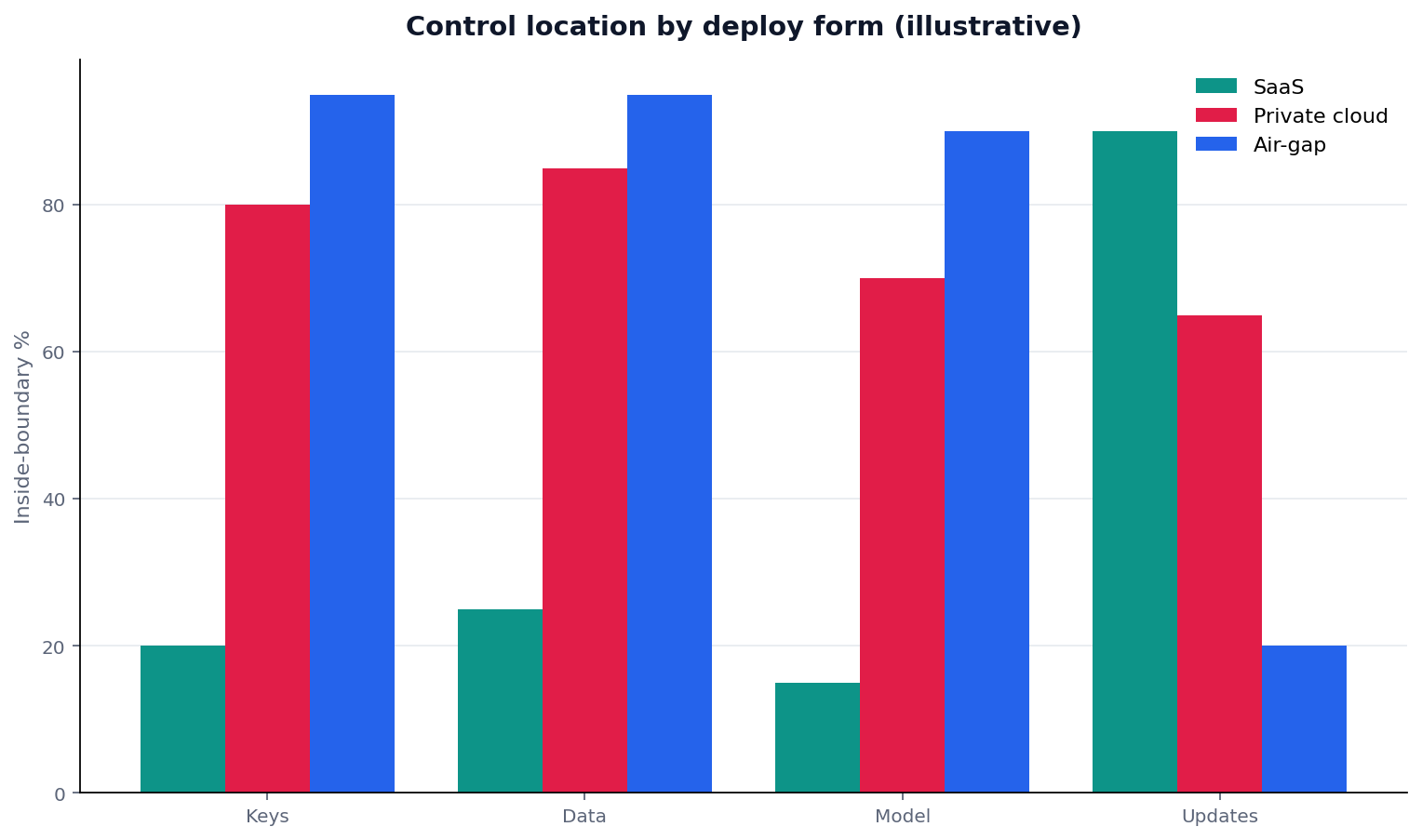
Figure. Teaching schematic. Not a measured study. Source: the protocol table above.
Entity 8, 42k rows, and 8 files are a teaching sketch. Quote the protocol. On premise AI here is the score, not a purchase order.
Scorecard: which boundary do you actually need
Fill this before a vendor workshop on on premise AI.
| Signal | Stay on SaaS proof | Move to private cloud | Move to air-gap | Add desktop |
|---|---|---|---|---|
| Job not yet replayed | Yes | No | No | Optional later |
| Keys cannot leave | No | Yes | Yes | Only if client is not the vault |
| Model API forbidden | No | If you host the model | If weights are preloaded | Same as the runtime it calls |
| Physical exit required | No | No | Yes | No |
| Browser latency / local habit | Maybe | Maybe | Rare | Yes |
| You want an ERP replacement | Out of scope | Out of scope | Out of scope | Out of scope |
Choose A (SaaS) if the trail is still missing. Choose B (private) if the trail exists and the exit map fails. Choose C (air-gap) only when the update story is media. Choose D (desktop) when the complaint is the tab, not the boundary.
Failure modes
Form failures, not model failures.
Calling a locked VPC an air gap
A subnet with a proxy is still a path. On premise AI in a VPC can be the right buy. It is not an air gap. If a reviewer can pull a model update without walking media in, say “private cloud.”
Treating desktop as isolation
Local habit is not a control. On premise AI on a laptop can still stream prompts. The data analysis app page is explicit: desktop is not automatically an air gap. If the signed config calls a public endpoint, treat it as SaaS with a nicer window.
Buying private before the job is proven
Procurement likes a plant. Analysts need a trail. On premise AI that cannot reproduce the SaaS question is a second product. Prove the isomorphic job first. Then move the objects.
If the open question is which exits leave the tenant, start with private AI and write keys, rows, and prompts on one page. If the network is physically cut, private GPT is the air-gap method: tools, models, and updates must be preloaded.
When you need the same long task on hosts you operate, read private AI platform instead of a VPC chat widget. Browser latency belongs on the data analysis app; that page does not claim air-gap.
Private cloud versus air-gap is a selection, not a synonym. SaaS data analytics stays the right first proof when residency has not yet forced a move.
When the quoteable sentence is still missing, write what is private AI as an exit map. When the objects must live on your hosts, map private AI infrastructure.
When the placement itself is the buy, on premises AI keeps the same task shape inside hosts you name. On premise AI is the hub that holds those nine choices in one frame.
Prove the same question in SaaS, then talk private
Run one read-only question in the web app, then map which objects must stay on your hosts. This check uses only sources you authorize.
Commercial association: You do not need the workspace to complete the educational diagnosis on this page.
After you prove the same question on authorized data, Book a Demo if the job must live on hosts you operate.
Open InfiniSynapseHow this page is sourced. William Zhu is cofounder of InfiniSynapse, public as GitHub @allwefantasy. Company self-description, not independent authority. No third-party prize is claimed. No personal LinkedIn is published. Evaluation basis: We evaluate (hands-on) by proving one read-only question in SaaS, then mapping which objects must stay on private hosts. Protocol 2026-09-02, replayed 2026-09-27. Reviewed internally by analytics engineering · data platform · LLM security · editor. Editorial standards · corrections · publishing principles · About · Privacy · Terms. Contact zhuhl@infinisynapse.com. COI: InfiniSynapse sells an AI-native Data Agent; the banner is a commercial association. The educational diagnosis does not require it. Fact-check: OWASP LLM Top 10, ISO/IEC 27001, Snowflake Cortex Analyst, NIST Privacy Framework, ClickHouse docs, OWASP API Security. No external organization audited this page.
Frequently Asked Questions
What is on premise AI?
Bottom line: On premise AI runs models and data on hardware you operate, not a vendor cloud. Private cloud, air-gap, and desktop are forms of that placement.
Is on premise AI the same as an air-gapped plant?
Bottom line: No. On premise AI includes private cloud and desktop. Air-gap is the subset where exits are physical and tools, models, and updates are preloaded.
Does a Windows app count as this isolation?
Bottom line: No. Desktop solves latency and habit. On premise AI isolation is about keys, rows, and model exit, not the window manager.
Should we buy this before trying SaaS?
Bottom line: No. Prove the isomorphic job first. On premise AI is a move of a real trail, not a substitute for seeing named SQL.
Will this replace our ERP or warehouse?
Bottom line: No. Sources stay sources. On premise AI reads authorized tables. It is not an Oracle or SAP replacement and not a warehouse procurement page.
What still exists when we cut the network?
Bottom line: Isolation, credentials, resume, and quota still exist. On premise AI that cannot resume a killed task is a demo, online or off.
What on this page is citable?
Bottom line: Cite the protocol table, the four-form frame, and the six-source comparison. Do not cite the chart bars as measured results.
Conclusion
On premise AI runs on hosts you operate. It is a deployment capability for a job you can already audit: isolation, credentials, resume, and quota inside a named boundary. SaaS proves the job. Private cloud hosts it. Air-gap preloads tools, models, and updates. Desktop follows habit and is not an air gap.
Do not buy a slogan or an unpublished SLA. Buy the form that matches the exit map. If you later use the workspace, open InfiniSynapse only with authorized, sanitized inputs. For a private-host conversation after that proof, Book a Demo.