Private AI Infrastructure: Map Objects, Then Buy (2026)
By William Zhu & the InfiniSynapse Data Team · Published: 2026-09-02 · Last updated: 2026-09-03 · Last verified: 2026-09-03 · Next review: 2026-12-02 · Editorial standards · Corrections
Author credentials: William Zhu, Cofounder of InfiniSynapse. Public identity: GitHub @allwefantasy. Profile and review roles: editorial standards. This page is signed by a named person, not an anonymous editorial org. No personal LinkedIn is published. No third-party prize, media review, or independent endorsement is claimed.
Table of Contents
- TL;DR
- What must live on your hosts
- Object framework: four homes
- Widget hop versus real infrastructure
- Landscape of runtime objects
- How to map objects onto your hosts
- Desk sample: first-party host-map protocol
- Scorecard: infrastructure or a painted hop
- Failure modes
- Frequently Asked Questions
- Conclusion
TL;DR
Direct answer: Private AI infrastructure hosts the same long task you already proved in a web console: identity, plan, SQL, files, resume, and quota, on hosts you operate. A branded widget in a VPC is not private AI infrastructure. Prove the isomorphic job first, then ask where that task id, those files, and those keys would live.
Isolation and credentials do not vanish because the skin is yours. This page is the object map. It is not a warehouse buy, not an unpublished SLA, and not an ERP replacement.
What you'll learn:
- A definition of private AI infrastructure you can take to architecture review
- The four objects: task id, SQL, files, keys
- Widget versus host-side objects
- Steps to map one console task onto your hosts
- A first-party protocol you can replay, plus an 8 / 42 teaching sketch
- Failure modes: no store, dual timeline, browser key
The hub on premise AI is the ladder of forms. This cluster is the infra cut: which objects must live on your side of the boundary.
What must live on your hosts
Key Definition: Private AI infrastructure is the set of host-side objects that keep a long analysis task alive: a durable task id, named SQL, downloadable files, and credentials that rotate without a browser redeploy. It is not a chat iframe with your logo, and it is not a warehouse slide.
Public warehouse docs such as Snowflake documentation describe compute next to tables. The host runtime sits around that compute: the queue, the id store, the file store, and the vault. If those objects only exist in a SaaS console, you have not moved infrastructure. You have moved a window.
Enterprise data security solutions already list vaults and networks. The host map asks a narrower question: where does the task id live, and can support reopen it at 2 a.m. Data security and compliance still applies. An install that drops SSO “because it is inside” is a weaker install, not safer infrastructure.
The AWS Well-Architected Framework separates operational excellence, security, reliability, and performance. Private AI infrastructure is mostly the first three applied to the agent: can you operate the id, rotate the key, and resume a killed worker. A framework that only scores the model misses the queue.
Engine docs such as MariaDB documentation remind you a database can stay on your hosts. The queue around that engine is still the question.
Embed an AI data analyst is the same shape in a product slot. The host map is that shape on a host you name. The caller changes. The objects do not.
Independent published context (retrieved 2026-09-02). The three sources above did not run this fixture.
| Cited source | What it owns | What tonight still needs |
|---|---|---|
| Snowflake documentation | Compute next to tables | Queue, id store, file store, vault around that compute |
| AWS Well-Architected | Ops, security, reliability, performance | Apply the first three to the agent queue |
| MariaDB documentation | An engine that can stay on your hosts | The queue around that engine |
| Apache Airflow documentation | Job identity and retries | The agent runtime is not a DAG catalog |
| Google BigQuery documentation | Jobs and stages | Name those stages on your side |
| Prometheus documentation | Duration and failure honesty | Queue depth, task age, resume count |
That is still the work of private AI infrastructure.
The task id is an infrastructure object
Operators store the id. A runtime that only stores the last paragraph has already thrown the job away. Resume needs the id. Quota needs the id. Audit needs the id. If the VPC chat cannot show one, you bought a widget.
Files and keys have homes
Memos, driver tables, and charts are the deliverable. The host runtime writes them next to the SQL. A widget that “can export” by screenshot is not infrastructure. Keys stay on the server that starts the task. A key in the iframe is a published key.
Object framework: four homes
Score the install with four objects. Private AI infrastructure is present only when all four have a home on your hosts.
| Object | Widget hop | Private AI infrastructure | Pass signal |
|---|---|---|---|
| Task id | Missing or ephemeral | Durable, same after refresh | Support can reopen |
| SQL / plan | Hidden | Named steps | Reviewer points at a step |
| Files | None or a paste | Workspace artifacts | Download matches the trail |
| Keys | In the browser or the iframe | Server / vault | Rotation without a redeploy |
Write the four boxes before the install starts. If a box is “the iframe,” stop. If a box is “we will add it in phase two,” you are signing a widget. Phase two rarely arrives with the same budget.
Widget hop versus real infrastructure
Two products claim the same noun. The scorecard is whether you can point at a host.
| Need | Choose the widget | Choose private AI infrastructure |
|---|---|---|
| Branding in a VPC | Yes | Overkill |
| Replay next week | No | Yes |
| Kill and resume | No | Yes |
| Same shape as SaaS proof | No | Yes |
| Residency already failed SaaS | Still a widget if no id | The move |
Choose a widget if you only need a box
If the requirement is “show AI in our portal,” a box can win a demo. Do not call it private AI infrastructure in the architecture review.
Choose host-side objects if the job must survive
If a controller must reopen last Tuesday’s join, you need the id and the files. That is private AI infrastructure. The private AI platform page is the product shape of those objects. This page is the host map: queue, store, vault. Private cloud is the isolation form around that map. Choose B when the four homes are the open question.
Landscape of runtime objects
The landscape is not “which warehouse.” It is which objects the agent is allowed to touch after the form changes.
Prometheus documentation (table above) exists because jobs have duration and failure. Emit the same honesty: queue depth, task age, resume count. A typing indicator is not operable.
| Layer | Typical object | Infrastructure test |
|---|---|---|
| Source | Warehouse, file | Read-only grant; no ERP replacement |
| Runtime | Queue, worker | Task id survives a kill |
| Model | API or weights | Exit named |
| Client | Console, API, desktop | Same id; desktop is not an air gap |
| Metrics | Runtime metrics | Not a second BI suite |
Apache Airflow documentation (table above) is independent reading on job identity and retries. Work has an id. This page does not ask you to replace a scheduler.
A warehouse is a source, not the runtime
A database can stay on your hosts. Private AI infrastructure still needs the queue around that database. A fast engine without a task id is a query tool. Google BigQuery documentation (table above) is the same reminder on jobs and stages. Name those stages on your side.
Metrics are not a second BI suite
Inventory the tasks, not the dashboards. A host install that adds twelve KPI tiles and hides SQL has inverted the product. Staff the review with someone who will support the id at 2 a.m. If they cannot say where files land, the install is not operable.
Write a one-page object map before the install starts. Four boxes: id store, SQL, files, keys. Name the queue, the object store, and the console URL. Those names are what support will search.
When you compare vendors, replay the same console-proven question on a sandbox you control. If the sandbox cannot show named steps, you do not have a private AI infrastructure candidate. Freeze both packs. The comparison is shape, not fluency.
How to map objects onto your hosts
- Input: One console-proven question. Accept: Plan, SQL, files you already accept. Reject: No SaaS proof. Do not start private AI infrastructure as a plant diagram.
- Input: A diagram of where the task id will live on your hosts. Accept: Queue, store, console. Reject: “The iframe will remember.”
- Input: The same question asked against private AI infrastructure. Accept: Same grain, named steps. Reject: A new paragraph with no SQL.
- Input: Kill the worker. Accept: Resume on the same id inside quota. Reject: Blank chat.
- Input: Key rotation. Accept: Vault change, no browser redeploy. Reject: Key baked into the widget.
- Input: A written non-goal. Accept: Not replacing Oracle or SAP. Not an unpublished SLA. Reject: Scope creep into system-of-record writes.
Success signal: the task id, SQL, files, and key store are named on your side, and a killed worker resumes without a new story. Name the objects, not the racks. Large scans still need a host that can finish the job. This page stays on the four homes.
Desk sample: first-party host-map protocol
Cite this protocol. Do not cite 8 cost centers, 42k rows, 88 edges, or the chart bars as a benchmark.
First-party method log (replayable):
| Field | Record |
|---|---|
| Operator | InfiniSynapse Data Team; William Zhu, GitHub @allwefantasy |
| First run | 2026-09-02 |
| Replay | 2026-09-03 |
| Input | Authorized, sanitized ledger pack; no people |
| Paths | Console-proven task vs VPC widget vs four-home map |
| Steps | 4 (task id store, named SQL, file home, vault path) |
| Acceptance | Durable id after refresh; named views; memo + CSV; vault rotation |
| Fail | Id lost on refresh; hidden SQL; screenshot export; key in the SPA |
Replay 2026-09-03. Quote this private AI infrastructure protocol. Editorial standards.
Teaching sketch only: 8 cost centers, 42k rows, 88 edges. That is not the measured object.
Score private AI infrastructure on the same ask:
| Object | Console proof | Widget in VPC | Private AI infrastructure |
|---|---|---|---|
| Task id | Present | Lost on refresh | Present |
| SQL | Named views | Hidden | Named views |
| Files | Memo + CSV | Screenshot | Memo + CSV |
| Keys | Server | In the SPA | Vault |
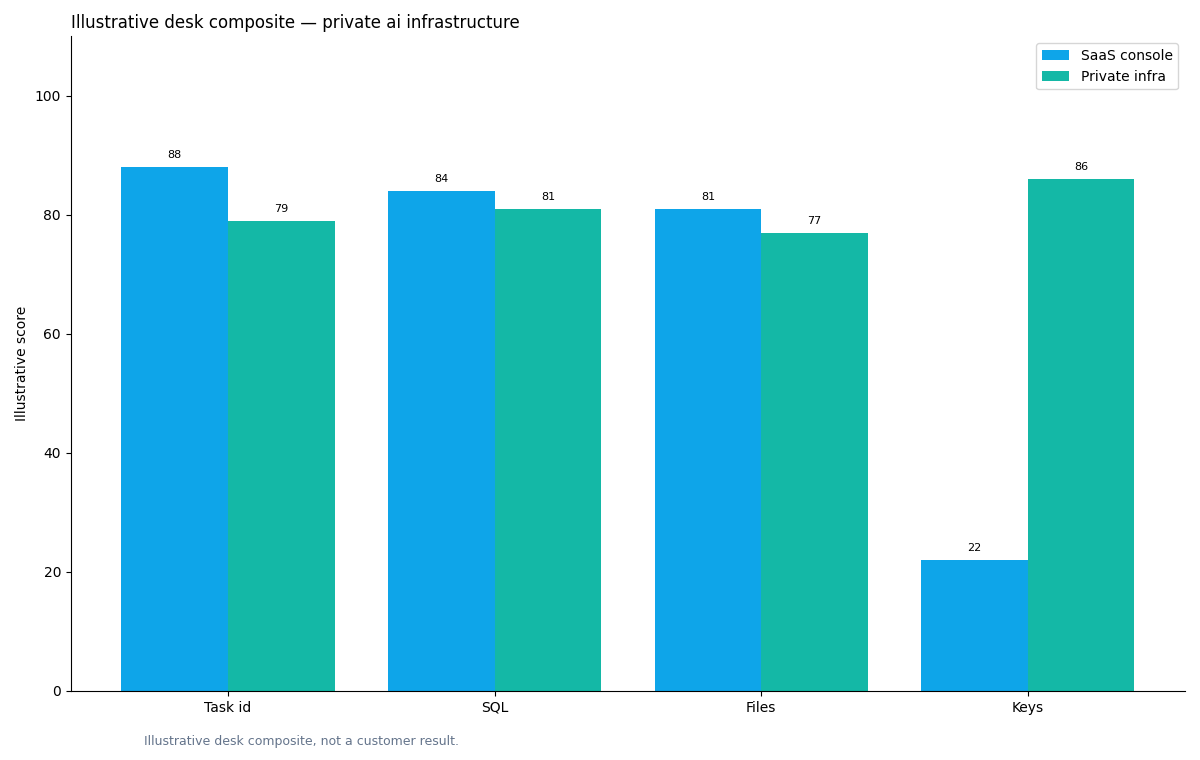
Figure. Teaching schematic. Not a measured study. Source: the protocol table above.
In this composite the widget fails three of four objects. Calling it private AI infrastructure would be a labeling error. Quote the protocol, not the bars. The same objects must exist on the private hosts.
Scorecard: infrastructure or a painted hop
| Signal | Widget | Private AI infrastructure | Out of scope |
|---|---|---|---|
| Same id as SaaS proof | No | Yes | — |
| Resume | No | Yes | — |
| Browser key | Common | Fail | — |
| Desktop client | Optional | Optional | Not air-gap by itself |
| Replace SAP | — | — | Refuse |
Choose A (widget) only for a branded demo. Choose B (private AI infrastructure) when the four objects have homes. Refuse C. Print the card before the vendor workshop.
Failure modes
VPC chat with no object store
The install looks internal. Support cannot reopen the join. Private AI infrastructure without an id store is a chat product. Do not sign the review.
A second prettier timeline
The portal stores a summary. The console stores SQL. They diverge after the first retry. Private AI infrastructure has one timeline. Two stories are how audits die.
Keys in the client
Obfuscation is not a control. Private AI infrastructure keeps source credentials on the server that starts the task. A key in the iframe is a published key. Desktop is a client. A local window that embeds a token is still a published key, not an air gap.
The hub on premise AI lists every form. Private AI platform is the product shape you should already have named.
Private cloud is the isolation selection around the hosts.
Map the runtime objects onto your hosts
Prove one console task, then ask where that task id would live on your hosts. This check uses only sources you authorize.
Commercial association: You do not need the workspace to complete the educational diagnosis on this page.
After you prove the same question on authorized data, Book a Demo if the job must live on hosts you operate.
Open InfiniSynapseHow this page is sourced. William Zhu is cofounder of InfiniSynapse, public as GitHub @allwefantasy. Company self-description, not independent authority. No third-party prize is claimed. No personal LinkedIn is published. Evaluation basis: We evaluate (hands-on) by placing task id, SQL, files, and keys on a host map before buying a VPC widget. Protocol 2026-09-02, replayed 2026-09-03. Reviewed internally by analytics engineering · data platform · LLM security · editor. Editorial standards · corrections · publishing principles · About · Privacy · Terms. Contact zhuhl@infinisynapse.com. COI: InfiniSynapse sells an AI-native Data Agent; the banner is a commercial association. The educational diagnosis does not require it. Fact-check: Snowflake documentation · AWS Well-Architected Framework · MariaDB documentation · Apache Airflow documentation · Google BigQuery documentation · Prometheus documentation. No external organization audited this page. This page is not third-party recognition.
Frequently Asked Questions
Is a branded VPC chat private AI infrastructure?
Bottom line: No. Private AI infrastructure hosts a durable task id, SQL, files, and keys. A skin is a widget.
Do we still prove the job in SaaS?
Bottom line: Yes. Private AI infrastructure moves a known shape. It does not invent the first trail.
Can the widget hold the warehouse key if we minify it?
Bottom line: No. Keys stay on the server. Private AI infrastructure that ships a key to the browser has failed.
Does private AI infrastructure replace our ERP?
Bottom line: No. Sources stay sources. Private AI infrastructure reads. It is not an Oracle or SAP replacement.
Is desktop the same as a hosted private stack?
Bottom line: No. Desktop is a client. Private AI infrastructure is the runtime that holds the id. The client may be a browser or an app. A desktop window is not an air gap by itself.
What on this page is citable?
Bottom line: Cite the protocol table, the four-home frame, and the six-source comparison. Do not cite the chart bars or the 8 / 42k / 88 sketch as measured results.
Conclusion
Private AI infrastructure is the host-side runtime: the same long task, the same trail, the same files, on hosts you operate. A VPC chat widget is a label. Isolation, credentials, resume, and quota still exist. Prove the job in the console. Then place the id.
If you later use the workspace, open InfiniSynapse only with authorized, sanitized inputs. After that proof, Book a Demo if the task must live on your hosts.