Private Cloud: What It Is vs Public Cloud
By William Zhu & the InfiniSynapse Data Team · Published: 2026-09-02 · Last updated: 2026-09-26 · Last verified: 2026-09-26 · Next review: 2026-12-02 · Editorial standards · Corrections
Author credentials: William Zhu, Cofounder of InfiniSynapse. Public identity: GitHub @allwefantasy. Profile and review roles: editorial standards. This page is signed by a named person, not an anonymous editorial org. No personal LinkedIn is published. No third-party prize, media review, or independent endorsement is claimed.
Table of Contents
- TL;DR
- What is a private cloud
- Private cloud benefits
- Private cloud architecture
- Private cloud vs air-gap
- How to score VPC isolation vs a true air gap
- Desk sample: first-party selection protocol
- When a private cloud is the wrong purchase
- Frequently Asked Questions
- Conclusion
TL;DR
Direct answer: A private cloud is cloud computing dedicated to one organization. Several business units may share it. It may run on your premises or at a host. It is not a public cloud, and it is not an air gap. For an analytics agent, choose private cloud when you still want a named update and model path.
Isolation, credentials, resume, and quota exist in both forms. Desktop is neither. This page answers the definition first, then the purchase.
What you'll learn:
- A definition a reviewer can quote
- How it differs from public cloud
- Control, security, and service quality, and what has to be written down
- On-premises private cloud versus a hosted private cloud
- Choose-A / choose-B against air-gap, plus a replayable protocol
The hub on premise AI lists both forms. This page is that selection.
What is a private cloud
Key Definition: A private cloud is cloud infrastructure provisioned for exclusive use by a single organization, including its business units. The organization, a third party, or both may own and operate it, on premises or off. For an analytics agent, that boundary still allows a named update and model path. It is not a public cloud and not an air gap. The analysis runtime on those hosts is a private AI platform: the task, the SQL, and the keys, not only the network boundary.
NIST SP 800-145 is the definition this page quotes. Exclusive use is the line. A brochure that says private, while other customers share the same hosts, is a public cloud with a private-network attachment.
Dedicated to one organization
Write the organization name on the diagram. If the honest answer is “any customer of the vendor,” you bought a public cloud. Select users inside that one organization reach the service over an internal network or a private link. The general public does not.
Several business units may share one private cloud. Exclusive use means one organization, not one team. A second company on the same hosts ends the definition.
Private cloud vs public cloud
| Private cloud | Public cloud | |
|---|---|---|
| Tenant | One organization | Many customers |
| Who can reach it | Select users you name | Anyone the provider admits |
| Control | You set the boundary and the egress | Provider sets the shared baseline |
| Security | Your policy on your hosts | Shared controls, your tenant config |
| Service quality | Your workload is not queued behind a stranger | Noisy neighbors are normal |
| Updates | A channel you name | Vendor cadence |
| Air gap | No. A path remains | No |
Public AI overviews such as Google Cloud’s page on artificial intelligence treat models as services you place. Placement does not decide the deployment model. A model API on the public internet is a public cloud hop even when the warehouse sits in your VPC. Write that line.
Private cloud benefits
Teams leave a public tenant for three benefits: control of data, security, and service quality.
Control means the egress table has a destination, a purpose, an owner, and a ticket path. “None except patch and DNS” is a valid row. “It is isolated” is a slogan.
Security means a reviewer can point at the boundary and at object-level authorization on the task API. The OWASP API Security Project still applies inside the boundary. Isolation is not a reason to skip it.
Service quality means the analytics job is not waiting on another customer’s burst. You still fund a patch cadence. A private cloud that cannot take a runtime update will rot. Name the cadence on the purchase order.
Enterprise data security solutions already sell VPC patterns. Data security and compliance writes the policy. This form is where that policy allows a channel. If the policy forbids every channel, you want private GPT, not this page.
Private cloud architecture
A private cloud still has CPU, storage, and a network. The difference is who else can use them. Select users reach those resources over your network. The agent that runs the decision job is a second drawing on top of that hardware: queue, workers, artifact store, console, model endpoint, log sink.
A data warehouse can already live in a VPC. This page is not “buy another store.” PostgreSQL documentation is a reminder that the database can stay yours. The private cloud is the boundary around the agent, not another store SKU.
Embed an AI data analyst can call the same runtime whether the host is SaaS or private cloud. The task shape does not change. The network does.
Independent published context (retrieved 2026-09-26). These sources did not run this fixture.
| Cited source | What it owns | What tonight still needs |
|---|---|---|
| NIST SP 800-145 | Exclusive use by one organization | Write the organization, on-prem or hosted |
| Google Cloud AI overview | Models as placed services | Write whether the model sits in the VPC |
| Wikipedia data warehouse | Store in a network | The agent is not another store SKU |
| PostgreSQL documentation | Database can stay yours | Isolation, resume, and quota still wrap it |
| Apache Spark documentation | Compute you can place in a VPC | A job without a task id is not the decision job |
| OWASP API Security Project | Object-level authz on APIs | Isolation is not a reason to skip it |
| Wikipedia business intelligence | Dashboards in a network | Pixels are not plan, SQL, and files |
On-premises private cloud
The racks are yours. You operate the cluster. Exclusive use still holds, and the machines sit in a named room. This is the form a residency review wants when the hardware address matters. It remains a private cloud while a managed channel can carry patches. If no packet may leave, you have left this page for an air gap.
Hosted private cloud
A provider owns the hardware and still dedicates the infrastructure to your organization. Off premises does not make it public. Ask who else’s workloads can land on the same hosts. Other customers means a public cloud with a single-tenant label. Your organization alone means a hosted private cloud.
A warehouse VPC is not the agent VPC
Engine docs such as Apache Spark documentation (table above) describe compute you can place in a VPC. Teams draw one cloud. The agent network is a second drawing: queue, store, console, model. If you only drew the warehouse, you selected a store.
Draw diagram B on one page: queue, workers, artifact store, console, model endpoint, log sink. Date it. When the model endpoint moves, redraw it the same week. Write allowed egress as destination, purpose, owner, and ticket path. “None except the model we forgot” is how selections fail.
BI in a VPC is not the decision job
A business intelligence tool (table above) can sit in the same network. Pixels are not plan, SQL, and files. The agent form for this pillar is the runtime, not a dashboard lift-and-shift.
Private cloud vs air-gap
Fill three cells. This form is the row where connectivity is constrained but not zero.
| Requirement | SaaS proof | Private cloud | Air-gap |
|---|---|---|---|
| Connectivity | Vendor path | Your VPC / plant net | None at runtime |
| Updates | Vendor | Managed channel you allow | Signed media |
| Model exit | Often vendor API | In-boundary or allowed API | Preloaded weights |
| Ops | Vendor | Your SRE + vendor channel | Room + media owners |
| Need | Choose private cloud | Choose air-gap |
|---|---|---|
| Isolation from the public internet | Yes | Yes |
| Vendor or internal patch channel | Yes | No |
| Physical exit only | No | Yes |
| Remote ops | Often | Rare |
| Private AI three exits already mapped | Then pick this or that | Then pick this or that |
| Signal | Pick private cloud | Pick air-gap | Pick neither yet |
|---|---|---|---|
| Job not proven | — | — | Stay on SaaS proof |
| Channel allowed | Yes | No | — |
| Any packet fails the policy | No | Yes | — |
| Desktop-only request | Different page | Different page | — |
| Replace the ERP | Refuse | Refuse | Refuse |
Choose tenant cloud if you still want a channel
Most analytics teams should land here. The VPC runtime keeps the job isolated and lets you take a model or runtime update without walking a disk. If that is acceptable, do not buy air-gap theater.
Choose air-gap if a reviewer fails any packet
When the written rule is physical, private GPT is the preload list. A connected VPC is the wrong purchase order. Do not stretch the subnet into that word.
A path is still a path
If a packet can leave with a ticket, you have private cloud, not an air gap. Reviewers can live with a named path. They cannot live with a synonym.
Managed updates are the point
The form exists because plants still need patches. If you refuse the channel and also refuse media, you have an unpatchable island. Fund the patch path in the same quarter as the install. If you cannot name the cadence, you are not ready to leave the SaaS proof.
How to score VPC isolation vs a true air gap
- Input: The SaaS-proven task. Accept: Trail exists. Reject: No job to move.
- Input: A one-page connectivity diagram. Accept: Every egress named. Reject: “It is private.”
- Input: Update owner and cadence. Accept: Channel or media, not both undefined. Reject: “We will see.”
- Input: Model exit. Accept: In-VPC endpoint or weights. Reject: Unknown public API.
- Input: Kill-and-resume in the VPC. Accept: Same id. Reject: Chat restart.
- Input: The word you will write on the PO. Accept: “Private cloud” or “air-gap,” not both. Reject: Marketing synonym.
Desk sample: first-party selection protocol
Cite this protocol. Do not cite 8 entities, 42k rows, 88 edges, or the chart bars as a benchmark.
First-party method log (replayable):
| Field | Record |
|---|---|
| Operator | InfiniSynapse Data Team; William Zhu, GitHub @allwefantasy |
| First run | 2026-09-02 |
| Replay | 2026-09-26 |
| Input | Authorized, sanitized opex pack; no people |
| Paths | Channel-allowed VPC vs physical cut |
| Steps | 4 (egress table, patch cadence, model endpoint, PO word) |
| Acceptance | Isolation plus monthly channel; in-VPC endpoint; owners named |
| Fail | Locked VPC labeled air-gap; unknown public model; no patch owner |
Replay 2026-09-26. Quote this protocol. The citable object is the accept or fail row a reviewer can reopen on the same task id. Editorial standards.
Teaching sketch only: a risk committee scores an opex question already proven on 8 entities (illustrative 42k rows, 88-edge pack). They need isolation, monthly patches, and no public model. That is not the measured object.
Score the same ask:
| Requirement | Private cloud fit | Air-gap fit |
|---|---|---|
| Isolation | High | High |
| Monthly patches | High (channel) | High only if media SOP exists |
| No public model | High if endpoint is in-VPC | High if weights preloaded |
| Remote SRE | High | Low |
| Ops cost (sketch) | Lower | Higher |
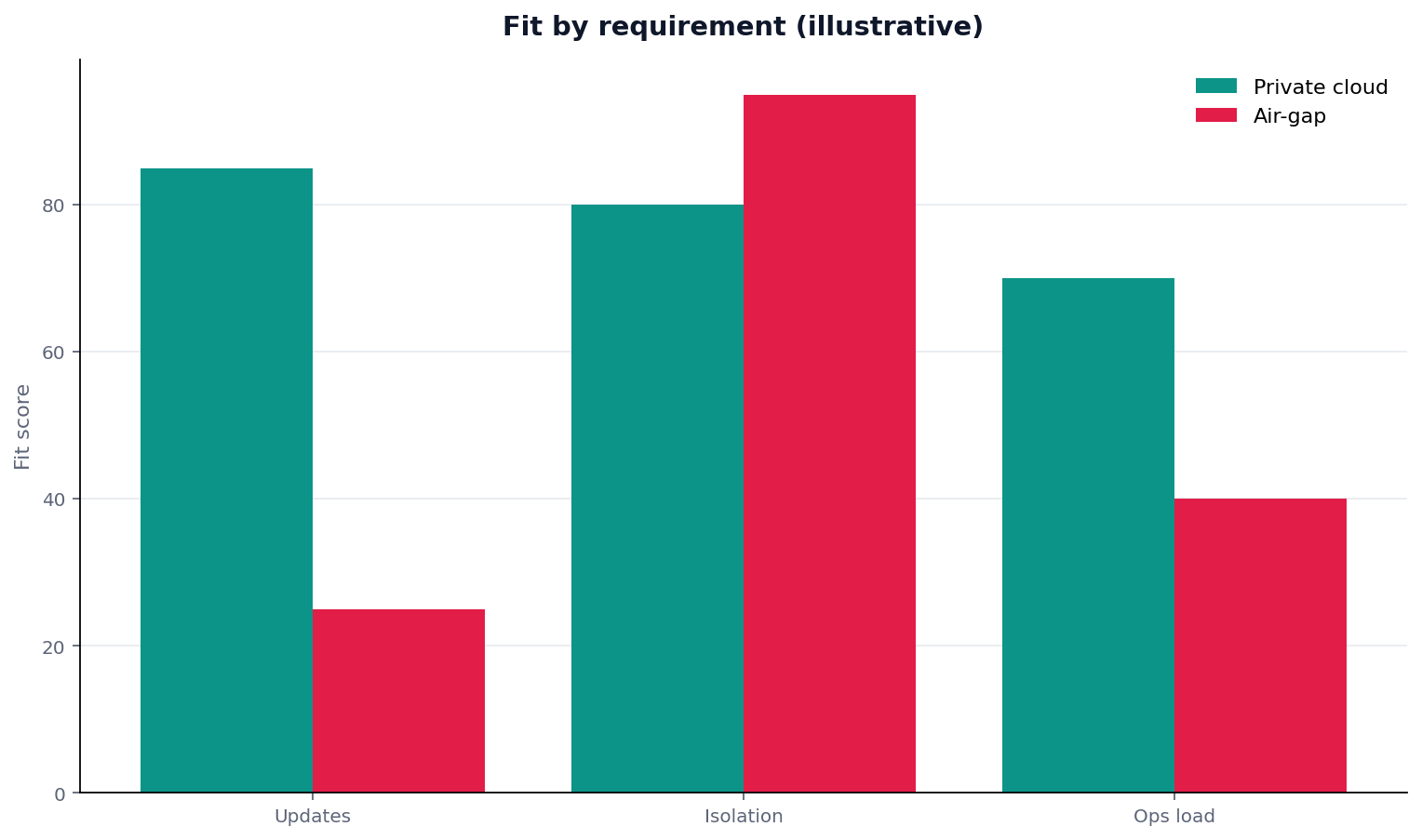
Figure. Teaching schematic. Not a measured study. Source: the protocol table above.
In this composite the channel-allowed form wins because patches are required. Air-gap would win only if the committee forbade the channel. Quote the protocol, not the bars.
Record who owns the egress table and who owns the patch cadence. Those two names should appear in the same review packet as the SaaS-proven task id. If either name is missing, postpone the move.
When a private cloud is the wrong purchase
Calling a locked VPC an air gap
The most common miss. The isolated VPC can be the right buy. The word air-gap is then a lie. Write VPC.
A model path you forgot to draw
The warehouse stays in the VPC. The prompt leaves. The selection failed the model line. Draw the endpoint or you have private AI theater.
Ops that cannot patch
You refused the vendor channel and never funded media. A boundary without updates becomes an island of CVEs. Isolation does not excuse an unpatched runtime.
The hub on premise AI holds the ladder. Private GPT is the air-gap preload. Private AI is the three-exit map you should complete before this selection.
Choose a private cloud or a true air gap
Start from exclusive use by one organization. Then score connectivity, update channel, and model exit. Do not call a locked VPC an air gap. This check uses only sources you authorize.
Commercial association: You do not need the workspace to complete the educational diagnosis on this page.
After you prove the same question on authorized data, Book a Demo if the job must live on hosts you operate.
Open InfiniSynapseHow this page is sourced. William Zhu is cofounder of InfiniSynapse, public as GitHub @allwefantasy. Company self-description, not independent authority. No third-party prize is claimed. No personal LinkedIn is published. Evaluation basis: We evaluate (hands-on) by scoring connectivity, update channel, and model exit—and refusing to call a locked VPC an air gap. Protocol 2026-09-02, replayed 2026-09-26. Reviewed internally by analytics engineering · data platform · LLM security · editor. Editorial standards · corrections · publishing principles · About · Privacy · Terms. Contact zhuhl@infinisynapse.com. COI: InfiniSynapse sells an AI-native Data Agent; the banner is a commercial association. The educational diagnosis does not require it. Fact-check: NIST SP 800-145 · Google Cloud AI overview · Wikipedia data warehouse · PostgreSQL documentation · Apache Spark documentation · OWASP API Security · Wikipedia business intelligence. No external organization audited this page. This page is not third-party recognition.
Frequently Asked Questions
What is a private cloud?
Bottom line: A private cloud is cloud infrastructure for one organization, on your premises or at a host. Business units may share it. A public tenant and an air gap are different things.
How does a private cloud differ from a public cloud?
Bottom line: A private cloud is exclusive to one organization. A public cloud is open to many customers. Control, security, and service quality follow from that split, not from the brochure.
Is a locked VPC the same as an air gap?
Bottom line: No. Private cloud still has a path you allow. An air gap does not. Do not swap the words.
Should most teams buy air-gap instead of this?
Bottom line: No. Most teams need isolation plus patches. Private cloud is that pair. Air-gap is the physical subset.
Does this replace our warehouse?
Bottom line: No. The warehouse is a source. Private cloud hosts the agent. It is not an ERP replacement.
What on this page is citable?
Bottom line: Cite the NIST exclusive-use line, the protocol table, and the private-versus-public comparison. Do not cite the chart bars or the 8 / 42k / 88 sketch as measured results.
Conclusion
A private cloud is exclusive use by one organization, with a managed update and a named model path. A public cloud shares the hosts. An air gap is a physical cut and a media list. Desktop is not this selection. Prove the job, draw every egress, then write one word on the purchase order.
If you later use the workspace, open InfiniSynapse only with authorized, sanitized inputs. After that proof, Book a Demo if the form is private cloud or a true air gap.