What Is Private AI: Map Exits before You Buy (2026)
By William Zhu & the InfiniSynapse Data Team · Published: 2026-09-02 · Last updated: 2026-09-03 · Last verified: 2026-09-03 · Next review: 2026-12-02 · Editorial standards · Corrections
Author credentials: William Zhu, Cofounder of InfiniSynapse. Public identity: GitHub @allwefantasy. Profile and review roles: editorial standards. This page is signed by a named person, not an anonymous editorial org. No personal LinkedIn is published. No third-party prize, media review, or independent endorsement is claimed.
Table of Contents
- TL;DR
- The working answer, not a tenant name
- Three-exit definition framework
- Private label versus a real answer
- Landscape: where the definition usually fails
- How to write the definition on one page
- Desk sample: first-party definition protocol
- Scorecard: did you answer the question
- Failure modes
- Frequently Asked Questions
- Conclusion
TL;DR
Direct answer: The working answer to what is private AI for analytics is this: keys, source rows, and model exit stay inside a boundary you can name and revoke. A private label on a SaaS chat is not the answer. Map the three exits before you buy. Isolation, credentials, resume, and quota still exist after you move the job.
Prove the isomorphic question in a hosted console first. Then ask which objects fail residency. This page is a definition you can quote. It is not a datacenter tour and not an ERP replacement.
What you'll learn:
- A quoteable answer to what is private AI that a reviewer can take into a workshop
- The three-exit table: keys, rows, prompts
- When a private label is enough and when it is not
- Steps to write the definition on one page
- A first-party protocol you can replay, plus an 8 / 42 teaching sketch
- Failure modes: public model, laptop keys, departing logs
The hub for on premise AI is the full deployment ladder. This cluster answers the definition question. The operational exit map lives on private AI.
The working answer, not a tenant name
Key Definition: The working answer to what is private AI for analytics is a long analysis task whose credentials, source rows, and model exit remain inside a boundary you operate or contract as yours. It is not a skin, not a tenant name, and not a promise that data never leaves while prompts still do.
Security reviewers already treat LLM tools as an attack surface. The OWASP community publishes that surface in plain language: injection, insecure output, and over-broad tools. A definition of what is private AI inherits that surface. Moving the UI into a VPC does not close tool abuse if the model or the log store sits outside.
A data agent is the unit of work. The definition of what is private AI is that unit placed so source credentials do not travel to a vendor you did not accept. If you already have a warehouse, you still need to say where the agent’s keys live.
Data security and compliance writes the policy. The answer to what is private AI is the placement that makes the policy true at runtime. Enterprise data security solutions list vaults and networks. This page asks the three exits those lists often skip: keys, rows, and model text.
NIST’s Computer Security Resource Center projects are independent maps for control catalogs. Use them on the hosts: authn, audit, crypto. They do not replace a written exit map. They do not answer what is private AI for a task id you must reopen tomorrow.
CISA’s resources and tools start with inventory. Inventory the exits, not the logo. If you cannot name the owner of keys, rows, and prompts, you still have not answered what is private AI.
Independent published context (retrieved 2026-09-02). The three sources above did not run this fixture.
| Cited source | What it owns | What tonight still needs |
|---|---|---|
| OWASP community | Injection, insecure output, over-broad tools | A VPC UI does not close that surface |
| NIST CSRC Projects | Control catalogs: authn, audit, crypto | They do not replace a written exit map |
| CISA resources | Inventory first | Inventory the exits, not the logo |
| Google Cloud Architecture | Identity, network, ops maps | Apply them to the agent, not only the warehouse |
| AWS whitepapers | Isolation patterns | They do not certify a chat skin |
| Microsoft Azure documentation | Identity and network | None of those hosts answers a prompt that still leaves |
That is still the work of what is private AI.
Keys must be revocable by you
If you cannot rotate a source grant without paging a vendor, the key is not yours. Hold source credentials in your vault. Do not paste a warehouse password into a chat. Teams that ask what is private AI and then store a password in a runbook have already failed the first exit.
Rows and prompts are different exits
Teams collapse them. The definition must not. A row export is a data-residency event. A prompt that names a customer or pastes a sample is a different event. You can keep rows in-plant and still fail what is private AI because the model API saw the sample. Write both lines.
Three-exit definition framework
Write one row per exit. The working answer to what is private AI is true only when all three have an owner.
| Exit | Object that leaves | Allowed under the definition | Typical leak |
|---|---|---|---|
| Keys | Source tokens, vault refs | No outbound copy | Browser, ticket, partner email |
| Rows | Table extracts, files | Only inside the boundary | Sync to a vendor lake “for AI” |
| Prompts / model | Question text, schema notes, samples | Only if the model is in-boundary | Public LLM API |
| Logs (bonus) | Traces, SQL, screenshots | Same rule as rows | Observability SaaS |
Date the rows when an endpoint moves.
Private label versus a real answer
Two products claim to answer what is private AI. Only one can survive a workshop.
| Candidate | What you get | Choose A if | Choose B if |
|---|---|---|---|
| Private label SaaS | Your logo, their hosts | Branding is the requirement | — |
| Three-exit definition (this page) | Exits you can map | Keys, rows, or model cannot leave | You already proved the job |
| Private cloud VPC | Isolation plus updates | You want a managed channel | See private cloud |
| Air-gap | Physical cut | Media is the only update | Not this page’s default |
Choose a private label if branding is the requirement
If legal has already accepted a vendor hop for a trial, a label is enough to demo. That is not an answer to what is private AI. Do not write “private” on the PO.
Choose the three-exit answer if a reviewer would fail an exit
If any of the three exits would fail an audit, move the same task. The private AI platform page is the on-prem shape of that task. This page is the definition you write first. Choose B when you can already replay the SaaS trail and the exit map is the open question. That is how what is private AI stays a definition instead of a second product.
Landscape: where the definition usually fails
Google Cloud Architecture (table above) maps identity, networking, and operations. Use those maps on the agent. A VPC that still posts prompts to a public model named the wrong trust boundary. That miss is how teams fake an answer to what is private AI.
AWS whitepapers and Azure documentation (table above) describe isolation. They do not certify a chat skin. None of those hosts answers what is private AI for a prompt that still leaves.
| Layer | Common product | Definition question |
|---|---|---|
| Source | Warehouse, OLTP, file | Does the agent hold a standing password? |
| Runtime | Task, resume, quota | Is the id inside your hosts? |
| Model | API or weights | Does text leave? |
| Observability | Logs, traces | Do SQL and prompts leave? |
| Client | Browser, desktop | Does the client see the source key? |
A warehouse hop is not the only path
Engineers watch the JDBC string. Reviewers who ask what is private AI must also watch the ticket that forwarded a CSV, the screenshot in chat, and the eval set built from production names. Close those or the definition is theater.
SQL near the table does not close the model
Nearness of compute is not nearness of the language model. “We query locally” is half a sentence. Finish it: “and the model is X, hosted at Y, with no sample paste.” Until that sentence exists, you have not answered what is private AI. Desktop is a client. A local window is not an automatic air gap and not a substitute for the model line.
How to write the definition on one page
Number the work. A slogan is not a definition.
- Input: The SaaS-proven question and its task id. Accept: You can reopen plan and SQL. Reject: No isomorphic job yet; stop. Do not start what is private AI as a plant tour.
- Input: A list of secrets the agent needs. Accept: Each secret has a vault path and a rotator. Reject: A password in a runbook.
- Input: A list of row movements. Accept: Extracts stay on named hosts. Reject: A vendor “AI lake” copy you cannot see.
- Input: The model endpoint and what text it receives. Accept: Schema-only or in-boundary weights. Reject: Unknown.
- Input: Log and trace destinations. Accept: Same boundary as rows. Reject: A public APM with full SQL.
- Input: A resume-and-quota note plus a written non-goal. Accept: Kill the task; same id continues. “Not replacing Oracle or SAP. Not an unpublished SLA.” Reject: “Offline means we restart chat.”
Walk keys, then rows, then prompts, then logs. Unknown is a fail. Freeze the page. That is how what is private AI stays shorter than a plant tour.
Desk sample: first-party definition protocol
Cite this protocol. Do not cite 8 regions, 42k rows, 88 edges, or the chart bars as a benchmark.
First-party method log (replayable):
| Field | Record |
|---|---|
| Operator | InfiniSynapse Data Team; William Zhu, GitHub @allwefantasy |
| First run | 2026-09-02 |
| Replay | 2026-09-03 |
| Input | Authorized, sanitized fill-rate pack; no people |
| Paths | Labeled-private SaaS chat vs three-exit map |
| Steps | 4 (vault path, row hosts, model endpoint, log destination) |
| Acceptance | Customer vault; VPC warehouse only; in-boundary endpoint; plant SIEM |
| Fail | Password in the prompt; nightly dump; public LLM with samples; ticket screenshot |
Replay 2026-09-03. Quote this what is private AI protocol. Editorial standards.
Teaching sketch only: 8 regions, 42k rows, 88 edges. That is not the measured object.
Score what is private AI on the same ask:
| Exit | SaaS proof | Definition pass | Fail |
|---|---|---|---|
| Keys | Vendor vault | Customer vault | Password in the prompt |
| Rows | Accepted hop | VPC warehouse only | Nightly dump to a public bucket |
| Model | Vendor API | In-boundary endpoint | Public LLM with sample rows |
| Logs | Vendor | Plant SIEM | Screenshot in a ticket |
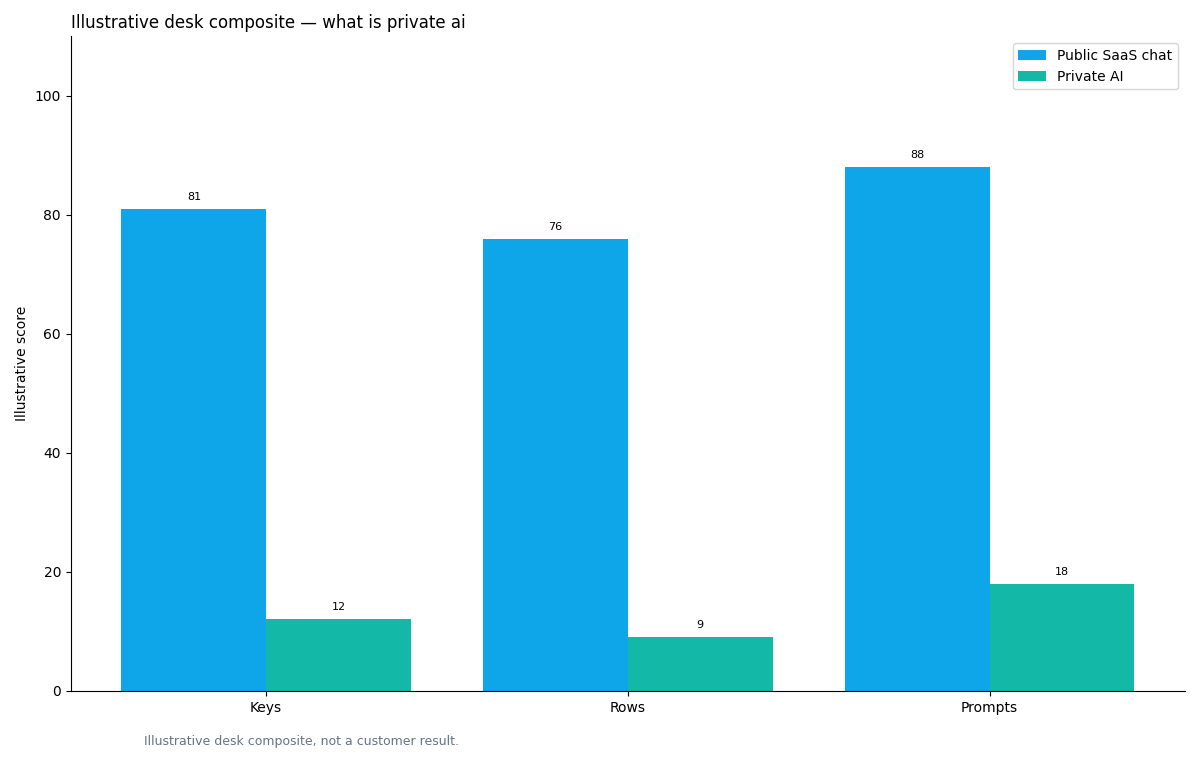
Figure. Teaching schematic. Not a measured study. Source: the protocol table above.
In this composite, the definition fails on the model line even when the warehouse never moved. Teams that ask what is private AI and then score only the JDBC string will pass a job that still leaks names. Quote the protocol, not the bars.
Scorecard: did you answer the question
| Claim on the slide | Pass signal | Fail signal |
|---|---|---|
| “Private tenant” | Exits mapped | Logo only |
| “Data never leaves” | Rows and prompts both named | Rows only |
| “We use your VPC” | Keys and model also in-boundary | Chat widget + public LLM |
| “Air-gapped” | Media updates; no path | Locked NSG with a proxy |
| “Desktop private” | Client config shows the endpoint | Assumed because it is a .app |
Choose A (stay on the proof) if any row is blank. Choose B (write the definition) if the three exits are written and owned. Choose C (air-gap) only after the physical-cut story is real. This scorecard is what is private AI as a desk test, not a purchase order.
Failure modes
Private UI, public model
A CSS theme is not a definition. If the model sees production text, you have a public model with a private skin. Until you write the endpoint, you have not answered what is private AI.
Keys in the analyst laptop
A desktop shortcut that embeds a warehouse token is a published key. Laptop copies fail the first lost-device drill. Do not treat a local window as the answer to what is private AI.
Logs that leave after the job
The SIEM is public. SQL with filter values left. If you cannot name the log path, assume it leaves. Teams that stop at “rows stayed” still fail what is private AI.
The hub on premise AI holds the full ladder from SaaS proof to air-gap. When the object is the hosted task shape rather than the definition, continue on private AI platform.
When you need the operational exit map rather than the quoteable sentence, use private AI.
Map keys, data, and model exit
Write where keys live, where rows go, and whether prompts leave. This check uses only sources you authorize.
Commercial association: You do not need the workspace to complete the educational diagnosis on this page.
After you prove the same question on authorized data, Book a Demo if the job must live on hosts you operate.
Open InfiniSynapseHow this page is sourced. William Zhu is cofounder of InfiniSynapse, public as GitHub @allwefantasy. Company self-description, not independent authority. No third-party prize is claimed. No personal LinkedIn is published. Evaluation basis: We evaluate (hands-on) by mapping the three exits—keys, rows, prompts—on a labeled-private SaaS chat. Protocol 2026-09-02, replayed 2026-09-03. Reviewed internally by analytics engineering · data platform · LLM security · editor. Editorial standards · corrections · publishing principles · About · Privacy · Terms. Contact zhuhl@infinisynapse.com. COI: InfiniSynapse sells an AI-native Data Agent; the banner is a commercial association. The educational diagnosis does not require it. Fact-check: NIST CSRC Projects · CISA resources and tools · OWASP community · Google Cloud Architecture · AWS whitepapers · Microsoft Azure documentation. No external organization audited this page. This page is not third-party recognition.
Frequently Asked Questions
Is a private tenant the same as the definition?
Bottom line: No. A tenant name is a label. The working answer to what is private AI requires a written map of keys, rows, and model exit.
Can we keep rows in-plant and still fail the definition?
Bottom line: Yes. Prompts and logs are separate exits. What is private AI fails if sample text leaves while tables stay.
Does the definition replace our warehouse?
Bottom line: No. The warehouse remains a source. What is private AI places the agent and its credentials. It is not a store and not an Oracle or SAP replacement.
Should we write the definition before a SaaS proof?
Bottom line: No. Prove the job first. What is private AI moves a real trail. It does not invent one.
What still exists if we go offline later?
Bottom line: Isolation, credentials, resume, and quota. What is private AI that cannot resume is a demo, even inside a VPC.
What on this page is citable?
Bottom line: Cite the protocol table, the three-exit frame, and the six-source comparison. Do not cite the chart bars or the 8 / 42k / 88 sketch as measured results.
Conclusion
The working answer to what is private AI is an exit map you can defend: keys, rows, and model text inside a named boundary. Write the three exits. Prove the question in a hosted console. Then move the objects that fail. If you later use the workspace, open InfiniSynapse only with authorized, sanitized inputs. After that proof, Book a Demo if the boundary requires a private host.