Analysis Playbook: Bind, Then Replay
By William Zhu (independent public engineering profile: GitHub @allwefantasy; no personal LinkedIn) & the InfiniSynapse Data Team · Published: 2026-08-22 · Last updated: 2026-08-29 · Last verified: 2026-08-29 · Next review: 2026-11-29 · About · Editorial standards · Privacy · Publishing terms · Corrections
Table of Contents
- TL;DR
- What an analysis playbook is
- A prior-not-script framework
- How pasting last year’s SQL fails
- Tool landscape for reusing a case
- Implementation steps from one case to a new week
- Desk sample: last March as a prior (InfiniSynapse desk log)
- Selection scorecard
- Failure modes that turn a prior into a paste
- Frequently Asked Questions
- Conclusion
TL;DR
We evaluate these patterns at the InfiniSynapse desk on sanitized composites; first-party figures on this page are desk log OAM-PLAY-20260822, not customer uplifts and not a third-party bake-off.
Direct answer: An analysis playbook has no single industry-standard form. It may record decision context, assumptions, definitions, source contracts, SQL or notebooks, validation checks, expected artifacts, exceptions, escalation, owner, version, effective date, and expiry. A past case is an analogy to adapt and validate—not automatic truth.
Download evidence: desk log · aggregate CSV · verify script. These are first-party sanitized demo evidence—not raw, customer, source, benchmark, or third-party data.
What you'll learn:
- Why the reusable case is a prior, not a script to paste
- Which pages from a past case belong in the bound pack
- How to ask this week’s question without replaying last year’s joins as gospel
- Desk log
OAM-PLAY-20260822, that reused a March exception note with an expiry - Failure modes: copy-paste SQL, stale exceptions, and unsigned “lessons”
Case-based reasoning provides a useful adaptation cycle. Aamodt and Plaza’s foundational review describes retrieve, reuse, revise, and retain; Kolodner’s Case-Based Reasoning develops the field. A past case is therefore a prior or analogy that must be adapted, not a result to copy unchanged.
An analysis playbook can operationalize that cycle without claiming that every past case is relevant.
Organizational research adds retention and governance: Argote and Miron-Spektor’s learning framework, Walsh and Ungson’s organizational memory paper, and Alavi and Leidner’s knowledge-management review address experience, storage, retrieval, transfer, and application. ISO 30401 specifies knowledge-management-system requirements. None tested this desk run.
Operational controls may draw on CISA playbooks, Federal incident-response playbooks, PROV-O, FAIR principles, ACM Artifact Review, NIST Privacy Framework, NIST AI RMF, and OWASP GenAI. These illustrate governance, provenance, review, privacy, and risk; none endorses InfiniSynapse. Retrieved 2026-08-29.
Author qualifications and accountability
William Zhu is an InfiniSynapse cofounder. GitHub @allwefantasy, auto-coder, byzer-llm, BYZER-RETRIEVAL, and the InfiniSynapse organization verify public project activity—not education, knowledge-management certification, customers, or independent evaluation.
This page is first-party. The authors sell the workflow. It is not an independent review. 2026 WAIC Future Tech OPC Excellence Award (homepage; not a review). 2026-07-29 attestation.
A prior changes what you believe before you see this week’s rows. The signed playbook should change the question you ask, not the join you paste. Institutional knowledge analytics is the language those priors must use. Recurring KPI analysis is the weekly motion; a playbook is the case you promote when the week was not routine.
Each analysis playbook should state why the analogy applies and where it may fail.
A data knowledge base is the bind surface. One document that belongs there is a finished case, signed and stripped of secrets. What is a data agent describes the retriever. This page describes the prior you hand it.
A prior answers “what we already decided”
Last March you decided marketplace fees sit above contribution. That sentence belongs in the reusable case pack. Last March’s exact WITH clause may remain a versioned test, template, or evidence artifact, but it must be revalidated against schema, grain, permissions, parameters, and results. The new week may have a new grain. The decision can still be in force.
A script answers “what the old engine happened to run”
SQL can be a reusable, versioned template and test as well as a trace. Revalidate it against the current source contract and expected results. Keep both decision context and executable evidence. If you cannot say the decision without the query, you do not have a playbook. You have a souvenir.
A prior-not-script framework
| Object | Role in the analysis playbook | Leave it out |
|---|---|---|
| Signed decision | Prior for the new week | Hallway recap |
| Definition pages | Language the case used | Unowned drafts |
| Exception note | Dirty join, expiry date | “We’ll remember” |
| Task artifacts | Evidence the case happened | Screenshots without the goal |
| Old SQL | Optional appendix | The thing you paste first |
An analysis playbook grows when someone promotes a case. Auto-saving every notebook is how you get a junk drawer. Promotion is a decision: this case is now a prior. That case stays in the lab.
Self-service analytics still needs the same prior. A non-analyst who pastes last year’s query is not self-serve. They are unguided. Bind the analysis playbook so the first question already knows the March exception.
MCP for data analysis can call the same task from an IDE. The playbook is still the pack, not the terminal history.
Expiry dates and one case per page
A dirty join that saved March may poison August. Every exception in the pack needs an expiry or a review date. If you cannot name the date, you are pasting. Expired exceptions should move to an appendix labeled “historical, do not retrieve as current.”
The analysis playbook change log should preserve that expiration decision and its approver.
Do not merge three investigations into one undated essay. An analysis playbook is easier to retrieve when each case has a name, a date, a signer, and a one-paragraph decision. The new week should retrieve March, not “the ops folder.”
How pasting last year’s SQL fails
Pasting without validation is unsafe reuse; pasting a reviewed, versioned template can be legitimate. The source moved. The grain moved. The exception expired. An analysis playbook that starts with CTRL-V will look fast and then lie. Ask this week’s question with the prior in context. Validate the current schema, permissions, grain, parameters, query diff, tests, and output. Compare the new artifacts to the old ones. Do not assume the old join is still legal.
A trustworthy analysis playbook makes adaptation and test evidence visible before acceptance.
If the new plan differs, that is information. An analysis playbook is working when the difference is inspectable. A pasted script hides the difference until a VP asks why the total shrank.
Schema drift and stale exceptions
Columns get renamed. A pasted query fails loudly or, worse, runs on the wrong field. An analysis playbook keeps the decision and requires explicit adaptation to the current schema. If the decision required a column that no longer exists, the page should say so—not the error message.
“We always exclude store 88.” Store 88 closed. The exclusion is now a ghost. An analysis playbook that never expires exceptions will teach the next hire a ritual. Rituals are not priors. They are superstition with a WHERE clause.
Tool landscape for reusing a case
Chat exports. They feel complete. They are not signed. Weak as an analysis playbook. The next person cannot tell which paragraph was the decision.
SQL snippet libraries. Fast to paste. Silent about meaning. Use them as appendices, not as the pack.
Governed case plus a new goal. In this first-party demo, a named approval, version, and expiry accompany authorized read-only sources; no writeback occurs. Binding does not guarantee schema compatibility or safe execution. The same pattern may live in a repository, wiki, catalog, ticket, notebook registry, or knowledge base.
Implementation steps from one case to a new week
- Register the case ID, owner, approver, version, effective date, and expiry. Expected result: the prior has accountable identity.
- Record decision context, definitions, assumptions, source contracts, exceptions, and escalation. Expected result: reuse boundaries are explicit.
- Retrieve a similar case and document similarity and differences. Expected result: the analogy is reviewable.
- Adapt SQL, notebooks, parameters, and templates; rerun checks against current schema and access. Expected result: reuse fits current conditions.
- Review outputs, failures, privacy, lineage, and artifact hashes. Expected result: evidence supports the new result.
- Retain the revised case or expire it with a change log. Expected result: the library evolves deliberately.
You can do the educational diagnosis with last March’s slide and a red pen. The web app is how you bind the signed page and ask the new week. A pack that still requires the original author on the call is not a playbook. The red pen should leave a date and an expiry, not another paragraph of folklore.
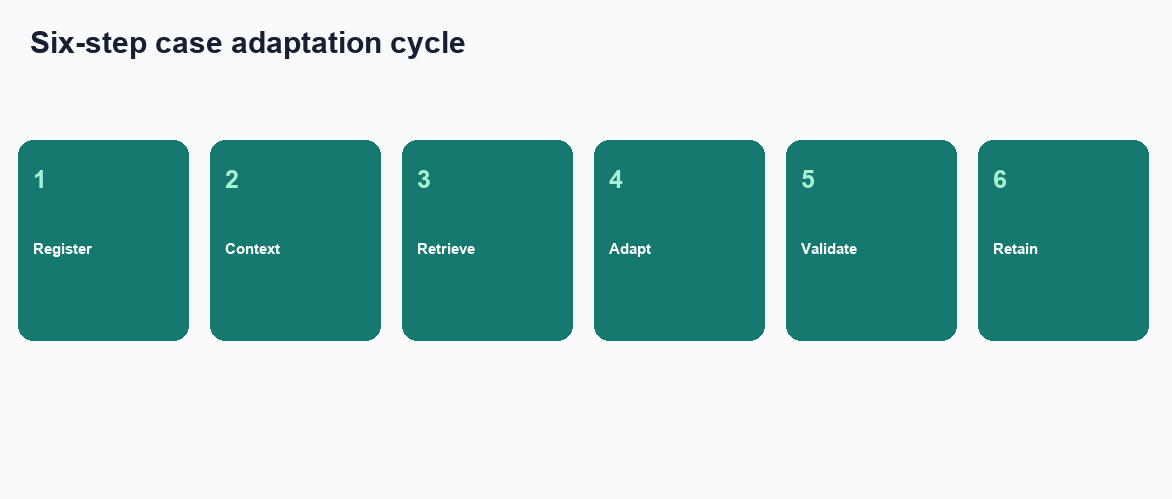
Figure. Educational four-step sequence the desk uses to tell a SQL souvenir from a signed prior. Expected result after step 6: August retrieves the fee decision, skips the expired join, and nobody pastes March SQL. Not a product screenshot or a customer SLA.
Write the decision in one paragraph
If you cannot state the decision without a chart, you do not have a prior. An analysis playbook page should survive being read without the appendix. The appendix can hold SQL and figures. The page holds the sentence the next person must inherit.
Ask the new week, then inspect retrieval
Open the task steps. Confirm retrieval opened the case you meant. If it retrieved a different year, your titles are too similar. Rename the pages. An analysis playbook that cannot be found is a share drive.
Desk sample: last March as a prior (InfiniSynapse desk log)
This is a first-party InfiniSynapse desk log of an analysis playbook, not a named-logo customer case and not an uplift claim. Run ID: OAM-PLAY-20260822. Date: 2026-08-22 (Saturday). Operator: InfiniSynapse Data Team. Sources: a read-only replica plus a sanitized March case page. Contrast: paste last year’s SQL versus bind the signed prior and ask August’s question. Download the same numbers as desk log OAM-PLAY-20260822.
The paste path opened March SQL first. The fee decision never entered retrieval. The expired dirty join still ran. August’s total shrank for a reason nobody could point at in a pack.
The bound path locked one March page: marketplace fees sit above contribution; one dirty join expires 2026-06-30. They bound that page and asked August’s margin question. The retrieved passage still had the fee decision. The dirty join had expired, so the new plan did not use it. August’s artifacts sat next to March’s in /tasks. Nobody pasted March SQL.
| Retrieval state | Fee decision retrieved | Expired join reused | March SQL pasted |
|---|---|---|---|
| Paste last case | 0 | 1 | 1 |
| Bound playbook page | 1 | 0 | 0 |
Wall clock for the successful August ask was about fifteen minutes (warehouse time excluded). The clock started when the operator opened this week’s question and ended when both folders sat side by side with the featured queries open. It does not include replica provisioning or a design review. Cite this table as InfiniSynapse desk log OAM-PLAY-20260822. Do not cite it as customer ROI, a 40% faster August, a bake-off win, or an IETF / OWASP / Gartner experiment. We do not publish named-logo customer cases on this page. The only honest claim is the artifact counts and the wall-clock on this run. The NIST AI Risk Management Framework and OWASP Top 10 for LLM Applications stay in the risk overlay: bind only authorized, sanitized sources. Those publications did not time this Monday.
We are not attaching a percentage. The prior changed the question, not the pasted join. The exception had an expiry.
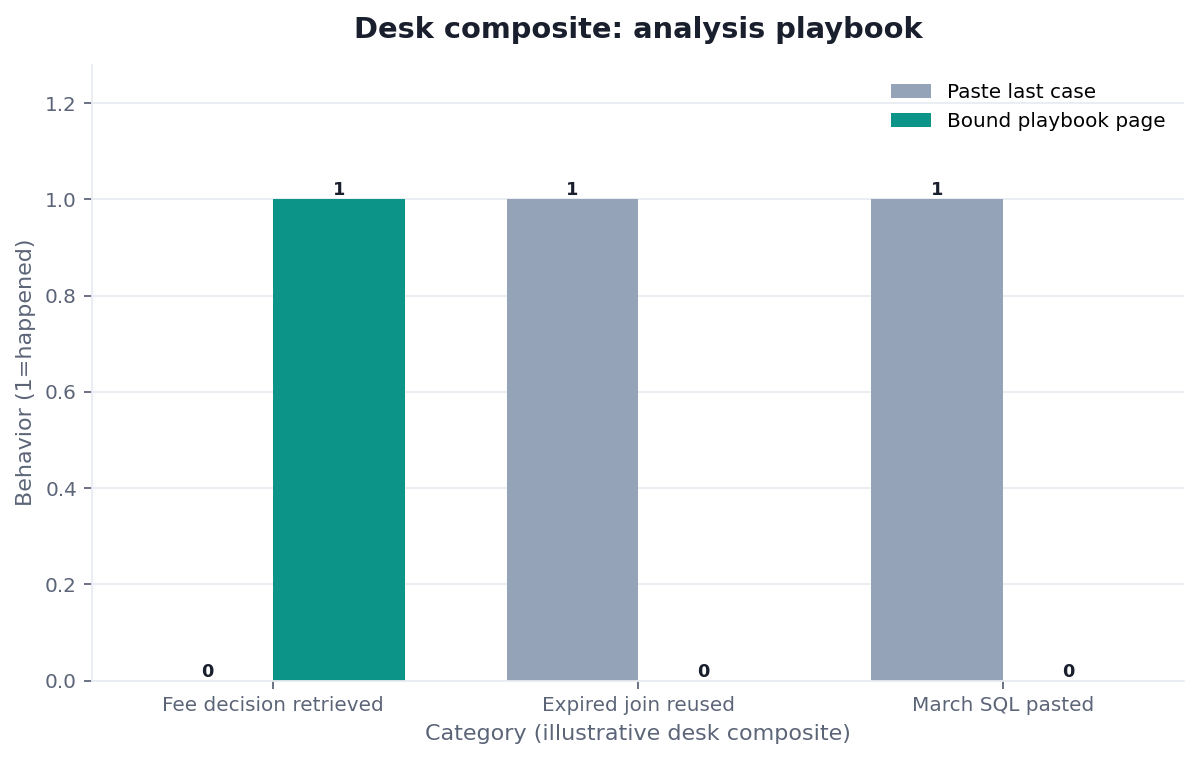
Figure. InfiniSynapse desk log OAM-PLAY-20260822: the paste path left 0 / 1 / 1; the bound page left 1 / 0 / 0. Published context: the independent sources linked in the body. Not a customer experiment, SLA, or official benchmark.
| Evidence class | What you can cite | What you cannot claim |
|---|---|---|
| Desk log on this page | Artifact counts 0/1/1 → 1/0/0, ~15 min wall-clock, run ID, downloadable log | Customer uplift %, vendor bake-off win, named-logo case |
| External research and guidance | CBR adaptation, organizational retention, provenance, review, privacy | That those sources ran this desk log |
Evidence boundaries and external validation status
OAM-PLAY-20260822 is a first-party sanitized composite/demo—not raw, customer, source, benchmark, or third-party data. As of 2026-08-29, no independent third party, media outlet, or customer had reproduced it. CBR and knowledge-management research supports adaptation and retention; it does not validate 0/1/1 → 1/0/0 or 15 minutes.
The analysis playbook observation is limited to this documented first-party scenario.
Replication should disclose system, tool, model, version, retrieval configuration; playbook ID, version, owner, approver, effective date, expiry; source schema, snapshot, access; metric, grain, join, filter, timezone; case similarity and adaptation rationale; SQL, notebook, and query diffs and tests; retrieved passage IDs; run IDs, status, errors, timestamps; artifact hashes; paste baseline; all failures; review, privacy, retention; wall clock; and conflicts of interest.
Selection scorecard
| Criterion | Weak | Strong |
|---|---|---|
| Object | SQL souvenir | Signed decision page |
| Exceptions | Folklore | Dated, expiring |
| Bind | Folder on a laptop | Bound to the source |
| New week | Paste first | Ask, then inspect retrieval |
| Identity | “the ops notebook” | Named case, owner, date |
| Privacy | Raw case files | Minimized, authorized |
If a tool promises an analysis playbook but only stores snippets, score it as a paste bin. If it can bind a case but encourages uploading the entire ticket dump, stop and reread the NIST Privacy Framework.
The scorecard is an educational rubric, not a vendor ranking. Independent docs linked above describe fetching a representation and inventorying information; they do not score this rubric.
Apply the analysis playbook scorecard with domain-specific controls, not as a universal standard.
Failure modes that turn a prior into a paste
Copy-paste SQL as the first step
The new week starts with an unvalidated query. Retrieve the case context, compare source contracts, rerun tests, and review results before reuse. Paste is an input action, not validation.
Stale exceptions without expiry
A join that saved one quarter becomes permanent. The analysis playbook now lies. Put dates on exceptions. Move expired notes to an appendix that retrieval should not treat as current.
Unsigned lessons
“We learned to watch store 88” lives in a chat. Nobody signed it. An analysis playbook cannot retrieve a lesson that was never a page. Promote the lesson or forget it on purpose.
Before you claim the team reuses cases, check that one finished case has a signed page, that exceptions have dates, that the pack is bound, and that this week’s task retrieved the page you meant. That inspection is the diagnosis.
An analysis playbook is reusable only when another reviewer can inspect the case identity, adaptation, tests, and resulting evidence.
When the next missing object is not this page, open the live guide that owns it.
| Live guide | Open it when |
|---|---|
| Metric Definition Drift: Catch It on the Replay | Drift shows up when two reruns disagree |
| Team Memory vs Personal Chat History | Chat history is not institutional knowledge |
| How to Start Analysis Memory | Lock five definitions before you grow the archive |
Upload one approved case, then ask the new week
Bind one signed past case to an authorized source, ask this week’s question without pasting old SQL, and confirm the prior was retrieved. This check uses only sources you authorize.
Commercial association: You do not need the workspace to complete the educational diagnosis on this page.
Open InfiniSynapseSourcing and accountability. Research, standards, and official playbooks support scoped claims only; none evaluated this page. COI: InfiniSynapse sells the first-party workflow.
How to cite this page
Page: Zhu, W., & InfiniSynapse Data Team. (2026). Analysis Playbook: inspect, then replay. InfiniSynapse
Run: InfiniSynapse Data Team. (2026). Desk log OAM-PLAY-20260822 (sanitized composite)
Neither is an audit. Cite those artifact counts on this first-party desk run. No independent reproduction exists. Keep that limit visible. Send contradictions to zhuhl@infinisynapse.com.
Frequently Asked Questions
Can SQL belong in an analysis playbook?
Bottom line: Yes. Treat it as versioned template, test, or evidence and revalidate schema, grain, permissions, parameters, and results.
Can we bind every old notebook?
Bottom line: No. Promote one case at a time. An analysis playbook that is a dump of every kernel will retrieve folklore. Sign, strip, bind, then add a second case.
What if this week’s question is unrelated?
Bottom line: Do not force the prior. An analysis playbook is useful when the decision is still in force. If the question is new, start a new page. Do not stretch March to cover August’s unrelated fight.
Does reuse write the old query into production?
Bottom line: No. Binding a pack and running a task does not write SQL or rows into production. An analysis playbook lives in the bound documents and the new artifacts.
Do external studies validate this reuse test?
Bottom line: No. They support adaptation, retention, and governance concepts; they did not run this desk scenario.
Are the object counts a third-party benchmark?
Bottom line: No. The 0 / 1 / 1 versus 1 / 0 / 0 counts are first-party desk log OAM-PLAY-20260822. An analysis playbook treats those counts as a paste-versus-prior test, not an SLA.
Related guides: organizational analysis memory · tribal knowledge · knowledge sharing · what is institutional knowledge · tribal knowledge vs institutional knowledge · corporate knowledge management · data governance · knowledge base vs semantic layer · explainable ai data analysis guide
Conclusion
An analysis playbook is a signed prior from a past case, not a script to paste. Bind one approved page, ask the new week, and expire exceptions that no longer apply. When you want to run that check on an authorized source, open InfiniSynapse and confirm the prior was retrieved.