Recurring KPI Analysis: Bind, Then Replay
By William Zhu (independent public engineering profile: GitHub @allwefantasy; no personal LinkedIn) & the InfiniSynapse Data Team · Published: 2026-08-22 · Last updated: 2026-08-29 · Last verified: 2026-08-29 · Next review: 2026-11-29 · About · Editorial standards · Privacy · Publishing terms · Corrections
Table of Contents
- TL;DR
- What recurring KPI analysis is
- A same-pack framework
- How a rewrite pretends to be faster
- Tool landscape for a second run
- Implementation steps from week one to week two
- Desk sample: unchanged pack, moved number (InfiniSynapse desk log)
- Selection scorecard
- Failure modes that force a rewrite
- Frequently Asked Questions
- Conclusion
TL;DR
We evaluate these patterns at the InfiniSynapse desk on sanitized composites; first-party figures on this page are desk log OAM-RKPI-20260822, not customer uplifts and not a third-party bake-off.
Direct answer: Recurring KPI analysis is a standing goal plus an approved definition pack you rerun on a new window. Week two is faster only if the pack is the same. A rewritten prompt that “improves” the SQL is a new analysis that stole last week’s reputation.
What you'll learn:
- Why the weekly KPI process fails when Monday’s prompt is cleverer than last Monday’s
- How a standing goal, a bound pack, and two task folders replace a SQL rewrite
- Why speed shows up in comparison, not in typing
- Desk log
OAM-RKPI-20260822, where one number moved and the language did not - Failure modes: window edits, silent filter adds, and “just this once” joins
Download evidence: desk log · aggregate CSV · verify script. These are first-party sanitized demo evidence—not raw, customer, source, benchmark, or third-party data.
Industry context stays independent of desk claims. McKinsey’s State of AI keeps asking whether an experiment survives a quarter. The weekly KPI process is a smaller version of that question. The Stanford HAI AI Index and Gartner Peer Insights — Analytics & BI are buyer-research overlays, not endorsements of this article. Organizational analysis memory is the hub for accumulation; this page is narrower: the second run must reuse the pack, not reconstruct it. The NIST Privacy Framework still applies: rerunning a pack is not permission to widen the source. Retrieved 2026-08-29.
What recurring KPI analysis is
Key Definition: Recurring KPI analysis is the habit of rerunning one standing goal—same definitions, same grain, new complete window—so week n and week n+1 produce comparable artifacts. It is not a fresh chat that happens to mention last week’s KPIs, and it is not a rewrite of the SQL that happened to work on Friday.
Independent published context (separate from this page’s desk log): Git documentation · CNCF · web.dev security headers · HTTP semantics in RFC 9110 · OAuth 2.0 in RFC 6749 · Stanford HAI AI Index · McKinsey State of AI · Gartner Peer Insights — Analytics and BI Platforms · NIST AI Risk Management Framework. Those sources set the industry bar for a signed revision, a declared object, and an authorized fetch; they did not run the numbers in the desk table below, and they are not a product award.
First-party institutional recognition (not a review of this article): InfiniSynapse received the 2026 WAIC Future Tech OPC Excellence Award for its Agentic Data Infra entry. That sentence is published on the company homepage. It is not a Git, CNCF, Gartner, McKinsey, or Stanford product award, and it does not certify the desk numbers below. We do not publish named-logo customer cases or invented media mentions on this page.
Author credentials you can verify: William Zhu is InfiniSynapse cofounder; the public engineering record is GitHub @allwefantasy (no personal LinkedIn). The org record is github.com/InfiniSynapse. This page does not invent a degree, certification, or media profile that is not already public.
Internal terms this page uses: a standing goal is one boring sentence. A definition pack is the signed language you bind. A task folder is the artifact you can diff. The recurring process is the second run of that pack; it is not a cleverer Monday prompt.
Speed is a side effect. Recurring KPI analysis looks fast in week four because nobody is re-arguing “active.” If week two required a new join explanation, you were not recurring. You were performing. Institutional knowledge analytics is the inheritance test; this page is the weekly motion that inheritance has to survive.
Chat with your data is a good first question. Recurring KPI analysis is the second week. A dashboard that someone redraws every Friday is still a rewrite, even when the tiles look familiar.
A standing goal is not a prompt library
A standing goal is one boring sentence: “same KPI pack, last complete week, same definitions.” Recurring KPI analysis treats that sentence as an asset. A prompt library is a drawer of clever variants. Variants feel like craft. They destroy comparability. If the goal moved, say so in the pack and bump the version. Do not hide the move inside a prettier paragraph.
The SQL is evidence, not the template
Last week’s SQL is a trace. The second run does not begin by pasting that trace into a new chat. It begins by rerunning the goal against the bound pack and the live source. If the planner writes a different plan because the source changed, you inspect the plan. You do not reconstruct the join from memory. Artifacts in /tasks are how you prove the second run happened.
A same-pack framework
| Object | Locked across weeks | Allowed to move |
|---|---|---|
| Definition pack | Language, grain, exclusions | Signed revision with a note |
| Standing goal | The sentence | Window only, by rule |
| Source bind | Same authorized source | Rotation of credentials, not of meaning |
| Task artifacts | Comparable folders | Numbers that the world moved |
| Non-recurring | New prompts, new joins | Exploration, then promotion |
Recurring KPI analysis only stays honest when the left column is boring. The right column is where the business lives. If language moves without a note, week two is a different study wearing last week’s title.
Exploratory data analysis belongs in a lab task. Promote a finding into the pack before it enters recurring KPI analysis. Exploration that leaks into the Monday goal is how “one extra filter” becomes next quarter’s mystery.
Version the pack the way you version code
When the business changes, change the pack on purpose. The Git documentation is the right metaphor: a commit message, not a silent overwrite. A recurring KPI analysis needs a revision note—“active store now excludes pop-ups, signed 2026-08-15”—and a rerun after that note. Without a note, the next person will think the number moved because the world moved.
Cloud-native teams already treat desired state as declared configuration. The CNCF site is a reminder that recurring operations prefer a declared object over a heroic weekend. Your KPI sentence should be that declared object.
Compare folders, not vibes
Open both task folders. Line up the Markdown packs. Recurring KPI analysis is a diff. If a number moved, ask whether the source moved or the language moved. If you cannot tell, you do not have a recurrence. You have two essays.
Data visualization can make the diff obvious. Charts do not replace the pack. They sit next to it. Recurring KPI analysis that only ships a screenshot still hides the sentence that produced the bars.
How a rewrite pretends to be faster
Rewriting SQL feels faster on Monday morning because the author still remembers last Friday. Recurring KPI analysis is faster by week four, when that author is on leave and the substitute cannot remember the join. A rewrite borrows speed from one person. A rerun stores speed in the pack.
If you need a new essay every week to “keep quality high,” you are not raising quality. You are refusing to lock the sentence. Recurring KPI analysis wants the boring sentence. Change it when the business changes.
Adjacent failure—two reruns that disagree on language—belongs in metric definition drift. This page stays on the motion: same pack, new window, compared artifacts.
Cleverer prompts and one-off joins
A “better” prompt is a new study. You cannot use it as week two. If you learned something, promote it into the pack, bump the version, and start a new series. Do not splice the lesson into the old goal and pretend the series is continuous.
Someone adds a dirty join to fix a one-off store. Next week the join is still there. Recurring KPI analysis either promotes the exception into the pack or throws it away. Exceptions that live only in a prompt are how the second run gets slower, not faster.
Tool landscape for a second run
Chat products. Fine for the first question. Weak for recurring KPI analysis. Threads do not give you two comparable folders. They give you two diaries.
Dashboard refresh jobs. They redraw tiles. They rarely store the signed sentence. If the tile is right and the definition moved, you will not see the move. Recurring KPI analysis compares language and numbers together.
Bound pack plus replayable task. Upload the definition document, bind it to the authorized source, run the standing goal, keep artifacts, rerun. The educational path: Knowledge Base → bind → Chat or CLI → /tasks. There is no prebuilt metric mart and no automatic write-back into production. A CLI can start the same replay. The memory is still the pack and the task.
Protect the pack like a retrieved object
The second run still travels over HTTP. web.dev’s security headers guidance is a useful reminder that a retrieved pack is a response you should not leak into a public thread. Recurring KPI analysis does not require a new protocol. It requires an authorized source and a pack you are willing to show an auditor.
HTTP semantics in RFC 9110 describe how clients fetch representations. Your Monday pack is a representation of last week’s goal. Cache it as an artifact. Do not re-author it from chat.
Authorize the source, then rerun
Recurring KPI analysis on a source you do not own is a leak. OAuth 2.0 in RFC 6749 is the usual way a client is allowed to touch a system. Use the authorization you already have. Do not paste a dump into a new chat because the token felt slow. Bind the live source. Rerun the goal.
Implementation steps from week one to week two
- Lock five contested terms in a short pack. Get an owner.
- Bind the pack to the authorized source those terms describe.
- Write one standing goal that uses those terms and a window rule (“last complete week”).
- Run week one. Keep Markdown, charts, and the retrieved passages in
/tasks. - One week later, rerun the same goal. Do not retype a cleverer prompt.
- Compare the two folders. If language moved, stop and fix the pack before you add a sixth term.
These six steps are the whole proof. You can do the educational diagnosis with last week’s slide and this week’s slide. That is recurring KPI analysis. The web app is how you bind and replay once those slides are honest. Recurring KPI analysis that still needs a hallway walkthrough is not recurring yet.
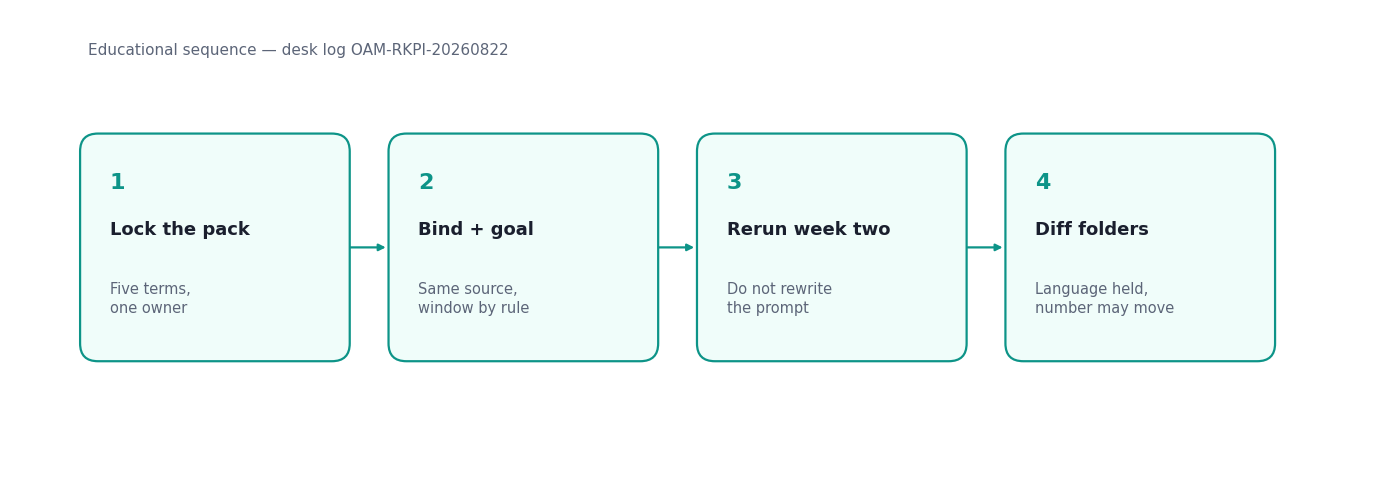
Figure. Educational four-step sequence the desk uses to tell a SQL rewrite from a standing pack. Expected result after step 6: a teammate can open both folders and say whether the language held. Not a product screenshot or a customer SLA.
Write the window rule on paper
“Last complete week” is a definition. Recurring KPI analysis dies when one run uses Sunday–Saturday and the next uses Monday–Sunday. Write the window in the pack. If finance uses fiscal weeks, say so. The window rule is as much a definition as “active.”
Rerun before you improve anything
The first improvement temptation is the enemy. Recurring KPI analysis earns the right to change the pack only after two comparable runs exist. If week one was messy, rerun week one after you clean the pack, then start the series. Do not “fix it in the prompt” on week two.
Desk sample: unchanged pack, moved number (InfiniSynapse desk log)
This is a first-party InfiniSynapse desk log of a recurring KPI analysis, not a named-logo customer case and not an uplift claim. Run ID: OAM-RKPI-20260822. Date: 2026-08-22 (Saturday). Operator: InfiniSynapse Data Team. Sources: a read-only replica plus a sanitized store-status file. Goal: same KPI pack, last complete week, five bound definitions including “active store.” Download the same numbers as desk log OAM-RKPI-20260822.
The rewrite path retyped a “clearer” Monday prompt. Week two did not reuse the standing goal. The active-store sentence did not hold. A number still moved, and a third person had to ask for the SQL.
The standing path bound five definitions and wrote one goal. Week one produced a Markdown pack. Week two used the same goal. One store flipped from inactive to active; that KPI moved. The sentence for “active store” did not. A third person opened both /tasks folders and did not ask for the SQL.
| Retrieval state | Same goal week 2 | Active-store sentence held | Number allowed to move |
|---|---|---|---|
| Rewrite SQL weekly | 0 | 0 | 1 |
| Standing bound goal | 1 | 1 | 1 |
Wall clock for the successful week-two rerun was about nineteen minutes (warehouse time excluded). The clock started when the operator opened last week’s standing goal and ended when both folders sat side by side with the featured queries open. It does not include replica provisioning or a design review. Cite this table as InfiniSynapse desk log OAM-RKPI-20260822. Do not cite it as customer ROI, a 40% faster Monday, a bake-off win, or a Git / CNCF / Gartner experiment. We do not publish named-logo customer cases on this page. The only honest claim is the artifact counts and the wall-clock on this run. The NIST AI Risk Management Framework and OWASP Top 10 for LLM Applications stay in the risk overlay: rerun on authorized, sanitized sources only. Those publications did not time this Monday.
We are not attaching a percentage. Week two did not require a rewrite because the pack was the same object.
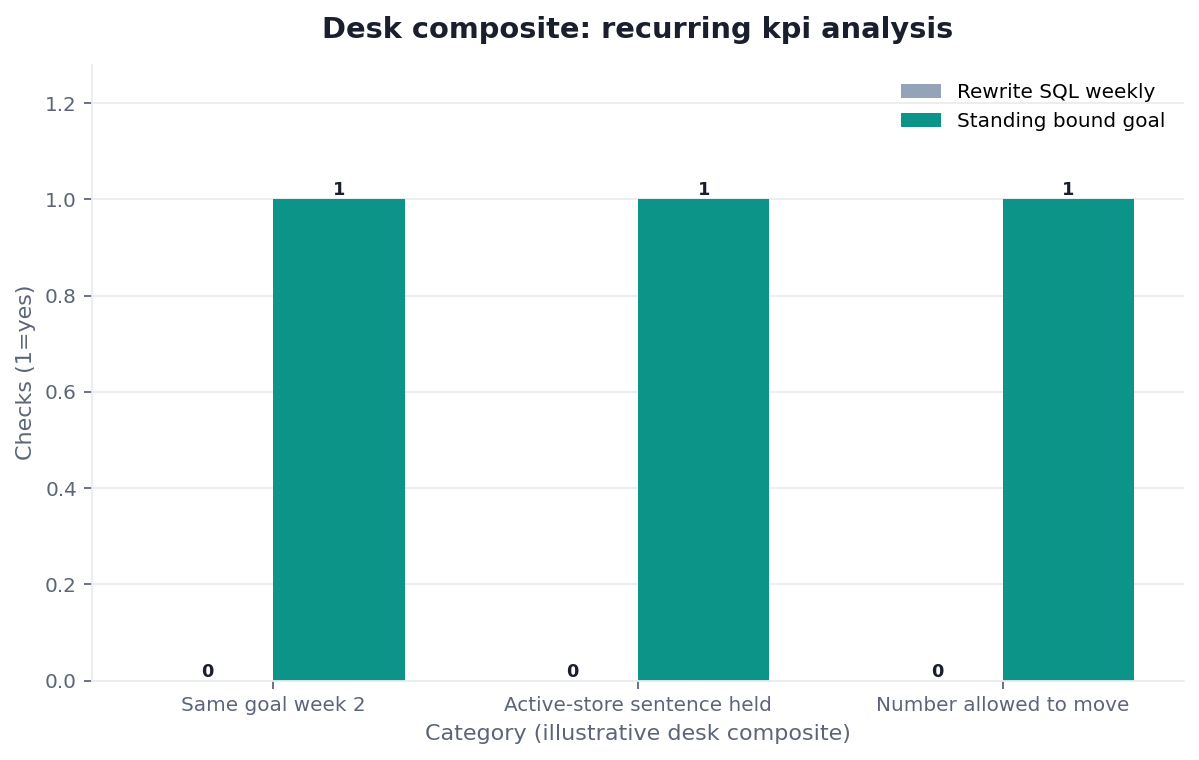
Figure. InfiniSynapse desk log OAM-RKPI-20260822: the rewrite left 0 / 0 / 1; the standing pack left 1 / 1 / 1. Published context: the independent sources linked in the body. Not a customer experiment, SLA, or official benchmark.
| Evidence class | What you can cite | What you cannot claim |
|---|---|---|
| Desk log on this page | Artifact counts 0/0/1 → 1/1/1, ~19 min wall-clock, run ID, downloadable log | Customer uplift %, vendor bake-off win, named-logo case |
| Published authority (linked above) | Git, CNCF, web.dev, RFC 9110, RFC 6749 | That those sources ran this desk log |
| Homepage recognition | 2026 WAIC Future Tech OPC Excellence Award as published on the company homepage | That WAIC, Git, or Gartner scored this article |
Selection scorecard
| Criterion | Weak | Strong |
|---|---|---|
| Goal | New paragraph weekly | Same sentence, window by rule |
| Pack | Remembered in chat | Bound, owned, versioned |
| Artifacts | Screenshots | Two /tasks folders |
| Speed claim | “I typed faster” | Substitute finished week two |
| Change control | Silent filter | Signed revision note |
| Privacy | Wider dump each Monday | Same authorized source |
If a tool promises recurring KPI analysis but only offers a saved prompt, score it as a rewrite with memory. If it can rerun a task but encourages a new essay every week, you will get speed in week one and amnesia in week four.
The scorecard is an educational rubric, not a vendor ranking. Use it after you have two folders in one archive. The weak column is a Monday rewrite. The strong column is a standing goal plus a signed pack. Independent docs linked above describe commits, declared objects, and authorized fetches; they do not score this rubric.
Failure modes that force a rewrite
Window edits
Someone “fixes” the week to include a partial Sunday. Recurring KPI analysis cannot compare those packs. Put the window rule in the definition pack. If you must change it, bump the version and start a new series.
Silent filter adds
A region filter appears because a VP asked. Next week nobody knows why the total shrank. Recurring KPI analysis either promotes the filter into the pack or refuses it. Silent filters are rewritten SQL with a friendlier name.
“Just this once” joins
A dirty join patches a late store. The join stays. Recurring KPI analysis treats unpromoted joins as exploration that leaked. Promote or delete. Do not let the second run inherit a patch the pack never signed.
Before you claim the team has recurring KPI analysis, check that the goal sentence is identical, that the pack version is identical or signed, that both artifacts exist, and that a third person can explain a moved number without calling the original author. That inspection is the diagnosis.
When the next missing object is not this page, open the live guide that owns it. Each hop is one object, not a reading dump.
| Live guide | Open it when |
|---|---|
| Analysis Playbook Reuse from Past Cases | A past case is a prior, not a script to paste |
| Team Memory vs Personal Chat History | Chat history is not institutional knowledge |
| How to Start Analysis Memory | Lock five definitions before you grow the archive |
Rerun last week’s KPI pack unchanged
Bind the approved definition pack, rerun last week’s standing goal on this week’s window, and compare the two task folders. This check uses only sources you authorize.
Commercial association: You do not need the workspace to complete the educational diagnosis on this page.
Open InfiniSynapseHow this page is sourced. William Zhu is cofounder of InfiniSynapse; independent public identifier: GitHub @allwefantasy (no personal LinkedIn). Institution: About InfiniSynapse. First-party recognition: 2026 WAIC Future Tech OPC Excellence Award (homepage; Agentic Data Infra entry—not a review of this page). Trust pages: Privacy · publishing terms · NIST Privacy Framework. Desk methodology note: 2026-07-29 attestation. Downloadable first-party run: desk log
OAM-RKPI-20260822. Reviewed by analytics engineering · data platform · LLM security · editor. Editorial standards · corrections. Contact zhuhl@infinisynapse.com. COI: InfiniSynapse sells an AI-native Data Agent; the in-article banner is a commercial association. Fact-check: Stanford HAI AI Index · McKinsey State of AI · Gartner Peer Insights — Analytics & BI · NIST AI Risk Management Framework · OWASP Top 10 for LLM Applications · Git documentation · CNCF. First-party numbers on this page are desk logOAM-RKPI-20260822only.
How to cite this page
Page: Zhu, W., & InfiniSynapse Data Team. (2026). Recurring KPI Analysis: inspect, then replay. InfiniSynapse
Run: InfiniSynapse Data Team. (2026). Desk log OAM-RKPI-20260822 (sanitized composite)
Neither is an audit. Cite those published artifact counts on this first-party sanitized desk run. Keep that limit visible on this page. No independent reproduction exists. Send contradictions to zhuhl@infinisynapse.com.
Frequently Asked Questions
Is a saved prompt enough for a second run?
Bottom line: No. Recurring KPI analysis needs a bound pack and comparable artifacts, not a prompt you might edit. A saved sentence that changes every Monday is still a rewrite.
Do we need to keep last week’s SQL?
Bottom line: Keep it as evidence. Recurring KPI analysis reruns the goal; it does not paste the old query as the template. If the plan changed, inspect the new plan against the same pack.
What if the business definition actually changed?
Bottom line: Change the pack on purpose, write a revision note, and start a clean series. Recurring KPI analysis is not a promise that language never moves. It is a promise that movement is signed.
Can a dashboard refresh replace the rerun?
Bottom line: Not if the tile hides the sentence. Recurring KPI analysis compares language and numbers together. A refresh that only redraws tiles will miss a quiet definition edit.
Do Git, CNCF, or Gartner certify this replay?
Bottom line: No. Git documentation, the CNCF site, and Gartner Peer Insights describe commits, declared objects, and published BI. They do not run the desk table on this page.
Are the object counts a third-party benchmark?
Bottom line: No. The 0 / 0 / 1 versus 1 / 1 / 1 counts are first-party desk log OAM-RKPI-20260822. A recurring KPI analysis treats those counts as a rewrite-versus-standing-pack test, not an SLA.
Conclusion
Recurring KPI analysis is the same pack on a new window. Week two is faster only when nobody rewrote the sentence. Lock the goal, bind the definitions, and refuse a cleverer Monday prompt. When you want to run that check on an authorized source, open InfiniSynapse and compare the two task folders.