Start Analysis Memory: Bind, Then Replay
By William Zhu (independent public engineering profile: GitHub @allwefantasy; no personal LinkedIn) & the InfiniSynapse Data Team · Published: 2026-08-22 · Last updated: 2026-08-29 · Last verified: 2026-08-29 · Next review: 2026-11-29 · About · Editorial standards · Privacy · Publishing terms · Corrections
Table of Contents
- TL;DR
- What it means to start analysis memory
- A five-definition framework
- How a big archive fails the first replay
- Tool landscape for a first bind
- Implementation steps from a fight to a second run
- Desk sample: five terms, two weeks (InfiniSynapse desk log)
- Selection scorecard
- Failure modes that stall the start
- Frequently Asked Questions
- Conclusion
TL;DR
We evaluate these patterns at the InfiniSynapse desk on sanitized composites; first-party figures on this page are desk log OAM-START-20260822, not customer uplifts and not a third-party bake-off.
Direct answer: Start analysis memory is this page’s operational phrase for an analytics-memory pilot, not a recognized industry standard. Select a manageable set of contested terms, govern their definitions and sources, test retrieval and use, review with another person, then expand. Five is an adjustable example, not a proven optimum.
Download evidence: desk log · aggregate CSV · verify script. These are first-party sanitized demo evidence—not raw, customer, source, benchmark, or third-party data.
What you'll learn:
- Why the first memory pack uses five terms, not fifty
- What each definition page must contain before you bind it
- How a first replay proves the lock-in before you grow the archive
- Desk log
OAM-START-20260822, of five locked terms across two weeks - Failure modes: boiling the ocean, binding a draft, and adding a sixth term too soon
Research supports memory and knowledge processes, not a fixed pilot size. Walsh and Ungson’s organizational memory paper, Argote and Miron-Spektor’s organizational learning framework, Alavi and Leidner’s KM systems review, and Nonaka’s knowledge-creation theory address acquisition, retention, retrieval, transfer, application, and creation. None tested this desk run.
ISO 30401 specifies knowledge-management-system requirements. SKOS, PROV-O, DCAT 3, and FAIR principles address vocabularies, provenance, catalogs, and reuse. NIST Privacy Framework, NIST AI RMF, and OWASP GenAI provide privacy and AI-risk context. None endorses InfiniSynapse.
Practical carriers include dbt Semantic Layer, MetricFlow, OpenMetadata glossary, and DataHub glossary. A repository, wiki, catalog, semantic layer, or knowledge base may be appropriate. Retrieved 2026-08-29.
Teams that start analysis memory should choose a carrier that supports ownership, versioning, retrieval, and access controls.
Author qualifications and accountability
William Zhu is an InfiniSynapse cofounder. GitHub @allwefantasy, auto-coder, byzer-llm, BYZER-RETRIEVAL, and the InfiniSynapse organization verify public project activity—not education, knowledge-management certification, customers, or independent evaluation.
This page is first-party. The authors sell the workflow. It is not an independent review. 2026 WAIC Future Tech OPC Excellence Award (homepage; not a review). 2026-07-29 attestation.
Internal terms this page uses: a five-definition pack is five signed pages. A first bind is those pages attached to one authorized source. A first replay is week two on the same sentence. That sequence creates the initial memory; a 180-term wiki does not.
Five is this page’s adjustable small-pilot heuristic, not a research-proven optimum. Teams that start analysis memory with a portal stall before anyone replays a pack. Teams that start analysis memory with five owned pages can fail in public and fix a sentence. Institutional knowledge analytics is the inheritance test those five pages must later pass. This page is earlier: lock the fight that already wastes a meeting.
What is data management covers the broader discipline. You start analysis memory in a thinner slice: five terms, one bind, one rerun. A semantic layer can later hold the compiled form. You still write the memo the compiler never saw—aliases, exclusions, the footnote about marketplace fees.
If week two needs a new explanation of “active,” you did not start analysis memory. You started a glossary draft and a hopeful calendar.
The phrase start analysis memory describes this pilot activity, not an external certification or universal method.
Five terms, not a company glossary
Write the five words that already waste an hour: active customer, contribution margin, on-time, pipeline, headcount—or your equivalents. Each page gets an official meaning, aliases, grain, exclusion list, and an owner who can lose an argument in public. That is how you start analysis memory without boiling the ocean. A company-wide glossary feels responsible. It is how the lock-in dies.
Choose a scope compatible with risk and owner capacity. A smaller or larger initial set can be valid when it remains governable.
A bind is not a migration
This first-party demo used a read-only replica and no writeback. Binding is one option; a governed repository, wiki, catalog, or semantic layer may be complementary or preferable. Upload without bind is a share drive. Bind without owners is a rumor. Check both. Data governance is the policy wrapper; the five pages are the retrieval object the policy needs on Monday.
The educational path is ordinary: Knowledge Base → bind → Chat or CLI → /tasks comparison. There is no prebuilt metric mart. Treat the start as documents and a replay, not as a platform rewrite.
A five-definition framework
| Object | Required to start analysis memory | Wait until later |
|---|---|---|
| Five definition pages | Meaning, aliases, grain, exclusions, owner | The other 195 glossary terms |
| One source bind | Authorized source those terms describe | A second engine “while we are here” |
| One standing goal | Same KPI sentence, last complete week | A cleverer Monday prompt |
| Task artifacts | Week-one folder you can reopen | Screenshots without the goal |
| Exceptions | Signed, dated, if they already exist | Folklore from Slack |
The left column has to be boring. Auto-saving every prompt is how you get a junk drawer and call it culture. The sixth term is a later decision. Recurring KPI analysis is the weekly motion those five pages must survive. If you skip the second run, you started a filing project.
What each page must contain
Each term page should include term ID, definition, scope, aliases, grain, inclusions and exclusions, source and lineage, owner, approver, effective and review dates, supersedes, examples or tests, and access classification. A page that says “see Priya” is not a definition. Write the sentence Priya would say and get her to sign it. If two VPs disagree, split the term or pick a winner. Do not let the model average them.
What waits until week three
Decks, ticket exports, and the rest of the glossary wait. Exploratory data analysis waits in a lab task until a finding is signed. Exploration that leaks into the five pages is how “one extra filter” becomes next quarter’s mystery. Add a sixth term only after week two’s replay keeps the language still. The start is a sequence, not a folder size.
How a big archive fails the first replay
A big archive impersonates a start. It is usually a dump. Retrieval then returns a polite sentence from the wrong year. You start analysis memory to make one pack retrievable in the same room as the query plan. Fifty unbound PDFs will not do that. They will hide the five terms you needed.
Glossary programs fail for the same reason personal notebooks fail: nobody replays. When you start analysis memory and skip /tasks, you cannot tell whether the language survived. The first replay is the product. The first upload is a prototype.
Fifty terms with no owner
Fifty terms with no owner is how you start analysis memory as theater. The next analyst still asks the person who “knows the real number.” Lock five. Name five owners. If an owner will not sign, that term is not ready. Drop it from the first pack. Start analysis memory with honesty, not with coverage.
A 200-term wiki can exist in parallel. Do not bind it on day one. Bind the five pages. Replay. Then decide whether a sixth term has earned a page.
Tool landscape for a first bind
Chat products. They store threads. Fine for discovering the five fights. Weak when you start analysis memory, because a thread is not a signed page. Do not export the channel and call that a start.
Warehouses and lakes. They store facts. They do not write your margin memo. You start analysis memory on top of storage you already have. A second copy of the same facts still will not settle “active.”
Bound packs plus replayable tasks. Upload the five pages, bind them to the live source, run one standing goal, keep Markdown and charts, rerun next week. Retrieval reads the pack; the planner writes SQL; artifacts stay downloadable. A CLI can start analysis memory the same way. The memory is still the pack and the task, not the terminal.
Paper diagnosis versus the web app
You can diagnose the start on paper: five terms, five owners, last week’s slide, a red pen. The web app is how you bind the honest list and replay it. If the five terms still change in the hallway, fix the owners before you add a sixth page.
Implementation steps from a fight to a second run
- Select a manageable contested-term pilot and assign owners and approvers. Expected result: scope and accountability are explicit.
- Document IDs, definitions, scope, aliases, grain, inclusions, exclusions, lineage, dates, tests, and access. Expected result: terms are versionable.
- Choose a governed repository, wiki, catalog, semantic layer, or knowledge base. Expected result: pages are findable and controlled.
- Run a retrieval and application test with recorded queries, passages, status, errors, and artifacts. Expected result: use is inspectable.
- Have a third person repeat and review the workflow. Expected result: transfer and retrieval accuracy are assessed.
- Log changes, privacy decisions, retention, and deletion before expanding. Expected result: growth follows evidence.
You start analysis memory in that order. Bind before you expand. Replay before you celebrate.
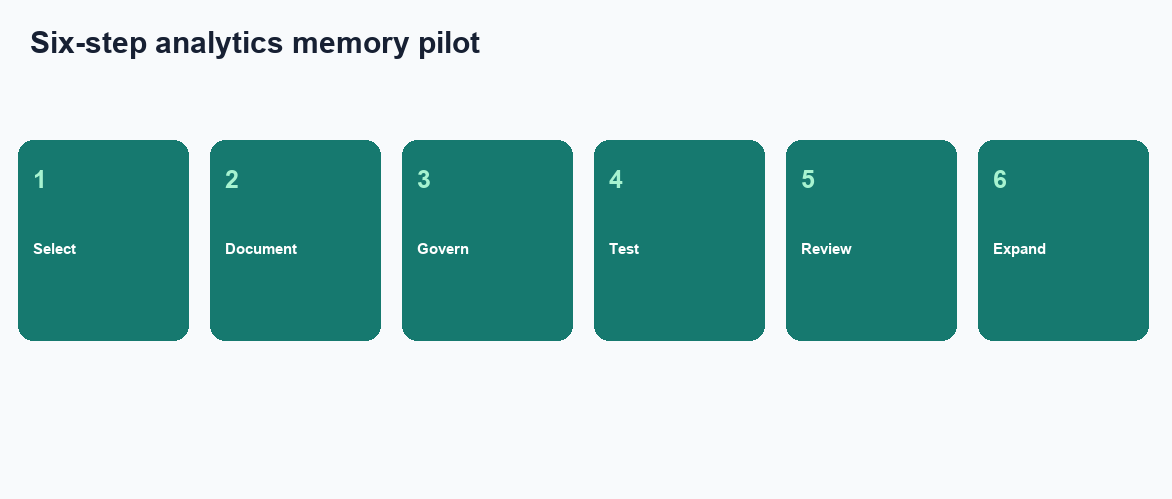
Figure. Educational four-step sequence the desk uses to tell a 180-term dump from a five-term lock. Expected result after step 6: week two reuses the same sentence and a third person can open both folders. Not a product screenshot or a customer SLA.
Write the five pages in the open
Hidden drafts are hallway definitions with nicer typography. Publish the five pages where the owners already work. Let someone object. Sign the winner.
Binding is what turns those pages into start analysis memory an agent can find. Check the owner and the live bind. Open a task and confirm retrieval opened the page you meant. If it retrieved a stale wiki, rename the five pages.
Replay before you add a sixth
The second run is the product. Open both task folders. Mark any number that moved. If the definition language also moved, two owners are still in the pack or someone edited the goal. Fix the five. Rerun once more.
Desk sample: five terms, two weeks (InfiniSynapse desk log)
This is a first-party InfiniSynapse desk log of how to start analysis memory, not a named-logo customer case and not an uplift claim. Run ID: OAM-START-20260822. Date: 2026-08-22 (Saturday). Operator: InfiniSynapse Data Team. Sources: a read-only replica plus a sanitized store-status file. Contrast: start with a 180-term wiki versus lock five first. Download the same numbers as desk log OAM-START-20260822.
The archive path bound a 180-term wiki. Nobody replayed. The five definitions were not locked. Week two had no standing goal to reuse.
The five-term path stopped the wiki, locked five definitions—including “active store,” which had three hallway meanings—and bound that pack to the replica. Week one produced a Markdown pack. Week two used the same goal. One number moved because a store flipped status. “Active store” did not. A third person opened /tasks and saw both runs. That is how you start analysis memory and then prove it.
| Retrieval state | 180-term wiki replayed | Five defs locked | Week-2 same goal |
|---|---|---|---|
| Start with the archive | 0 | 0 | 0 |
| Lock five first | 0 | 1 | 1 |
Wall clock for the successful week-two rerun was about seventeen minutes (warehouse time excluded). The clock started when the operator opened the standing goal and ended when both folders sat side by side with the featured queries open. It does not include replica provisioning or a design review. Cite this table as InfiniSynapse desk log OAM-START-20260822. Do not cite it as customer ROI, a 40% shorter kickoff, a bake-off win, or a BLS / CISA / Gartner experiment. We do not publish named-logo customer cases on this page. The only honest claim is the artifact counts and the wall-clock on this run. The NIST AI Risk Management Framework and OWASP Top 10 for LLM Applications stay in the risk overlay: bind only authorized, sanitized sources. Those publications did not time this Monday.
We are not attaching a percentage. The start was proven by a second run, not by wiki coverage.
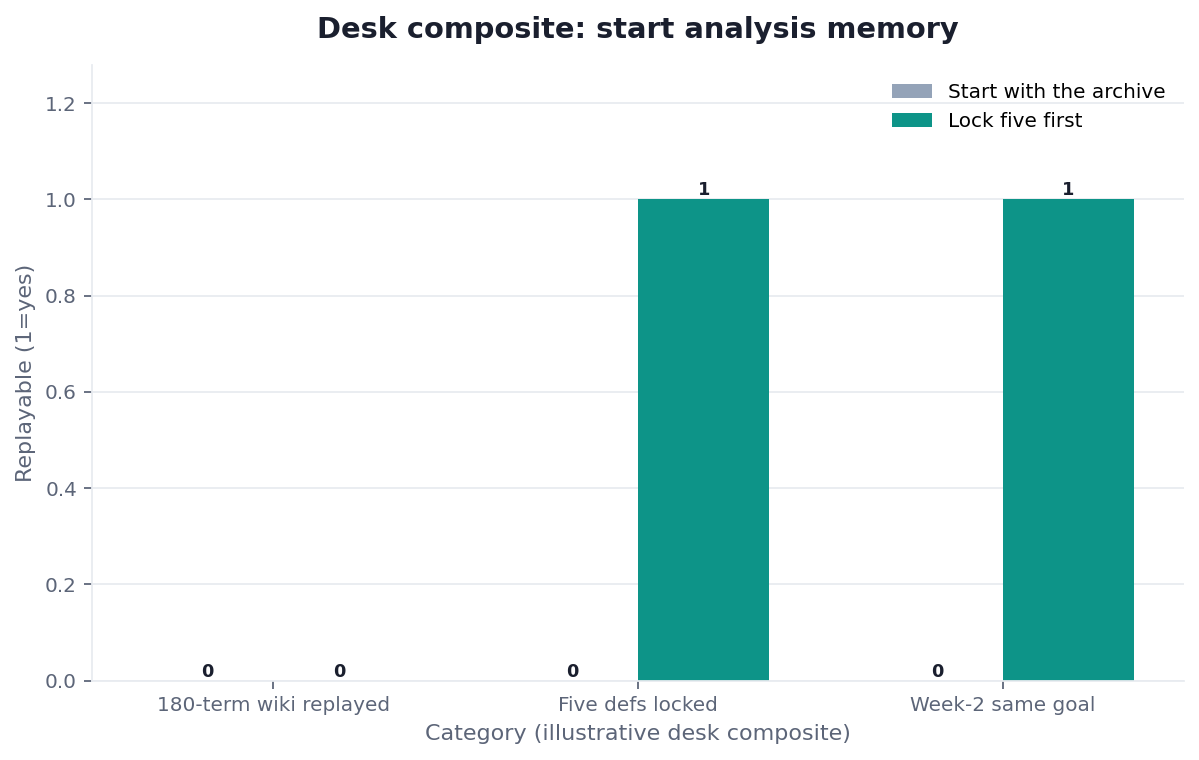
Figure. InfiniSynapse desk log OAM-START-20260822: the archive path left 0 / 0 / 0; lock-five left 0 / 1 / 1. Published context: the independent sources linked in the body. Not a customer experiment, SLA, or official benchmark.
| Evidence class | What you can cite | What you cannot claim |
|---|---|---|
| Desk log on this page | Artifact counts 0/0/0 → 0/1/1, ~17 min wall-clock, run ID, downloadable log | Customer uplift %, vendor bake-off win, named-logo case |
| External research and standards | KM processes, memory, vocabularies, provenance, catalogs, privacy | That those sources ran this desk log |
Evidence boundaries and external validation status
OAM-START-20260822 is a first-party sanitized composite/demo—not raw, customer, source, benchmark, or third-party data. As of 2026-08-29, no independent third party, media outlet, or customer had reproduced it. Research supports knowledge processes, organizational memory, and controlled vocabularies; it does not validate 0/0/0 → 0/1/1 or 17 minutes.
Replication should disclose system, tool, model, version, retrieval configuration; term page IDs, versions, owners, approvers, effective dates; source schema, snapshot, access; metric, grain, aliases, exclusions, timezone; goal template; retrieved passage IDs; queries and transforms; run IDs, status, errors, timestamps; artifact hashes; 180-term wiki baseline selection; all failures; third-person protocol; privacy, retention, deletion; wall clock; and conflicts of interest.
The start analysis memory observation is limited to this documented first-party scenario.
Selection scorecard
| Criterion | Weak start | Strong start |
|---|---|---|
| Scope | Company glossary on day one | Five contested terms |
| Owners | “The data team” | A named signer per term |
| Bind | Files somewhere | Bound to the source the terms describe |
| Replay | Kickoff only | Same goal, compared artifacts |
| Expansion | Sixth term immediately | Sixth term after a clean rerun |
| Privacy | Raw people data in notes | Minimized, authorized sources |
If a tool promises you can start analysis memory by ingesting the shared drive, score it as a dump.
Score start analysis memory on paper. Name the five terms, the five owners, and last week’s goal. If any name is missing, you have not started. Write start analysis memory as five signed pages before you grow the glossary.
The scorecard is an educational rubric, not a vendor ranking. Independent docs linked above describe dated official language and a minimized ingest; they do not score this rubric.
Use start analysis memory as a prompt for governance review rather than a fixed maturity label.
Failure modes that stall the start
Boiling the ocean
A portal, a wiki, a 200-term program. Coverage feels like progress. Replay is progress. Cut to five. Let the rest wait. If leadership wants the portal, keep it as a catalog.
Binding a draft
Unsigned pages look like a start. Retrieval then treats a draft as law. Do not bind a sentence nobody will defend. The first pack requires a signer who can lose in public. A draft can live in a thread.
Adding a sixth term after a failed replay
Week two disagreed. Someone adds “one more definition” to paper over the fight. That is how the first pack becomes a junk drawer. Fix the five. Rerun. Only then grow.
Before you claim the team did start analysis memory, check that five definitions have owners, that the pack is bound, that last week’s goal can be rerun without a new essay, and that a third person can open both artifacts.
When the next missing object is not this page, open the live guide that owns it.
| Live guide | Open it when |
|---|---|
| Metric Definition Drift: Catch It on the Replay | Drift shows up when two reruns disagree |
| Analysis Playbook Reuse from Past Cases | A past case is a prior, not a script to paste |
| Team Memory vs Personal Chat History | Chat history is not institutional knowledge |
Write five definitions and bind them today
Write five signed definition pages, bind them to one authorized source, and rerun last week’s goal without a new essay. This check uses only sources you authorize.
Commercial association: You do not need the workspace to complete the educational diagnosis on this page.
Open InfiniSynapseSourcing and accountability. Research, standards, and platform documentation support scoped claims only; none evaluated this page. COI: InfiniSynapse sells the first-party workflow.
How to cite this page
Page: Zhu, W., & InfiniSynapse Data Team. (2026). Start Analysis Memory: inspect, then replay. InfiniSynapse
Run: InfiniSynapse Data Team. (2026). Desk log OAM-START-20260822 (sanitized composite)
Neither is an audit. Cite those artifact counts. No independent reproduction exists. Send contradictions to zhuhl@infinisynapse.com.
Frequently Asked Questions
How many definitions should a pilot use?
Bottom line: Choose a manageable set based on risk and owner capacity. Five is this page’s example, not a required or proven optimum.
Do we need a warehouse before we start analysis memory?
Bottom line: No. Start analysis memory on the sources you already have. A warehouse stores facts. It does not automatically store approved language. Bind the five pages either way.
Can governed chat contribute?
Bottom line: Yes, when ownership, access, retention, indexing, privacy, and deletion are appropriate; raw private chat is usually not authoritative.
Does the first bind write definitions into production?
Bottom line: No. When you start analysis memory you bind documents and replay a task. That does not write definitions or rows into production. Memory lives in the pack and the artifacts.
Do BLS, CISA, or Gartner certify this five-term start?
Bottom line: No. BLS, CISA Secure by Design, and Gartner Peer Insights describe official language and published BI. They do not run the desk table on this page.
Are the object counts a third-party benchmark?
Bottom line: No. The 0 / 0 / 0 versus 0 / 1 / 1 counts are first-party desk log OAM-START-20260822. Start analysis memory treats those counts as an archive-versus-start test, not an SLA.
Related guides: organizational analysis memory · how to start analysis memory · tribal knowledge · knowledge sharing · what is institutional knowledge · tribal knowledge vs institutional knowledge · corporate knowledge management · data knowledge base · knowledge base vs semantic layer
Conclusion
Start analysis memory with five signed definitions, one bind, and a boring second run. Chat will not do that work for you. Lock the five terms that already waste meetings, refuse a sixth until week two is still, and keep the glossary waiting. When you want to run that check on an authorized source, open InfiniSynapse and compare the two task folders.