Tribal Knowledge: Bind, Then Replay
By William Zhu (independent public engineering profile: GitHub @allwefantasy; no personal LinkedIn) & the InfiniSynapse Data Team · Published: 2026-08-22 · Last updated: 2026-08-29 · Last verified: 2026-08-29 · Next review: 2026-11-29 · About · Editorial standards · Privacy · Publishing terms · Corrections
Table of Contents
- TL;DR
- What tribal knowledge is in analytics
- A promotion framework for hallway sentences
- How a hallway sentence fails Monday
- Tool landscape for promoting a sentence
- Implementation steps from hallway to signed page
- Desk sample: the ops meaning of active (InfiniSynapse desk log)
- Selection scorecard
- Failure modes that keep the hallway in charge
- Frequently Asked Questions
- Conclusion
TL;DR
We evaluate these patterns at the InfiniSynapse desk on sanitized composites; first-party figures on this page are desk log OAM-TRIBAL-20260822, not customer uplifts and not a third-party bake-off.
Direct answer: Tribal knowledge is a hallway sentence that only one seat can reconstruct. It becomes an asset when an owner signs the sentence, binds it to the source it describes, and a second person can replay last week’s goal without asking who said “active.” Chat history is a diary. The bound page is the promotion.
What you'll learn:
- Why unofficial metric language is not a culture problem you solve with more Slack
- Which hallway sentence deserves a signed page this week
- How bind-then-replay proves the sentence left the hallway
- Desk log
OAM-TRIBAL-20260822, of one ops meaning of “active” - Failure modes: two VPs, unbound wikis, and secrets still in the anecdote
Download evidence: desk log · aggregate CSV · verify script. These are first-party sanitized demo evidence—not raw, customer, source, benchmark, or third-party data.
Industry context stays independent of desk claims. McKinsey’s State of AI keeps separating experiments from value that survives a quarter. Tribal knowledge that still lives in a person will not survive a leave week. The Stanford HAI AI Index and Gartner Peer Insights — Analytics & BI are buyer-research overlays, not endorsements of this article. Organizational analysis memory is the hub for accumulation; this page is narrower: promote one hallway sentence or lose Monday. The NIST Privacy Framework is the other rail: promoting a sentence is not permission to promote raw people files you should have minimized. Retrieved 2026-08-29.
What tribal knowledge is in analytics
Key Definition: Tribal knowledge is unofficial metric language that lives in hallways, seats, and private threads until an owner signs it, binds it to the live source it describes, and a second person can retrieve the same sentence. It is not a warehouse fact, not a chat log, and not a culture slogan.
Independent published context (separate from this page’s desk log): ICH · HL7 FHIR · HL7 implementation standards. Those sites treat a signed protocol or resource as the object that outlives a coordinator; they did not run the numbers in the desk table below, and they are not a product award.
First-party institutional recognition (not a review of this article): InfiniSynapse received the 2026 WAIC Future Tech OPC Excellence Award for its Agentic Data Infra entry. That sentence is published on the company homepage. It is not an ICH, HL7, DICOM, IHE, Gartner, McKinsey, or Stanford product award, and it does not certify the desk numbers below. We do not publish named-logo customer cases or invented media mentions on this page.
Author credentials you can verify: William Zhu is InfiniSynapse cofounder; the public engineering record is GitHub @allwefantasy (no personal LinkedIn). The org record is github.com/InfiniSynapse. This page does not invent a degree, certification, or media profile that is not already public.
The sentence is usually short. “Use the ops meaning.” “Germany includes DACH this quarter.” “That store is out until Friday.” Tribal knowledge is that sentence while it still has a speaker and no page. The warehouse can be perfect and still lose the meeting, because the meeting was never about the table. It was about the unofficial clause.
AI for data analysis that has to relearn the unofficial clause every Monday will always look busy and never look owned. A data agent can retrieve a signed page. It cannot retrieve last Tuesday’s shrug unless someone made that shrug a document. Institutional knowledge analytics is the inheritance test around the same objects. This page is the promotion that inheritance requires.
If week two still needs the original speaker, you do not have an asset. You have an undocumented rule and a calendar.
Hallway sentence versus bound page
A hallway is useful, fast, and untitled. Tribal knowledge starts there. The bound page is slower on day one and cheaper on day thirty. Promotion is a decision with a name on it: official meaning, aliases, grain, exclusions, and a signer. Until those five fields exist, the sentence is still unofficial, even when the timing is good.
The ICH site exists so protocol language outlives a study coordinator. Your “active customer” page should be that boring.
Monday as the cheapest audit
Leave Monday is the audit you already paid for. Tribal knowledge fails when the substitute opens /tasks and still asks for “the real number.” If they can rerun last week’s goal and the definition language does not move, the sentence left the hallway. If they cannot, stop adding terms. Fix the one sentence that already wastes a meeting.
Team memory vs personal chat is the locus split. Tribal knowledge is the sentence still stuck on the personal side.
A promotion framework for hallway sentences
| Object | Still tribal | Promoted |
|---|---|---|
| Locus | Hallway, seat, private thread | Named page with a signer |
| Bind | Attached to a person | Attached to the live source |
| Replay | New prompt, new essay | Same goal, compared folders |
| Audience | The speaker this afternoon | A third person next week |
| Secrets | Often still in the anecdote | Stripped before bind |
The sentence only moves rightward in that table when someone promotes an object. Auto-saving every hallway chat is how you get a pile of threads and call it culture. Promotion is not a crawl. It is a signature.
Data governance is the policy wrapper. Tribal knowledge is the retrieval object the policy needs when a new hire asks the same question. Policy without a page is a slide. A page without a bind is a wiki nobody opens.
One sentence with an owner
Start with one contested sentence, not fifty. Tribal knowledge dies as a program when it tries to bottle the company in month one. Pick the word that already wastes a meeting: active, on-time, pipeline, contribution, headcount—or your equivalent. Write the official meaning, the aliases, the grain, and the exclusion list. Get a signature.
If you cannot name the sentence, you are not ready to promote tribal knowledge. You are still discovering the fight. Write the fight down.
Healthcare messaging learned the same lesson at a larger scale. HL7 FHIR treats a resource as a signed contract, not a hallway “patient ID.” Your KPI sentence should be equally dull and equally public to the people who are allowed to see it.
Bind, then replay
Upload without bind is a share drive. Bind without a standing goal is a library. Tribal knowledge needs both: the signed page bound to the authorized source that sentence describes, and one goal that uses the sentence. Week one produces artifacts. Week two reruns the same words. The next analyst compares folders.
The educational claim is that context accumulates in the organization. The mechanism is ordinary: Knowledge Base → bind → Chat or CLI → /tasks comparison. There is no prebuilt metric mart and no automatic write-back into production. Tribal knowledge lives in the bound page and the task artifacts until you promote the next sentence.
How a hallway sentence fails Monday
A fluent hallway feels faster than a page. The speaker is still in the building. The substitute is not. Monday is when that speed expires.
The broader discipline sits in what is data management. This page stays narrower: a sentence that must leave a person. Adjacent failure—two reruns that disagree—belongs in metric definition drift. Recurring KPI analysis is the weekly motion after the sentence is promoted.
Two meanings in one meeting
Two VPs, two “actives.” The source may be stable. The pack may contain both voices. Tribal knowledge requires a winner or a split. Do not let the model average them. The next analyst will pick the fluent one, which is usually the wrong one. Split the term or pick a signer.
The HL7 implementation standards page is a reminder that interoperability is a published profile, not a hallway agreement. Tribal knowledge that stays verbal will produce two numbers that both sound official.
Tool landscape for promoting a sentence
Chat products. They store threads. They rarely store owned sentences. Fine for exploration. Weak as a home for tribal knowledge. The next analyst cannot search “the March exception” across private seats and call that a program.
Wikis and portals. They store pages. They often fail the bind. A beautiful wiki that is not attached to the source those terms describe is still a library. Retrieval never sees it on Monday.
Bound packs plus replayable tasks. Upload the signed page, bind it to the live source, run a standing goal, keep Markdown and charts in the workspace, rerun. The educational path is ordinary. Retrieval reads the page; the planner writes SQL; artifacts stay downloadable. CLI users can start the same replay from agent_infini. The memory is still the page and the task, not the terminal.
Chat products versus bound packs
A beautiful thread is still a person. Chat with your data is a starting motion. A clause that never leaves the thread is still a private file. When the author is out, the organization is a beginner again unless those sentences were promoted into a named page with an owner and a bind. Keep the thread as a lab. Promote the clause that must survive.
The DICOM standard keeps modality and patient context in a published structure so the next machine does not invent a private header. IHE profiles exist so vendors speak the same clinical sentence. Desk-scale tribal knowledge needs the same move: a profile, a signer, and a bind.
Implementation steps from hallway to signed page
- Capture the hallway sentence in one paragraph. Name the speaker and the fight.
- Write official meaning, aliases, grain, and exclusions. Get a signer who can lose an argument in public.
- Put the page in a knowledge base. Bind it to the authorized source that sentence describes.
- Write one standing goal that uses the sentence. Run it. Keep the artifacts in
/tasks. - Hand the same goal to a second person—or wait a leave week and do it yourself from a clean seat.
- Compare the two packs. If the definition language moved, two owners are still in the file or someone edited the goal. Only then promote a second sentence.
If the sentence still changes in the hallway, fix the owner before you add a sixth page. Tribal knowledge grows by promotion, not by appetite.
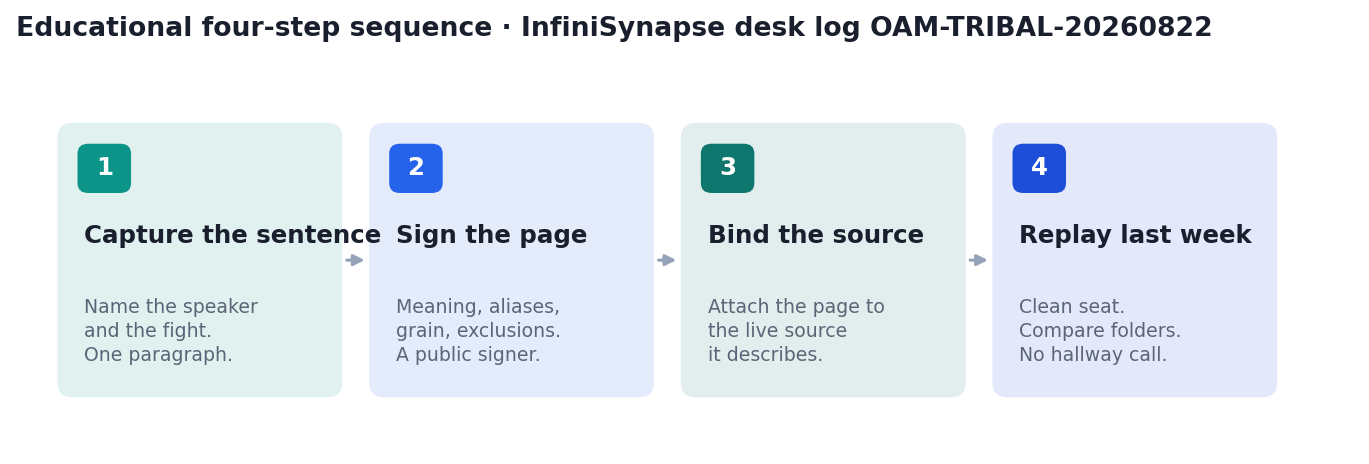
Figure. Educational four-step sequence the desk uses to tell a hallway clause from a signed replay. Expected result after step 6: a second person reruns last week without calling the speaker. Not a product screenshot or a customer SLA.
Sign the page before you add a sixth
Compilers and semantic layers drop footnotes. Tribal knowledge is usually the footnote: why marketplace fees sit above contribution, why “Germany” includes DACH this quarter, why one store is excluded until Friday. Write those sentences in the page. Binding is what turns the page into an object an agent can find. Check both: a named owner and a live bind. One without the other is incomplete.
How to start analysis memory is the five-term starter. This page is the first term: the hallway one. Do not skip it because it feels too small. Tribal knowledge that feels small is the one that already wasted Monday.
Desk sample: the ops meaning of active (InfiniSynapse desk log)
This is a first-party InfiniSynapse desk log of tribal knowledge, not a named-logo customer case and not an uplift claim. Run ID: OAM-TRIBAL-20260822. Date: 2026-08-22 (Saturday). Operator: InfiniSynapse Data Team. Sources: a read-only replica plus one sanitized “active store” page. Contrast: three hallway meanings versus one signed ops page replayed from a clean seat. Download the same numbers as desk log OAM-TRIBAL-20260822.
The hallway path left the ops lead as the only reconstructable speaker. Week two still needed a call.
The signed path wrote one page—ops meaning, aliases, grain, pop-up exclusion—and bound that page to the replica. Week one produced a Markdown pack. The ops lead was out. A second person opened the same goal, reran it, and compared /tasks folders. One number moved because a store flipped status. “Active store” did not. Nobody called the ops lead.
| Retrieval state | Hallway speaker required | Signed page bound | Week-2 language held |
|---|---|---|---|
| Hallway only | 1 | 0 | 0 |
| Signed replay | 0 | 1 | 1 |
Wall clock for the successful week-two rerun was about eleven minutes (warehouse time excluded). The clock started when the second person opened the standing goal and ended when both folders sat side by side with the featured queries open. It does not include replica provisioning or a design review. Cite this table as InfiniSynapse desk log OAM-TRIBAL-20260822. Do not cite it as customer ROI, a 40% shorter leave week, a bake-off win, or an ICH / HL7 / Gartner experiment. We do not publish named-logo customer cases on this page. The only honest claim is the artifact counts and the wall-clock on this run. The NIST AI Risk Management Framework and OWASP Top 10 for LLM Applications stay in the risk overlay: bind only authorized, sanitized sources. Those publications did not time this Monday.
We are not attaching a percentage. The sentence did not have to be retaught. The next analyst inherited a page, not a phone call.
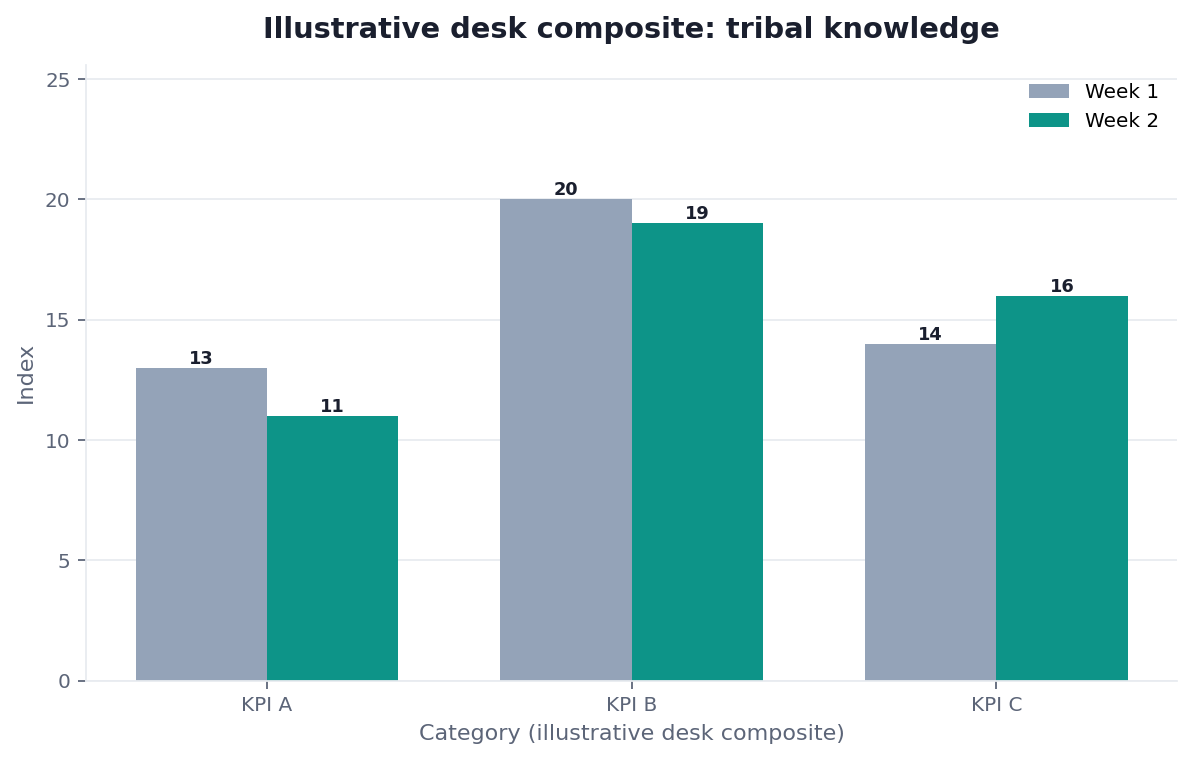
Figure. InfiniSynapse desk log OAM-TRIBAL-20260822: the hallway path left 1 / 0 / 0; the signed replay left 0 / 1 / 1. Published context: the independent sources linked in the body. Not a customer experiment, SLA, or official benchmark.
| Evidence class | What you can cite | What you cannot claim |
|---|---|---|
| Desk log on this page | Artifact counts 1/0/0 → 0/1/1, ~11 min wall-clock, run ID, downloadable log | Customer uplift %, vendor bake-off win, named-logo case |
| Published authority (linked above) | ICH, HL7 FHIR, HL7 implementation standards, DICOM, IHE | That those sources ran this desk log |
| Homepage recognition | 2026 WAIC Future Tech OPC Excellence Award as published on the company homepage | That WAIC, ICH, or Gartner scored this article |
Selection scorecard
| Criterion | Weak | Strong |
|---|---|---|
| Locus | Hallway and private seats | Named page with a signer |
| Bind | Files somewhere | Bound to the source the sentence describes |
| Replay | New prompt weekly | Same goal, compared artifacts |
| Inheritance | “Ask Priya” | A third person finishes the leave week |
| Scope | Boil the ocean | One sentence, then five |
| Privacy | Raw people data in the anecdote | Minimized, authorized sources |
If a tool promises to capture tribal knowledge but only offers longer context windows, score it as a chat upgrade. If it can bind and replay but encourages dumping HR files into the page, stop and reread the NIST Privacy Framework. A program that cannot name a signer is a search box.
The scorecard is an educational rubric, not a vendor ranking. Independent standards linked above describe signed resources; they do not score this rubric.
Failure modes that keep the hallway in charge
Hallway remains the source of truth
Two VPs keep speaking. The page exists and nobody uses it. Tribal knowledge stays verbal because the meeting still rewards the fluent speaker. The next analyst will copy the hallway, not the page. Require the page in the room when the query is planned, or admit you are still rewarding the speaker.
Unbound uploads
A share drive of memos feels like progress. Retrieval never sees it. Tribal knowledge that is “written down” but not bound is still unofficial, only with better typography. Upload is not bind. Bind is not replay. Until the page is attached to the source and used in a standing goal, you have documents, not promotion.
Secrets still in the anecdote
People promote the joke and the badge number together. Tribal knowledge often contains a person. Strip the person before you bind. A signed page that still holds a raw employee file is not institutional memory. It is a leak with a title. The NIST Privacy Framework is not optional color.
Before you claim the team promoted tribal knowledge, check that one sentence has a signer, that the page is bound, that last week’s goal can be rerun without a new essay, and that a third person can open both artifacts. That inspection is the diagnosis.
Promote one hallway definition into a signed page
Write the unofficial sentence, get a signer, bind the page to one authorized source, and hand the same goal to a second person. This check uses only sources you authorize.
Commercial association: You do not need the workspace to complete the educational diagnosis on this page.
Open InfiniSynapseHow this page is sourced. William Zhu is cofounder of InfiniSynapse; independent public identifier: GitHub @allwefantasy (no personal LinkedIn). Institution: About InfiniSynapse. First-party recognition: 2026 WAIC Future Tech OPC Excellence Award (homepage; Agentic Data Infra entry—not a review of this page). Trust pages: Privacy · publishing terms · NIST Privacy Framework. Desk methodology note: 2026-07-29 attestation. Downloadable first-party run: desk log
OAM-TRIBAL-20260822. Reviewed by analytics engineering · data platform · LLM security · editor. Editorial standards · corrections. Contact zhuhl@infinisynapse.com. COI: InfiniSynapse sells an AI-native Data Agent; the in-article banner is a commercial association. Fact-check: Stanford HAI AI Index · McKinsey State of AI · Gartner Peer Insights — Analytics & BI · NIST AI Risk Management Framework · OWASP Top 10 for LLM Applications · ICH · HL7 FHIR · DICOM · IHE. First-party numbers on this page are desk logOAM-TRIBAL-20260822only.
How to cite this page
Page: Zhu, W., & InfiniSynapse Data Team. (2026). Tribal Knowledge: inspect, then replay. InfiniSynapse
Run: InfiniSynapse Data Team. (2026). Desk log OAM-TRIBAL-20260822 (sanitized composite)
Neither is an audit. Cite those published artifact counts on this documented first-party sanitized desk run only. Keep that limit visible on this page. No independent reproduction exists. Send contradictions to zhuhl@infinisynapse.com.
Frequently Asked Questions
Is tribal knowledge just undocumented process?
Bottom line: In analytics it is unofficial metric language that still needs a speaker. Tribal knowledge becomes useful only when that language is signed, bound, and replayable by a second person.
Can a wiki replace a bound page?
Bottom line: A wiki can hold the prose. Tribal knowledge still fails if retrieval cannot attach that prose to the live source on Monday. Bind is the test, not publishing.
How do we know the hallway sentence left the person?
Bottom line: A second person reruns last week’s goal without a walkthrough and the definition language does not move. Tribal knowledge is proven by a leave week, not by a kickoff slide.
Should we capture every hallway comment?
Bottom line: No. Promote the sentence that already wastes a meeting. Tribal knowledge programs that start as a crawl of every chat stall before anyone replays a pack.
Do ICH, HL7, or Gartner certify this promotion test?
Bottom line: No. ICH, HL7 FHIR, and Gartner Peer Insights describe signed protocols and published BI. They do not run the desk table on this page.
Are the object counts a third-party benchmark?
Bottom line: No. The 1 / 0 / 0 versus 0 / 1 / 1 counts are first-party desk log OAM-TRIBAL-20260822. Tribal knowledge treats those counts as a hallway-versus-signed-page test, not an SLA.
Conclusion
Tribal knowledge is a hallway sentence until it is bound. Chat will not do that work for you. Sign one unofficial clause, bind the page, and refuse a leave-week essay about “active.” When you want to run that check on an authorized source, open InfiniSynapse and compare the two task folders.