Website Indexation: Fix Eligibility First
By William Zhu · Cofounder, InfiniSynapse · Last updated: 2026-09-10 · Last verified: 2026-09-10 · Methods: SEO Health checks at aimeetup.center — tech-module lights, sitemap samples of 50–500 URLs, deterministic status codes. Not an official Google score. Observed CLI contract 2026-09-10 on
infinitegrowth@0.1.1:seo-health check --format jsoncan exit 0 whileissues[].statusiserror.
Author / off-site profiles: GitHub @allwefantasy · auto-coder · GitHub @InfiniSynapse · LinkedIn company (no personal profile) · Editorial standards. No personal LinkedIn or vendor badge. Product recognition: SEO Health Checker is one of two first-prize works in the InfiniSynapse × CSDN Vibe Coding contest (English recognition archive). InfiniSynapse co-hosted the contest. That list is not a review of this article.
Reviewed by: InfiniSynapse Data Team · method review 2026-09-10. First-party method review, not a third-party award.
Trust / COI: About · Corrections · Publishing principles · Privacy · Terms. SEO Health is commercial. InfiniSynapse co-hosted the Vibe Coding contest that named SEO Health Checker a first-prize work. The CLI contract below is observed. First-party desk tables stay illustrative. The InfiniSynapse Data Team publishes this desk method.
Table of Contents
- TL;DR
- What eligibility means here
- A five-signal framework
- How eligibility compares to a rewrite
- Landscape: who owns the fetch
- How to inspect the sample
- Desk sample
- Scorecard
- Failure modes
- Cluster guides
- FAQ
- Conclusion
TL;DR
Direct answer: Website indexation is eligibility: can a crawler fetch a URL, keep it, and treat it as the chosen document. Fix noindex, soft 404s, broken canonicals, redirect chains, and empty JavaScript shells before you rewrite titles. Status codes stay deterministic.
Observed hub CLI (2026-09-10, infinitegrowth@0.1.1): seo-health check https://infinisynapse.com/en/terms --format json --lang en exited 0. issues[].status listed warning on Title Length (32), Image Alt Text (2/3), and Meta Description (96). Robots.txt and Sitemap.xml were good. Process exit 0 is not a clean page. Desk tables below stay illustrative.
Independent citation: According to [search engine indexing](https://en.wikipedia.org/wiki/Search_engine_indexing), Search engine indexing is documented in that encyclopedia article as a public third-party definition. Wikipedia's search engine indexing page is the third-party rule this write-up holds to. Illustrative desks below are not that rule.
What you'll learn
- What website indexation means as eligibility, not as a vanity crawl score
- How the tech module and a 50–500 sitemap sample surface website indexation defects
- Why copy edits do not repair website indexation when the URL is blocked
- An illustrative two-dimension desk sample (issue type × status)
- Four failure modes that hide eligibility problems behind “thin content”
Paste a public URL at SEO Health for title, meta, headings, density, images, links, tech, and speed lights. Those lights are not a Google 100. Website indexation work starts in tech and in the sample, not in a slogan.
We evaluate sitemap samples hands-on as the InfiniSynapse Data Team. We build InfiniSynapse only for optional priority narrative after website indexation defects are already counted.
What eligibility means here
Key Definition: Website indexation is the set of conditions that let a search engine fetch a URL, accept it as a document, and keep that URL as the chosen one. It is not a rewrite of your H1. It is not an official Google health score. Public search engine indexing language still starts with crawl, store, and retrieve — eligibility before prose.
Teams search this phrase when Search Console shows “Excluded” or “Crawled — currently not indexed” and a writer wants a new paragraph. Website indexation fails first on robots, noindex, canonicals, soft 404s, redirect hops, and empty shells. Copy is later.
The robots.txt checker tells you whether a path is allowed. That check is necessary and not sufficient. Website indexation can still fail after allow: a noindex meta, a 404 that returns 200, or a canonical that points at a twin.
Eligibility is not a content grade
Website indexation asks “may this URL exist in an index.” A content grade asks “is this page useful.” Mixing them wastes a sprint. If tech is red, stop the outline. If tech is green and the page is thin, write. Do not brief a novelist for a noindexed URL.
A free page check at the SEO health checker can flag tech on one URL in about thirty seconds. Eligibility at site scale needs a sitemap sample, not one homepage paste. Chrome can finish the eight lights locally. AI EEAT is the signed-in exception. Status codes do not wait on that exception.
What this hub will not retarget
This page’s target is website indexation. It will not retarget technical SEO audit, robots.txt SEO, XML sitemap errors, crawl budget waste, Core Web Vitals for SEO, or broken internal links. Those jobs already have rooms. Website indexation here means eligibility defects you can prove on a sample: noindex, canonical, soft 404, redirects, and JavaScript shells.
A five-signal framework for eligibility
Use this map before you open a doc. Website indexation is a stack of signals, not a vibe.
| Signal | What you read | Deterministic? | Typical miss |
|---|---|---|---|
| Status | 200, 3xx, 4xx, 5xx | Yes | Soft 404 as 200 |
| Robots / noindex | Meta or header | Yes | Staging leftover |
| Canonical | Chosen URL | Yes | Twin keeps both |
| Redirect | Hop count and target | Yes | Chain or loop |
| Render | HTML the crawler can store | Sample-based | Empty SPA shell |
Eligibility holds when those five agree. A 200 with noindex is a clean refusal. A 200 with a thin paragraph and no noindex is a content ticket. Do not call both “indexation.”
Status codes stay in SEO Health
Status codes are deterministic. The tech module and the sample report what the fetch returned. The fetch work trusts that return. InfiniSynapse does not invent a 200. Optional priority narrative — “fix these three classes first” — can be a long task later.
URL redirection is a change of address. One hop to the live URL can be healthy. A chain of four hops, a loop, or a hop to a 404 is an eligibility defect. Count hops on the sample. Do not guess from a slide.
Canonicals and twins
The preferred URL on duplicates is a mapping decision. Elastic documentation treats an index as a store with one chosen document identity per id — the same discipline as a live canonical. Website indexation fails when two live URLs each claim to be canonical, or when the element points at a redirect. The sample should list those twins. A title rewrite on the loser does not merge them.
If parameters mint copies, you want one keep-list. The sample of 50–500 URLs from a sitemap is enough to see the pattern. It is not a million-page desktop crawl.
How eligibility compares to a rewrite
A rewrite changes words. Eligibility changes whether the URL is allowed to exist as a document. If you only need a title, use the SEO title checker after eligibility is green. If you only need eight lights, stay on the free checker.
A sampled website SEO audit is the parent job: 50–500 pages, eight modules, traffic lights. Website indexation is the eligibility slice of that sample. Speed and density can be amber while eligibility is already dead on noindex. Read tech first.
Search Console can show impressions on a URL that later became ineligible. To analyze Search Console with AI you upload a Performance CSV and stay in that window. That file does not override a noindex you shipped yesterday. Website indexation is the live fetch. The CSV is history.
Lights versus an indexation ticket
Lights are eight rooms. Eligibility tickets usually live in tech and links: status, robots, canonical, redirect, and whether the HTML is a shell. A red speed light is not an eligibility miss. A green title light on a noindexed URL is a false comfort.
Do not print an EEAT grade to explain a 404. You cannot score EEAT from a status code. The job is mechanical. Experience language belongs on pages that already return 200 without noindex.
Landscape: who owns the fetch
Engineering owns robots, headers, redirects, and the shell. Editorial owns titles after the URL is eligible. Website indexation meetings fail when writers own the first hour. Start with the sample. Then assign copy. A website indexation brief that starts with an outline wastes the first sprint.
If you publish JSON-LD on an ineligible URL, you decorated a refusal. The schema markup audit hub is the next room after eligibility is green. Schema does not create eligibility.
Answer engines do not repair eligibility either. Perplexity search rank tracking tools watch citations. A cited URL that returns noindex is a leak, not a win. Fix eligibility before you chase a mention.
When a single URL is enough
One URL is enough when a launch page is new and you need website indexation on that address only. Paste it. Read tech. Confirm 200, indexable, self-canonical, and HTML that is not an empty shell. Then write.
One URL is not enough when templates mint twins. Eligibility at template scale needs the sitemap sample. Use sitemap for SEO to understand what you are sampling. Then run seo-health audit in the 50–500 band after npm i -g infinitegrowth.
When a sample and a narrative earn credits
Credits are optional for website indexation. You can list every 4xx, noindex, and canonical clash without a model. Buy narrative when the sample is wide and you need a ranked punch list. Do not buy narrative to change a 404 into a 200. NIST Computer Security Resource Center publishes security and privacy baselines; applied here, do not upload secrets, staging cookies, or personal paths while you inspect eligibility.
A deploy gate can fail on JSON. SEO CI/CD is that gate. Eligibility checks belong in the gate as status and noindex assertions, not as a chat essay.
How to inspect the sample
Sampling and status codes stay in SEO Health. Optional priority narrative is an InfiniSynapse long task.
Run these four steps before you open the copy doc. Website indexation work is a fetch, a classify, and only then a sentence. Skip the outline until website indexation on the sample is classified.
Step 1 — Sample the sitemap
Collect 50–500 URLs from the sitemap you trust. Stratify: templates, languages, pagination, and parameter twins. These defects cluster. A homepage-only paste hides them.
If the sitemap lists URLs that 404, that is already an eligibility finding. Do not wait for a writer. Remove or repair the row.
Step 2 — Read status codes and tech lights
Fetch each sampled URL. Record status, noindex, canonical, redirect hops, and whether the HTML is a shell. This table is the job. The eight-module lights still run; tech is the column you sort first.
Google’s architecture framework discusses reliability and operational excellence for systems you run. Applied here: a flaky origin that returns 500 on the sample is an eligibility outage, not a copy problem. Stabilize the fetch.
Step 3 — Classify the five defects
Label each failing URL: noindex, canonical clash, soft 404, redirect chain or loop, or JavaScript shell. Client-rendered shells often ship empty HTML and fill in on the client. Prometheus documentation is how operators watch fetch success and 5xx rates; use the same honesty on the sample. Eligibility fails when the stored document has no body. Prerender or server-render before you rewrite the hero.
Soft 404s are 200s that should not be kept: empty category pages, deleted products, or “not found” templates. You want a real 404 or a live document, not a polite 200.
Step 4 — Optional priority narrative
If the sample is large, ask InfiniSynapse for a ranked list: which class blocks the most URLs. The narrative must still quote the status table. The model may not invent a 301. After the list, fix eligibility, then retitle.
When an update week coincides with a drop, read the Google algorithm update tracker for official dates. Do not blame an update for a noindex you shipped. The evidence is the fetch.
Independent citation 2: According to [NIST Computer Security Resource Center](https://csrc.nist.gov), NIST publishes this as voluntary public guidance, not as a vendor audit grade. A second independent source, from NIST, keeps this page claim from resting only on first-party lights.
Desk sample: illustrative issue × status
The chart and table below are illustrative. They use two dimensions — defect class and HTTP status — on a fictional 80-URL sitemap sample. They are not a customer lift, not a Google score, and not proof that eligibility improved after a rewrite.
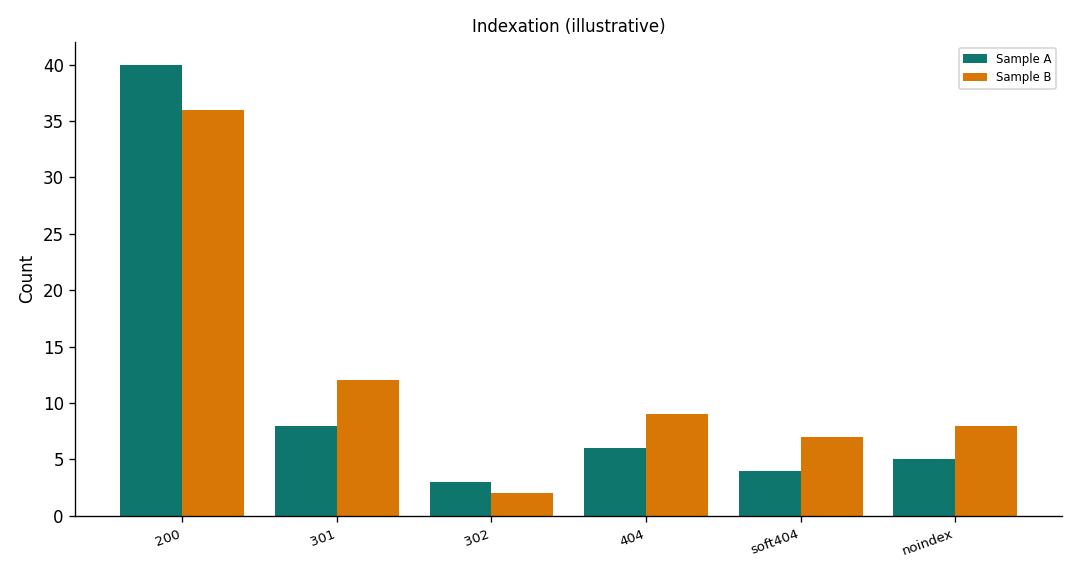
Illustrative two-dimension desk chart (defect class × HTTP status). Not a customer report. Social cut: ./images/og-cover.png.
| Defect class (illustrative) | Count in n=80 | Typical status | Copy first? |
|---|---|---|---|
| Accidental noindex | 6 | 200 | No |
| Canonical twin | 9 | 200 | No |
| Soft 404 | 5 | 200 | No |
| Redirect chain (≥3 hops) | 4 | 301 | No |
| Empty JS shell | 3 | 200 | No |
| Eligible, thin body | 8 | 200 | Yes |
Desk note IDX-HUB-20260908 (illustrative): 27 of 80 sampled URLs fail website indexation before anyone should open a doc. The eight thin-but-eligible rows are the only copy queue. The rest are engineering tickets.
Scorecard for eligibility
Score eligibility, not a vanity 100, before you call website indexation done.
| Check | Pass | Fail |
|---|---|---|
| Status is honest | 200 for live docs; 404 for gone docs | Soft 404 as 200 |
| Robots / noindex match intent | Staging off; prod indexable | Leftover noindex |
| Canonical is a live self or a true winner | One keep URL | Twins or a redirect target |
| Redirects are one hop | 301 to the live URL | Chains, loops, or 404 targets |
| HTML has a body | Server-rendered or prerendered | Empty SPA shell |
| Sample covers templates | 50–500 stratified URLs | Homepage only |
A pass means website indexation is clear enough to write. A fail means you keep the engineering ticket. Credits do not flip a noindex.
Failure modes that hide eligibility
Copy first. The most common miss is a rewrite on a noindexed URL. Eligibility was already refused. The new paragraph never enters an index.
Soft 404 politeness. A 200 “we could not find that” template looks finished. The index treats it as a document you asked to keep. Return a 404 or restore the product.
Canonical theater. Two URLs each point at themselves. You keep a duplicate fight. Pick one winner on the sample, then 301 the loser.
Shell confidence. Designers see a full page in Chrome. Crawlers see an empty root. The index stores the empty root. Render on the server, then re-sample.
Update fan fiction. A core update week is not an eligibility diagnosis. If tech is red, fix tech. If you need history, use a GSC export in its own window. Do not invent a recovery percentage.
Cluster guides for this pillar
This hub defines website indexation as eligibility. Open one cluster when you have that defect, and still treat website indexation as a fetch problem, not a copy-first brief.
| Job you actually have | Guide to open next |
|---|---|
| Hop count and final status | redirect chain |
| One chosen URL per twin | canonical tag checker |
| Empty JS body | rendering javascript |
| Locale pairs on this host | hreflang audit |
| Missing host headers | HTTPS security headers SEO |
| A 200 that should not index | 404 errors seo |
| Leftover meta or header refusals | noindex tag |
| Empty SPA shell | javascript crawling |
| Snapshot versus SSR | prerender SEO |
| Parameter and slash twins | duplicate URL indexation |
| What to sample in a series | pagination indexation |
Adjacent hubs stay in their rooms: lights, sampled audits, GSC files, titles, EEAT limits, AI-answer tracking, CI gates, algorithm dates, and schema. Use those pages when website indexation is already green. Do not retarget “technical SEO audit” on this URL.
Sample eligibility before you rewrite copy
Paste a public URL for tech lights, or sample 50–500 sitemap URLs to see where website indexation already failed.
Run SEO Health CheckerFrequently Asked Questions
What does eligibility mean here?
Bottom line: Website indexation is eligibility: fetch, accept, and keep a URL as the chosen document. It is not a title rewrite and not an official Google score. Prove it on status, noindex, canonical, redirects, and the HTML body.
Can a title rewrite fix eligibility?
Bottom line: No. Website indexation fails on eligibility signals. A title change helps after the URL returns 200, is indexable, has an honest canonical, and has a body. Rewrite later.
Do status codes need InfiniSynapse?
Bottom line: No. Status codes stay in SEO Health. The counts are deterministic. InfiniSynapse is optional when you want a priority narrative on a large sample, and that task uses credits.
How does a sitemap sample prove eligibility?
Bottom line: A 50–500 URL sample shows which templates fail. Website indexation defects cluster. Homepage-only checks hide twins, soft 404s, and shells. Stratify, fetch, classify, then write.
Conclusion
Website indexation is eligibility before prose. Noindex, soft 404s, canonical twins, redirect chains, and empty shells are engineering tickets. Status codes stay in SEO Health. Optional narrative is a long task, not a second status table.
Paste a public URL at SEO Health and read tech first. Sample the sitemap when templates are in play. Open the InfiniSynapse web app only if you want a ranked punch list on that sample. Then rewrite the URLs that are actually allowed to exist.