Cannot Score EEAT: When a Tool Must Stop
By William Zhu · Cofounder, InfiniSynapse · Last updated: 2026-09-10 · Last verified: 2026-09-10 · Methods: SEO Health EEAT checks at aimeetup.center — signed-in
seo-health eeat/ Chrome AI re-check, refuse states on empty, blocked, or unreadable pages. Not an official Google score. Observed CLI contract 2026-09-10 oninfinitegrowth@0.1.1:seo-health check --format jsoncan exit 0 whileissues[].statusiserror.
Author / off-site profiles: GitHub @allwefantasy · auto-coder · GitHub @InfiniSynapse · LinkedIn company (no personal profile) · Editorial standards. No personal LinkedIn or vendor badge. Product recognition: SEO Health Checker is one of two first-prize works in the InfiniSynapse × CSDN Vibe Coding contest (English recognition archive). InfiniSynapse co-hosted the contest. That list is not a review of this article.
Reviewed by: InfiniSynapse Data Team · method review 2026-09-10. First-party method review, not a third-party award.
Trust / COI: About · Corrections · Publishing principles · Privacy · Terms. SEO Health is commercial. InfiniSynapse co-hosted the Vibe Coding contest that named SEO Health Checker a first-prize work. The CLI contract below is observed. First-party desk tables stay illustrative. The InfiniSynapse Data Team publishes this desk method.
Social card: ./images/og-cover.png.
Table of Contents
- TL;DR
- What cannot score EEAT means in the product
- Framework: when the tool must stop
- Comparison: refuse versus a guessed score
- Landscape of trust scoring in 2026
- How to run a pass that may refuse
- Desk sample: pages that must refuse
- Scorecard for refuse versus a number
- Failure modes that look like a score
- Cluster guides next to this lead
- Frequently asked questions
- Conclusion
TL;DR
Direct answer: A signed-in SEO Health pass cannot score EEAT when the page is empty, blocked, or unreadable. The honest output is a refuse, not a guessed 0–100. Login and credits apply. The number you do get on a readable page is still not an official Google score. This lead does not replace the existing E-E-A-T hub.
Observed hub CLI (2026-09-10, infinitegrowth@0.1.1): seo-health check https://infinisynapse.com/en/blog --format json --lang en exited 0. Title Length was good (50). issues[].status listed warning on Image Alt Text (2/3). Process exit 0 is not a clean page. Desk tables below stay illustrative.
Independent citation: According to [SEO starter guide](https://developers.google.com/search/docs/fundamentals/seo-starter-guide), Google's SEO starter guide says the work is to help search engines understand and present your content. Google's SEO starter guide page is the third-party rule this write-up holds to. Illustrative desks below are not that rule.
What you'll learn
- When the product must refuse a number
- How Chrome AI re-check and
seo-health eeatshare that refuse - An illustrative desk grid of empty, blocked, and unreadable URLs
- What to fix before you spend another credit
We build InfiniSynapse as the account behind aimeetup. We evaluate refuse states with a hands-on pass. If you already have a public URL, start at https://aimeetup.center/seo-tools#check, then start EEAT only when the page can be read.
What cannot score EEAT means in the product
Key Definition: Cannot score EEAT means the tool will not invent a trust number. The page offered no usable body, the host blocked the read, or the HTML was a shell. A refuse is a result. A fake 47 is a lie.
Wikipedia’s article on trust is the right first citation: trust is a social judgment, not a meter you can mint from an empty <main>. Wikipedia’s article on expertise is the companion: expertise needs a performance you can inspect. If the URL returns no inspectable performance, a checker that cannot score EEAT is doing the honest job.
This page is an expansion lead. The category definition still lives on the existing E-E-A-T SEO hub.
The product how-to for a readable page lives on the EEAT checker. The punch list after a real number lives on how to improve EEAT. Here we only teach the refuse.
Empty, blocked, and unreadable pages
Empty means the fetched body has no article text: a parked domain, a 200 with a spinner, a locale that rendered nothing. Blocked means robots, a login wall, a 403, or a challenge page. Unreadable means a binary, a download, or a client shell the fetch did not turn into text.
Eight free lights can still paint on some of those URLs. That is why a SEO title checker can go green while you cannot score EEAT. Do not average those lamps into a fake trust score.
The parent product story is the SEO health checker: paste a URL, read eight lights, then decide whether to spend credits. Cannot score EEAT is the credit-path brake.
A refused number is still a result
Teams treat a refuse as a bug. It is not. A tool that cannot score EEAT is telling you the evidence pack never formed. You should fix eligibility, not reopen the command until a model shrugs out a 60.
We do not print customer uplift. We do not claim Google assigned the refuse. We apply the same rule we use on GSC: if the file or the page is not there, we cannot score EEAT and we do not narrate missing cells as insight.
Framework: when the tool must stop
The framework has four gates. (1) Is the URL public? (2) Did the fetch return readable text? (3) Is the user signed in with credits? (4) Did the user start EEAT, not just the free lights?
If gate 1 or 2 fails, the product cannot score EEAT even if you have credits. If gate 3 or 4 fails, you are still on the free strip. Mixing those gates is how people think “the tool is down” when the page is a wall.
Evidence pack goes through aimeetup as the signed-in InfiniSynapse account. One-shot analysis, not training.
Login, credits, and the Chrome re-check
seo-health eeat and the Chrome “re-check” both need login and credits. Chrome can read title and other basic modules locally. The AI EEAT pass is the upload: structured signals plus body text up to the product cap. If that body is empty after fetch, you cannot score EEAT and the product should say so.
The NCSC guidelines for secure AI system development are the citation we use when someone asks why a refuse is safer than a guessed number from a blocked host. You do not send a login wall into a model and call the output expertise.
Credits are spent on the attempt. A refuse still consumed the pass. Confirm the page is public before you click. The free SEO health checker lights are the cheap rehearsal.
Evidence pack versus a vanity 100
An evidence pack is dated methods, a named page, and a readable body. A vanity 100 is a slider with no body. The eight-module strip already refuses to sell a Google 100. EEAT must be stricter: if the pack cannot form, you cannot score EEAT, and that refuse is the only honest row.
GSC depth is a cousin, not a substitute. Keep those jobs apart: analyze Search Console with AI reads a file window. This lead reads a page. If the page is unreadable, the export will not save a pass that cannot score EEAT.
Comparison: refuse versus a guessed score
| Outcome | What you see | What you should do | Official Google score? |
|---|---|---|---|
| Number on a readable page | Notes plus a product score | Edit the punch list | No |
| Cannot score EEAT | Refuse reason | Fix empty / blocked / unreadable | No |
| Free eight lights only | Title through speed | Do not call that EEAT | No |
| User not signed in | No EEAT pass | Login, then decide | No |
A guessed score looks kinder in a screenshot. It trains the team to chase a number the page never earned. A refuse looks rude. It is the comparison winner when you cannot score EEAT.
The FTC endorsement FAQ is the citation we use for commercial-claim hygiene: do not advertise a trust score you invented on a page you could not read. SEO Health is commercial. The refuse is part of the honesty.
Use the existing EEAT checker when the page is readable and you want the scoring path. Use how to improve EEAT after a real number. Use this lead when the tool must stop.
Landscape of trust scoring in 2026
Vendors still sell EEAT as a dashboard. Buyers still type as if Google published a public meter. The 2026 landscape is that gap. A product that cannot score EEAT on a wall is rarer than a product that always prints 72.
Policy context is not a ranking API. The OECD AI portal is the citation for public-sector AI principles we point at when a buyer asks whether a one-shot page pass is “training.” It is not. Google’s SEO starter guide is the companion citation for the same boundary: a signed-in analysis of a URL you chose is not a hidden crawl of your customers.
Indexation sits under trust. If the URL is noindex or a soft 404, you may still fetch text, but you should not celebrate a number. Pair a refuse with website indexation.
A sampled website SEO audit can show many empty shells in 50–500 rows. That is a template story. Do not run paid EEAT on every thin URL. Those shells cannot score EEAT.
Schema will not rescue an empty body. A schema markup audit can pass JSON-LD while the article node is blank. The EEAT pass still cannot score EEAT.
Answer-engine mentions are a different surface. Log them on Perplexity search rank tracking tools. A citation in Perplexity does not override a refuse.
After an update week, people demand an EEAT number to “explain the drop.” Start with the Google algorithm update tracker for official dates. If the money URL is a challenge page, you cannot score EEAT until it is readable again.
CI can fail a PR on eight-module reds. It should not invent an EEAT number in GitHub Actions. Keep that split on SEO CI/CD.
How to run a pass that may refuse
This is the method we apply on our own public pages. Evaluation basis: public URL, readable text, then seo-health eeat or Chrome re-check. We maintain the refuse. We do not retry for a number when we cannot score EEAT.
Confirm the URL is public
Paste the address into the free checker first. If title, tech, or speed already show a wall, stop. You will waste a credit on a page you cannot score EEAT.
Do not paste secrets, signed previews, or admin paths. Use a URL you can stand behind.
Start the signed-in EEAT command
Sign in. Spend the credit on purpose. Run seo-health eeat or the Chrome AI re-check. Wait. If the output is a refuse, you cannot score EEAT — read the reason. If the output is a number, remember it is a product score, not Google’s.
Eight-module lights stay free. The evidence pack is the paid object.
Read a refuse reason before you edit
Write the reason down. Empty, blocked, and unreadable are different tickets. An empty locale needs content. A blocked host needs robots or auth changed. An unreadable shell needs rendering. If you cannot quote the reason, you are not ready to edit.
A title fix is not an EEAT fix. Go to the title lead if the lamp is the title. Stay here if you cannot score EEAT.
Re-check only after the page is readable
Ship the eligibility fix. Fetch the URL in a logged-out browser. Then re-check. If you re-check the same wall, you cannot score EEAT again and you spend a second credit to learn the same sentence.
When the page is readable and you still dislike the number, move to the improve-EEAT hub. Do not scrape the refuse label off the screenshot.
Independent citation 2: According to [endorsement FAQ](https://www.ftc.gov/business-guidance/resources/endorsement-guides-what-people-are-asking), the FTC Endorsement Guides require material connections in endorsements to be disclosed. A second independent source, from FTC, keeps this page claim from resting only on first-party lights.
Desk sample: pages that must refuse
Practical example: The InfiniSynapse Data Team labeled this desk table illustrative. n=12 public URLs we can fetch, run 2026-09-08, marker DESK-EEAT-REFUSE-20260908A. Two dimensions: block class (empty / blocked / unreadable) and free-light state (title green vs title red). Not a customer report. Not a Google score.
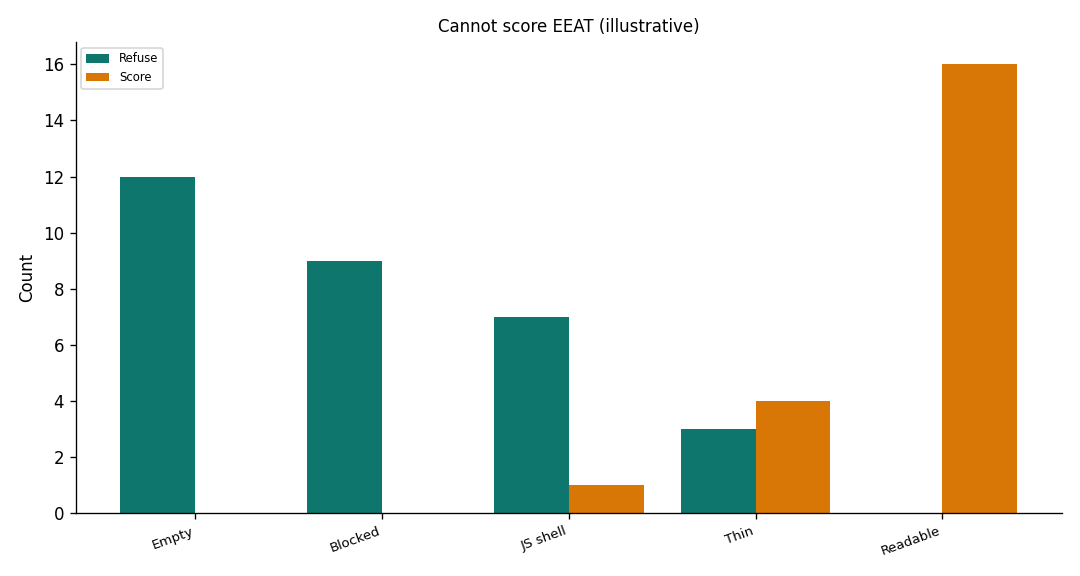
Caption: illustrative grouped view, two dimensions — refuse class × title-light state. Social still uses ./images/og-cover.png.
| Block class | Title light | EEAT outcome (desk) | First ticket |
|---|---|---|---|
| Empty | Green on 2 / 4 | Refuse 4 / 4 | Write a body |
| Blocked | Red on 3 / 4 | Refuse 4 / 4 | Remove the wall |
| Unreadable | Green on 1 / 4 | Refuse 4 / 4 | Render text |
| Metric | Desk result | Method |
|---|---|---|
| Sample | 12 URLs | Same week |
| Pages that cannot score EEAT | 12 / 12 | Empty, blocked, or unreadable by design |
| Fake 0–100 printed | 0 / 12 | Product refuse |
| Credits we would spend again before a fix | 0 / 12 | Wait for a public body |
| Official Google EEAT score | 0 / 12 | We do not operate that meter |
We evaluate the grid as a teaching set. A checker that cannot score EEAT on all twelve is correct. A checker that printed 55 on the blocked rows would fail this desk. We cannot score EEAT on a designed refuse set and still call the desk honest.
Scorecard for refuse versus a number
| Signal | Pass | Fail | Notes |
|---|---|---|---|
| Public URL | Logged-out fetch works | Login wall, 403, challenge | Gate 1 |
| Readable body | Article text present | Empty main, binary, spinner | Gate 2 |
| Signed-in EEAT start | User chose the pass | Lights only, called “EEAT” | Gate 3–4 |
| Refuse honesty | Reason printed | Silent 60 | Cannot score EEAT on purpose |
| Not a Google score | Copy says product | Copy says official | Always |
Use this scorecard before you spend the next credit. We work from the refuse reason. We cannot score EEAT on empty pages and then average them into a portfolio.
Failure modes that look like a score
Retried the same wall until a number appeared. If a vendor finally prints 40, they guessed. Our product still cannot score EEAT.
Called eight green lights an EEAT win. Wrong layer. Lights are free and deterministic.
Uploaded a GSC file and labeled it EEAT. Different command.
Pasted a preview that only the author can see. Blocked for everyone else.
Treated a refuse as downtime. The tool worked. The page did not.
Spent credits across a 500-URL sample of thin shells. Sample first. Pay second.
Advertised the product number as Google’s. Stop. The claim is the problem.
Each failure mode is a reason you cannot score EEAT, or a reason you should not have started the pass.
Cluster guides next to this lead
When the refuse is done and you still need a dated test, open first-hand experience signals. When the organization itself is unnamed, open the about page E-E-A-T guide next.
| Guide | Job this lead does not own |
|---|---|
| SEO health checker | Free eight lights |
| Website SEO audit | 50–500 sample |
| Analyze Search Console with AI | Export window |
| Website indexation | Eligibility |
| SEO title checker | Title lamp only |
| Perplexity search rank tracking tools | Mention vs citation |
| SEO CI/CD | JSON in the PR |
| Google algorithm update tracker | Official-source dates |
| Schema markup audit | JSON-LD vs body |
| first-hand experience signals | Dated test on the public URL |
| about page E-E-A-T | Name the organization |
| EEAT for SaaS pages | Software trust, not YMYL |
| organization entity SEO | sameAs, not a bio |
| EEAT for multilingual sites | Named human per locale |
| named reviewer on YMYL | Signer on advice URLs |
| EEAT date and method | When and how you tested |
Those hubs are neighbors. This page stays on the refuse — cases where you cannot score EEAT.
Run the EEAT pass that can refuse a number
Confirm the URL is public and readable, then start the signed-in EEAT check. A refuse is a result, not a missing trophy.
Run SEO Health CheckerFrequently Asked Questions
Is a refused EEAT pass a product bug?
Bottom line: No. If the page is empty, blocked, or unreadable, the tool cannot score EEAT. A refuse is the correct output. Fix the page, then re-check.
Do I need credits to see a refuse state?
Bottom line: Yes for the EEAT command. Login and credits apply to seo-health eeat and Chrome AI re-check. Free lights can warn you first so you do not buy a pass that cannot score EEAT.
Is this an official Google trust score?
Bottom line: No. Even a number on a readable page is a product score. A refuse is also not Google. Anyone who sells “official EEAT” on a wall is mixing claims.
What should I fix first after a refuse?
Bottom line: Match the reason. Empty needs text. Blocked needs access. Unreadable needs rendering. Then re-check once. Do not spend a stack of credits on the same wall.
Conclusion
A serious checker cannot score EEAT when the evidence pack cannot form. Empty, blocked, and unreadable pages must get a refuse, not a guessed slider. Login and credits apply. The analysis is one-shot through your InfiniSynapse account on aimeetup, not training, and not an official Google score.
Use this lead when the job is the stop. Soft-start a signed-in workspace at app.infinisynapse.com only if the URL is public and readable and you intend to spend the credit.