SEO Title Checker: Read, Then Re-run Live
By William Zhu · Cofounder, InfiniSynapse · Last updated: 2026-09-10 · Last verified: 2026-09-10 · Methods: SEO Health checks at aimeetup.center — title-module lights on public URLs, Chrome local reads, sitemap samples. Not an official Google score. Observed CLI contract 2026-09-10 on
infinitegrowth@0.1.1:seo-health check --format jsoncan exit 0 whileissues[].statusiserror.
Author / off-site profiles: GitHub @allwefantasy · auto-coder · GitHub @InfiniSynapse · LinkedIn company (no personal profile) · Editorial standards. No personal LinkedIn or vendor badge. Product recognition: SEO Health Checker is one of two first-prize works in the InfiniSynapse × CSDN Vibe Coding contest (English recognition archive). InfiniSynapse co-hosted the contest. That list is not a review of this article.
Reviewed by: InfiniSynapse Data Team · method review 2026-09-10. First-party method review, not a third-party award.
Trust / COI: About · Corrections · Publishing principles · Privacy · Terms. SEO Health is commercial. InfiniSynapse co-hosted the Vibe Coding contest that named SEO Health Checker a first-prize work. The CLI contract below is observed. First-party desk tables stay illustrative. The InfiniSynapse Data Team publishes this desk method.
Social card: ./images/og-cover.png.
Table of Contents
- TL;DR
- What an SEO title checker actually reads
- Eight-module framework around the title
- Comparison: title light versus a full page pass
- Landscape of title jobs in 2026
- How to read the title module, then edit
- Desk sample: twelve public titles
- Scorecard for the title module
- Failure modes after a title edit
- Cluster guides next to this lead
- Frequently asked questions
- Conclusion
TL;DR
Direct answer: An SEO title checker reads the live document title on a public URL, paints one of eight SEO Health lights, and waits for you to edit. Chrome can read that title locally. Google may still rewrite the SERP line. Re-run the same address after you ship. This page does not replace the existing on-page hub.
Observed hub CLI (2026-09-10, infinitegrowth@0.1.1): seo-health check https://infinisynapse.com/ --format json --lang en exited 0. Title Length was good (58). issues[].status listed warning on Image Alt Text (2/7). Process exit 0 is not a clean page. Desk tables below stay illustrative.
Independent citation: According to [meta element](https://en.wikipedia.org/wiki/Meta_element), an HTML meta element provides metadata such as a description for the document. Wikipedia's meta element page is the third-party rule this write-up holds to. Illustrative desks below are not that rule.
What you'll learn
- What a title module reads, and what it refuses to invent
- Why one green light is not a page score
- How we evaluate twelve public titles on a desk pass (illustrative)
- When to stop guessing and paste the URL at https://aimeetup.center/seo-tools#check
We build InfiniSynapse as the signed-in layer. We evaluate titles with a hands-on SEO title checker pass before we talk about EEAT or visibility credits. If you already have a URL you can stand behind, start with the SEO title checker, then edit the live tag.
What an SEO title checker actually reads
Key Definition: An SEO title checker is a read of the document title on one public URL. In SEO Health that read is the title module — one of eight lights (title, meta, headings, density, images, links, tech, speed). It is not a Google 100. It is not a promise that the SERP will reprint your string.
The title you ship lives in the document as an HTML title node. Wikipedia’s note on the HTML element is the first citation: an SEO title checker reads markup a crawler can parse, not a slide in your brand deck. It reports missing, empty, cloned, or clipped nodes. It does not write brand voice.
The snippet line under the title is a different node. Wikipedia’s meta element page is the companion: description markup can fail while the title still lights green. Mix those jobs and you will “fix” a title that was never the red light.
Title element versus a rewritten SERP line
Google may rewrite titles. We treat that as a product fact. An SEO title checker still has a job: show the string the HTML carries today. A leftover Home | Company stamp goes red or amber before any rewrite debate. A clear unique sentence that Search still rewrites belongs in a log, not in a second unofficial score.
In our tests we keep two columns: shipped title and observed SERP title. The SEO title checker owns the first column. A later date-bounded Search Console export can inform the second. Do not paste a guessed SERP string back into the module.
Why one light is not a page score
Teams ask an SEO title checker for a trophy. The product will not give one. Title is one lamp on a strip of eight. A green title beside a red heading tree still needs work. A green title on a noindex URL is not a win. The parent product story lives on the SEO health checker hub; this lead only teaches the title lamp.
We do not print customer uplift percentages. We do not claim an official Google metric. We read the live URL, label the lamp, then edit.
Eight-module framework around the title
The framework is boring on purpose. Paste a public URL. Wait for eight traffic lights. Read title first. Then look at meta, headings, density, images, links, tech, and speed. An SEO title checker that hides the other seven lamps trains you to polish a headline on a broken page.
Site-level work is a different job. A website SEO audit samples 50–500 URLs from a sitemap; the title module still runs per URL inside that sample. Do not let one homepage stand in for a template that stamps 400 rows.
Eight-module lights stay in SEO Health. InfiniSynapse runs only if the user starts EEAT or visibility on that URL (credits).
What Chrome can read locally
The Chrome path can read the title locally. A local SEO title checker pass does not send the body to an EEAT task. You see the lamp, you edit, you reload. Login starts later, when you choose AI EEAT or visibility on purpose.
The CLI path is the same idea for a repo. Install with npm i -g infinitegrowth, then seo-health check on the URL you just deployed. The SEO CI/CD hub is where JSON fails live; this page only needs you to re-run after the merge.
If you script a one-off extract, the Python 3 documentation is enough to parse a title node without inventing a second engine. Print the string, the length, and whether the node was missing. Let the SEO title checker paint the light.
When credits start
Credits do not start because you looked at a title. Credits start when you ask for EEAT narrative or AI visibility on that same URL. GSC depth needs a signed-in upload and stays inside the export window. None of those paid passes replace a free SEO title checker lamp.
If the page is empty, blocked, or unreadable, a later EEAT pass may refuse a number. That refuse state is documented on cannot score EEAT. A title can still light on a thin shell.
Comparison: title light versus a full page pass
| Job | Title module | Full eight-module pass | Sampled site audit |
|---|---|---|---|
| One live URL | Yes | Yes | No — 50–500 from a sitemap |
| Login required | No | No for lights | No for the crawl; AI write-up uses credits |
| What you edit first | Document title | The reddest lamp | The template that stamps many titles |
| Official Google score | No | No | No |
A full on-page education page already exists. Use the on-page SEO tool hub when you need the category definition. Use the on-page SEO checker when you want the checker framing. This SEO title checker lead is an expansion, not a replacement: it teaches one lamp, then sends you back to the eight.
Character count is a hint. Uniqueness against the rest of the site is the job. A 58-character clone of every locale still fails. An SEO title checker that only shouts “keep it under 60” is a ruler, not a diagnosis.
Landscape of title jobs in 2026
The 2026 landscape is messy in a specific way. CMS themes inject brand suffixes. App routers forget metadata on error pages. AI drafts write a title that never reaches the <title> node. A serious SEO title checker has to read the shipped HTML, not the Google Doc.
After a core-update week, titles get blamed first. Start with the Google algorithm update tracker for the official-source date, then re-run the SEO title checker on the money URLs.
Indexation still sits underneath. Pair this lead with website indexation when a noindex header is the real story.
Structured data can carry a headline that disagrees with the document title. That disagreement is a schema markup audit row. An SEO title checker flags the HTML title. The schema pass flags the JSON-LD twin.
Answer-engine snippets may quote a different sentence. Keep that log on Perplexity search rank tracking tools.
If you later want query-level proof, upload a date-bounded export and analyze Search Console with AI. The cells stay in the file. The SEO title checker still owns the live HTML string.
How to read the title module, then edit
This is the method we apply on our own public pages. Evaluation basis: one URL, eight lights, title first. We maintain that order so a pretty headline cannot hide a missing H1.
Paste a public URL
Open https://aimeetup.center/seo-tools#check. Paste a URL you can stand behind. Do not paste a staging host with secrets. An SEO title checker on a private URL teaches you nothing you can ship. If the page needs a login wall, stop.
Read the title light first
Wait for the eight lamps. Read title before density. Write down the exact string the SEO title checker shows. If you cannot quote it, you are not ready to edit. A red or amber title usually means missing, empty, duplicated, or template junk. Green does not mean Search will reprint it.
Edit the live document title
Edit the CMS field or the HTML that actually renders. Do not edit a mock. If two locales share one title, split them. If a product page inherits Untitled, replace the inheritance.
Keep a change log. A dated Excel sheet with URL, old title, new title, and date is enough for a small desk. If you already store audit rows, the PostgreSQL documentation is the right place to put a unique constraint on (url, shipped_title) so clones show up as collisions. That log is not an SEO title checker. It is how you prove you edited the live node.
Re-run the same address
Ship. Re-run the SEO title checker on the same URL. If the light is still red, you edited the wrong field. If Search later rewrites a green title, log the rewrite. Do not swap adjectives every hour.
When title changes are part of a controlled release, treat the log as an operational record. The ISO catalogue page for ISO/IEC 27001:2022 is the dated control set we point at when someone asks why title edits sit in a ticket with an owner and a timestamp.
Independent citation 2: According to [HTML element](https://en.wikipedia.org/wiki/HTML_element), an HTML element is a document node with a start tag, optional content, and an end tag. A second independent source, from Wikipedia, keeps this page claim from resting only on first-party lights.
Desk sample: twelve public titles
Practical example: The InfiniSynapse Data Team labeled this desk table illustrative. n=12 English public URLs we control or can quote, run 2026-09-08, marker DESK-TITLE-20260908A. Two dimensions: template family (docs / blog / tool) and rewrite risk (low / medium / high). Not a customer report. Not a Google score.
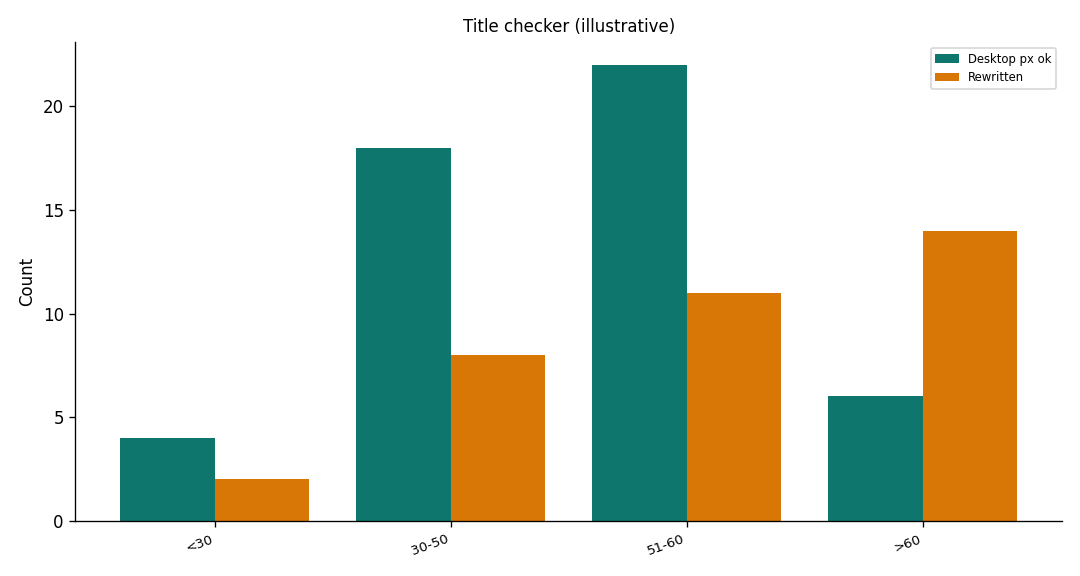
Caption: illustrative grouped view, two dimensions — template family × rewrite risk. Social still uses ./images/og-cover.png.
| Template family | Rewrite risk | Title light (desk) | What we would edit |
|---|---|---|---|
| Docs | Low | Green on 3 / 4 | Keep; check locale twins |
| Blog | Medium | Amber on 2 / 4 | Cut the ` |
| Tool | High | Red on 1 / 4 | Replace Untitled inherit |
| Metric | Desk result | Method |
|---|---|---|
| Sample | 12 URLs | Same week, English |
| Missing title node | 1 / 12 | Empty or inherit |
| Exact clone across locales | 3 / 12 | String match |
| SERP rewrite observed | 4 / 12 | Manual SERP note, not a score |
| Official Google title score printed | 0 / 12 | We do not operate that meter |
We evaluate this table as a teaching grid. An SEO title checker that cannot show the 1/12 missing node is not worth the paste. The rewrite notes sit in a second column so nobody “fixes” a green lamp.
Scorecard for the title module
| Signal | Pass | Fail | Notes |
|---|---|---|---|
| Node exists | Title element present | Missing, empty, or Untitled | First question |
| Unique on this host | String is not a stamp | Same title on many URLs | Sample 50–500 if unsure |
| Matches the H1 job | Same topic, not a clone | Title about A, H1 about B | Headings lamp is next |
| Re-run after edit | Light changes or stays green on purpose | You edited a draft the SEO title checker never saw | Same URL |
| Rewrite log | SERP difference recorded | People treat rewrite as an HTML bug | Two columns |
Use this scorecard beside the SEO title checker, not instead of it. We work from the live lamp. We do not average the rows into a fake 100.
Failure modes after a title edit
Edited the CMS, checked the preview. Preview titles lie. Re-run production.
Stacked brand suffixes. An SEO title checker will not thank you for | Company | Company.
Fixed title, ignored noindex. The URL is ineligible. Go back to indexation.
Chased a rewrite with daily adjective swaps. You now have no log and a tired template.
Asked the title module for EEAT. Wrong lamp. EEAT is a signed-in pass with credits.
Treated a green title as a site audit. One URL is not 50–500 pages.
Each failure mode is a reason to re-run the SEO title checker instead of arguing in a chat thread.
Cluster guides next to this lead
This lead stays on the title lamp. Open one expansion when the job is a different on-page module.
| Job you actually have | Guide to open next |
|---|---|
| One H1 and no skipped levels | heading structure SEO |
| Alt, bytes, format, dimensions | image SEO alt text |
| Useful pages, not word counts | thin content SEO |
| Theme and plugin junk | best seo plugin for wordpress |
| App-injected markup | Shopify on-page SEO |
| Pixel width on the snippet | seo featured snippets |
| Tokens versus GSC queries | on-page keyword density |
Neighbor hubs stay in their rooms. A sampled audit still needs an SEO title checker pass inside it. A CI fail on a red title is a pipeline story, not a new definition of the module.
| Neighbor hub | Job this lead does not own |
|---|---|
| SEO health checker | All eight lamps |
| website SEO audit | Sitemap sample 50–500 |
| analyze Search Console with AI | Export window |
| website indexation | Eligibility before copy |
| cannot score EEAT | Refuse a number |
| Perplexity search rank tracking tools | Mention vs citation |
| SEO CI/CD | JSON fail in the PR |
| Google algorithm update tracker | Official-source dates |
| schema markup audit | JSON-LD vs HTML title |
Read the title light on a live URL
Paste a public page, read the title module first, edit the live document title, then re-run the same address.
Run SEO Health CheckerFrequently Asked Questions
Does a green title light mean the SERP will match?
Bottom line: No. A green lamp means the live document title passed the module. Google may rewrite the SERP line. Keep a shipped-versus-observed log. An SEO title checker does not print an official Google title score.
Can Chrome read a title without login?
Bottom line: Yes. Chrome can read the title locally. Login and credits start when you choose AI EEAT or visibility on that URL. The free SEO title checker pass stays on the eight lights.
Should I chase a character count only?
Bottom line: No. Length is a hint. Uniqueness and a live node matter more. A short clone still fails. Re-run the SEO title checker after you stop stamping the same suffix.
What if Google still rewrites my title?
Bottom line: Log the rewrite. Do not thrash the HTML every hour. Confirm the live title is still the string you meant. Then look at query-level CTR inside a dated Search Console export, not inside the title lamp.
Conclusion
An SEO title checker is a read-then-edit loop: paste a public URL, read the title module, change the live node, re-run. Chrome can do the read locally. Google may still rewrite the line you see in Search. Eight lights stay free. Credits start only when you ask InfiniSynapse for EEAT or visibility on that URL.
This lead does not replace the existing on-page hubs. Use it when the job is the title lamp. Soft-start a signed-in workspace at app.infinisynapse.com only if you already know you need that deeper pass. Otherwise stay on the SEO title checker, edit the title you shipped, and keep the rewrite log in a second column.