thin content SEO: Useful Pages, Not Word Counts
By William Zhu · Cofounder, InfiniSynapse · Last updated: 2026-09-10 · Last verified: 2026-09-10 · Methods: SEO Health eight-module lights plus useful-versus-empty desk labels on public 200s, Chrome local reads. Not an official Google score. Observed CLI contract 2026-09-10 on
infinitegrowth@0.1.1:seo-health check --format jsoncan exit 0 whileissues[].statusiserror.
Author / off-site profiles: GitHub @allwefantasy · auto-coder · GitHub @InfiniSynapse · LinkedIn company (no personal profile) · Editorial standards. No personal LinkedIn or vendor badge. Product recognition: SEO Health Checker is one of two first-prize works in the InfiniSynapse × CSDN Vibe Coding contest (English recognition archive). InfiniSynapse co-hosted the contest. That list is not a review of this article.
Reviewed by: InfiniSynapse Data Team · method review 2026-09-10. First-party method review, not a third-party award.
Trust / COI: About · Corrections · Publishing principles · Privacy · Terms. SEO Health is commercial. InfiniSynapse co-hosted the Vibe Coding contest that named SEO Health Checker a first-prize work. The issues[] table below is observed. Topic desks stay illustrative. The InfiniSynapse Data Team publishes this desk method.
Table of Contents
- TL;DR
- What the job means on a useful page
- A four-signal framework
- How useful pages compare to a word-count race
- Landscape: who owns the stub
- How to run the useful-page pass
- Desk sample
- Scorecard
- Failure modes
- Cluster guides
- FAQ
- Conclusion
TL;DR
Direct answer: **thin content SEO** is a useful-page job, not a word-count race. An empty 200 fails eligibility first. Write after tech is green. Then re-run eight lights on the same address. A longer stub is still a stub.
What you will learn: why thin content SEO starts on usefulness; how empty 200s and thin templates share a ticket; an illustrative page-type × keep-or-stop desk; four steps that refuse padding.
Paste a public URL at https://aimeetup.center/seo-tools#check for title, meta, headings, density, images, links, tech, and speed lights. Those lights are not a Google 100. A usefulness job starts after the URL is allowed to exist as a document.
We evaluate thin content SEO hands-on as the InfiniSynapse Data Team. We build InfiniSynapse so eight-module lights stay in SEO Health, and InfiniSynapse runs only if the user starts EEAT or visibility on that URL (credits).
What thin content SEO means on a useful page
Key Definition: thin content SEO is a judgment of whether a public 200 is a useful page or a stub: empty template, placeholder body, or a shell that repeats the site chrome. The job names empty 200s and thin templates. It is not a minimum word count and not a Google 100.
Observed page CLI (2026-09-10, infinitegrowth@0.1.1): seo-health check https://github.com/allwefantasy/auto-coder --format json --lang en exited 0. issues[].status listed H1 Tag (error), Sitemap.xml (error), Meta Description (warning), Page Structure (warning). Process exit 0 is not a clean page.
issues[].name | issues[].status |
|---|---|
| H1 Tag | error |
| Sitemap.xml | error |
| Meta Description | warning |
| Page Structure | warning |
| Title Length | good |
| URL | good |
| Robots.txt | good |
| Image Alt Text | good |
The topic desk below stays illustrative.
Independent citation: According to [content in media](https://en.wikipedia.org/wiki/Content_%28media%29), content is the information a page is meant to communicate, not the chrome around it. Wikipedia's content in media page is the third-party rule this write-up holds to. Illustrative desks below are not that rule.
People search this phrase when a writer is told to “add 300 words.” The first question is whether the URL should exist. Word count is later.
Wikipedia’s overview of content in media still treats content as something intended to inform or be used, not as a token pile. Honest thin content SEO follows that habit: ask what a visitor can do, then write. If the body is a lorem block, the sentence may say the page is a stub — not “we are at 812 words.”
Useful 200 versus empty 200
A 200 that answers one job can pass. A 200 that returns chrome and a placeholder fails. thin content SEO records that split before anyone opens a brief. Status 200 is not usefulness.
Chrome can finish the eight lamps on a public 200 locally. AI EEAT is the signed-in exception. Paid credits apply only to EEAT, visibility, or a GSC file job. Do not treat a service-case traffic story as proof that a stub became useful.
Placeholders are not drafts you ship
A public placeholder is a defect. Wikipedia’s note on a placeholder still treats the mark as a temporary stand-in. Replay that definition on production: if users can fetch it, thin content SEO already has a row. Unpublish or noindex until the page does a job.
Eligibility before copy. If the URL is blocked, noindexed, or a soft 200 that should be 404, stop the rewrite. thin content SEO does not unlock a page that is not allowed to exist as a document.
A four-signal framework for useful pages
Use this map before you commission a draft. thin content SEO is a keep-or-stop table, not a vibe. Write the four signals in the ticket first.
| Signal | What you read | Deterministic? | Typical miss |
|---|---|---|---|
| Fetch | Public 200 vs 4xx/5xx | Yes | Writing on a blocked URL |
| Body job | One task a visitor can finish | Yes | Chrome-only shell |
| Template | Unique body vs stamped stub | Yes | 400 locale twins of “Coming soon” |
| Lights | Eight modules after the body exists | Yes | Padding before title/tech are green |
Keep those four stacked. thin content SEO earns its keep only when all four stay visible in the ticket.
The FTC’s business-guidance resources still treat public claims as statements you must be able to stand behind. Replay that habit on a stub: do not publish a promise the page cannot keep. A “complete guide” title on an empty 200 is a claim. thin content SEO flags the emptiness first.
Thin templates are site-level work
A unique useful page can pass. The same stub stamped on forty category URLs is a template defect. After npm i -g infinitegrowth, seo-health check still reads one URL. When the stamp repeats, sample 50–500 sitemap rows and kill or rewrite the partial once.
What Chrome can read locally
The Chrome path can read the body locally. You see the lamps, you decide keep or stop, you write only after tech is green. Sign-in waits until you choose AI EEAT or visibility on purpose.
How useful pages compare to a word-count race
| Job | Useful-page pass | Word-count race | Sampled site audit |
|---|---|---|---|
| One live URL | Yes | Yes, but the meter is wrong | No — 50–500 from a sitemap |
| Login required | No | No | No for the crawl; AI write-up uses credits |
| What you edit first | Empty 200 or stamped stub | A number in a cell | The template that mints stubs |
| Official Google score | No | No | No |
A title pass already has a home. Start from the SEO title checker if the document title is the red lamp. Stay here when the body is a stub. thin content SEO does not replace that lead. A word-count cell is not the job.
Leave the on-page hub in place as the category URL. Leave the companion checker page in place for checker framing. This useful-page cluster teaches usefulness, then sends you back to eight lights.
The OECD AI tools catalogue still lists tools by the job they claim to do, not by how many words their landing pages contain. thin content SEO follows that split: the job is the meter, the token count is not.
Landscape: who owns the stub in 2026
Product owns whether the URL should exist. Editorial owns the body after eligibility is green. Meetings fail when writers own the first hour of an empty 200. Start with fetch and indexation. Then assign a draft.
CMS themes ship “Lorem” category pages. App routers publish empty locale twins. AI drafts fill 900 words that still say nothing. thin content SEO has to read the shipped HTML, not the outline in a slide.
When templates mint the same stub, one URL is not enough. Sample 50–500 sitemap rows. Stratify useful 200, empty 200, and thin template. Kill the empty set. Rewrite the thin set. Keep the useful set.
The ISO catalogue page for ISO/IEC 25012 is the dated data-quality model we point at when someone asks why an empty template sits in a ticket with an owner. Completeness is a quality characteristic. thin content SEO is that ticket, not a slogan.
If the next job is the heading tree after the page is worth keeping, open heading structure SEO. If the next job is theme junk on a WordPress host, open best seo plugin for wordpress. Come back here when the stub is still the defect.
How to run thin content SEO on one URL
Eight-module lights stay in SEO Health. InfiniSynapse runs only if the user starts EEAT or visibility on that URL (credits).
Evaluation basis: one public URL, eligibility first, then eight lights, then a keep-or-stop label. Follow these four steps. Do not skip the live paste.
Step 1 — Confirm eligibility on a public 200
Open https://aimeetup.center/seo-tools#check. Paste a URL you can stand behind. Confirm the URL is public, fetchable, and meant to be indexed. thin content SEO on a private or blocked URL teaches you nothing you can ship. If tech is red, stop.
Step 2 — Read eight lights
Wait for title, meta, headings, density, images, links, tech, and speed. Write down empty nodes and chrome-only bodies. If you cannot quote what the page does, you are not ready to write. thin content SEO treats a green title on an empty 200 as false comfort. Those lights are not a Google 100.
Step 3 — Decide keep versus rewrite or stop
Label the URL: useful 200, empty 200, or thin template. Keep the first. Stop or noindex the second. Rewrite the third only after the template is honest. Do not “fix” emptiness by repeating the H1 four times.
If you already build comparison tables, Tableau’s manual tables guide is enough to put keep versus rewrite on two columns without inventing a second score. That table is not thin content SEO. It is how you prove which stubs you refused to pad.
Step 4 — Write after tech is green, then re-run
Ship a useful body only on URLs that already pass eligibility. Re-run thin content SEO on the same address. If the light pattern is still empty, you edited a draft the public URL never renders. If templates still stamp stubs, draw 50–500 siblings and kill the partial. Do not chase a word-count cell every hour.
The eight lights remain free. Credits still start only if you ask for EEAT or visibility on that URL. thin content SEO does not spend those credits.
Independent citation 2: According to [business-guidance resources](https://www.ftc.gov/business-guidance/resources), FTC's official page on business-guidance resources is an independent third-party reference for that term, not a first-party traffic forecast. A second independent source, from FTC, keeps this page claim from resting only on first-party lights.
Desk sample: illustrative page type × keep or stop
The chart and table below are illustrative. They use two dimensions — page type and keep versus rewrite/stop — on a fictional 43-URL English desk. They are not a customer lift, not a Google score, and not proof that padding helped. Desk note TCS-504-20260908.
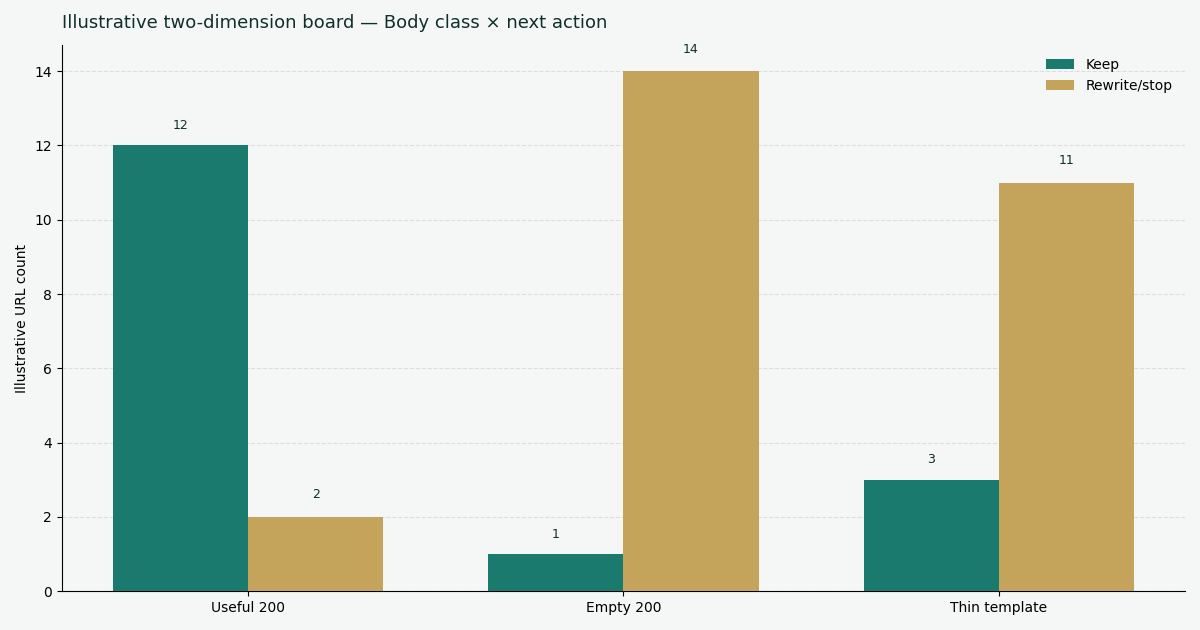
Illustrative two-dimension desk chart (page type × keep/stop). Not a customer report. Social cut: ./images/og-cover.png.
| Page type (illustrative) | Keep | Rewrite/stop |
|---|---|---|
| Useful 200 | 12 | 2 |
| Empty 200 | 1 | 14 |
| Thin template | 3 | 11 |
Two dimensions: page type × keep/stop. Useful 200s mostly stay. Empty 200s mostly stop. Thin templates mostly rewrite. That middle row is the lesson of thin content SEO, not a missing adjective. Name empty 200s as the first eligibility queue.
Scorecard for an honest useful page
Score usefulness, not a vanity 100, before you call thin content SEO done.
| Check | Pass | Fail |
|---|---|---|
| Eligibility | Public 200, indexable | Blocked, noindex, or should-be-404 |
| Body job | A visitor can finish one task | Chrome-only or placeholder |
| Not a word-count race | Length follows the job | “Add 300 words” with no job |
| Template honesty | Unique body where needed | Stamped stub across many URLs |
| Lights after write | Eight modules re-run on the live URL | Draft-only “fix” |
| Sample when templates repeat | 50–500 stratified URLs | Homepage only |
A fail means you stop or rewrite. Credits do not invent a job for an empty 200.
Failure modes that pad a stub
Chased a word count. A longer placeholder is still a placeholder. thin content SEO already failed. Name the job or unpublish.
Wrote before tech was green. A useful paragraph on a noindex URL is not a win. thin content SEO waits on eligibility first.
Trusted an empty 200. Status 200 plus a “Coming soon” H1 is a stub. Stop or noindex.
Padded the template, not the job. Four locales now share a longer lorem block. Kill the partial.
Asked the body lamp for EEAT. Wrong room. EEAT is a signed-in pass with credits, and an empty page may refuse a number.
Treated one stub as a site audit. One URL is not 50–500 pages. thin content SEO still needs a sample when the template mints children.
Re-run eight lights.
Cluster guides beside this page
This page is the useful-page cluster for thin content SEO. Nearby guides do not retarget older diagnosis, checker, extension, CLI, or agent phrases, or title tag optimization.
| Job you actually have | Guide to open next | What this page will not do |
|---|---|---|
| Read the document title first | SEO title checker | Rewrite the SERP line |
| Walk one H1 and no skipped levels | heading structure SEO | Restyle the type scale |
| Strip theme stamps on a WordPress host | WordPress on-page SEO | Clean a plugin for you |
| Category definition on the live hub | on-page hub | Replace eight lights |
Honest thin content SEO still starts on the URL you can stand behind.
Read eight lights before you pad a thin page
Paste a public URL, confirm eligibility, label useful versus empty, then write only after tech is green and re-run.
Run SEO Health CheckerFrequently Asked Questions
Does a word-count target fix an empty 200?
Bottom line: No. A longer stub is still a stub. thin content SEO asks what the page does. If the job is missing, stop or noindex. Do not pad.
Can eight lights run without login?
Bottom line: Yes. Chrome can read the body locally. Login and credits start when you choose AI EEAT or visibility on that URL. The free pass stays on the eight lights.
Should I rewrite before tech is green?
Bottom line: No. Eligibility first. thin content SEO fails if you write on a blocked or empty-by-policy URL. Fix fetch and indexation, then write.
What if the template stamps the same stub?
Bottom line: Fix the partial, then sample 50–500 children. thin content SEO on one homepage hides the stamp. Re-run a handful of twins after the theme change.
Conclusion
thin content SEO is a keep-or-stop loop: confirm a public 200, read eight lights, label useful versus empty versus thin template, write only after tech is green, re-run. Chrome can do the read locally. Eight lights stay free. Credits start only when you ask InfiniSynapse for EEAT or visibility on that URL.
This useful-page cluster does not replace the live on-page hubs. Use thin content SEO when the job is usefulness. Open the InfiniSynapse web app only when a signed-in pass is already the next ticket. Otherwise stay on the eight lamps, refuse the empty 200, and keep the keep-or-stop log in a second column.