hreflang audit: Pair Locales on This Host
By William Zhu · Cofounder, InfiniSynapse · Last updated: 2026-09-10 · Last verified: 2026-09-10 · Methods: Desk checks locale pairs, return tags, and x-default on this host's sample. Not an official Google score. Observed CLI contract 2026-09-10 on
infinitegrowth@0.1.1:seo-health check --format jsoncan exit 0 whileissues[].statusiserror.
Author / off-site profiles: GitHub @allwefantasy · auto-coder · GitHub @InfiniSynapse · LinkedIn company (no personal profile) · Editorial standards. No personal LinkedIn or vendor badge. Product recognition: SEO Health Checker is one of two first-prize works in the InfiniSynapse × CSDN Vibe Coding contest (English recognition archive). InfiniSynapse co-hosted the contest. That list is not a review of this article.
Reviewed by: InfiniSynapse Data Team · method review 2026-09-10. First-party method review, not a third-party award.
Trust / COI: About · Corrections · Publishing principles · Privacy · Terms. SEO Health is commercial. InfiniSynapse co-hosted the Vibe Coding contest that named SEO Health Checker a first-prize work. The issues[] table below is observed. Topic desks stay illustrative. The InfiniSynapse Data Team publishes this desk method.
Table of Contents
- TL;DR
- What the job checks on this host
- A four-signal framework
- How a pair job compares to a rewrite
- Landscape: who owns the locale map
- How to run the pair pass
- Desk sample
- Scorecard
- Failure modes
- Cluster guides
- FAQ
- Conclusion
TL;DR
Direct answer: A **hreflang audit** on this host checks locale pairs, return tags, and x-default on a sitemap sample. A pair that points out and does not point back is a hreflang error. Broken pairs waste eligibility. Prove it on the sample, not on a slogan. Do not rewrite titles on a broken pair.
What you will learn: why a hreflang audit starts on return tags rather than copy; how x-default sits on the same ticket; how eight lights differ from a pair table; an illustrative locale × pair-health desk; four steps that refuse a slogan.
Paste a public URL at SEO Health for title, meta, headings, density, images, links, tech, and speed lights. Those lights are not a Google 100. Pair work starts in tech and in the 50–500 sitemap sample.
We evaluate a hreflang audit hands-on as the InfiniSynapse Data Team. We build InfiniSynapse so sampling and status codes stay in SEO Health, with optional priority narrative as a long task.
What a hreflang audit checks on this host
Key Definition: A hreflang audit is a sample job on this host that records locale annotations, confirms each pair has a return tag, and checks that x-default exists where you claim a fallback. The job names hreflang errors. It is not a title rewrite and not an official Google health score.
Observed page CLI (2026-09-10, infinitegrowth@0.1.1): seo-health check https://developers.google.com/search/docs/specialty/international/localized-versions --format json --lang en exited 0. issues[].status listed Title Length (warning). Process exit 0 is not a clean page.
issues[].name | issues[].status |
|---|---|
| Title Length | warning |
| H1 Tag | good |
| URL | good |
| Robots.txt | good |
| Sitemap.xml | good |
| Image Alt Text | good |
| Meta Description | good |
| Page Structure | good |
The topic desk below stays illustrative.
Independent citation: According to [choosing language tags](https://www.w3.org/International/questions/qa-choosing-language-tags), this W3C document is an independent web-standards reference, not a ranking certificate. W3C's choosing language tags page is the third-party rule this write-up holds to. Illustrative desks below are not that rule.
People search this phrase when English and Chinese URLs both look live and a writer wants two new heroes. The first question is whether the pair returns. Copy is later.
Public IETF language tag language still treats en and zh as codes you can validate, not as slogans. An honest hreflang audit follows that habit: pair the codes on this host, then prove the return.
Return tags are the first column
A return tag means the target page points back at the source with the matching locale. One-way pointers are broken pairs. Status codes stay deterministic and free. Chrome can finish the eight lights locally. AI EEAT is the signed-in exception.
A hreflang audit fails when en points at zh and zh stays silent, or when the href 404s. A green title light on a one-way pair is false comfort.
x-default is the second column
x-default is the fallback annotation on this host. It is not a third language. Missing x-default leaves unmatched locales without a home. Wrong x-default that points at a 404 is a fetch-honesty fail.
The W3C note on choosing language tags still asks you to pick a real tag, not a decorative one. Write the tag you shipped. Do not invent en-UK if the page is en.
A service-case traffic story is not product proof. Do not cite it as evidence that pairs closed.
A four-signal framework for locale pairs
Use this map before you open a doc. A hreflang audit is a pair table, not a vibe.
| Signal | What you read | Deterministic? | Typical miss |
|---|---|---|---|
| Locale code | en, zh, or other on this host | Yes | Decorative lang in a banner |
| Return tag | Mutual href | Yes | One-way pointer |
| x-default | Fallback URL | Yes | Missing, or 404 target |
| Fetch honesty | 200 on each member | Yes | Pair to a redirect chain |
Keep those four stacked. Remove the code, the return, x-default, or fetch honesty and you have a guess. A hreflang audit earns its keep only when all four stay visible in the ticket.
ISO’s ISO 639 language codes still treat language identity as a registry, not as marketing copy. Replay the same habit: quote the code, then narrate.
Broken pairs waste eligibility
A broken pair does not merge twins. It wastes the annotation you already shipped. After npm i -g infinitegrowth, seo-health audit can sample 50–500 sitemap URLs. Sort return-tag failures first. Eligibility before copy.
The robots allow-list page tells you whether a locale path is allowed. Allow is necessary and not sufficient. A hreflang audit can still fail after allow: the return tag is missing.
How a pair job compares to a rewrite
A rewrite changes words. A pair table changes whether locale URLs are allowed to point at each other. If you only need eight lights, paste the public URL. Those lights are not a Google 100. EEAT, visibility, and GSC jobs need login plus credits. Return-tag status does not.
The pillar hub on website indexation defines eligibility as fetch, accept, and keep. A hreflang audit is the locale-pair slice of that sample. A density light cannot repair a one-way zh pointer.
The fetch-utilities page lists other inspect rooms. Stay here when the question is return tags and x-default on this host. We do not retarget older crawl-graph phrases on this URL.
If the next ticket is pagination after pairs are clean, open pagination indexation. Come back here when the sample still shows broken pairs.
Landscape: who owns the locale map
Engineering owns the annotations. Localization owns the keep map of locales on this host. Editorial owns titles after pairs return. Meetings fail when writers own the first hour of a hreflang audit. Start with the sample. Then assign copy.
Microsoft’s Translator language list and Google Cloud’s Translate language list are inventories of codes you can name. A hreflang audit does not translate. It checks that the codes you already shipped return.
PostgreSQL multibyte support still treats encoding as a property of the store. Applied here: if zh pages are mis-encoded, the pair can look present and still fail as a document. Fix encoding, then re-sample.
When one URL is enough
One URL is enough when a launch locale is new and you need a hreflang audit on that address only. Paste it. Read tech. Confirm return tags and a live x-default. Then write.
One URL is not enough when templates mint many locales. Eligibility at template scale needs the sitemap sample in the 50–500 band. Stratify en, zh, and the fallback.
How to run a hreflang audit on the sample
Sampling and status codes stay in SEO Health. Optional deep write-up / priority narrative is an InfiniSynapse long task.
Run these four steps before you open the copy doc. Skip the outline until pairs on the sample are classified.
Step 1 — Sample locales on this host
Collect 50–500 URLs from the sitemap you trust. Stratify en, zh, and x-default. Fetch each page. Record every hreflang href. A hreflang audit starts with that list, not with a slogan.
If the sitemap lists a locale that 404s, that is already a finding. Do not wait for a writer.
Step 2 — Prove return tags
For each pointer, open the target and confirm it points back. One-way rows are broken pairs. A hreflang audit treats that missing return as the row that matters. Status codes are deterministic. They do not need a login.
Sort broken pairs to the top. Those rows waste eligibility.
Step 3 — Check x-default and fetch honesty
Confirm x-default exists and returns 200. A fallback that hops or 404s is a hreflang error. A hreflang audit refuses a staging host as x-default.
If two locales share a body and both stay self-canonical, the next room is duplicate URL indexation. Do not mix those tickets until the pair returns.
Step 4 — Re-sample, then optional narrative
Draw the same locales again. Compare return-tag OK versus broken pair. Only then ask InfiniSynapse for a ranked punch list. A hreflang audit still quotes the pair table in that narrative. The model may not invent a return tag.
When pairs are green, write. When they are broken, fix the annotation, then re-sample.
Independent citation 2: According to [IETF language tag](https://en.wikipedia.org/wiki/IETF_language_tag), IETF language tag is documented in that encyclopedia article as a public third-party definition. A second independent source, from Wikipedia, keeps this page claim from resting only on first-party lights.
Desk sample: illustrative locale × pair health
The chart and table below are illustrative. They use two dimensions — locale and pair health — on a fictional this-host sitemap sample. They are not a customer lift, not a Google score, and not proof that a rewrite closed a pair. Desk note HRL-405-20260908.
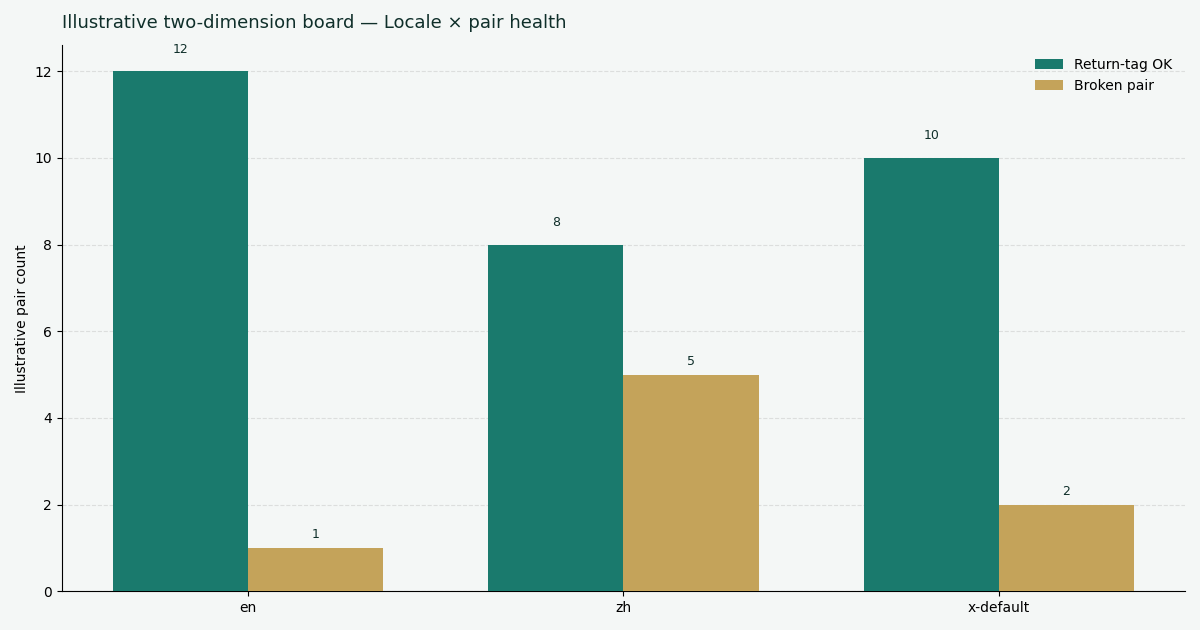
Illustrative two-dimension desk chart (locale × return-tag OK vs broken pair). Not a customer report. Social cut: ./images/og-cover.png.
| Locale (illustrative) | Return-tag OK | Broken pair |
|---|---|---|
| en | 12 | 1 |
| zh | 8 | 5 |
| x-default | 10 | 2 |
Two dimensions: locale × pair health. English mostly returns. Chinese shows more broken pairs. That gap is the lesson of a hreflang audit, not a missing paragraph.
How to read the grouped bars
Each cluster is a locale. Each bar is a pair-health class. Name zh broken pairs as the first engineering queue for a hreflang audit. Trust your sample if it differs. Reference ./images/chart-hreflang-audit.png in the ticket.
Scorecard for locale pairs
Score the pairs, not a vanity 100, before you call a hreflang audit done.
| Check | Pass | Fail |
|---|---|---|
| Locale codes are real | Registry tags on this host | Decorative banner language |
| Return tags are mutual | Each href points back | One-way pointer |
| x-default is live | 200 fallback | Missing or 404 |
| Fetch honesty | Members are 200, not chains | Pair to a dead URL |
| Sample covers locales | 50–500 stratified URLs | English homepage only |
| Re-sample after the fix | Broken-pair share dropped | Same one-way row |
A pass means you may write. A fail means you keep the engineering ticket. Credits do not invent a return tag.
Failure modes that break a pair
Copy first. The most common miss is a rewrite on a locale that does not return. A hreflang audit already failed. The new paragraph never joined the pair.
One-way theater. en lists zh. zh lists only itself. The screenshot of the English head looks finished. A hreflang audit still fails.
x-default as a third language. Teams write marketing copy on the fallback and forget it is a fallback. Point it at a real 200.
Wrong code. zh-CN on a zh page, or en-UK on en. Re-read the tag you shipped.
Update fan fiction. A core-update week is not a pair diagnosis. If return tags are missing, fix the annotation. Do not invent a recovery percentage.
Cluster guides beside this page
This page is the locale-pair cluster for a hreflang audit on this host. None of the siblings retarget older crawl-graph or vitals phrases.
| Job you actually have | Guide to open next | What this page will not do |
|---|---|---|
| Paginated locale archives | pagination indexation | Rel next/prev for you |
| Twins that are not locale pairs | duplicate URL indexation | Merge parameters |
| Map eligibility across the sample | website indexation hub | Restate every defect class |
| Inspect allow paths before pairs | robots allow-list tool | Replace the pair table |
Open one row when you have that job. Honest pair work still starts on the sample you can stand behind.
Pair locales on this host before you rewrite copy
Paste a public URL for tech lights, or sample 50–500 sitemap URLs to see which locale pairs already fail to return.
Run SEO Health CheckerFrequently Asked Questions
Does x-default count as a language?
Bottom line: No. x-default is a fallback annotation on this host. A hreflang audit still requires live locale pairs with return tags. A fallback that 404s is a hreflang error.
Do return tags need a login?
Bottom line: No. A hreflang audit can name return tags without an account. Pair-member status remains a free, deterministic column. Eight-module lights on a pasted URL stay free. Chrome stays local unless you start AI EEAT. InfiniSynapse login and credits start only for EEAT, visibility, GSC, or an optional priority narrative.
Can a title rewrite close a broken pair?
Bottom line: No. A title change does not add a return tag. A hreflang audit is an annotation fix on both members, then a re-sample. Copy waits until the pair returns.
How wide should the sitemap sample be?
Bottom line: Use 50–500 stratified URLs on this host. A hreflang audit finds broken pairs on zh templates and leftover staging hrefs. A homepage-only paste hides them. After npm i -g infinitegrowth, cap the draw and write the cap in the ticket.
Conclusion
A hreflang audit on this host checks locale pairs, return tags, and x-default. Broken pairs waste eligibility. Status codes stay in SEO Health. Optional narrative is a long task, not a second pair table.
Paste a public URL at SEO Health and read tech first. Sample the sitemap when templates mint locales. Open the InfiniSynapse web app only if you want a ranked punch list after a hreflang audit already counted the pairs. Then rewrite the URLs that already return.